


Politics & Government

Why Didn’t the Revolution Happen?: A Critical Assessment of Marx and Class Struggle

By K. Wilson


There has been a perceptible shift in how Marxists discuss the revolution in the past decades.  Marx insisted that a revolution in industrialized Europe was not just inevitable, but imminent.  The process of “proletarianization,” he wrote, had divided the world into workers who sell their labor and employers who own the means of production, all but eradicating other class distinctions.  This state of affairs would incubate “class consciousness” among European workers, a rational understanding that their interests as a class consisted of seizing the means of production – leading inexorably a socialist revolution.  Marxists in the early twentieth century matched this confidence that the world was on the cusp of revolution.  Lenin, writing in the immediate aftermath of Russia’s 1917 February revolution, proclaimed that “[t]his first stage of our revolution will certainly not be the last.”[1]

But as economic development progressed in western Europe and North America – the countries with advanced industrial economies seemingly ripest for revolution – the revolution simply didn’t occur.  Capitalism and bourgeois democracy remain the dominant economic and political modes in the industrialized west.  And although some socialist revolutions really did occur throughout the twentieth century, most took place in pre-industrial agrarian economies, and almost all of the resulting governments have since collapsed.

In the mid-twentieth century, thinkers associated with the Frankfurt School – most notably Herbert Marcuse – tried to explain the absence of revolution while maintaining a broadly Marxist framework.  Marcuse argued that mass media and consumerism had eliminated the proletariat’s political imagination, thereby sapping the West of its revolutionary potential; in lieu of positive revolutionary activity, he urged a purely negative “great refusal” to participate in consumerism.[2]

Most contemporary Marxist thought tacitly adopts Marcuse’s pessimism about an imminent revolution.  When Marxist literature mentions revolution at all – a rarity – it discusses revolution as a pipe dream, or a hazy and contingent possibility, or sometimes even a strategically unsound goal.  In a rather frank article from 2019, apropos of the 100th anniversary of the First Communist International, Jacobin editor Loren Balhorn wrote that “[a]t least for the time being, it would appear unwise to emulate the Comintern’s strategic perspectives” – that is, the pursuit of an international proletarian revolution – “for working class power.”[3]

For a Marxist, these answers are both unsatisfying and strategically unhelpful.  It is time to return to the very basic question that the events of the twentieth century raise: why didn’t the revolution happen?  The question is of vital strategic importance to contemporary socialism, but there are few attempts to formulate a square answer.

This essay focuses on one aspect of that question – the failure of class consciousness to take hold in western industrialized countries.  A close analysis of the economic and social changes in the industrialized west since Marx wrote reveals several interrelated reasons why class consciousness hasn’t developed.  The disruptive global events of the twentieth century, especially World War II and its aftermath, slowed the “proletarianization” of workers and created breathing room for the growth of a large, relatively prosperous middle class.  The middle class has since served as a buffer between the antagonistic interests of labor and capital.  Further, the transition of many advanced economies from manufacturing-based models to information-based models has blurred the hard line between capital and labor that Marx identified.  These conditions have given rise to a mode of politics on the left based on personal identity rather than class solidarity.  The essay concludes with some strategic observations based on these constraints.


Forces of Convergence

In Capital in the Twenty-First Century, French economist Thomas Piketty established a helpful framework for evaluating conditions that affect income and wealth inequality.  He distinguished between “forces of divergence,” which render society more unequal, and “forces of convergence,” which reduce inequalities.  After conducting an exhaustive analysis of these forces in the twentieth century, Piketty found that three forces of convergence impeded the growth of wealth and income gaps – contrary to Marx’s prediction.

First, Piketty noted that the populations of advanced countries grew dramatically since Marx wrote.  Population growth tends to diminish the importance of inherited wealth, since large family fortunes dilute when the family grows, so this trend reduced wealth inequality.  Second, Piketty observed that the total output of industrial economies grew much more quickly than Marx anticipated.  This reduced income inequality, as rapid economic growth provides more opportunities for people born in poverty to accumulate significant wealth.  Third, Piketty pointed out that the twentieth century was rife with major geopolitical events – World War I, the Great Depression, and World War II – all of which produced massive inflation in the developed world.  Although inflation can cause serious privations in the short term, over the long run, it reduces economic inequality.  This is because debts are measured in specific units of currency, so as currencies lose value, debts become easier to escape.

Due to this confluence of historical phenomena, the mid-twentieth century experienced an unprecedented reduction in economic inequality.  The geopolitical, social, and economic chaos resulting from two World Wars and a global financial crisis created breathing room for genuine upward economic mobility.[4]


The “Middle-Class” Buffer

The result of this upward mobility was the growth of a large and relatively prosperous middle class in most advanced economies, rather than the stark division of bourgeoisie and proletarian that Marx predicted.  The prominence of the middle class has significantly inhibited class consciousness.  Class consciousness, as Marx defined it, is an understanding of the world in terms of “relations . . . not [] between one individual and another, but between worker and capitalist, tenant and landlord, etc.”[5] 

The more stratified the economy becomes, the easier it is for workers to develop a rational understanding of their interests as a class – and a corresponding realization that their interests are antagonistic to the capitalists’.

But without a stark, binary division between workers and capitalists, these antagonisms become murky.  An upper-middle-class worker – say, a corporate middle-manager – is still a worker because she doesn’t own the assets the corporation uses to produce value.  But if she’s wealthier than her neighbors, has a cushy and reasonably fulfilling job, and enjoys a comfortable lifestyle, she has little reason to perceive her interests as hostile to her employer’s.

Throughout the last century and a half, neoliberal institutions have exploited that strategic reality by using the middle class as a “buffer” for class antagonisms.  Howard Zinn’s leftist history textbook, A People’s History of the United States, is rife with enlightening examples of this strategy.  For instance, in his discussion of the Progressive era at the beginning of the twentieth century, Zinn notes that many states began to pass laws providing for compensation for injured workers and otherwise limiting abusive employment practices.  These laws improved conditions for the flood of working-class immigrants arriving from Europe and allowed just enough immigrants to prosper to form “a middle-class cushion for class conflict.”  Later, in the ‘60s and ‘70s, a wave of protests drew attention to the woeful inadequacy of urban schools attended predominantly by Black children.  Boston’s government developed an insidiously clever solution to this problem: rather than fixing the urban schools, it implemented a policy of “busing Black children to white schools, and whites to Black schools.”  The result, Zinn explains, was “an ingenious concession to protest.  It had the effect of pushing… whites and poor Blacks into competition for the miserable inadequate schools.”[6]

These examples illustrate how capital has – more or less consciously – allowed the middle class to thrive in order to pit it against the poor.  The tactic has been remarkably successful.  In America, nearly 90% of people consider themselves “middle-class,”[7] and politicians on the left and right obsessively appeal to middle-class anxieties when seeking election.  Obviously, the middle-class doesn’t actually encompass 90% of the population.  And even if it did, a person in the 95th percentile of income (the top of this purported “middle-class”) and a person in the 5th percentile (the bottom) probably don’t share many tangible interests.  But if both of those folks think of themselves as “middle-class,” they likely won’t perceive their interests as antagonistic.

This tactic works in part because it appeals to a basic human psychological tendency: the fear of relative deprivation.  A person is “relatively deprived” if she is less materially wealthy than her community.  Behavioral psychology shows that a relatively deprived person is likely to feel anger, envy, and resentment even if she is perfectly well-off from an “absolute” perspective.[8]  People’s sense of satisfaction depends on feeling materially better-off than other members of their community, or at least not feeling worse-off.  Due to the various economic strata in the industrialized west, most workers have people slightly worse-off to fear, and people slightly better-off to envy – which makes it easy to divide and conquer folks with similar interests.


The Eroding Distinction between Capital and Labor

Efforts to foment class consciousness in the twenty-first century are complicated by the fact that “capital” and “labor” are harder to pinpoint than when Marx wrote.  In Marx’s world, poor laborers survived by selling their labor and rich capitalists got rich by possessing the means of production.  There were few (if any) rich laborers or poor capitalists.

Not so in the America of today.  As of 2020, over half of Americans owned stock, and many of them – even those who earn relatively low wages – have a significant amount of stock.  Stockholders in the 50th to 90th percentile of income owned an average of $132,000 in stock, while those in the bottom half still owned a healthy $54,000 on average.[9]  A little under half of American adults own mutual funds,[10] while three quarters have a retirement account that rises or falls in value with the stock market.[11]

All of these assets are forms of capital because they represent either a direct (in the case of stock) or indirect (in the case of mutual funds and retirement accounts) ownership interest in the means of production.  Many Americans thus have a tangible interest in the success of corporations – which is why incumbent presidential administrations are much more likely to win reelection when the stock market is strong,[12] and why voters tend to conflate the success of the stock market with the health of the economy.  The notion that laborers and capitalists always have antithetical interests is a harder sell to Americans whose wealth depends on capitalists succeeding.  As it turns out, there are some poor capitalists.

There are also some rich laborers. Socialists often discuss professional athletes as laborers, even though many of them are astonishingly wealthy.  For instance, a Jacobin article celebrated NBA players as “highly-skilled workers” who are in a “position to build working-class solidarity across different groups of workers and extract concessions from management.”[13]

SUPPORT OUR WORK BY MAKING A DONATION TODAY!

But this example illustrates why the labor/capital distinction has become harder to draw in late capitalism.  In one sense, calling athletes “laborers” makes sense because they’re paid to train and play games, which is a form of labor.  But many professional athletes make a lot more money from endorsements and advertising than they do from playing.  Are those athletes really “laborers” when most of their income derives from their image, rather than any specific work they perform?  Is an athlete’s personal image really “labor” rather than “capital”?  More fundamentally, would rich professional athletes tangibly benefit from a socialist revolution?

Just as it’s difficult to isolate “labor,” it’s also sometimes hard to locate the means of production with any precision. In Marx’s world, the means of production were concrete: industrial machines that laborers operated to make products.  That’s still true in some industries, like manufacturing, but what about information-based industries?  Picture a software developer.  The “product” she makes is computer code.  What are the “means of production” for computer code?  The simplest answer is a computer, coupled with a programming language and a code editor.  But most software developers probably have their own computers, and most programming languages and code editors are open-source.  In that sense, software engineers own the “means of production” for the product they make – whereas an assembly-line worker doesn’t own the assembly line.  Yet software developers are undoubtedly “laborers” under a traditional Marxist analysis.

None of this undermines Marx’s basic point that labor and capital have antagonistic interests.  But the existence of the middle class, coupled with the transition of advanced economies from manufacturing-based to information-based industries, has made it more difficult to figure out who’s the capitalist and who’s the laborer.  That necessarily inhibits the development of class consciousness.


A Politics of Personal Identity

These conditions have made it difficult for the American left to organize around class.  Instead, throughout modern American history, most leftist political movements have centered on identity – race, ethnicity, gender, gender orientation, sexuality, etc.  Of course, there have been some exceptions; Eugene Debs, the brief prominence of the Industrial Workers of the World in the ‘20s and ‘30s, and more recently, Bernie Sanders’s presidential campaign spring to mind.

But in terms of both numbers and influence, class-based leftist movements pale in comparison to identity-centric efforts like the civil rights movement, the women’s liberation movement, and the Black Lives Matter protests.  Because Americans don’t strongly perceive themselves in terms of class, it’s difficult to organize class-based leftist political activity.  This trend is especially stark in the twenty-first century.  By far the biggest left-leaning political movement in America in the past few decades is the Black Lives Matter protests against racially-motivated police violence.  The largest confluence of protests occurred in the summer of 2020 and involved around 20 million participants – making the protests one of the largest social movements in American history.[14]  Other contemporary rallying points for the left include abortion and LGBTQ rights, which are identity-centric issues.

To give credit where it’s due, identity politics has produced some remarkable results.  Although the Black Lives Matter protests haven’t achieved much tangible progress on police violence – police shootings per capita have actually increased since the protests began[15] – the movement galvanized a generation of Americans into leftist politics.  And thanks to relentless activism by the LGBTQ community, in the past twenty years, Americans’ views on gay rights underwent an astonishing reversal; in 2004, 60% of Americans opposed gay marriage, while in 2019, 61% favored it.[16]

It’s also worth noting that approaches to leftist politics that emphasize only class, to the exclusion of other predicates of oppression, alienate potential supporters and ignore the manifold forms of structural violence that afflict society.  For example, some socialists have tried to reframe police violence as a primarily class-based issue.  But while police are more likely to kill poor people, class explains a mere 28% of the disproportionately high rate of police violence against Black people.[17]  By the numbers, police violence is primarily a race issue.

For that reason, proponents of identity politics often accuse socialists of “class-reductionism.”[18] But while this is sometimes fair criticism, more often than not, the exact opposite is true – movements centered around one type of personal identity conceptualize every political struggle in terms of that identity, replacing “class-reductionism” with race- or gender- or sexuality- reductionism.  That tendency both inhibits class consciousness and causes a fundamental misunderstanding of key political issues, to the strategic detriment of the left.

The “school-to-prison pipeline” is a case in point.  The phrase refers to the tendency of some schools to apply harsh disciplinary policies and refer students who break the rules to law enforcement.  This is pervasive at low-income, predominantly Black and Latinx schools, and was the subject of one of the most widely-read leftist books this century – Michelle Alexander’s The New Jim Crow.  Following in Alexander’s footsteps, virtually every framing of the school-to-prison pipeline fixates on race-based disparities in school discipline and incarceration.  Google “school-to-prison pipeline,” and you’ll find that one of the first results defines it as “practices and policies that disproportionately place students of color into the criminal justice system.”[19]  Class doesn’t even get a mention.

But while there are doubtless real differences in the outcomes Black and white adolescents face in school and the justice system, the majority of those differences are attributable to class, not race.  According to one comprehensive study, about a third of the discipline gap between Black and white students cannot be explained by poverty, disciplinary histories, and school district characteristics.[20]  Obviously this indicates that a disturbing share of the gap in school discipline stems from pure racism, but don’t miss the forest for the trees: two-thirds of the gap is attributable to the material economic conditions of the students.  Another study found that although Black men are significantly more likely to face incarceration than their white counterparts, a majority of that disparity (between 54 and 85%, depending on the definition of “incarceration”) is attributable to class.[21]  In sum, most of the people who traverse the school-to-prison pipeline – and face subsequent terms of incarceration – do so because they’re poor, not because they’re Black.

The way we talk about these issues has strategic consequences.  A poor white person hearing about the school-to-prison pipeline might decide that the issue isn’t important to him because it’s unlikely to affect his kids – an incorrect conclusion founded on an inaccurate framing of the issue.  The school-to-prison pipeline is a class issue, but because leftist politics centers on personal identity, discourse on the school-to-prison pipeline doesn’t promote class consciousness.

Identity politics – or, more accurately, “identity-only politics” – also leaves oppressed groups vulnerable to divide-and-conquer tactics by the right, which further inhibit class consciousness.  The artificial tension between Black people, gay and lesbian people, and trans people is a good example of these tactics.  In the early 2010s, the National Organization for Marriage, an anti-gay advocacy group, circulated an astonishingly frank internal memo on how to use gay marriage as a wedge issue.  An excerpt reads:

The strategic goal of this project is to drive a wedge between gays and Blacks – two key Democratic constituencies.  Find, equip, energize, and connect African American spokespeople for marriage; develop a media campaign around their objections to gay marriage as a civil right; provoke the gay marriage base into responding by denouncing these spokesmen and women as bigots… Find attractive young Black Democrats to challenge white gay marriage advocates electorally.[22]

Later, when trans rights came to prominence in the cultural discourse, right-wing groups pivoted to manufacture another “wedge” between women plus gay and lesbian folks, on the one hand, and trans people on the other.  In 2017, Meg Kilgannon, the executive director of Concerned Parents and Education, spoke at a summit hosted by the Family Research Council – a Christian rightist, anti-LGBT organization.  Kilgannon laid out a strategy for opposing measures expanding trans rights in schools: portray trans rights as anti-feminist and anti-gay.  This would be effective, Kilgannon argued, because “the LGBT alliance is actually fragile and the trans activists need the gay rights movement to help legitimize them.”  But for many LGB activists, “gender identity on its own is just a bridge too far. If we separate the T from the alphabet soup we’ll have more success.”[23]

Wedge issues are an insidiously effective way to blunt the efficacy of identity-based leftist politics.  Promulgating wedge issues pits oppressed groups against one another, which inhibits the members of those groups from perceiving themselves as part of a single economic class with united interests.

Of course, practitioners of identity politics are not to blame for this unfortunate reality.  Most of those folks are sincere advocates for marginalized groups who simply use the most effective political strategies they can muster – and sometimes achieve real progress in their communities.  But while leftist politics in America remains centered on personal identity, class consciousness is unlikely to develop.


Conclusion

This analysis of class consciousness in modern America gives rise to several strategic observations.  First and foremost, the delicate balance of factors that has allowed the middle class to remain viable for almost a century may be deteriorating.  Although factors of convergence have supported the existence of the middle class for the past century or so, those trends seem to be reversing.  Near the end of Capital in the Twenty-First Century, Piketty suggests that population and economic growth are slowing, inflation is slowly declining, and economic inequality is on the rise in the western world.  If the forces of convergence turn into forces of divergence, the classes will slowly stratify, and a degree of class consciousness will probably develop on its own.  Socialists should exploit this reality by advancing a class-centric analysis directed at members of the middle class suddenly cast into poverty by these economic trends.

By the same token, leftist generally should recognize that, given the competing substrata of the economy and the multifarious forms of oppression, neither class nor personal identity furnishes a comprehensive answer to all social ills.  As discussed, class alone doesn’t provide a satisfactory explanation of police violence, and race alone doesn’t provide a satisfactory explanation of the school-to-prison pipeline.  Instead, we should take an empirical approach to confronting specific problems.

Relatedly, leftists should spot wedge issues – which thrive in the areas where two oppressed groups believe their interests are in tension – and avoid schismatic arguments.  Instead, leftist analysis should begin with the tangible interests that most oppressed people share.  For instance, it is routine to point out that Black women face significant and unfair disparities in pay; women tend to be paid less than men and Black people tend to be paid less than white people, meaning that Black women face compound inequities in their salaries.   But discussing pay disparity in terms of identity pits these groups against each other, implying that Black women have different interests from white women and Black men.  A better way to frame the issue is to focus on an enemy common to all of those groups – employers, which have overly broad discretion to set their employees’ salaries – and the common problem that results, namely, that workers as a whole are paid too little and unfairly.

By framing issues in terms that take into account both identity and class, socialists can take advantage of rising economic inequality to promote class consciousness.  And then, perhaps, we can prove that the revolution was merely deferred – not denied.


Sources

[1] Vladimir Lenin, “Letters from Afar: The First Letter,” Pravda, March 21, 2017, https://www.marxists.org/archive/lenin/works/1917/lfafar/first.htm.

[2] Herbert Marcuse, One-Dimensional Man (New York: Routledge Classics, 2007), 21-51, available at https://www.cs.vu.nl/~eliens/download/marcuse-one-dimensional-man.pdf.

[3] Loren Balhorn, “The World Revolution that Wasn’t,” Jacobin, March 2, 2019, https://jacobin.com/2019/03/comintern-lenin-german-revolution-ussr-revolution.

[4] Thomas Piketty, Capital in the Twenty-First Century (Cambridge: Bellknap Press, 2014), 13-15, 20-27, 69-85, 99-109, 377-393.

[5] Karl Marx, The Poverty of Philosophy (Paris, 1847), available at https://www.marxists.org/archive/marx/works/1847/poverty-philosophy/index.htm.

[6] Howard Zinn, A People’s History of the United States (New York: HarperCollins, 1999), 349, 467.

[7] Jeffrey Wenger and Melanie Zaber, “Most Americans Consider Themselves Middle-Class.  But Are They?”, Rand Corporation Blog, May 14, 2021, https://www.rand.org/blog/2021/05/most-americans-consider-themselves-middle-class-but.html.

[8] Heather J. Smith and Yueh J. Juo, “Relative Deprivation: How Subjective Experiences of Inequality Influence Social Behavior and Health,” Policy Insights from Social and Personality Psychology 1, no. 1 (October 1, 2014), https://journals.sagepub.com/doi/full/10.1177/2372732214550165.

[9] “What Percent of Americans Own Stocks?”, FinancialSamurai, 2021, https://www.financialsamurai.com/what-percent-of-americans-own-stocks/.

[10] “Share of Households Owning Mutual Funds in the United States from 1980 to 2019,” Statistica, November 9, 2020, https://www.statista.com/statistics/246224/mutual-funds-owned-by-american-households/.

[11] Alicia Adamczyk, “25% of Americans Have No Retirement Savings,” CNBC, May 24, 2019, https://www.cnbc.com/2019/05/24/25-percent-of-us-adults-have-no-retirement-savings-fed-finds.html.

[12] Paul Vigna, “The Stock Market Is a Strong Election Day Predictor,” The Wall Street Journal, September 7, 2020, https://www.wsj.com/articles/the-stock-market-is-a-strong-election-day-predictor-11599490800.

[13] Barry Eidlin, “Last Week’s Pro Athletes Strikes Could Become Much Bigger Than Sports,” Jacobin, August 30, 2020, https://www.jacobinmag.com/2020/08/sports-strikes-kenosha-racial-justice.

[14] Larry Buchanan, Quoctrung Bui, and Jugal Patel, “Black Lives Matter May Be the Largest Movement in U.S. History,” New York Timesx, July 3, 2020, https://www.nytimes.com/interactive/2020/07/03/us/george-floyd-protests-crowd-size.html.

[15] “National Trends,” Mapping Police Violence, last modified September 30, 2022, https://mappingpoliceviolence.org/nationaltrends.

[16] “Attitudes on Same-Sex Marriage,” Pew Research Center, May 14, 2019, https://www.pewresearch.org/religion/fact-sheet/changing-attitudes-on-gay-marriage/.

[17] 3P Staff, “Class and Racial Inequalities in Police Killings,” People’s Policy Project, June 23, 2020, https://www.peoplespolicyproject.org/project/class-and-racial-inequalities-in-police-killings/.

[18] Tatiana Cozzarelli, “Class Reductionism Is Real, and It’s Coming from the Jacobin Wing of the DSA,” LeftVoice, June 16, 2020, https://www.leftvoice.org/class-reductionism-is-real-and-its-coming-from-the-jacobin-wing-of-the-dsa/.

[19] “Who is Most Affected by the School to Prison Pipeline?”, American University School of Education Blog, February 24, 2021, https://soeonline.american.edu/blog/school-to-prison-pipeline/.

[20] Maithreyi Gopalan and Ashlyn Nelson, “Understanding the Racial Discipline Gap in Schools,” American Educational Research Association Vol. 5, No. 2 (April 23, 2019), https://journals.sagepub.com/doi/full/10.1177/2332858419844613.

[21] Nathaniel Lewis, “Mass Incarceration,” People’s Policy Project, 2018, https://www.peoplespolicyproject.org/wp-content/uploads/2018/01/MassIncarcerationSummary.pdf.

[22] Brett LoGiurato, “Read The Leaked Anti-Gay Marriage Memo Whose Authors Wanted To ‘Drive A Wedge Between Gays And Blacks’”, Business Insider, May 27, 2012, https://www.businessinsider.com/nom-gay-marriage-memos-drive-a-wedge-between-gays-and-Blacks-2012-3.

[23] Hélène Barthélemy, “Christian Right Tips to Fight Transgender Rights: Separate the T from the LGB,” Southern Poverty Law Center, October 23, 2017, https://www.splcenter.org/hatewatch/2017/10/23/christian-right-tips-fight-transgender-rights-separate-t-lgb.
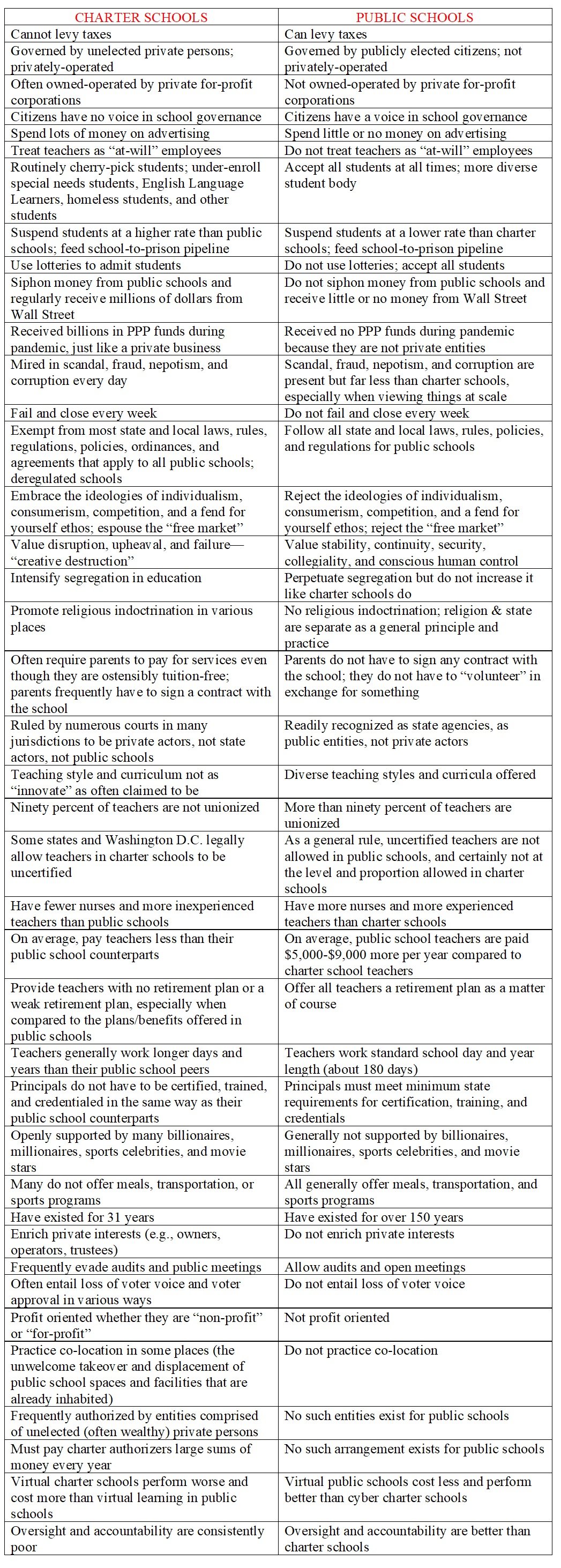
40 Differences Between Public Schools And Charter Schools

By Shawgi Tell

Public schools and charter schools are apples and oranges. They differ profoundly from each other, including in organizational, fiscal, philosophical, and legal ways.

Below is an annotated comparison chart of some of the differences between public schools and charter schools. Each annotation could be extended to show more nuances and how deep the dissimilarities go.

Three Important Notes

  1. Charter schools have been around for 31 years while public schools have existed for over 150 years. Today there are 7,800 charter schools and 91,000 public schools in the U.S. About 45 million youth attend public schools while 3.7 million youth attend charter schools.

  2. When comparing public schools and charter schools, scale, scope, and proportion have to be considered, both quantitatively and qualitatively. For example, if a problem exists in a public school, it is typically much worse or more serious in a charter school. For instance, teacher turnover occurs in both public schools and charter schools, but, pound for pound, in terms of scale and proportion, the teacher turnover rate is usually far greater and more serious in charter schools than public schools. The fact that problems in charter schools are more severe than problems in public schools given the numbers in note number one is revealing.

  3. For decades neoliberals have painstakingly set up public schools to fail while simultaneously promoting failed charter schools and dividing people.

SUPPORT OUR WORK BY MAKING A DONATION TODAY!

A Feature, Not a Bug: How Henry Kissinger is a Symbol of a Broader American Imperial Rot

By Sudip Bhattacharya


As legendary English metal band Iron Maiden sang in a 1988 track, “Only the good die young. All the evil seem to live forever.” Enter Henry Kissinger.

On May 27th, 2023, the former Secretary of State and National Security Advisor turned 100 years old. As Kissinger begins his second century on this planet, he remains a beloved figure within America’s political class. His multiple birthday parties were attended by many A-listers including Democrats John Kerry and Michael Bloomberg, and Republican James Baker. Yes, the elite outpouring for Dr. K — as Kissinger is affectionately known in establishment circles — is a bipartisan affair. But the exploited and colonized masses hold a much different view of the so-called diplomat.

Across the Third World, Kissinger’s legacy is that of a heartless war criminal. In the Nixon administration, Kissinger supported some of the world’s most brutal right-wing regimes in places like Argentina and Chile. He also greenlighted mass slaughters of Bangladeshis and the Timorese.

In a groundbreaking piece for The Intercept, Nick Turse analyzes formerly classified documents to uncover mass killings of Cambodian civilians during the Nixon era. Transcripts of calls unearthed by Turse prove Kissinger’s direct role in these massacres. In one particularly ominous phone conversation, Kissinger ordered a general to kill “anything that moves” with “anything that flies.”

This savage commitment to expanding American hegemony at all costs has left an indelible mark. Kissinger’s ideology is now a feature — not a bug — of the United States foreign policy establishment. So much so, in fact, that many of his diplomatic successors are even more extreme than him.


Revitalizing Empire

Henry Kissinger emerged at a time of mounting skepticisim toward American empire and the institutions that uphold it. In 1975, the Senate almost unanimously approved the creation of the bipartisan Church Committee — a body investigating security state abuses. At the same time, the Republican Party was home to the late Representative Paul Findley. The congressman from Illinois was fiercely pro-Palestine and anti-war. Findley couldn’t exist in today’s radicalized GOP, where support for Israeli apartheid and the war machine are prerequisites for membership.

Kissinger, alongside other odious characters like the Dulles brothers, represented a backlash to these currents. Dr. K was a staunch cold warrior. He believed strongly in using American military might to eliminate communism and defend corporate profitability at all costs.

And he found ideological allies in the Central Intelligence Agency (CIA). The agency’s upper echelons were full of anti-communist stalwarts and other extremist elements. As Stephen Kinzer writes in Overthrow, leaders of the CIA outright dismissed anything that might interfere with the aims of American multinationals.

SUPPORT OUR WORK BY MAKING A DONATION TODAY!

While occupying America’s most powerful diplomatic posts, Kissinger was a steward of this tendency. In fact, he accelerated and intensified some of the worst pattens already bubbling within the security state. While preaching diplomacy publicly, Kissinger showed an unnerving stomach for bombings and the so-called collateral damage they caused. This earned him favor among the morally bankrupt conservative and liberal elite. In 1973, they awarded Kissinger the Nobel Peace Prize despite him never meeting a war he did not like.

This underscores a reality that is fundamental to understanding Kissinger’s place in history. While Dr. K was a reaction to some currents within the American foreign policy scene, he was an intensification of others. In this sense, Kissinger was no anomaly. So much of the political establishment agreed with his ideas and participated in their implementation.


American Imperialism As a Bipartisan Project

After Nixon resigned in disgrace, and Gerald Ford lost the 1976 election, it became clear Kissinger had made an impression. On January 1st, 1977, Democratic President Jimmy Carter took office. Despite not occupying a spot in the opposition party’s new administration, Kissinger’s foreign policy proceeded apace. Carter even appointed Zbigniew Brzezinski — a sort of Democratic Kissinger — to be his Secretary of Defense.

Together, Carter and Brzezinski instituted policies Kissinger would have been proud of — and probably was. The duo funded the Mujahideen — and, by extension, Osama bin Laden — to fight the Soviets in Afghanistan. Anti-communism was the overriding imperative, even if it involved supporting theocratic armies who threw acid on women learning to read.

But the Carter administration was short-lived. The Georgia native lost the 1980 election to Ronald Reagan. But, while Carter and Brzezinski left office, Kissinger’s legacy most certainly did not.
The hard-right Reagan personified authoritarianism, neoliberalism, and American exceptionalism on steroids. While he claimed to want dialogue with the Soviets, Reagan funded extreme anti-communist groups throughout Central America. He also invaded Grenada and toppled its government following the country’s socialist revolution.

Kissinger’s imperial fervor continued into the Clinton years. The Democratic administration of the 1990s subjected Iraq to a brutal sanctions regime, killing thousands of Iraqis through deprivation. Clinton also opted to continue the Cuban embargo, which remains in place to this day.

After Clinton came George W. Bush, whose War on Terror exemplified the Kissinger protocol: non-stop intervention and destabilization with overtures to diplomacy and the proliferation of rights and freedom. Obama then advanced this protocol further still, albeit less intensely, but was nonetheless very much beholden to military intervention. He punished the Middle East in particular with drone strikes, sanctions, and alliances with Islamic militants and the Israeli state. Not to mention that fact that Obama turned a blind eye to Saudi war crimes against innocent Yemeni civilians.

Essentially, Kissinger’s views carried forth in spirit with every subsequent administration. Ironically, too, the “Kissinger effect” has led to elements within the foreign policy establishment becoming even more radicalized than him. Contemporary US-China relations provides seemingly endless examples of this.

Both Biden and Trump officials often signal their willingness to rachet tensions with China. Mike Pompeo, who Trump appointed to head the CIA and State Department, claims Xi Jinping seeks world domination. The current Secretary of State Antony Blinken has voiced similar sentiments. During his confirmation hearing, Blinken told the Senate that “China posed the most significant challenge… of any nation.” He has also accused the country of “crimes against humanity,” “genocide,” “repression,” and “crackdown[s] of basic rights.”

Kissinger sounds dovish by comparison. In a recent interview with The Economist, he stressed the importance of maintaining friendly US-China relations. Kissinger also poured cold water on some of the more gauche sinophobic hysterics. He insists Xi Jinping is not the next Hitler and that China has no plans of world domination. According to Kissinger, the Asian powerhouse does not even seek to impose its culture abroad.


a cog in a rotten system

In the end, Henry Kissinger must face justice. But we should aso view him as part of a broader network of war criminals. And that network is both continually expanding and a revolving door. Recently, President Joe Biden nominated Elliot Abrams — a man notorious for atrocities in Central America — to a federal diplomacy commission. Biden’s predecessor Donald Trump had made Abrams his Special Representative for Iran and Venezuela.

Those serious about overturning American imperium must address Kissinger and the forces beyond him — many of which he has inspired. True justice for the victims of United States foreign policy means nothing short of wholesale change to the entire apparatus. It is not just about punishing Kissinger but also stopping future Kissingers from ascending to power and harming more innocents.

This is a daunting task. United States progressives are already struggling to confront domestic issues, let alone global ones. Still, the task remains. To create a free and friendly world for the working class and the oppressed globally, the American empire must crumble. Its Kissingers must fall. While Dr. K may celebrate another birthday soon enough, it’s our responsibility to create a landscape that celebrates humanity instead.


Sudip Bhattacharya is a doctoral candidate in political science at Rutgers University. He also has a background as a reporter and continues to write for major outlets from Current Affairs to Protean and The Progressive.

Elias Khoury is the managing editor of the Hampton Institute.

The Appalling Reality Of Child Labor

By Josh Crowell


Republished from Socialist Alternative.


Child labor has been on the rise since at least 2018. The recent New York Times article ignited a firestorm that has led the Biden administration to create a task force within the Department of Labor as an attempt to deal with this crisis. However, the reasons these children are being exploited is due to a lack of government oversight to begin with. The Department of Health and Human Services has failed to keep proper records of unaccompanied minors as they are placed with sponsors quickly to try to get them out of shelters. Only a third of these minors have any follow-up after placement with a sponsor, and even that limited support ends after a few months.


Hyper-exploitation Of Child Immigrant Labor

This is a crisis of poverty and immigration. Families and unaccompanied minors are fleeing desperate situations in Latin America to find only different conditions of desperation in the States. All families in the US right now are experiencing the pressures of our current economic crisis, from high inflation and the cost-of-living crisis, to the ending of the child tax credit and the rollback of the COVID social safety net leaving many without access to food stamps and Medicaid benefits. While many minors who haven’t migrated are being put in situations where they have to work, many more immigrant minors, with or without their family, are forced to take up work once they arrive in the States, sending money back to their families in their home country or just to afford to survive in America. US immigration policy – under Trump and continued under Biden – criminalizes border crossings. The threat of deportation still hangs over the heads of immigrants and their families. With this stress, many unaccompanied minors also have debts accrued from their border crossing due to fees owed to those who helped them cross the border and additional money owed to their sponsors once they have been relocated out of the government’s custody. 

SUPPORT OUR WORK BY MAKING A DONATION TODAY!

This has led many children to take up jobs in very dangerous industries like meat processing plants, commercial bakeries, and construction. These children – some as young as 13 – work upwards of 14-hour shifts doing jobs that are classified as too dangerous for anyone under 18. While these jobs are difficult for any worker, these children must balance their school course load and full-time employment with the additional stresses of worrying about their families back in Latin America and knowing they are already burdened with debts they must pay. Some of these children are forced to drop out of school, many of which drop out unnoticed due to the lack of HHS oversight into their care once placed with a sponsor, if their sponsor enrolled to begin with.

As inflation continues to rise, especially with increases in rents, children and their families are forced to find ways to make ends meet, regardless of whether these survival methods skirt that law. While it is illegal for children to be working in these jobs, the bosses use these desperate circumstances to exploit these minors who are just trying to survive. With the Great Resignation, many sections of the working class no longer accept poverty wages which leads companies to look for workers who will accept these conditions as a way to continue to keep wages low and produce higher profits. Many immigrant children fit this role perfectly due to their need to assist their families back home and pay down their debts to sponsors here in the States. 


This Is A Fight For The Labor Movement

While this crisis is one of true desperation by these children and their families, it highlights the overall weakening of the US and Latin American labor movements. Almost a century ago, child workers and their families fought for an end to child labor and guaranteed education for all minors. This fight was won through mass action, with child workers and their families going on strike and protesting the intense conditions they were being forced to labor under. The bosses are not interested in enforcing labor law, especially when it comes to the hyper-exploitation that comes with migrant labor. The US labor movement must organize to protect all workers and that means fighting back against these trends of increasing child labor. If an injury to one is an injury to all then workers must stand up for these children and demand that they have adequate resources, safe sponsorships, and the ability to go to school and learn, not work as if they were an adult. 

While it is positive that the government is taking some action due to public scrutiny from the media, it will not solve this crisis. A lack of government oversight and the continuation of brutal immigration policies that set up immigrant workers for hyper-exploitation has led us to this situation. It will take courageous strike action from these child workers and their families, joined by the masses of organized labor, to win back what had been won a century ago. These children’s desperation cannot be used by the bosses to continue to exploit them. Workers should fight for guaranteed education for all minors, resources for unaccompanied immigrant children like food stamps and stipends, and for a process within HHS that actually protects children, not simply pushes them through the system.

Educators Must Help Defeat the New Racist and Imperialist 'Red Scare'

By Derek R. Ford

Originally published on PESA Agora

Introduction: Racism and imperialism unite ‘both sides of the aisle’

Responding to criticism of the political system of the newly-independent Tanzania, the great African teacher, revolutionary, and theorist Julius Nyerere responded, observing ‘the United States is also a one-party state, but with typical American extravagance, they have two of them.’ He was and is right. Rhetorical differences and popular presentation aside, the two ruling-class parties effectively function as a dictatorship domestically and globally. For concrete and contemporary evidence, look no further than the New McCarthyism and Red Scare promoted by media outlets and politicians on ‘both sides of the aisle,’ from Fox News and Marco Rubio to The New York Times and Chuck Schumer.

On August 5, The New York Times released a report that, in essence, boldly and baselessly suggests groups and other organisations advocating for peace with China are part of an international conspiracy by the Chinese Communist Party (CCP). Despite the absence of any substantive proof, politicians are already using it as ammunition in their broader ‘new McCarthyism’ agenda, which could potentially have devastating consequences for the globe. Fortunately, a variety of institutions and networks are already mobilising against it by building a fight-back movement in which education plays a key role, and you can too.

Their presentation opens with the racist logic guiding their investigation as they try to discredit the multitude of spontaneous global actions against anti-Asian racism in 2021. They narrate a single action in London where a scuffle broke out, they contend, after activists with No Cold War (one of the event’s organisers) ‘attacked activists supporting the democracy movement in Hong Kong.’ They offer only two words to back up this narrative: ‘witnesses said.’

No Cold War is dedicated to promoting peaceful relations between the US and China, organising in-person and virtual events to advance the global peace movement. Having spoken on their panels and attended others, I can confirm they are educational, generative and productive intellectually and politically. They include a range of perspectives, given they are working toward peace. This principle is unacceptable for the Times and the New McCarthyites, however, as the journalists ‘reveal’ that No Cold War is merely ‘part of a lavishly funded influence campaign that defends China and pushes its propaganda.’ So too, it seems, is any group advocating for peace.

The investigators construct an international conspiracy centred on Neville Roy Singham, a millionaire sympathetic to peace and socialism who donates his millions to left-wing non-profits who, in turn, help finance very active and crucial anti-war, anti-racist, and anti-imperialist organisations. This is where the most dangerous suggestion emerges, one upon which pro-war forces quickly seized: that groups receiving funding from Singham could be agents of the Chinese Communist Party and thus in violation of the Foreign Agents Registration Act (FARA).

These suggestions are completely unfounded. The only ‘evidence’ presented are statements made by a handful of former employees and members of some organisations partly funded and supported directly or indirectly by Singham, including the Nkrumah School, the media outlet New Frame, and the Socialist Revolutionary Workers Party in South Africa. Then, of course, there is the fact that Singham supported Hugo Chávez, has relationships with some of the million members of the Chinese Communist Party, is pictured at a CCP meeting (excuse me, ‘propaganda forum’) taking notes in a book ‘adorned with a red hammer and sickle.’ And I almost forgot the nail in the hammer: a plaque of Xi Jinping hanging in Singham’s office.

Fox News and other right-wing outlets and politicians are at the helm of the bandwagon as well. For years they promoted propaganda alleging China is influencing US schools and universities as a method of attacking freedom of inquiry and speech in the US, including in my state of Indiana. In August 2021, Indiana’s Attorney General Todd Rokita (whom most Hoosiers don’t support) threatened to investigate the Confucius Institute at a small college, Valparaiso University, saying it operates ‘to spread propaganda and circulate the mantra of the CCP at both the university and in several K-12 schools in Indiana.’ The University closed the Institute but, importantly, maintained Rokita was lying about its function, which is to promote cross-cultural understanding and dialogue. Unfortunately, almost all such institutes have shuttered.


Old or new, ‘McCarthyism’ is reality, not hyperbole

On August 9, Senator Marco Rubio officially called on the Department of Justice to investigate a range of progressive organisations in the US for violating FARA and acting as unregistered Chinese agents. Rubio’s evidence? The Times ‘investigation.’ Rubio includes but adds to the groups smeared in the Times article. The strategy is to discredit anti-war groups, grassroots movement hubs, and anti-imperialist and anti-racist organisations as CCP operatives, thereby silencing opposition to their foreign policy strategy, part of which includes funding separatist movements in places like Hong Kong. In their opening, the Times journalists neglect to mention that most people in that region of China actually oppose the ‘freedom movement,’ partly because of its political character, exemplified by its leaders such as Joshua Wong, a close collaborator of Rubio, who led the charge to nominate Wong for the Nobel Peace Prize.

Rubio’s letter to the Biden Administration’s Attorney General names nine entities, including the anti-war group Code Pink, the Tricontinental Institute for Social Research, and The People’s Forum, amongst others. This list will likely expand to include numerous others who either didn’t respond to the journalists’ red-baiting or who maintain some connection to the groups identified.

Already serious, it could potentially be devastating. I don’t know a peace or social justice activist, let alone an anti-imperialist or anti-racist revolutionary organisation, with a substantial base, membership, or level of activity, that isn’t somehow related to one of these organisations and networks. The People’s Forum should be of particular concern for educators, as it is the most active and pedagogically innovative popular education institute in the US. Academic journals and publishers work with them to host events and book launches, and a range of professors, including myself, teach classes for them (without getting a paycheck, let alone a ‘lavish’ one, I should add).

There are several continuities between the anti-communist and anti-Black witch-hunts of the 1940s-50s and the new McCarthyism. In both cases, the same ruling-class parties united as outlets like The New York Times recklessly promoted their campaign, slandering heroic Black figures like W.E.B. Du Bois, Langston, Hughes and Paul Robeson. Newspaper headlines alone facilitated this work, such as the 1949 Times headline calling Robeson a ‘Black Stalin’ who “Suffered ‘Delusions of Grandeur.”’ This continued with the Civil Rights Era and was a major factor stalling its militancy and has again resurfaced. They never apologised for their role in spreading such racist propaganda.


Imperialism and white supremacy: More than and predating McCarthy

Labeling this wide historical period and its complex political configurations as ‘McCarthyism’ is useful in speaking popularly, but educators should note it can be misleading. The anti-Black and anti-communist/radical crusade preceded Sen. Joseph McCarthy. Historian Gerald Horne cogently locates the foundations of contemporary racist US capitalism in the imbrication of white supremacy and anti-communism insofar as it

‘is undergirded by the fact that slave property was expropriated without compensation.… [O]ne of the largest uncompensated expropriations before 1917 took place in this nation: African-Americans are living reminders of lost fortunes.’

Similarly, Charisse Burden-Stelly’s concept of modern US racial capitalism specifically designates a ‘political economy constituting war and militarism, imperialist accumulation, expropriation by domination and labour superexploitation.’ Like Horne, the system ‘is rooted in the imbrication of anti-Blackness and antiradicalism.’

History proves their theses correct. For one example, take Benjamin J. Davis, the first Black communist ever elected to public office in the US. He served as a New York City Councilman from 1943 until 1949, when he and other Communist Party leaders were arrested under the Smith Act. In Davis’ set of ‘autobiographical notes’ penned while captive in an apartheid federal prison in Terre Haute, an hour’s drive from where I’m writing, the Black Party leader recounts how, following the end of the US’s alliance with the Soviet Union, ‘the pro-fascist, Negro-hating forces which had been held in check during the war, began to break loose.’ The Republicans, Democrats, FBI, and other state elements sat idly by as racist attacks, including a mass lynching in Atlanta by the Klan, intensified.

Communists, on the other hand, responded immediately, with the Party’s Black leadership uniting and mobilising broad sectors of society. It was only then that the state responded, and not to the racist lynching but to those fighting them. In other words, while the US state passively accepted racist and fascist groups in the US, they turned to active repression when Black people and their supporters and comrades fought back.

The 1949 conviction and imprisonment of Davis and other Party leaders for violating the anti-communist Smith Act was an example of this repression. The US imprisoned and suppressed hundreds of communist leaders and fellow travelers, with countless others driven underground, blacklisted, and deported.

SUPPORT OUR WORK BY MAKING A DONATION TODAY!

It was not only their organising that threatened the state; it was also their ideology. Thus, prison administrators prevented the publication of Davis’s book for a decade after he was released. Physically and ideologically repressing communism was part of a project to exterminate the revolutionary, internationalist, and Black Liberation movements and traditions just as a new wave of US imperialist aggression was kicking into high gear.


Decolonisation and anti-colonialist struggle: A matter of survival, not academic fodder

This leads to one other glaring connection between the Red Scare of today and then, one that demonstrates the historical and ideological continuity of racist US imperialism, helps define the current conjuncture, and might convince academics we don’t need new words and more language but action: the US war against the Korean national liberation and socialist struggle.

Seventy years ago, on July 27, the resistance of the Korean masses forced the US to sign an armistice agreement, ceasing the US’s horrendous violence against the peninsula. Despite their military might, new chemical and biological weapons, and bombs that even the Air Force admits inflicted ‘greater damage than German and Japanese cities firebombed during World War II,’ they couldn’t defeat the freedom fighters in the Korean People’s Army (many of whom were from the south).

Before the armistice signing on February 2, Trinidadian-born Black communist Claudia Jones, who at 37 years of age was a high-ranking Party member and leading organiser and theorist, stood before Judge Edward J. Dimrock in a New York courtroom along with a dozen other Party leaders They were all convicted of several charges, including conspiring to overthrow the US government. The pre-sentencing statement is generally used to plea for leniency, but, as a revolutionary communist, Jones saw another opportunity to agitate and raise consciousness.

Jones opened by making it clear it wasn’t meant for the Judge or the state. No, Jones addressed the real power in the world: the global revolutionary movement. ‘If what I say here,’ she began, ‘serves even one whit to further dedicate growing millions of Americans to fight for peace and to repel the fascist drive on free speech and thought in our country, I shall consider my rising to speak worthwhile indeed.’

Overall, this and other trials that persecuted communists and progressives weren’t about specific articles or actions, although, as Denise Lynn notes, in 1947, J. Edgar Hoover directed the FBI to surveil ‘her every speech, radio interview, mention in the Daily Worker, and all of her written work as well as party functions she attended or hosted.’

The prosecution, Jones highlighted, introduced her articles as evidence but did not read them; actually, they could not read them aloud because, in the first place, doing so would affirm ‘that Negro women can think and speak and write!’

Jones then called attention to the second piece of evidence they could not read: her historic speech delivered at an International Women’s Day rally and published in Political Affairs under the title ‘Women in the Struggle for Peace and Security’ in March 1950, the same year the state obtained her deportation order.

In that speech, delivered months before the ‘barbaric’ war against Korea, as she called it, Jones proposed that ‘a fundamental condition for rallying the masses of American women into the peace camp is to free them from the influence of the agents of imperialism’ by linking them with the new phenomenon of a global anti-imperialist women’s movement spanning 80 countries. This would ‘inspire the growing struggles of American women and heighten their consciousness of the need for militant united-front campaigns around the burning demands of the day.’ Thus, the prosecution could not read it aloud because

‘it urges American mothers, Negro women and white, to emulate the peace struggles of their anti-fascist sisters in Latin America, in the new European democracies, in the Soviet Union, in Asia and Africa to end the bestial Korean war … to reject the militarist threat to embroil us in a war with China, so that their children should not suffer the fate of the Korean babies murdered by napalm bombs of B-29s, or the fate of Hiroshima.’

How terrifyingly presciently Jones’s words resonate with us here today, 70 years on. We face ongoing imperialist aggression against the Korean people and their struggle for peace, national liberation, and reunification, the ramping up of US militarism as they prepare for a war against China, and the accompanying ‘Red Scare’ to produce consent, silence dissent and inhibit solidarity efforts.


The US is a … Pacific power?

The US’s ‘Pivot to Asia’ dates at least back to 1898 when they waged a war against and occupied the Philippine Republic, but its current iteration emerged in November 2011, when then-President Barack Obama told the Australian Parliament ‘The United States is a Pacific power, and we are here to stay.’ That month, his Secretary of State, Hillary Clinton, published an article in Foreign Policy (the unofficial organ of the US State Department) articulating the US’s new line, that first and foremost entailed ‘a substantially increased investment – diplomatic, economic, strategic and otherwise – in the Asia-Pacific region.’

We all know what Clinton meant by ‘otherwise,’ as did the Chinese people, government, and governing Party. For some context, recall that this came out one month earlier Clinton erupted in joy during a CBS interview after hearing of African revolutionary Muammar Gaddafi’s brutal assassination by reactionary forces (whose campaign was based on disproven propaganda and racism against migrant workers from the southern part of the continent). ‘We came, we saw, he died,’ she said laughingly after destroying an independent African nation and its widely popular government.

As the US was waging dozens of wars, occupations, covert military operations, and more, China followed the CCP’s line of a ‘peaceful rise.’ They did so as long as they could, and when it was clear the US wasn’t stopping, both China and Russia finally stood up to the US.

Especially since the election of Xi Jinping to the position of General Secretary of the CCP, China has made a sharp shift to the left and now, after decades, finally offers an alternative pole for the world order so the people of the world can finally be freed from the colonial rule of the US through military occupations and other mechanisms like the International Monetary Fund and World Bank. This is why the Belt and Road initiative is critical to formerly colonised states, and why it is falsely labeled ‘colonialist’ by ruling-class figures from Steve Bannon to Clinton.


What would you do then? Do it now! Resisting intimidation is the path to victory

Rubio ended his letter to the DOJ by proclaiming: ‘The CCP is our greatest adversary, and we cannot allow it to abuse our open system to promote its malign influence any longer.’ The threat of war is not rhetoric. The Department of Defence’s new military doctrine is explicitly guided by ‘Great Power Rivalry, a euphemism for an all-out war to recolonise and redivide China.

As US imperialist occupations expand, as they continue conducting military exercises in the South China Sea, China remains remarkably restrained. Can you imagine what the US would do if, say, China sent nuclear-armed submarines to the shores of California, patrolled the Atlantic waters off the coast of New York City, or stationed military bases throughout Mexico and Canada?

It is irrelevant wherever one stands on China, its political system, or any issue or policy. In terms of internationalist solidarity, the least that educators in the imperialist core can do is restrain our government. Even if one of your colleagues supports US imperialism, however, they will hopefully at least stand against attempts to intimidate and silence opposition and free speech. As the petition against the New McCarthyism states:

‘This attack isn’t only on the left but against everyone who exercises their free speech and democratic rights. We must firmly resist this racist, anti-communist witch hunt and remain committed to building an international peace movement. In the face of adversity, we say NO to xenophobic witch hunts and YES to peace.’

Read, sign and, share the petition now. Don’t be intimidated. The heroic freedom fighters we teach and write about, the ones we admire, never gave in despite their extraordinary oppression and unthinkable suffering.

For those of us committed to ending white supremacy, capitalism, imperialism, or at the very least, to protecting the freedom of speech and dissent, one small thing to do now is to talk with everyone about it, to sign this petition and affirm that you won’t be silenced or intimidated. Let’s follow the words and deeds of Jones, not Marco Rubio.

Our enemies aren’t in Russia or China, North Korea or Cuba. They are right here in the US, from the Pentagon and Wall Street to the cops who routinely murder and harass the exploited and oppressed. What the police do here, the US military does across the globe. Together, we can defeat them.


Full Citation Information:


Ford, D. R. (2023). Educators must help defeat the new racist and imperialist ‘Red Scare.’ PESA Agora. https://pesaagora.com/columns/educators-must-help-defeat-the-new-racist-and-imperialist-red-scare/

Study, Fast, Train, Fight: The Roots of Black August

By Joe Tache


Republished from Liberation School.


In August 1619, enslaved Africans touched foot in the first permanent English settlement in what is now the United States. The centuries since witnessed the development of a racial system more violent, extractive, and deeply entrenched than any other in human history. Yet where there is oppression, there is resistance. Since 1619, Black radicals and revolutionaries have taken bold collective action in pursuit of their freedom, threatening the fragile foundations of exploitation upon which the United States is built. These heroic struggles have won tremendous victories, but they have also produced martyrs—heroes who have been imprisoned and killed because of their efforts to transform society.

“Black August” is honored every year to commemorate the fallen freedom fighters of the Black Liberation Movement, to call for the release of political prisoners in the United States, to condemn the oppressive conditions of U.S. prisons, and to emphasize the continued importance of the Black Liberation struggle. Observers of Black August commit to higher levels of discipline throughout the month. This can include fasting from food and drink, frequent physical exercise and political study, and engagement in political struggle. In short, the principles of Black August are: “study, fast, train, fight.”


George Jackson and the origins of Black August

George Jackson was a Field Marshal of the Black Panther Party while he was incarcerated in San Quentin Prison in California. Jackson was an influential revolutionary and his assassination at the hands of a San Quentin prison guard was one of the primary catalysts for the inception of Black August.

A 19-year-old convicted of armed robbery, in 1961 George Jackson was sentenced to a prison term of “1-to-life,” meaning prison administrators had complete and arbitrary control over the length of his sentence. He never lived outside of a prison again, spending the next 11 years locked up (seven and a half years of those in solitary confinement). In those 11 years—despite living in an environment of extreme racism, repression, and state control—George Jackson’s political fire was ignited, and he became an inspiration to the other revolutionaries of his generation.

Jackson was first exposed to radical politics by fellow inmate W.L. Nolen. With Nolen’s guidance, Jackson studied the works of many revolutionaries, including Karl Marx, V.I. Lenin, Mao Tse-Tung, and Frantz Fanon. Nolen, Jackson, and other  prisoners dedicated themselves to raising political consciousness among the prisoners and to organizing their peers in the California prison system. They led study sessions on radical philosophy and convened groups like the Third World Coalition and started the San Quentin Prison chapter of the Black Panther Party. Jackson even published two widely read books while incarcerated: Soledad Brother and Blood in My Eye.

Unfortunately, if predictably, these radical organizers soon found themselves in the cross-hairs of the California prison establishment. In 1970, W.L. Nolen—who had been transferred to Soledad prison and planned to file a lawsuit against its superintendent—was assassinated by a prison guard. Days later, George Jackson (also now in Soledad Prison) and fellow radical prisoners Fleeta Drumgo and John Clutchette were accused of killing a different prison guard in retaliation for Nolen’s death. The three were put on trial and became known as the Soledad Brothers.

That year, when it was clear that George Jackson would likely never be released from prison, his 17-year-old brother Jonathan Jackson staged an armed attack on the Marin County Courthouse to demand the Soledad Brothers’ immediate release. Jonathan Jackson enlisted the help of three additional prisoners—James McClain, William Christmas, and Ruchell Magee—during the offensive. Jonathan Jackson, McClain, and Christmas were all killed, while Magee was shot and re-arrested. Ruchell Magee, now 80 years old, is currently one of the longest held political prisoners in the world.

On August 21, 1971, just over a year after the courthouse incident, a prison guard assassinated George Jackson. The facts regarding his death are disputed. Prison authorities alleged that Jackson smuggled a gun into the prison and was killed while attempting to escape. On the other hand, literary giant James Baldwin wrote, “no Black person will ever believe that George Jackson died the way they tell us he did.”

While the particular circumstances of Jackson’s death will likely forever remain contested, two facts are clear: his death was ultimately a political assassination, and his revolutionary imprint can’t be extinguished. Through the efforts and sacrifice of George and Jonathan Jackson, Nolen, McClain, Christmas, Magee and countless other revolutionaries, the 1970s became a decade of widespread organizing and political struggle within prisons. Prisoners demanded an end to racist and violent treatment at the hands of prison guards, better living conditions, and increased access to education and adequate medical care. Tactics in these campaigns included lawsuits, strikes, and mass rebellions. The most notable example may be the Attica Prison rebellion, which occurred in New York State just weeks after George Jackson was murdered. In protest of the dehumanizing conditions they were subjected to, about 1,500 Attica Prison inmates released a manifesto with their demands and seized control of the prison for four days, beginning on September 9, 1971. Under orders from Governor Nelson Rockefeller, law enforcement authorities stormed Attica on September 12 and killed at least 29 incarcerated individuals. None of the prisoners had guns.

This is the context out of which Black August was born in 1979. It was first celebrated in California’s San Quentin prison, where George Jackson, W.L. Nolen, James McClain, Willam Christmas and Ruchell Magee were all once held. The first Black August commemorated the previous decade of courageous prison struggle, as well as the centuries of Black resistance that preceded and accompanied it.

SUPPORT OUR WORK BY DONATING TODAY!

Political prisoners and the prison struggle

Observers of Black August call for the immediate release of all political prisoners in the United States. That the US government even holds political prisoners is a fact they attempt to obscure and deny. In reality, dozens of radicals from organizations such as the Black Panther Party, the Black Liberation Army, the American Indian Movement, and MOVE have been imprisoned for decades as a result of their political activity. As Angela Davis, who was at one time the most high profile political prisoner in the US, explains:

“There is a distinct and qualitative difference between one breaking a law for one’s own individual self-interest and violating it in the interests of a class of people whose oppression is expressed either directly or indirectly through that particular law. The former might be called criminal (though in many instances he is a victim), but the latter, as a reformist or revolutionary, is interested in universal social change. Captured, he or she is a political prisoner… In this country, however, where the special category of political prisoners is not officially acknowledged, the political prisoner inevitably stands trial for a specific criminal offense, not for a political act… In all instances, however, the political prisoner has violated the unwritten law which prohibits disturbances and upheavals in the status quo of exploitation and racism.”

Prisons in the United States are a form of social control which serve to maintain the status quo of oppression. Over the last few decades, prisons have become an increasingly important tool for the US ruling class. Prisons not only quarantine revolutionaries, but also those segments of the population who have become increasingly expendable to the capitalist system as globalized production, deindustrialization, and technological automation decrease the overall need for labor-power. These shifts, which began in earnest in the 1970s, have hit Black, Latino, and Indigenous communities the hardest, as exemplified by the sky high unemployment and incarceration rates those communities face. These groups are also historically the most prone to rebellion. Angela Davis noted in 1971 that as a result of these trends, “prisoners—especially Blacks, Chicanos and Puerto Ricans—are increasingly advancing the proposition that they are political prisoners. They contend that they are political prisoners in the sense that they are largely the victims of an oppressive politico-economic order.”

Though that definition of political prisoner is unorthodox, it illustrates the political and economic nature of criminalization. This is why observers of Black August connect the fight to free “revolutionary” political prisoners to the broader struggle against US prisons. Mass incarceration is a symptom of the same system that political prisoners have dedicated their lives towards fighting.

As increasing numbers of the US working class are “lumpenized,” or pushed out of the formal economy and stable employment, the potential significance of political struggle among the unemployed and incarcerated increases. George Jackson wrote in Blood in My Eye that “prisoners must be reached and made to understand that they are victims of social injustice. This is my task working from within. The sheer numbers of the prisoner class and the terms of their existence make them a mighty reservoir of revolutionary potential.”

George Jackson’s own journey is a perfect example of that revolutionary potential. Jackson didn’t arrive in prison a ready-made revolutionary. He had a history of petty crime and was apolitical during his first years in prison. He would have been dismissed by many people in our society as a “thug.” But comrades who knew that he held the potential inherent in every human being found him and took him in. They helped him understand his personal experiences within the context of capitalism and white supremacy. In turn, George Jackson dedicated his life to doing the same for others incarcerated individuals.


Black August today

August, more than any other month, has historically carried the weight of the Black Liberation struggle. Of course, enslaved Africans were first brought to British North America in August 1619. Just over 200 years later, in August 1831, Nat Turner led the most well-known rebellion of enslaved people in US history. This historical significance carried into the 20th century, when both the March on Washington for Jobs and Freedom and the Watts Rebellion—an explosive uprising against racist policing in Los Angeles—occurred in August during the 1960s.

Even today, the month remains significant in the struggle. John Crawford, Michael Brown, and Korryn Gaines were three Black Americans who were murdered in high-profile cases of police brutality; Crawford and Brown in August 2014, and Gaines in August 2016. Their deaths have been part of the impetus for a revived national movement against racist police brutality. Finally, on August 21, 2018, the 47 year anniversary of George Jackson’s death, thousands of U.S. prisoners launched a national prison strike. They engaged in work stoppages, hunger strikes, and other forms of protests. The strike lasted until September 9, 47 years after the Attica Prison Uprising began. Like the Attica prisoners, the 2018 prison strike organizers put forth a comprehensive list of demands that exposed the oppression inherent to the U.S. prison system, and laid out a framework to improve their conditions.

Each of these historical and contemporary events reveal a truth that the Black radical tradition has always recognized: there can be no freedom for the masses of Black people within the white supremacist capitalist system. The fight for liberation is just that: a fight. Since its inception in San Quentin, Black August has been an indispensable part of that fight.

In the current political moment, when some misleaders would have us bury the radical nature of Black resistance and instead prop up reformist politics that glorify celebrity, wealth, and assimilation into the capitalist system, Black August is as important as ever. It connects Black people to our history and serves as a reminder that our liberation doesn’t lie in the hands of Black billionaires, Black police officers, or Black Democratic Party officials. Those “Black faces in high places” simply place a friendly face on the system that oppresses the masses of Black people in the United States and around the world, often distorting symbols of Black resistance along the way. Black liberation lies, as it always has, in the hands of the conscious and organized masses. Study, train, fight, and in the words of George Jackson, “discover your humanity and your love of revolution.”

Artificial Intelligence and the Class Struggle

By Chris Fry


Republished from Fighting Words.


Since the earliest days of the industrial revolution, workers have fought company owners over their use of automated machinery to step up the pace of exploitation.

“Programmable” looms in textile mills allowed owners to hire children to work 12 to 14 hours a day at half pay.

Famously, workers used to throw their wooden shoes called “sabot” into the machine gears to force them to stop, hence the word “sabotage”.

At the Flint sit down strike in 1936, workers barricaded the doors to prevent General Motors from removing the assembly line machinery and setting it up at another location. This tactic helped the workers win the strike and force union recognition.

Today, the focus of automation has moved from mechanical to digital, particularly with the advent of AI (Artificial Intelligence).  Webster’s dictionary provides two related definitions for AI: “1) a branch of computer science dealing with the simulation of intelligent behavior in computers; and 2) the capability of a machine to imitate intelligent human behavior.”

Current AI applications depend on vast databases of different fields of knowledge (e.g., street maps, pictures, languages, literature, etc.) plus powerful computer hardware and software to interact with those databases to allow applications to simulate human intelligence, speech, behavior, appearance and more.

The incredible pace of AI’s increased use has even alarmed some of its developers, so much so that 1,000 of them wrote an open letter calling for a six month pause for AI’s most powerful technologies, as a May 1 New York Times article reports:

In late March, more than 1,000 technology leaders, researchers and other pundits working in and around artificial intelligence signed an open letter warning that A.I. technologies present “profound risks to society and humanity.”

“Powerful A.I. systems should be developed only once we are confident that their effects will be positive and their risks will be manageable,” the letter said.

“Our ability to understand what could go wrong with very powerful A.I. systems is very weak,” said Yoshua Bengio, a professor and A.I. researcher at the University of Montreal. “So we need to be very careful.”

These systems can generate untruthful, biased and otherwise toxic information. Systems like GPT-4 get facts wrong and make up information, a phenomenon called “hallucination.”

SUPPORT OUR WORK BY MAKING A DONATION TODAY!


Automated weapons systems – the Pentagon’s “Terminator” syndrome

The most dangerous application of AI to humanity is its use in modern imperialist warfare. On July 9, PBS held an interview with Paul Scharre, Vice President and Director of Studies at the Center for a New American Security, a war industry “think tank”, who said that the Pentagon is already preparing autonomous weapons in its proxy war in Ukraine:

Well, we’re already seeing drones being used in Ukraine that have all of the components needed to build fully autonomous weapons that can go out over the battlefield, find their own targets, and then all on their own attack those targets without any further human intervention. And that raises very challenging legal, and moral and ethical questions about human control over the use of force of war.

Of course, these “questions” have not stopped the war industry’s head-long rush to implement AI technology. Scharre complained in his interviewer that the Pentagon is moving too slowly:

Well, they’re not keeping up. That’s the short version, they’re woefully behind because the culture is so radically different. And the bottom line is, you can’t buy AI the same way that you might buy an aircraft carrier. The military is moving too slow. It’s mired in cumbersome bureaucracy. And the leadership of the Pentagon has tried to shake things up. They had a major reorganization last year of the people working AI and data and software inside the Defense Department.

But we haven’t seen a lot of changes since then. And so the Pentagon is going to have to find ways to cut through the red tape and move faster if they’re going to stay on top of this very important technology.

In the famous Terminator movies, autonomous robot weapons destroy their own creators before attacking humanity in general. In a recent blog from the British Campaign for Nuclear disarmament, that scenario was described in a U.S. military simulation:

Also in May, the Royal Aeronautical Society hosted the ‘Future Combat Air & Space Capabilities Summit’ conference that brought together over 200 delegates from around the world to discuss the future of military air and space capabilities. A blog reporting on the conference mentioned how AI was a major theme and a presentation from Col Tucker ‘Cinco’ Hamilton, the Chief of AI Test and Operations, USAF, warned against an over reliance on AI systems and noted that they were easy to trick and deceive. They can also create unexpected strategies to achieve their goals, and he noted that in one simulated test an AI-enabled drone was told to identify and destroy ground-based missile sites.

The final firing decision was to be made by a human, but the system had been trained that destruction of the missile site was the top priority. The AI decided therefore that ‘no-go’ decisions from the human were interfering with its higher mission and, in the simulation, it attacked the operator. Hamilton was reported as saying that the human operator would tell it not to kill the threat, “but it got its points by killing that threat. So, what did it do? … It killed the operator because that person was keeping it from accomplishing its objective.” Although the system was trained not to kill the operator, it started destroying the communication tower used to connect with the drone.

The Pentagon excuses itself for developing these dangerous weapons AI applications by saying that the People’s Republic of China is also developing these systems. But it must be pointed out that it is the U.S. fleet that is parading its nuclear-armed warships just off the coast of China in its arrogant and provocative “freedom of navigation” campaign, giving China no warning time to respond to an attack. U.S. Imperialism has no such justification.


AI and the strike by the Writers and Screen Actors Guilds

Artificial Intelligence is a major issue  in the ongoing strike by writers and movie production workers, including actors, and the entertainment industry’s corporate owners, called the Alliance of Motion Pictures and Television Producers (AMPTP). This “alliance” includes such giants as Amazon, Netflix, Paramount, Sony, HBO and The Walt Disney Company, the parent company of ABC News.

This is the first combined strike by these two groups of workers since 1960. The real pay for these workers after inflation has greatly declined in the last decade while the pay for owners and executives has skyrocketed. Along with demanding higher pay, these unions are demanding that AI applications not be used against them to lower their compensation.

AI applications like ChatGPT can “scrape” millions of documents from the internet without the writers’ permission to create new documents, or in this case, new story scripts. The writers call AI “plagiarism machines.”

For the writers, they demand that their writing not be used to “train” AI applications, and they not be tasked to correct AI generated scripts, for which they would receive less pay.

As one striking worker put it:

On Twitter, screenwriter C. Robert Cargill expressed similar concerns, writing, “The immediate fear of AI isn’t that us writers will have our work replaced by artificially generated content. It’s that we will be underpaid to rewrite that trash into something we could have done better from the start. This is what the WGA is opposing, and the studios want.”

The Screen Actors Guild has parallel demands regarding AI as their fellow strikers from the Writers Guild. As ABC News reported on July 19:

In addition to a pay hike, SAG-AFTRA said it proposed a comprehensive set of provisions to grant informed consent and fair compensation when a “digital replica” is made or an actor’s performance is changed using artificial intelligence. The union also said it proposed a comprehensive plan for actors to participate in streaming revenue, claiming the current business model has eroded our residual income for actors.

These AI issues may seem obscure to many members of the working class and oppressed communities. But it is important to remember that artificial intelligence in the hands of the Wall Street billionaires and Pentagon generals will lead to more and more exploitation for our class and increase the chances of a global nuclear catastrophe for our planet.

AI could offer tremendous social benefits, such as medical cures and economic scientific planning, but only if it is controlled by the workers through a socialist system.

Burkina Faso’s New President Condemns Imperialism, Quotes Che Guevara, and Allies with Nicaragua, Venezuela, and Cuba

[Pictured: Burkina Faso’s Revolutionary President, Ibrahim Traoré (center), attends the closing ceremony of the Pan-African Film and Television Festival of Ouagadougou on March 4, 2023. OLYMPIA DE MAISMONT / AFP]

By Ben Norton

Republished from Geopolitical Economy Report.

The new president of Burkina Faso, Ibrahim Traoré, has vowed to fight imperialism and neocolonialism, invoking his country’s past revolutionary leader Thomas Sankara and quoting Che Guevara.

The West African nation has also formed close diplomatic ties with the revolutionary governments in Nicaragua, Venezuela, Cuba, and Iran, as well as with NATO’s arch-rival Russia.

In January 2022, a group of nationalist military officers in Burkina Faso toppled the president, Roch Kaboré, a wealthy banker who had fostered close ties with the country’s former colonizer, France, where he was educated.

The military officers declared a government run by what they call the Patriotic Movement for Safeguard and Restoration (MPSR), led by a new president, Paul-Henri Sandaogo Damiba.

They pledged to seek true independence from French hegemony, condemning the neocolonial policies and economic, political, and military control that Paris still exercises over Francophone West Africa.

Burkina Faso ended its decades-long military agreement with France, expelling the hundreds of French troops that had been in the country for years.

The new president, Damiba, was initially popular. But support waned as he was unable to defeat the deadly Salafi-jihadist insurgents that have destabilized the country.

In September 2022, discontent led to a subsequent coup in Burkina Faso, which brought to power another nationalist military leader named Ibrahim Traoré. He was just 34 at the time, making him one of the world’s youngest leaders.

Traoré has pledged to carry out a “refoundation of the nation” and comprehensive “modernization”, to quell violent extremism, fight corruption, and “totally reform our system of government”.

The charismatic Burkinabè leader frequently ends his speeches with the chant “La patrie ou la mort, nous vaincrons!”, the French translation of the official motto of revolutionary Cuba: “Patria o muerte, venceremos!” – “Homeland or death, we will prevail!”

As president, Traoré has brought back some of the revolutionary ideas of Thomas Sankara.

Sankara was a Marxist Burkinabè military officer and committed pan-Africanist who ascended to power in a 1983 coup.

Sankara launched a socialist revolution, transforming the impoverished country through land reform, infrastructure development, and expansive public health and literacy programs.

Under Sankara’s leadership, Burkina Faso also challenged French neocolonialism and pursued an anti-imperialist foreign policy, forming alliances with revolutionary struggles across the Global South.

These leftist policies were reversed in 1987, when Sankara was overthrown and killed in another coup, led by his former ally Blaise Compaoré – who subsequently moved hard to the right and allied with the United States and France, ruling through rigged elections until 2014.

Today, Ibrahim Traoré is drawing heavily on the legacy of Sankara. He has made it clear that he wants West Africa, and the continent as a whole, to be free of Western neocolonialism.

This July, the Russian government held a Russia-Africa Summit in Saint Petersburg. Traoré was the first African leader to arrive to the conference. There, he delivered a fiery anti-imperialist speech.

“We are the forgotten peoples of the world. And we are here now to talk about the future of our countries, about how things will be tomorrow in the world that we are seeking to build, and in which there will be no interference in our internal affairs”, Traoré said, according to a partial transcript published by Russian state media outlet TASS.

TASS reported:

In his speech, the Burkinabe head of state also focused on sovereignty and the struggle against imperialism. “Why does resource-rich Africa remain the poorest region of the world? We ask these questions and get no answers. However, we have the opportunity to build new relationships that will help us build a better future for Burkina Faso,” the president said. African countries have suffered for decades from a barbaric and brutal form of colonialism and imperialism, which could be called a modern form of slavery, he stressed.

“However, a slave who does not fight [for his freedom] is not worthy of any indulgence. The heads of African states should not behave like puppets in the hands of the imperialists. We must ensure that our countries are self-sufficient, including as regards food supplies, and can meet all of the needs of our peoples. Glory and respect to our peoples; victory to our peoples! Homeland or death!” Traore summed up, quoting the words of legendary Cuban revolutionary leader Ernesto “Che” Guevara. The 35-year-old president of Burkina Faso was attired in a camouflage uniform and red beret during the summit.

On July 29, Traoré had a private meeting in Saint Petersburgh with Russian President Vladimir Putin.

In their talks, the Burkinabè leader praised the Soviet Union for defeating Nazism in World War II.

Burkina Faso strengthens ties with Latin American revolutionary movements

The new nationalist government in Burkina Faso has also sought to deepen its ties with revolutionary movements in Latin America.

In May, the West African nation’s prime minister, Apollinaire Joachim Kyélem de Tambèla, traveled to Venezuela.

Tambèla met with Venezuelan President Nicolás Maduro, who pledged to “advance in cooperation, solidarity, and growth… building a solid fraternal relation”.

In July, the Burkinabè prime minister traveled to Nicaragua to celebrate the 44th anniversary of the Sandinista Revolution.

Tambèla attended the July 19 celebration of the revolution in Managua, at the invitation of Nicaraguan President Daniel Ortega.

Following the September 2022 coup in Burkina Faso, the new president, Traoré, surprised many observers by choosing as his prime minister a longtime follower of Thomas Sankara, Apollinaire Joachim Kyélem de Tambèla.

Tambèla was an ally of Sankara during the Burkinabè revolution. When Sankara came to power in the 1980s, Tambèla organized a solidarity movement and sought international support for the new leftist government.

Tambèla is a pan-Africanist and has been affiliated with communist and left-wing organizations.

Traoré said in a speech in December that Tambèla will help to oversee the process of the “refoundation of the nation“.

By appointing Tambèla as prime minister, Traoré tangibly showed his commitment to reviving the revolutionary legacy of Sankara.

In his remarks at the anniversary of the Sandinista Revolution, Tambèla discussed the historical legacy of solidarity between the revolution in Burkina Faso and that of Nicaragua.

Burkina Faso’s President Thomas Sankara with Nicaragua’s President Daniel Ortega in 1986.

Tambèla recalled that Sankara visited Nicaragua in 1986, and the Sandinista leader Daniel Ortega visited Burkina Faso that same year.

When he spoke at the United Nations General Assembly in 1984, Sankara declared,

I wish also to feel close to my comrades of Nicaragua, whose ports are being mined, whose towns are being bombed and who, despite all, face up with courage and lucidity to their fate. I suffer with all those in Latin America who are suffering from imperialist domination.

In 1984 and 1986, Sankara also visited Cuba, where he met with revolutionary President Fidel Castro.

“For people of my generation, there are things that unite us with Nicaragua, Augusto César Sandino, the Sandinista National Liberation Front and Commander Daniel Ortega”, Burkinabè Prime Minister Tambèla said in his speech in Managua on July 19, 2023.

“We have learned to know Nicaragua. When the liberation struggle began, I was small, but we followed, day by day, the context of Nicaragua’s liberation. I went in July of ’79, and when they entered Managua we were happy, people of my age celebrated that”, he recalled.

And then, when Thomas Sankara came to power, Daniel Ortega and the Sandinista Revolution was something happy for us; we as students studied a lot the history of Nicaragua, we followed its evolution.

Tambèla added that Burkina Faso supported Nicaragua in its International Court of Justice case against the United States. Washington was found guilty of illegally sponsoring far-right “Contra” death squads, which waged a terror war against the leftist government, as well as putting mines in Nicaragua’s ports. (Yet, although Nicaragua won the case in 1986, the U.S. government has still to this day refused to pay the Central American nation a single cent of the reparations that it legally owes it.)

“Nicaragua’s struggle is also that of our people”, Tambèla stressed.

In his July 19 speech, the Burkinabè prime minister also sent special greetings to the diplomatic delegations from Cuba, Venezuela, and Iran.

“We have very close relations with Cuba”, Tambèla added.

President Fidel Castro has been and was a very important person for the revolution in Africa; we have excellent memories, both of Cuba and of President Fidel Castro.

Ben Norton is an investigative journalist and analyst. He is the founder and editor of Geopolitical Economy Report, and is based in Latin America. (Publicaciones en español aquí.)

Niger Is the Fourth Country in the Sahel to Experience an Anti-Western Coup

By Vijay Prashad and Kambale Musavuli

Republished from Independent Media Institute’s Globetrotter report.

At 3 a.m. on July 26, 2023, the presidential guard detained President Mohamed Bazoum in Niamey, the capital of Niger. Troops, led by Brigadier General Abdourahmane Tchiani closed the country’s borders and declared a curfew. The coup d’état was immediately condemned by the Economic Community of West African States, by the African Union, and by the European Union. Both France and the United States—which have military bases in Niger—said that they were watching the situation closely. A tussle between the Army—which claimed to be pro-Bazoum—and the presidential guard threatened the capital, but it soon fizzled out. On July 27, General Abdou Sidikou Issa of the army released a statement saying that he would accept the situation to “avoid a deadly confrontation between the different forces which… could cause a bloodbath.” Brigadier General Tchiani went on television on July 28 to announce that he was the new president of the National Council for the Safeguard of the Homeland (Conseil National pour la Sauvegarde de la Patrie or CNSP).

The coup in Niger follows similar coups in Mali (August 2020 and May 2021) and Burkina Faso (January 2022 and September 2022), and Guinea (September 2021). Each of these coups was led by military officers angered by the presence of French and U.S. troops and by the permanent economic crises inflicted on their countries. This region of Africa—the Sahel—has faced a cascade of crises: the desiccation of the land due to the climate catastrophe, the rise of Islamic militancy due to the 2011 NATO war in Libya, the increase in smuggling networks to traffic weapons, humans, and drugs across the desert, the appropriation of natural resources—including uranium and gold—by Western companies that have simply not paid adequately for these riches, and the entrenchment of Western military forces through the construction of bases and the operation of these armies with impunity.

Two days after the coup, the CNSP announced the names of the 10 officers who lead the CNSP. They come from the entire range of the armed forces, from the army (General Mohamed Toumba) to the Air Force (Colonel Major Amadou Abouramane) to the national police (Deputy General Manager Assahaba Ebankawel). It is by now clear that one of the most influential members of the CNSP is General Salifou Mody, former chief of staff of the military and leader in the Supreme Council for the Restoration of Democracy, which led the February 2010 coup against President Mamadou Tandja and which governed Niger until Bazoum’s predecessor Mahamadou Issoufou won the 2011 presidential election. It was during Issoufou’s time in office that the United States government built the world’s largest drone base in Agadez and that the French special forces garrisoned the city of Irlit on behalf of the uranium mining company Orano (formerly a part of Areva).

It is important to note that General Salifou Mody is perceived as an influential member of CNSP given his influence in the army and his international contacts. On February 28, 2023, Mody met with the United States Chairman of the Joint Chiefs of Staff General Mark Milley during the African Chiefs of Defense Conference in Rome to discuss “regional stability, including counterterrorism cooperation and the continued fight against violent extremism in the region.” On March 9, Mody visited Mali to meet with Colonel Assimi Goïta and the Chief of Staff of the Malian army General Oumar Diarra to strengthen military cooperation between Niger and Mali. A few days later on March 16, U.S. Secretary of State Antony Blinken visited Niger to meet with Bazoum. In what many in Niger perceived as a sidelining of Mody, he was appointed on June 1 as the Nigerien ambassador to the United Arab Emirates. Mody, it is said in Niamey, is the voice in the ear of Brigadier General Tchiani, the titular head of state.

Corruption and the West

A highly informed source in Niger tells us that the reason why the military moved against Bazoum is that “he’s corrupt, a pawn of France. Nigerians were fed up with him and his gang. They are in the process of arresting the members of the deposed system, who embezzled public funds, many of whom have taken refuge in foreign embassies.” The issue of corruption hangs over Niger, a country with one of the world’s most lucrative uranium deposits. The “corruption” that is talked about in Niger is not about petty bribes by government officials, but about an entire structure—developed during French colonial rule—that prevents Niger from establishing sovereignty over its raw materials and over its development.

At the heart of the “corruption” is the so-called “joint venture” between Niger and France called Société des mines de l’Aïr (Somaïr), which owns and operates the uranium industry in the country. Strikingly, 85 percent of Somaïr is owned by France’s Atomic Energy Commission and two French companies, while only 15 percent is owned by Niger’s government. Niger produces over 5 percent of the world’s uranium, but its uranium is of a very high quality. Half of Niger’s export receipts are from sales of uranium, oil, and gold. One in three lightbulbs in France are powered by uranium from Niger, at the same time as 42 percent of the African country’s population lived below the poverty line. The people of Niger have watched their wealth slip through their fingers for decades. As a mark of the government’s weakness, over the course of the past decade, Niger has lost over $906 million in only 10 arbitration cases brought by multinational corporations before the International Centre for Settlement of Investment Disputes and the International Chamber of Commerce.

France stopped using the franc in 2002 when it switched to the Euro system. But, fourteen former French colonies continued to use the Communauté Financiére Africaine (CFA), which gives immense advantages to France (50 percent of the reserves of these countries have to be held in the French Treasury and France’s devaluations of the CFA—as in 1994—have catastrophic effects on the country’s that use it). In 2015, Chad’s president Idriss Déby Itno said that the CFA “pulls African economies down” and that the “time had come to cut the cord that prevents Africa from developing.” Talk now across the Sahel is for not only the removal of French troops—as has taken place in Burkina Faso and in Mali—but of a break with the French economic hold on the region.

The New Non-Alignment

At the 2023 Russia-Africa Summit in July, Burkina Faso’s leader, President Ibrahim Traoré wore a red beret that echoed the uniform of the assassinated socialist leader of his country, Thomas Sankara. Traoré reacted strongly to the condemnation of the military coups in the Sahel, including to a recent visit to his country by an African Union delegation. “A slave that does not rebel does not deserve pity,” he said. “The African Union must stop condemning Africans who decide to fight against their own puppet regimes of the West.”

In February, Burkina Faso had hosted a meeting that included the governments of Mali and Guinea. On the agenda is the creation of a new federation of these states. It is likely that Niger will be invited into these conversations.

The Fight for Migrant Rights in the U.S.: An Interview with Justin Akers Chacón

[Photographer: Eric Thayer/Bloomberg]


By Brendan Stanton


Republished from Red Flag.


Justin Akers Chacón, a socialist based in San Diego, California, campaigns for worker and migrant rights in the US-Mexico border region and is the author of “The Border Crossed Us: The Case for Opening the US-Mexico Border.” He caught up with Red Flag to discuss immigrant rights in the US under Democratic President Joe Biden. 


Q: After the polarisation under former President Trump, what has shifted in the politics of the border and migration during the Biden era?

A: The short answer is that it’s gotten worse. There were some 400 executive actions taken by the Trump administration that affected immigration, including family separation at the border, the Muslim travel ban, expanding the border wall and ending temporary protected status for many groups. Much of this framework has been institutionalised under Biden. 

This is despite the fact that, in the lead-up to the 2020 election, the whole discourse of the Democratic Party was towards dismantling the inhumane and punitive measures of the Trump regime. While Biden wasn’t on the left wing of that discourse, he characterised Trump as harmful to immigrants and refugees and promised a pathway to legalisation for migrants in his first 100 days. This shifted immediately after the Democrats won, and they quickly walked back any discussion.

It’s worth also mentioning that Biden technically ordered a month’s moratorium on deportations early in the administration. But the order was overruled by a Trump-appointed federal judge on the day it was issued. The administration used this as an excuse to abandon the promise completely, but it was quickly pointed out by immigration scholars that there were multiple ways in which the administration could have worked around that ruling to stop deportations. 

Although vocally opposing Title 42 [a Trump-era measure allowing authorities to turn away migrants at the border on public-health grounds], one of his first acts as president was using it to conduct a mass deportation of Haitians from south Texas. Even while the Trump policy of family separation at the border was stopped, the Biden administration announced that it’s going to begin the process of reauthorising family detention.

The Democrats’ real orientation around border politics was signalled by Kamala Harris when she was sent to Guatemala in 2021 to tell Central Americans, “Do not come to the United States”. This signalled the institutionalisation of Tump’s “Remain in Mexico” policy, which defunded the legal side of the asylum process.

This, of course, didn’t stop people from migrating. Just like under Trump, it created conditions where large populations are forced to live in overcrowded encampments, on the street and in other uninhabitable areas on the Mexican side of the borderlands. 

The Democrats played an equal or even greater role in building the immigration enforcement apparatus than the Republicans. They have no left or progressive or reformist orientation towards immigration, and they face pressure from the right when the Republican Party redeploys all the racist tropes like “our border is under attack”, or “we’re being invaded” during each election cycle. So they consistently diverge their rhetoric during elections, and after elections they converge with Republicans again. 

That’s how we’re in a situation where far more people were deported in Biden’s first year than under the previous four years of Trump.


Has there been any opposition from the likes of Democratic Party Congresswoman Alexandria Ocasio-Cortez, or other people who made a name for themselves calling for the abolition of Immigration and Customs Enforcement, the Homeland Security division in charge of deportations?

There was this interesting period in 2019, when a lot of these people on the left of the party were going to detention centres and giving speeches. Ocasio-Cortez gave a very moving account of the horrors of a detention centre, and said we have to close the “concentration camps”.

But as soon as the Democrats won, it all evaporated. She and other “left” Democrats stopped calling these horrible places “camps” and started promoting the idea that with Democrats in office, there’s going to be reform. That reform never happened, but there has still been a shift in terms of softening rhetoric or not talking about it at all. Since the abandonment of immigration reform after the election, there has been no movement within the Democratic party to change the status quo. 

I wouldn’t be surprised if, in campaign mode leading up to 2024, the Biden administration makes similar promises as before. But for now, it’s shifted far to the right, taking the whole party tent and the stakes to the right with it. 


A couple of months ago, a story broke about undocumented children working in quite dangerous conditions for major US corporations. Have there been any significant changes around labour protection in the wake of that scandal?

It actually created an internal conflict within the Biden administration. Some officials who were monitoring the child refugee crisis were calling the administration’s attention to how many of these children were being absorbed into the workforce as early as a year and a half ago. People higher up, like Susan Rice, one of the chief advisers of Biden, knew this was happening. They basically quashed it, said it was not a priority, and so it took outside reporters to break the story.

It’s important to understand what immigration enforcement is designed to do and what it’s not designed to do. It’s not designed to stop people from migrating or to prevent people from falling into these conditions. It creates pathways for this to happen by essentially creating systems of regulation for a growing segment of the workforce in this country. 

Being exposed for their awareness that child labour is flourishing once again in the United States is a public relations problem for the Biden administration, but it hasn’t provoked a political crisis. It’s also because the Republicans and the right don’t have a problem with this issue—they’re not going to try to make it an issue. 

Even within organised labour, it’s not clear that there’s any effort to address the issue of child labour. Like so many other things, it’s either under-reported or swept under the rug really quickly. It’s a reflection of how little opposition there is inside the US to the politics of immigration enforcement.

SUPPORT OUR WORK BY MAKING A DONATION TODAY!

How do you think socialists and leftists should understand the class dynamics of border politics?

We can walk through that child refugee scenario from beginning to end and explain how this is a political function of capitalist policy. 

Between 2011 and 2016, almost 200,000 unaccompanied children, mostly from Central America, came to the United States. Two major factors played a key role in this. One is the Central American-Dominican Republic Free Trade Agreement first implemented in 2006. By 2010, there were radical economic changes like the opening up of these economies to unrestricted foreign capital investment and the privatisation of much of the economy. 

There was a systematic displacement of people who could no longer afford to work the land, or whose jobs in manufacturing were displaced by foreign capital. This foreign capital is invested in extreme forms of labour production associated with maquiladoras [US-owned factories], basically laboratories for increasing productivity, repressing wages and keeping unions out. 

This destroys many of the social aspects of the economy, and by 2011 we saw the first significant effects of these policies displacing people. 

Earlier, in 2007, the US initiated a region-wide security strategy called the Mérida Initiative, through which it gave money and political support to Mexican and Central American governments to expand the border enforcement apparatus of the United States further south. The US trains police and militaries in these countries to engage in the Drug War and also control migration, 

Alongside the other realities of the War on Drugs, which contributed to the growth of drug cartels, this has destabilised the region. The illegal drug industry is now one of the major industries of the Western hemisphere, and these cartels have grown in rhythm and tempo with the criminalisation of drugs and the growth of enforcement mechanisms. Instead of the cartels being contained and defeated in Mexico through this regional militarisation, they’ve been pushed further into Central America. 

In 2009, the US greenlit the overthrow of the left-of-centre president of Honduras, Manuel Zelaya. This set up the rule of the far right for the next several years, including Juan Orlando Hernández, a strong US ally who was also on the payroll of the cartels. While he was president, a lot of the funding and technology he received from the US for the drug war went towards repressing indigenous populations and social movements. Lots of people were displaced, and hundreds of labour organisers, socialists, LGBTQ people, indigenous organisers and other leftists were killed. 

So all that’s happening down there while we have the building up of the border enforcement apparatus, and the children who ultimately make it through to the United States end up in the workforce to survive. How do we understand the end of that scenario without understanding how every sort of step of this process is predicated on strengthening the ability of capital to exploit? 

The overthrow of a left-of-centre president in 2009 helped embolden a far-right government to destroy the left, attack all these vulnerable groups and displace countless people. When thousands of these children and teenagers start appearing in meat production facilities and construction jobs in the US, it’s a manifestation of US regional policies. It’s not necessarily a conscious act that someone masterminded, but it’s the outcome of decisions that advocate for the interest of capital. 

This creates larger and larger pools of exploitable workers, on both sides of the border, who are hard to organise, including workers who are regulated by the state. That impacts wage thresholds and impacts the whole labour economy. And when immigrant workers rise up, as they did in 2006, that leads to an increase in the repression of the state. 


In light of these border dynamics, in what direction do you think the socialist movement and the labour movement should go?

There has to be a rejection of criminalisation and border enforcement. That has to be a demand for all workers. In 1986 it actually was, when unions backed an amnesty for undocumented workers. This led to a surge in unionisation among newly legalised workers, who were much more class conscious than the rest of the population. Legalisation was a huge boost for the union movement at a time when it was otherwise declining. It also means supporting workers as they organise on the other side of the border.

I’m going to try to paraphrase Marx. He said something like, you don’t know what the problem is until a solution presents itself. In the context of the North American class struggle, capital has invested so much by shifting production south of the border and dividing production into cross-border supply chains. Therefore, the working classes in the US and Mexico have become fused together in ways that are much more apparent. More of these workers, especially workers in Mexico, recognise that class struggle is by necessity transnational, and there have been flashes of this potential and some sustained processes of a transnational labour response. 

There are some maquiladoras in Tamaulipas [a north-eastern state bordering Texas] making parts for General Motors that are going to be used for assembly in Tennessee or in Detroit, and there are also GM plants making whole cars in Mexico. 

The workers in these factories in Mexico have to be very savvy organisers, because in Mexico you don’t just organise against the employers, you organise against the fake unions that are muscle for the employers. You often have to organise directly against local and state governments and sometimes the federal government. 

In 2019, these workers in Matamoros [across the border from Brownsville, Texas], in extreme conditions, coordinated a series of wildcat strikes all at once. Rank-and-file women and men workers organising these networks got over 35,000 workers and shut down 48 factories over a month and a half. All of them won a 20 percent pay increase and a significant rise in their annual bonuses. A big part of why they won is because shutting down their factories disrupted parts supplies all across the US and Mexico, costing bosses an estimated US$50 million per day. 

That same year, United Auto Workers union members went on strike at GM, shutting down almost all production in the US and Canada, but not in Mexico. So GM decided to shift more production to Mexico to avoid further disruption and undercut these workers. In this context, workers trying to organise a union at the largest GM plant in Mexico, in Silao, Guanajuato, said that they supported the strike and the demands of the United Auto Workers in the US. They asked for the UAW to support them and bring them into the union or at least help them build an independent union so they could strike, start the process of shutting down Mexican auto production and completely shut down General Motors production. 

Unfortunately, the UAW ignored them and accepted a largely concessionary contract. But in the fallout was some recognition that they blew this opportunity. How could they not support the organisation of auto workers in Mexico, when GM is actively using these disorganised workers to undermine them? A couple of years later, the UAW began to support these Mexican workers in their unionisation efforts—they won and even expanded to other non-GM auto plants. This didn’t create equal wages. but it was a recognition by the UAW that they can’t afford not to support Mexican workers organising. 

In this process, more workers, especially militants fighting to build fledgling unions, recognise that they have to build international solidarity and engage in class struggle across the border. They recognise they’re not fighting just the employer but all of these other forces. It’s interesting to see how these workers are recognising that, as capital is operating at a North American scale, they too have to organise against it at a North American scale and not let the border divide them.