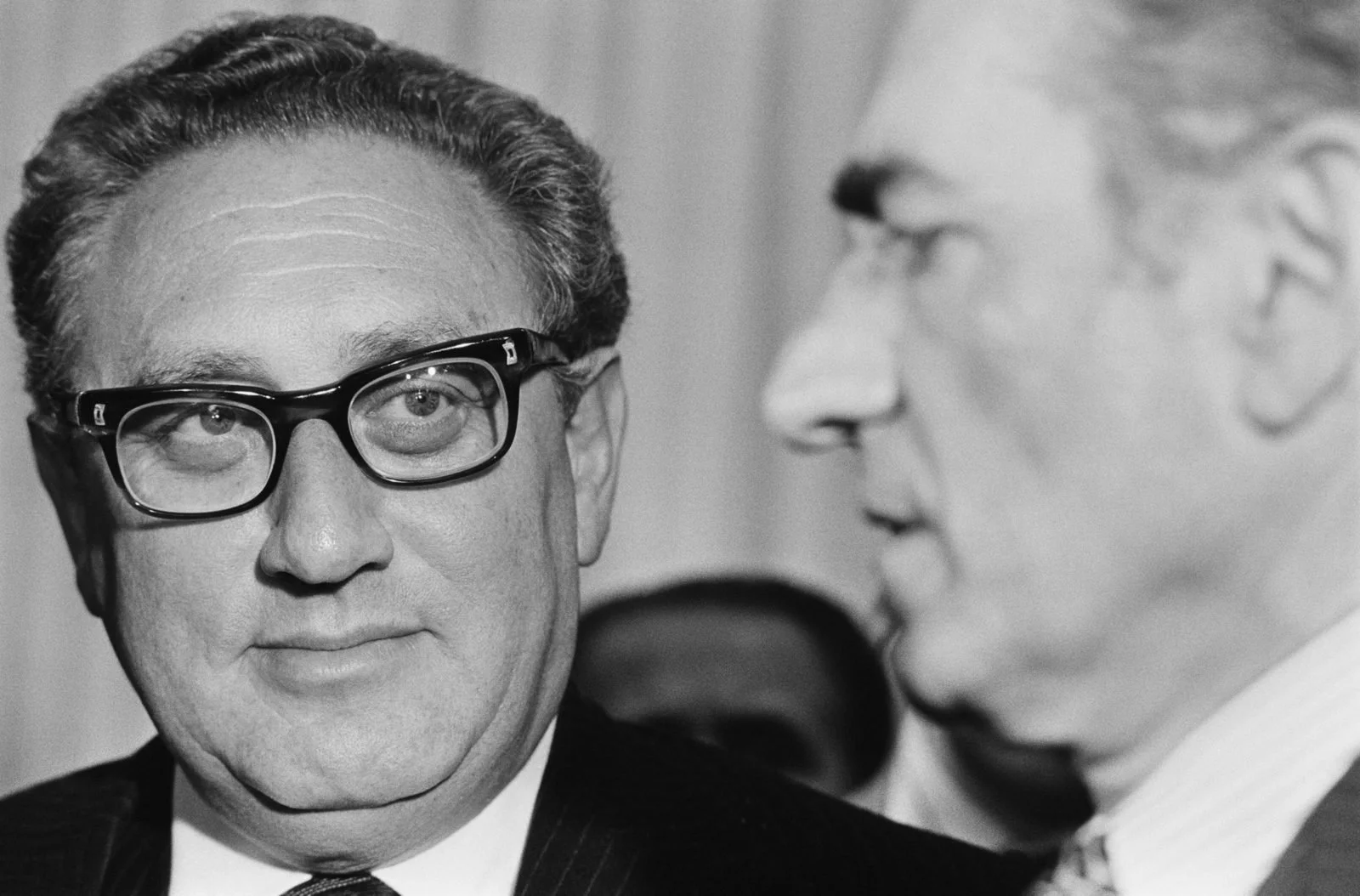
Pictured: Mohammed Reza Shah Pahlavi, the Shah of Iran, meets US Secretary of State, Henry Kissinger in Zurich amid tight security for a summit meeting. (Photo by James Andanson/Sygma via Getty Images)
By Yalda Slivo
There is a section in Washington Bullets where Vijay Prashad delves into the foundations of the Western self-image. Since reading the book two years ago, I haven’t stopped thinking about this particular passage, where Prashad traces the modern use of the concept “conspiracy theory” to Karl Popper’s highly influential work The Open Society and Its Enemies. But Prashad does not see Popper’s text as an honorable defence of truth, but rather as a sophisticated class attack. In his reading, this categorization was never really a principled objection to hidden political intrigues, but a highly developed method of invalidating criticism of imperialism and capitalism in advance, dismissing it as irrational or conspiratorial.
Although Prashad wrote this short, incisive book in just two weeks, in the aftermath of a coup attempt against Evo Morales in Bolivia, the text was clearly written from a point of great frustration: Why did the Western left refuse to support Morales? He ticked all the boxes of identity politics, but as soon as he challenged imperial power structures, he was left alone. The truth, of course, is that Prashad understands this better than most of us. He knows that what we are witnessing is not random hesitation; it is one of the pillars that has sustained Western global dominance for over a century: denialism.
Here we find ourselves at the heart of what for decades has been dismissed as conspiracy theories, but which in fact is one of the most well-documented political machineries in history. It is the unique case of Western denialism – the same machinery that makes it possible to talk about human rights while turning a blind eye to the most extreme violations of them, as long as they serve a geopolitical purpose, whether those involved are aware of it or not.
Now, my aim with this text is not to resolve the whole idea surrounding denialism – because there are many issues involved. For me, it operates in different ways across structures, particularly within civil society through what the Marxian tradition understands as the superstructure, from Antonio Gramsci to Louis Althusser’s idea of state apparatuses. Even though I will separate denialism into a three-part structure – institutional, bureaucratic and popular – in order to frame a historical narrative, my goal is not to waste time creating strict definitions for these categories or a blueprint for everyone to follow. Rather, the aim is to show how Western denialism has functioned as a geopolitical tool within the colonial powers of the West, from the beginning of the 20th century until today.
It is without doubt not an easy task, and it will remain complicated even after the reader finishes this text. It is also worth noting that I am working from what has been historically documented, meaning that just because institutional denialism is treated as a subject for the early 20th century in this text does not mean that popular denialism did not occur at the time.
However, to understand how we ended up with today’s media and political silence surrounding the popular denialism of the Gaza genocide, we must go back to the moments when this machinery was calibrated through institutions and bureaucracies. We must go back to the darkest hours of WWII – when British intelligence received a telegram that should never have been dismissed.
INSTITUTIONAL DENIALISM
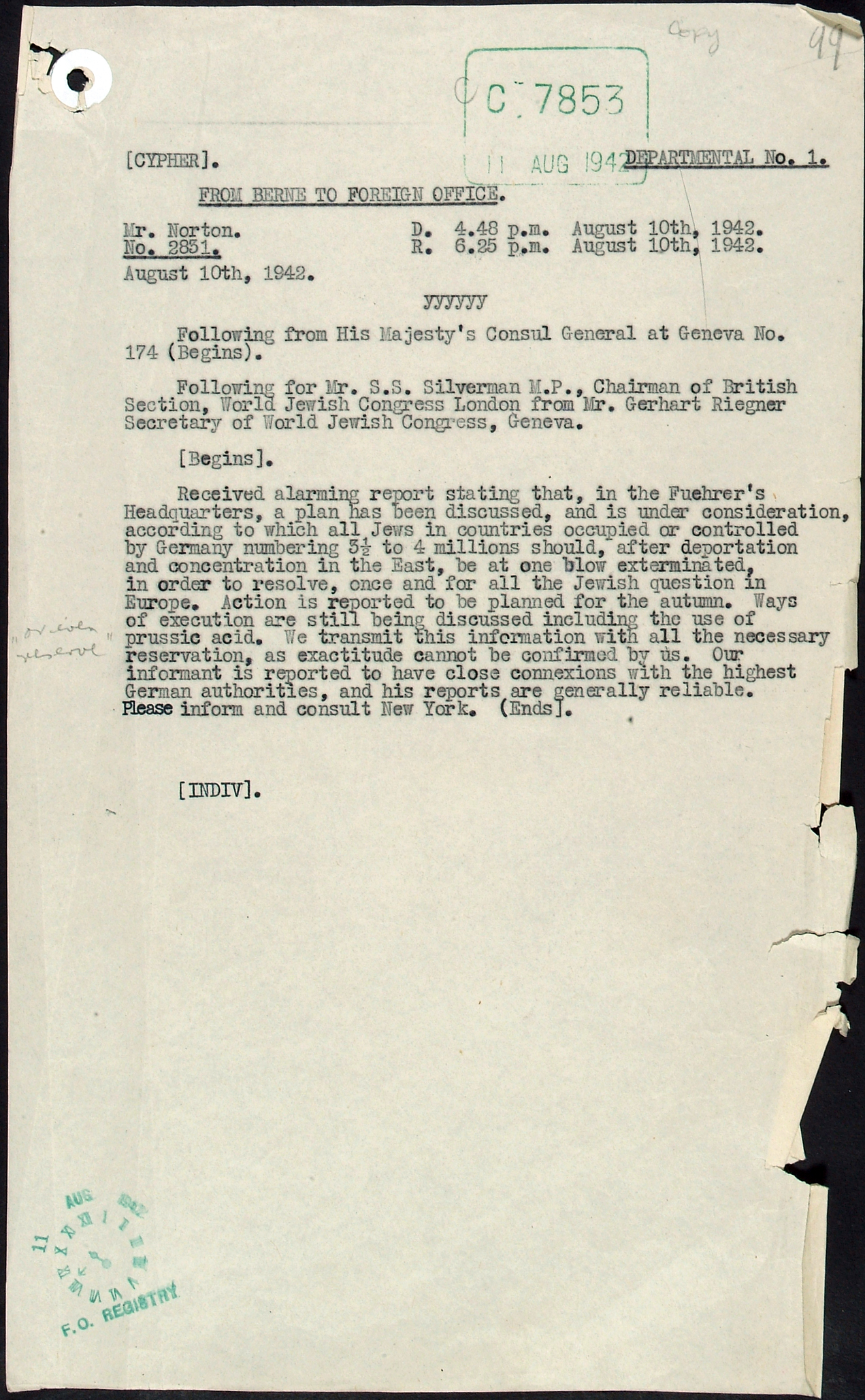
It is August 10, 1942. A coded message, later known as the Riegner Telegram, arrives at the British Foreign Office in London. The text of the telegram is brief but terrifying:
“Received alarming report stating that, in the Fuehrer’s Headquarters, a plan has been discussed, and is under consideration, according to which all Jews in countries occupied or controlled by Germany numbering 3 1/2 to 4 millions should, after deportation and concentration in the East, be at one blow exterminated, in order to resolve, once and for all the Jewish question in Europe. Action is reported to be planned for the autumn.
Ways of execution are still being discussed including the use of prussic acid. We transmit this information with all the necessary reservation, as exactitude cannot be confirmed by us. Our informant is reported to have close connexions with the highest German authorities, and his reports are generally reliable.”[1]
The message, based on information smuggled out of Nazi Germany via a German industrialist, is as inconceivable as it is nightmarish. Adolf Hitler had ordered the systematic extermination of Europe’s Jewish population. However, despite this terrifying detail, the report was met with cynical skepticism.
At the time, British officials initially dismissed the information, warning colleagues that circulating such claims might “provoke embarrassing repercussions”[2] – a rather cynical excuse revealing that the primary concern was not the fate of Europe’s Jewish people, but the political consequences of acknowledging atrocities that could raise difficult questions about refugees and Allied responsibilities, not least in Palestine – where the Zionist movement had already been growing for decades and immigration was tightly controlled by the British authorities.[3]
But reality told a different story – the struggle against fascism had deep ideological roots stretching back to the victory of the October Revolution 25 years earlier, a spark that had ignited hope among Europe's radical movements. For these movements, there was no doubt about the nature of the enemy: fascism was the brutal face of capitalism, a movement that cloaked itself in revolutionary rhetoric but shook hands with big finance.
This was apparent in the way Hitler’s war machine was lubricated by companies such as the chemical giant IG Farben, whose economic muscle and technical expertise helped lay the foundations for the apparatus of extermination – it was the same company that would later supply the prussic acid that filled the gas chambers of the concentration camps. A true textbook example of how monopoly capital integrated itself with fascist violence.
While the European labor movements recognized the threat early on, the colonial powers allowed their geopolitical interests and policies to be guided by cold realpolitik. Rather than confronting the rising Nazi regime, Britain and the United States were more interested in preserving their empires and exploiting labor in their respective colonies. The potential collapse of the Soviet Union at the hands of Hitler’s Germany was of no concern to Britain and the United States, as they had already attempted to undermine it – given that it was the only force challenging the global financial system in the first place. In the case of the Soviet Union, there was no geopolitical denial of the massacres, as the Soviet state was confronting the very regime it had predicted would rise to power if finance capital continued to metastasize. But for the survivors who managed to escape, the biggest challenge, apart from the trauma itself, was to be believed.
However, in Washington, the reports were once again met with suspicion of these “Jewish sources.” Despite the clear warning in the Riegner Telegram from August 1942, officials at the U.S. State Department refused for weeks to pass on the information. It would take 18 months, until January 1944, before then U.S. President Franklin D. Roosevelt finally bowed to political pressure and established the War Refugee Board. By then, however, millions of people – Jewish, Soviet POWs, Roma, and resistance fighters had already been murdered. This pattern of ignorance was systematic: even the U.S. Army’s own magazine, Yank, requested a “less Jewish story” so as not to provoke the home front.[4]
This inability to act had been going on before. In what has become known as “the first modern genocide,” the Ottoman killing of Armenians, Assyrians and Greeks in 1915 shows one of the earliest examples of how colonial powers used human tragedies as pawns in a geopolitical game. Here, we see a systematic policy of denial on full display – where the recognition of genocide is instrumentalized: highlighted when it damages an enemy, but silenced when it threatens one’s own alliances.
In the Ottoman case, their economy had been taken over by European creditors in 1881 via the Ottoman Public Debt Administration, meaning that instability in the region could disrupt the payment of loans.
Initially, British intelligence openly condemned the Ottoman massacres of Christian minorities. But this moral stance proved empty, as Yusuf Malek would later describe in his eyewitness account and testimony, The British Betrayal of the Assyrians, how the British exploited the Assyrian population for their military purposes as long as it served the interests of empire. Malek, who himself worked as an interpreter for British military intelligence, provides detailed insight into how the colonial power navigated between empty promises and cynical denial of human tragedies. When strategy required change, Christian minorities in the Ottoman Empire were left to deal with their own fate – sometimes forced to live in militarized zones under British mandate while the empire prioritized diplomatic relations with newly emerging powers in the region.
This form of systematic denial became evident in how Britain dealt with human tragedies throughout the 20th century – a pattern that culminated in the institutional structures of denial surrounding the Holocaust as it was carried out.
BUREAUCRATIC DENIALISM
After WWII, the United States took over the imperial baton but transformed colonial arrogance into an impenetrable bureaucratic apparatus. Henry Kissinger would later infamously emerge as the architect of this new order – in which imperialist goals hid behind layers of secrecy and technocracy.
One of the most effective tools in this apparatus was its ability to control narratives – often by labeling critics of U.S. involvement in coups and the destabilization of socialist movements as “conspiracy theorists.” This was not accidental: in 1967, the CIA famously issued Dispatch 1035-960 to its stations around the world, explicitly instructing agents to counter critics of the Warren Commission by deploying this very label – making visible the machinery that would go on to pre-emptively discredit anyone who dared question the official version of events.[5] In this way, the CIA effectively neutralized the truth.
As Marxist movements gained ground globally, bureaucratic attempts to stifle them intensified. One conveniently forgotten example is Korea: a country the U.S. first divided in two along an arbitrarily drawn line in 1945, then literally razed to the ground during a war that killed one million people – a tragedy erased from Western consciousness. This imperialist machine operated beyond any democratic scrutiny, imposing a form of capitalist dictatorship on the world whenever and wherever it wanted. Agencies such as the U.S. State Department bureaucratically erased all traces of human suffering wherever the U.S. and its allies had left their fingerprints.
The U.S. has consistently denied any involvement in coups globally – only to declassify documents decades later that confirm exactly what the conspiracy theorists had been claiming all along. This form of systematic denial is not merely a theoretical construct but has manifested in concrete covert operations, where the bureaucratic apparatus has been used to cover up the traces of U.S. imperialist interventions for decades. One could view the unsealing and declassifying of documents as a show of force: by denying the act itself for geopolitical reasons, only to later make it public, the bureaucratic message is clear – “So what if we did it, what are you going to do about it?” And the answer is indeed – absolutely nothing.
One of the most striking examples of this denialist mechanism is Iran in 1953, through Operation Ajax. When democratically elected Prime Minister Mohammad Mossadegh nationalized the country’s oil resources to benefit the people of Iran, the U.S. responded by organizing a coup d’état to protect Western capital interests. For six decades, the U.S. officially denied any involvement, describing the event as an internal Iranian affair. It wasn’t until 2013 that the CIA officially acknowledged its role and methods in the coup, demonstrating how bureaucratic secrecy managed to conceal the theft of Iran’s sovereignty for over half a century.[6]
The pattern was repeated with even more devastating consequences in Indonesia in 1965 through the operation known as the Jakarta Method. This strategy stemmed from the U.S. belief that it could befriend neutral countries in the so-called “Third World,” as long as it could keep communists out of power. However, in Indonesia, a growing communist movement represented by the Communist Party of Indonesia (PKI) faced a military purge supported by the U.S., resulting in at least 1,000,000 deaths – some sources even claim 3,000,000. Behind the scenes, the U.S. worked tirelessly to provide the Indonesian army with lists of communist leaders to target for murder, while outwardly maintaining diplomatic distance. This genocide was labeled an “internal security operation,” yet documents released in 2017 ultimately proved that U.S. support for the mass murders had been kept hidden in the archives.[7]
POPULAR DENIALISM
The pattern of denialism established during the 20th century has reached a critical point in our time in the handling of Gaza’s total demise. Here, denial is no longer just a matter of secret archives but a living synthesis of all three parts of the structure: institutional, bureaucratic and popular denialism. What distinguishes Gaza from every case examined in this text is not the scale of the atrocity or the cynicism of those enabling it – these have been constant across the century we have traced. What is different this time is the nature of the denial as it is happening in real time. With Korea, Iran and Indonesia, the state machine worked to conceal in retrospect by burying evidence in classified archives for decades before the truth surfaced. Gaza is the first case in this tradition where denial is not lagging behind the atrocity. The historical pattern has flipped: institutions that dedicated their existence to preventing genocide have named it as such in real time – and have been ignored in real time.
Despite the fact that international bodies such as Amnesty International had already established in February 2024 that Israel had failed to meet the International Court of Justice (ICJ) requirement to prevent genocide, the Western media instead decided to apply a surgical and seemingly “objective” lens to the daily horrors faced by Palestinians.[8] Even though the institutions had done more than enough careful work analyzing the facts, the media took it upon itself by reporting from a distance without journalists on the ground – resulting in rhetoric that systematically minimized the suffering. The media, therefore, acted as an extension of bureaucratic denial for Israel and its institutions, which for decades, have enjoyed the privilege of priority in the realm of genocide studies. Even though the media itself is not part of the state bureaucracy, it has utilized the same vocabulary that has been part of its tradition for decades in relation to human tragedies, while failing to recognize its own role as a denialist entity – only this time for the U.S.’s greatest ally. In addition, Human Rights Watch has repeatedly observed how Israel has defied court rulings, a defiance made possible by the diplomatic safety net provided by the U.S. – a contemporary continuation of its imperialist tradition of protecting geopolitical strategic allies at all costs, even when committing genocide.
However, the response to the ICJ findings was not to refute them. No one presented any counter-evidence or legal arguments. Instead, we were reminded of CIA Dispatch 1035-960 – the idea of pre-emptively discrediting any source. All of a sudden, methodology was questioned: how the dead were counted and how numbers were framed. But this was not because the evidence itself was weak, but because it would require governments, editorial boards and political establishments to reckon with their self-image surrounding “Never Again,” as they chose to look away while it was happening.
Here, popular denialism becomes more than just ignorance – it becomes labor for the state, which now recruits millions of people to dispute established facts in real time instead of burying evidence in classified archives for decades. The “Hamas-run” label, the “Pallywood” myth, the human shields argument, and debates over how many deaths were “historically acceptable” all constitute a form of denial – reducing the entire population of Gaza to either human shields or combatants by framing it as a “conflict.” In just the last two years, the arguments shifted constantly: first the death toll was disputed, then methodology, then the very definition of genocide itself – and none of this was due to a search for truth, but rather a perpetual moving of the goalposts.
These are all popular expressions of bureaucratic and institutional sentiment. To keep arms flowing, for European governments to maintain diplomatic relationships, and for the media to continue gaining special access, someone has to do the actual work of making the population comfortable with it – the work of popular denialism. And just as Gramsci understood the role of the superstructure 100 years ago, it’s not by forcing consent, but by making it feel like common sense.
This would all continue as the genocide moved toward a “final solution,” where starvation became policy and Hamas was being blamed for stealing food and aid – somehow accounting for mass hunger in a place where Israel had destroyed all infrastructure, schools and hospitals. This can only be seen as the “common sense” of a lie.
The circle that began with British officials dismissing “Jewish sources” in 1942 is now closing in an era where voices from Gaza are dismissed with the same cold logic – a logic that favors the interests of the empire and its superstructure over testimonies of human destruction.
Notes
[1] The National Archives (n.d.) Riegner Telegram, FO 371/30917. Available at: https://www.nationalarchives.gov.uk/wp-content/uploads/2017/09/2_FO-371-30917-Riegner.jpg (Accessed: 12 March 2026).
[2] World Jewish Congress (2020) 'This week in Jewish history: Riegner Telegram alerts world of Holocaust', World Jewish Congress. Available at: https://www.worldjewishcongress.org/en/news/this-week-in-jewish-history--riegner-telegram-alerts-world-of-holocaust-8-2-2020 (Accessed: 12 March 2026).
[3] His Majesty's Government (1939) British White Paper of 1939. Avalon Project, Yale Law School. Available at: https://avalon.law.yale.edu/20th_century/brwh1939.asp (Accessed: 13 March 2026).
[4] EBSCO (n.d.) 'Holocaust revisionism and censorship', EBSCO Research Starters: Communication and Mass Media. Available at: https://www.ebsco.com/research-starters/communication-and-mass-media/holocaust-revisionism-and-censorship (Accessed: 12 March 2026).
[5] Central Intelligence Agency (1967) Dispatch 1035-960, declassified document. Available via Mary Ferrell Foundation at: https://maryferrell.org/showDoc.html?docId=49975#relPageId=2 (Accessed: 12 March 2026).
[6] US Department of State (2017) Foreign Relations of the United States, 1951–1954: Iran. Available at: https://static.history.state.gov/frus/frus1951-54Iran/pdf/frus1951-54Iran.pdf (Accessed: 12 March 2026).
[7] Human Rights Watch (2017) 'Indonesia: US documents released on 1965–66 massacres', Human Rights Watch, 18 October. Available at: https://www.hrw.org/news/2017/10/18/indonesia-us-documents-released-1965-66-massacres (Accessed: 12 March 2026).
[8] Amnesty International (2024) 'Israel defying ICJ ruling to prevent genocide by failing to allow adequate humanitarian aid to reach Gaza', Amnesty International, February. Available at: https://www.amnesty.org/en/latest/news/2024/02/israel-defying-icj-ruling-to-prevent-genocide-by-failing-to-allow-adequate-humanitarian-aid-to-reach-gaza/ (Accessed: 12 March 2026).