Politics & Government

Reopening Schools: We Do Not Have To Descend Into COVID Hell

By Steve Miller, Rosemary Lee and E.B. Shaw

With Corona virus cases spiking across the country, America is on the verge of forcing millions of people into extreme danger. Suddenly, everyone from CEOs, the President, state governors, and the corporate media are calling for schools to open “to save the economy”.

No country has tried to open schools with the virus spreading like here in the US. We are currently in a massive wave of surging cases in 40 states. There are not enough tests or testing. How do you open schools if you can’t test and trace? There’s no way that you can keep a school safe from coronavirus if the virus is raging out of control in the community where the school is located.

Before schools physically re-open, certain principles of public health must be established:

  • No re-opening without full scientific best practices. So far, this is seriously lacking.

  • No re-opening without dealing with the vast practical hurdles. These steps require more funding, not less. So far, the funding to address these problems does not exist.

  • No re-opening without total and complete public transparency. So far, decisions are made behind closed doors. Planning is slapdash and haphazard at best. Teachers, unions and communities must be fully involved as co-equals with politicians in establishing policies.

  • Schools should continue to be food centers for the communities, but they should reinstate and expand what government has cut — access to nurses, vision services, mental health and cultural support. Communities need these services now more than ever.

  • We cannot fail to hold government accountable for securing public health and public safety. Governments must do what it takes to guarantee childcare in safe ways.. We have no choice here. Public schools are still controlled locally. We must exert our power to protect our children.

We’ve already seen what happens when we use shortcuts and go against public health guidance in reopening. Other countries have been successful in suppressing the level of COVID-19, they have one thing in common — a national coordinated strategy.

The US response to the virus has been fractured, reckless, and incompetent. Rather than the federal government organizing a national coordinated response, it has put corporations in total control.

The government refuses to provide adequate unemployment or health care, thus making families desperate to work.  Many European countries cover 60% to 90% of workers’ wages when they can not work. So do we really have to risk our children and our families so corporations benefit? It really does not have to be this way.

Corporations are demanding their workers return to work so they can make a profit from their investments, but they refuse to provide childcare. So children, teachers and school staff, families and communities, must risk their lives to open schools that could not even guarantee toilet paper before the virus. The only people to benefit from a premature physical opening will be billionaires and politicians of both parties. This is why they tout political reasons to re-open, while ignoring scientific precaution.

These same people, who previously had no trouble closing schools throughout neighborhoods and subjecting children to hours of high-stakes testing at computer screens, now state that keeping children out of school denies them the “emotional, social, and knowledge growth they desperately need.” Suddenly, also, the teachers who were degraded as the worst problem with public schools are now heroic essential fron-tline workers!

Schools are set to open district-by-district across the country while many nail shops, gyms, and bars remain closed. Many schools only use easily contaminated recycled air throughout whole buildings instead of widows that can be opened to bring in fresh air. Taking steps as minimal as social distancing will cost vast amounts. Little things become big problems. Before, a Kindergarten teacher could take the whole class to the bathroom at once. Now a class of 15, that requires 6 feet of spacing, forms a line 90 feet long! And how exactly are bathrooms going to be sanitized?

There are no clear guidelines; planning is confused and hidden from the public; PPE’s are in short supply; school budgets are being slashed even as the costs of adequately dealing with the virus skyrocket. School nurses were virtually eliminated before the virus hit. Now, what exactly is going to happen if a child feels sick?

The gap between school finances, destroyed by the virus, and the greatly increased costs, also caused by the virus, runs into billions. The American Federation of Teachers (AFT) has estimated the funding required to reopen public schools safely is at least $116.5 billion.

Trey Hollingsworth, Indiana Congressman, stated that people dying from the virus is the lesser of two evils to the economy not opening up. CNN reported that Hollingsworth said: “it is always the American government’s position to say, in the choice between the loss of our way of life as Americans and the loss of life, of American lives, we have to always choose the latter.” Lieutenant Governor of Texas, Dan Patrick, announced that old people should welcome re-opening, even if that means they would die.

This corporate class also touts the murderous notion of “herd immunity”, meaning that after 3 million people or so die, the virus cannot spread any more. We have watched health care workers sicken, live in their cars so not to infect their families, and wear plastic bags instead of PPEs. What will happen to school staff?

When policies and political choices set up people to die at “acceptable levels”, it is fair to conclude that this is not an accident. Even before the virus, digital technology has been turning jobs into temp work or no work at all. Corporations are simply not going to spend money to support people they cannot use. In this context, physical re-opening is designed to accept a specific amount of death, to establish toleration of death as a new normal.

Can schools physically re-open now? If so, how?

Hawaii has announced that schools will re-open when no one in the state has tested positive for one month. The Florida Education Commissioner, Richard Corcoran, is the former Speaker of the Florida House and a charter school owner. He demands that Florida open its schools 5 days a week even as Florida COVID cases reach record high levels. Precaution is scrapped for pragmatism.

America’s schools do not meet even the most lenient advice for physical re-opening, which are found on the White House websiteTeachers advocate no physical re-opening until no new cases arise in the past 14 days, the time for symptoms to appear. Some districts are beginning to scrap immediate physical re-opening.

Once again, as with the George Floyd rebellion, our character as a people will be tested. Will we stand together, or will our passivity make us complicit in sanctioning unnecessary public death?

Yes, the mental, physical and emotional health of children is critical. No, this cannot be achieved by physical re-opening schools like before. That is impossible. We can find ways to bring young people back together again, but it means letting go of the idea that schools can return to normal. This step requires the imagination and agency of the communities schools serve.

The virus proves that no one is safe unless everyone is safe. The same is true for our schools. For a country founded on genocide, slavery and inequality, the challenge once again is to stand up for the right of quality public education for all.

Everyone now can see the critical and vital importance of public schools to our communities. Even before the virus, schools have been the anchor of the community. Closing public schools is a method of gentrification and community dispossession. Now we see once again that healthy schools create healthy communities and healthy communities create healthy schools.

Teacher unions and parents are advocating that public schools, in these times of COVID, should anchor the communities by expanding the public services they offer.

Immediate and Future Challenges

Whether schools physically open or not, the nature of public education has dramatically changed. Through the Spring, public schools offered online distance learning. As students graduated in June, Zoom Video Communications, Inc announced that it was being used by 100,000 schools globally.

Education has gone from being supported by technology to being dependent on technology and from being corporate-supported to becoming corporate-dependent.

Corporations like Pearson and Google tout online education as a way of saving money in tough times, but this just leads to private profits for corporations.

The latest vampire is Turnitin.com. Students turn in their essays. The website checks for plagiarism; then it sends it back to you, marked in red where you copied something out of the encyclopedia. But they also offer school districts more advanced options like: grading every paper… or maybe even student surveillance.

Under corporate control, online learning, distance learning and virtual charter schools are a dismal failure. The California Attorney General is investigating the entire virtual charter industry for putting private profit ahead of quality education. The largest virtual charter corporation, K12 Inc, “educates” 120,000 students, making $900 million in revenue, all from taxpayer money earmarked for public education. Only half of online high school students graduate within four years, compared to 84% nationally. The Center for Research on Education Outcomes found that students in virtual charters do so poorly in math and English that it’s as if they didn’t attend school at all.

Most teachers estimate that only about 25% of their students do well in online education. The education model is the same drill & kill, test & fail regime that students could not succeed in even before the virus. Most students have trouble learning through screens since the other vital ways that humans learn are eliminated or reduced. And, of course, how does a family provide enough laptops for every child, much less the expense of connecting through Wi-fi?

Government at every level has invited billionaires, tech corporations, and CEOs to determine what public education will look like as the virus rolls on. New York Governor Andrew Cuomo invited Bill Gates and Google into the state to “re-imagine public education.” In other words, government is systematically replacing elected officials, who are (theoretically) accountable to the people, with private, unaccountable capitalists in a campaign to defund and privatize public schools and debase the purpose of education.

The ethical and moral implications of this corporate effort to terminate the education our children and communities need are highly disturbing. There is little public discussion about this even as government proclaims online learning as the miracle of the age.

US schools at every level are facing a crisis of unprecedented proportions. By the time the 2020-2021 school year is over, corporations and governments – if unopposed – will establish a degraded model that works only for the elite and very few others.

When government can bailout billionaires with trillions of dollars, we see that the money exists to build a system of public education that can build the leaders we need to transform the world.

Teaching today must unleash the marvelous powers and creativity of our collective humanity. Students are the people the world needs today to overcome the challenges of a desperately sick population, a sick society and a sick planet.

Unlike most of the world, where the needs of society were put first, in the US every problem is presented as an individual problem and every solution is presented as an individual solution.

It is the same with public education. Ronald Reagan proclaimed that there was no such thing as “society”, meaning no problems result from society, so you’re on your own. This has been America’s mantra ever since, unless of course it relates to corporate governance.

But now we see, scientifically, that the only solutions that can work must be organized at the national level by government to benefit everyone. Social problems are not individual; the emanate from how society is organized. Social problems require social solutions.

Just as COVID-19 demands a national coordinated strategythe problems of safely re-opening public schools demand national solutions. Not piecemeal, local, short-term quick fixes. Instead, upgrade our schools by combining a public health approach with a public schools approach.

Steve Miller, Rosemary Lee, and E.B. Shaw are members of the National Public Education Committee of the League of Revolutionaries for a New America

Frantz Fanon: A Personal Tribute to the Philosopher of the Colossal Mass

By Alieu Bah

Originally published at Red Voice.

"The colonized intellectual you so much detest has come to become the so-called guardian of your name. I hope you come into the whirlwind and destroy that myth... But in the end, I guess that’s our battle to fight."

The wretched of the earth, the damned of humanity are still here. Still clamoring, still caught in a thousand many battles with themselves and the world built to keep them in their place. Their fate signed, sealed, and packaged for the consumption of the rich and wealthy few of the earth — buffets where the flesh, blood and tears of the poor are served to a greedy, barbaric, capitalist horde are even more sumptuous. Their feasting is the stuff of legend and their belch a recognition of a satisfied bunch of heartless thieves who rejoice more in their heist than any sort of remorse or regret thereof. The proverbial cocktail party list that was supposed to be changed at the dawn of decolonization remains the same even as it is inherited and one family name supplanted for another in a vicious circle of inheritance.

(Un)fortunately your book ‘The Wretched of the Earth’ is still relevant to us. It was supposed to be an artifact of history, forever to rest in the museums of liberated territories. But fact is, it remains this living, breathing, painful reminder to us the colonized of the earth. We still study it because it’s more relevant than ever in this colonial continuity. From the favelas of Brazil, the hoodlands of America, the jungles of Chiapas, from the townships of Johannesburg to the slums of Nairobi, this masterpiece continues to shine in the eyes of a new generation whose parents were sold nothing but dreams.

The shantytown, the medinas, the slums of the world still persist. The compartmentalization of the world continues unabated. However, the divide gets deeper and more cancerous, the line, the border isn’t in the same town or neighborhood anymore, but between the geography of the oppressed — the third world — and the center of the oppressor, the colonist. With the ever-increasing globalized configuration of capital, the choke hold of a staggering market to the expansion of “soft” imperialism in the form of intergovernmental organizations and NGOs from the colonizer, the metropolis has exceeded all expectations of a shared analysis between our generations; the chasm deepened as Hannibal crossed the alps. It all has gotten deeper since you've succumbed to the white claws of death in that hospital in Maryland. The rich neighborhood and the slums today are mostly populated by the same faces, the same race of men and women. When I was in Nairobi last year, it reminded me so much of your analysis on the divided, schizophrenic colonial society.

In more ways than one it’s as if your take was about the neocolonial state in those illuminating first chapters of The Wretched of the Earth. The naked violence of it and the wanton disregard for human life makes you a prophet in this secular tradition of progressive politics we share. But more searing and penetrating of your analysis was the scholar and intellectual who comes home from the west. They’re here after all this time, still concerned about particulars and false western moralisms. They do all kinds of gymnastics with the minds of the masses to divert them from the struggle for land, bread, and water.

They are being found out, though. Young and old progressive Africans have started studying and propagating your works and see their (colonized intellectuals') likeness once again. The objective conditions are also giving rise to a newer, more badass context that defies the pull and gravity of bourgeois intellection grown from those barren western soils. These new rebels, ghetto-grown intellectuals, unknown revolutionaries, are at once denouncing these puppets and concretely building again the old-but-known mass organizational model that led to our liberation in times gone by from the clutches of classic colonialism.

Your name, though, continues to raise colonial anxiety. It continues to sound like metal dropping on the silence and soothing sounds of the corporate world. From Palestine to Panama, it continues to liberate, to agitate, even, as it brings home sanity to a lost generation. Your righteous ghost keeps coming back to haunt the Towers of Babel. Even after all this time! It reminds one of the old saying that wickedness tarries but a little while, but the works of the righteous lives on forevermore. Your lives and afterlives have clearly shown the truth and precision of that good old saying. Year after year, you resurface in the most unlikeliest of places, but unbeknownst to bourgeois historians, so long as oppression exists and there is a demand for the objective material conditions to change, you, the philosopher of the colossal mass, will show face, heart, and mind, and guide the movement even from the grave.

But there is trouble now. Your name and your work continues to be appropriated by academe. You’ve become a career for the well-to-do, the ones who erase. They have complicated your legacy. The colonized intellectual you so much detest has come to become the so-called guardian of your name. I hope you come into the whirlwind and destroy that myth. I hope you come into the thunder, into the tsunami, into the catalytic force of nature. But in the end, I guess that’s our battle to fight. To honor your name by bringing it home to the oppressed and the wretched of the earth.

There is so much to enrich this letter with, but so little time and space. But we who inherited the disinherited, we who took the pledge to raise a billion-strong army, we who know liberation and freedom is a birthright, we who want to end the compartmentalization of the world — the Manichaeism of the land — we are here, in our many forms, subjectively and objectively honoring the call to “...shake off the great mantle of night which has enveloped us, and reach for the light. The new day which is dawning must find us determined, enlightened and resolute. We must abandon our dreams and say farewell to our old beliefs and former friendships. Let us not lose time in useless laments or sickening mimicry.

Breonna Taylor and the Framing of Black Women as "Soft Targets" in America

By Ameer Hasan Loggins

Originally published at the author’s blog.

12:38 a.m. was the last peaceful minute of Breonna Taylor’s life.

On March 13, 2020, at 12:38 a.m., Breonna Taylor and her partner Kenneth Walker were asleep in bed. At 12:39 a.m. officers beat on her door for approximately one-minute. During that 59-seconds of banging, Taylor screamed “at the top of her lungs,” “Who is it?” But no one said a word. “No answer. No response. No anything.” The boogeymen kept beating on her door. By 12:40 a.m. Plainclothes Louisville Metro Police Department Officers Myles Cosgrove and Brett Hankison, as well as Sgt. Jonathan Mattingly, shattered the forest green front door of Breonna Taylor’s apartment with a battering ram.

“Boom. Boom. Boom. Boom. Boom.”

The police blindly shot over 20 rounds of bullets into the home of Breonna Taylor. Eight of those officers’ bullets found their way into Breonna’s Black body.

Sgt. Mattingly spoke to Louisville Police internal investigators roughly two weeks after Breonna’s killing. During that conversation he said officers were told her ground floor apartment was a “soft target” and that Taylor too was a soft target, because she, “should be there alone.”

A “soft target.”

A soft target is a person, location, or thing that is deemed as unprotected. As vulnerable. As powerless against military or terrorist attacks. Attacking soft targets are meant to, “disrupt daily life, and spread fear.” They are meant to target, “identities, histories and dignity.” They are meant to ambush and bring unexpected carnage. In 1845, attacking soft targets is how James Marion Sims, who is considered to be “the father” of modern gynecological studied, was permitted to experiment on enslaved Black women without consent, without anesthesia, and without consideration of their humanity. In 2015, attacking soft targets is what lead to 13 Black women testifying against Officer Daniel Holtzclaw. They spoke of how Holtzclaw targeted them during traffic stops and interrogations. How the officer forced them into sexual acts in his police car or in their homes. Prosecutors spoke to how Holtzclaw, “deliberately preyed on vulnerable Black women from low-income neighborhoods,” while committing his acts of sexual terrorism. 170 years separates the hellish acts of Sims and Holtzclaw, but what bridges the gap in time between those two men serially targeting the identities, dignities, and humanhood’s of these Black women is an unbroken history of war being waged on their entire self.

I cast my mind back to Malcolm X’s rebuking of this nation in 1962, when he said, “The most disrespected person in America is the Black woman. The most unprotected person in America is the Black woman. The most neglected person in America is the Black woman.” Here we are, in the year 2020, and the Louisville Police are framing Breonna Taylor as a “soft target.” It’s as if Brother Malcolm was talking about Breonna’s death before she was even born into this world. Before she was awakened by police pounding on her front door. Before she had a name that needed to be said. While Malcolm’s words may feel prophetic in their preciseness, they are not. They were painfully predictable. Malcolm lived, and died in anti-Black America. He was a scholar of America’s history of anti-Blackness.

There has never been a period in the history of America where Black women’s bodies, hearts, minds and beings have not been reduced to being treated as soft targets.

Black women have always been exploited in America. Violated in America. Terrorized in America. Killed in America. The relationship between Black women and America was birthed in targeting and torture.

In Antebellum America, white owners of enslaved African women freely and with legal impunity raped them, often in front of their own families and fictive kin. In Jim Crow America, close to 200 Black women too were murdered by lynch mobs in the American South, many of whom had been raped before having their necks bound and burned by knotted nooses before being hanged to death.

Black women too, were strange fruit.

Black women like Eliza Woods. Woods was a cook. A cook, who in 1866, was accused of poisoning a white woman to death by the woman’s husband. She was arrested and taken from the county jail by a lynch mob. She was stripped naked. She was hung from an elm tree in the courthouse yard. Her lifeless body was then riddled with bullets as over a thousand spectators watched.

In 1899, the husband admitted that he poisoned his wife — not Woods.

Black women like Laura Nelson. Nelson allegedly shot a sheriff, in 1911, to protect her 14-year-old son. A mob of white people seized Nelson along with her son, and lynched them both. Laura Nelson, “was first raped by several men. The bodies of Laura and her son were hung from a bridge for hundreds of people to see.”

Elderly Black women like 93-year-old Pearlie Golden (2014), 92-year-old Kathryn Johnson (2006), 66-year-old Eleanor Bumpurs (1984), and 66-year-old Deborah Danner (2016), all were in their homes and shot to death by the police. Michelle Cusseaux (2014) was 50-years-old. Kayla Moore (2013) was 41-years-old. Aura Rosser (2014) was 40-years-old. Tanisha Anderson (2014) was 37-years-old. Natasha McKenna (2015) was 37-year-old. Alesia Thomas (2012) was 35-years-old. Miriam Carey (2013) was 34-years-old. Charleen Lyles (2017) was 30-years-old. India Kager (2015) was 28-years-old. Sandra Bland (2015) was 28-years-old. Atatiana Jefferson (2019) was 28-years-old. Mya Hall (2015) was 27-years-old. Meagan Hockaday (2015) was 26-years-old. Shantel Davis (2012) was 23-years-old. Korryn Gains (2016) was 23-years-old. Rakia Boyd (2012) was 22-years-old. Gabriella Nevarez (2014) was 22-years-old. Janisha Fonville (2015) was 20-years-old.

The police did not give a damn about the ages of these Black women. They did not care if they had nearly lived for a century on this earth, or if they were just a few years removed from their high school graduation. They killed them just the same. The police have shown that anybody, at any age, can be on the fatal end of their force, if you were born with Black skin.

Aiyana Mo’nay Stanley-Jones was only seven-years-old. On May 16, 2010, at 12:40 am, a Detroit Police Department Special Response Team Officer ended her life. Her last peaceful minutes in this world were spent sleeping on the couch, near her grandmother. That’s before a no-knock warrant (at the wrong apartment) was executed. That’s before law enforcement threw a flash-bang grenade through her family’s front window. That’s before the grenade burned the blanket covering Aiyana’s body. That’s before the wooden front door exploded under the force of police boots. That’s before Officer Joseph Weekley fired a single shot, that entered Aiyana’s head and exited through her neck — all while an A&E crew were filming an episode of the cop- aganda program, The First 48.

There is no softer target in this world than a sleeping child.

Aiyana never had the chance to reach womanhood, but had she, her “soft target” status, both in perceived personhood and lived location, would have left her vulnerable to domestic anti-Black police terrorism attacks. The disturbing truth is that, as Kimberlie Crenshaw notes, “about a third of women who are killed by police in the United States are Black, but Black women are less than ten percent all women,” in this country. This speaks directly to the hazard level and susceptibility to anti-Black police terrorism faced by Black women of all ages in America. The devil is in the details. Look directly into the data, and see how many of the law enforcers who have killed Black women have been convicted of committing a crime. The American Judicial System does not protect Black women. It too treats them as soft targets. The lack of Black women’s names being said in conversations surrounding anti-Black police terror speaks directly to their deaths and narratives as being deemed as unworthy of outrage. Of newsworthiness. Of action.

Breonna Taylor’s killers are free. Brett Hankison, Jonathan Mattingly, and Myles Cosgrove are walking the streets…free. Breonna was shot dead in her home in March, and we are in the month of August. 143 days have passed…and her killers are free. There is no justice to be had for Black women when the intersections of their Blackness, their class, and their gender mark their bodies, their homes, and their narratives as “soft targets” to be attacked with little to no consequences.

The politics of Black women being unprotected against targeting in America, predates America being a sovereign nation. It goes as far back as Virginia’s December 1662 decree, “that the children of enslaved Africans and Englishmen would be ‘held bond or free according to the condition of the mother’ which, in effect, monetarily incentivized the sexual terror against Black women, “as their offspring would swell planters’ coffers — a prospect boon to countless rapes and instances of forced breeding.” One must understand, when you witness Black women passionately protesting on behalf of Breonna Taylor, yes, it is a fight for Black women today, but it is also a part of the uninterrupted fight Black women have always faced in America — the fight against being casualties of “soft target” terrorists attacks.

Gold and Oil: A Tale of Two Commodities

By Contention News

Enjoy this special edition of Contention News — a new dissident business news publication — with analysis exclusive to Hampton Institute. You can read more and subscribe here

Gold broke $1,930 an ounce this week, its highest level ever. This follows weeks of record inflows to gold-related exchange traded funds (ETFs), and comes alongside silver’s biggest weekly gain in four decades.

Oil also advanced last week, but prices remain depressed -- the fracking industry now faces “extinction.”

Solving the puzzle of how metals can be gaining while the production of the most crucial commodity of our times can “peak without ever making money in the aggregate” unlocks important insights into how our global system works at its core. 

Money and the world of commodities

To repeat: money exists to circulate commodities. [1] Anything can serve as money as long as there is a stable relationship between the value of money at large and the world of commodities it circulates. The best way to do this: pick a representative commodity to serve as money. [2] Metals have low carrying costs and are easily divisible, so most epochs have settled on gold or some other metal for this purpose.

Since 1973, however, the world money system has not relied upon a representative commodity. Instead it has relied upon the United States to use political and military means to keep commodity prices stable. [3] The easiest way to keep prices steady: pin them down. Prices and profits serve as the signal for action: higher commodity prices = higher input costs = squeezed margins. 

Politicians don’t have to worry about the monetary system, they just have to think about corporate earnings. 

Oil prices and economic crisis

This worked for most of the world’s commodities save one: petroleum. The oil crises of the 1970s prompted a multi-year inflation crisis and economic “stagflation.” The United States responded with the Carter Doctrine, which defined the free flow of oil in the Persian Gulf region as a matter of U.S. national interest, justifying persistent military presence in the region and strategic alliances with key oil-producing states to keep prices low.

This system broke down between 2003 and 2008, with oil prices spiking more than $120 a barrel over that period. What caused the spike? The most likely causes:

This price rise reached crisis levels in 2008 immediately prior to the Great Recession. Correlation isn’t causation, but it isn’t out of line to think that rising fuel and other commodity costs might have prompted an uptick in mortgage defaults. The same goes for investors selling off previously iron-clad securities as prices in general grew unstable. 

Fracking provides a crucial response to this kind of crisis. Not profitable under normal conditions, rising prices draw investment into the sector, bringing on new supply, driving prices down again. Companies borrow big to get started and go bust quickly, but executives get their golden parachutes, creditors get their settlements, attorneys make killer fees, and large firms gobble up all the abandoned assets. Only oil workers, royalty owners, and taxpayers lose.

Gold’s moment today 

Now a new crisis from outside the energy sector has destroyed demand and plummeted prices. [5] Central bank “money printing” in response should be inflationary, and thus the rise in gold prices, according to conventional economic wisdom.

Except that conventional wisdom is actually backwards. The money supply does not determine prices, commodity production determines how much money you need. If production goes up or production costs get bid upwards, [6] you need more money. Money gets pulled out of savings, banks increase lending, and the supply and velocity of money goes up.

Simply pouring more money into a depressed market, on the other hand, drives that cash into savings. This oversupplies money markets, driving down interest rates. As real rates — interest minus expected inflation — dip into negative territory, gold’s zero yield becomes a better bet than anything else. That’s how you end up with low oil prices, a collapsing fracking industry, and rising gold values. 

But now U.S. political failure is putting the whole dollar system into question over and on top of this. The result: investment flowing out of the dollar and into the yuan and the Euro. Without a clear alternative to the dollar as “world money,” gold is even more attractive as an asset. If rising demand in countries outside the United States drives up oil costs, price instability could make it even better. 

The puzzle still has pieces that have yet to be placed, but the image is clear: a fragile system is coming to an end, and when it falls who has the gold will rule. 

For more anti-imperialist business analysis, subscribe to Contention

Notes

[1] Much of the analysis here is inspired by collective study of The Value of Money by Prabhat Patnaik

[2] Any advances in the productive forces at large will shift the marginal value of all commodities, the money commodity included. Industrialization, for example, allowed the same amount of labor-power to produce a larger quantity of commodities, lowering the marginal value of each. Industrialization did the same for gold production, shifting its relative value to the world of commodities in the same way.

[3] The recent right-wing coup in Bolivia represents an example of this strategy. The United States could not tolerate an independent government controlling a significant supply of lithium. Even if Tesla buys its lithium in Australia, the prospect of an anti-colonial government controlling enough supply to boost prices — especially in alliance with China — not only impacts the automotive industry, it actually poses a risk for the whole monetary system. 

[4] Another way of putting this: the falling rate of profit produced rampant financialization which collided with class struggle against imperialist occupation and Western hegemony to destabilize commodity exchange on a fundamental level. 

[5] The crisis is internal to capitalism, not exogenous, the result of rampant deforestation and imperialist supply chains. See Rob Wallace et al. “COVID-19 and the Circuits of Capital.”

[6] Bid upwards by class struggle — workers fighting for higher wages, peasants demanding fairer prices for their outputs, colonized countries taking charge of their resources, etc.

Remembering Guaidó’s Last Stand

[Photo: Mark Wilson/Getty Images]

By Matthew Dolezal

Originally published at the author’s blog.

The year of our Lord 2020 will likely go down in the history books as one of the most existentially ridiculous years ever. It began with President Donald Trump belligerently assassinating Iranian General Qassem Soleimani, who was on a peace mission in Iraq. Unlike many controversial Middle Eastern figures, Solemani was universally beloved in Iran and played a leading role in the defeat of ISIS in Syria. Shortly thereafter, Chinese officials isolated a novel coronavirus strain noticing a strange influenza-like ailment afflicting residents in and around the city of Wuhan weeks earlier. Needless to say, the coronavirus behind what is now referred to as Covid-19 has led to a massive global pandemic. On May 25, with said catastrophe in full effect, a white Minneapolis police officer lynched an unarmed, nonviolent black man named George Floyd, causing nationwide rebellions and calls to defund/abolish the institution of American policing. And that’s just the tip of the quickly melting iceberg.

It has certainly been a hell of a year. But there’s a special little story that may have barely registered on the radar of all but the most avid connoisseurs of current events. During the first week of May, a ragtag gang of mercenaries launched from Colombia and was quickly apprehended by Venezuelan forces and socialist fishermen after attempting to invade the neighboring country via the coastal La Guaira State and the peninsula of Chuao. In the wake of this misadventure, news broke that two of the approximately sixty combatants were in fact American citizens and former Green Berets Luke Denman and Airan Berry. This embarrassingly botched mission, coined “Operation Gideon”, was quickly revealed to be yet another coup attempt against democratically-elected Venezuelan President Nicolás Maduro and the Bolivarian government more broadly. A leaked contract described tactics that included captures, assassinations, drone strikes, and even death squads in order to “liberate” the oil-rich nation.

The lead planner behind the foiled operation was none other than Silvercorp CEO Jordan Goudreau. Gourdreau's Florida-based private security firm was contracted for $212.9 million, yet only offered the aforementioned mercenaries between $50,000 and $100,000 each for their life-threatening services. Silvercorp USA initially began with hopes of converting military veterans into school security personnel — theoretically to protect students from school shooters for a small subscription fee — but the scheme appears to have been shelved. Gourdreau, himself a U.S. Army veteran, teamed up with retired Venezuelan General Cliver Alcala, who had previously been involved in various coup plots, often with assistance from the right-wing Colombian government. This was supposed to be Silvercorp’s big break.

As journalist Lucas Koerner summarized, “Jordan Goudreau, 43, was responsible for training a contingent of 300 Venezuelan army deserters in Colombia, who were to penetrate Venezuela in a heavily armed caravan and seize the capital of Caracas within 96 hours.” These details and more had been laid out in the aforementioned contract, which, thankfully, also contained an equal opportunity employment clause, promising to be inclusive “across gender, ethnicity, age, disabilities and national origin…”

One of the most notable aspects of the contract, however, is the fact that it named Juan Guaidó as the operation’s “Commander in Chief.” Guaidó, who initially denied any involvement, is a disgraced Venezuelan politician who clumsily declared himself “interim president” of the Bolivarian republic early last year and has since become embroiled in a corruption scandal.

The political trajectory of Guaidó is fascinating in its own right. In 2007, after graduating from Andrés Bello Catholic University in Caracas, Guaidó moved to Washington, D.C. to study under neoliberal economist Luis Enrique Berrizbeitia at George Washington University. Later that year, he took part in anti-government rallies after the Venezuelan government declined to renew the license of Radio Caracas Televisión (RCTV) — a privately owned station that played a prominent role in the 2002 coup attempt against then-president Hugo Chávez (an event chronicled in a documentary entitled, "The Revolution Will Not Be Televised"). And thus began Guaidó’s tumultuous tenure in the realm of Venezuelan politics.

The young Guaidó continued taking part in anti-government demonstrations with “Generation 2007” youth activists, and, in 2009, helped establish the Popular Will Party with infamous right-wing political figure Leopoldo Lopez. During the subsequent years, Guaidó met with various regime change specialists and wealthy business owners, and even participated in the violent guarimbas in 2014, which aimed to destabilize and ultimately overthrow the government. The emerging political figure then proceeded to publicly whitewash the deadly tactics used by right-wing protesters, presenting himself as a polished and professional advocate for democracy.

Guaidó also participated in Venezuela’s National Assembly, spending many years as an alternate deputy, until the 2015 elections when he narrowly secured a seat on the governing body. The opposition-dominated National Assembly eventually selected Guaidó as its president — a position that is awarded on a rotating basis. This new development made Guaidó the perfect candidate for Washington’s regime change efforts. Despite still being unknown to 81% of Venezuelans, Guaidó declared himself “interim president” on January 22, 2019 with the full support of the Trump administration. What followed was a series of Western media misinformation campaigns, bungled coup attempts, and, after all else failed, a new wave of U.S. economic sanctions that killed an estimated 40,000 Venezuelans in just one year.

After losing his National Assembly seat in early January, 2020, Guaidó staged a childish scene in which he attempted to climb over the fence surrounding parliament. The floundering politician then faded from the spotlight until the recent failed incursion. Indeed, Operation Gideon — also referred to as “Stupid Bay of Pigs” — appears to have been a pathetic, last-ditch effort to install Guaidó as Venezuela’s president and implement a program of neoliberal “shock therapy”, primarily focused on privatizing the country's vast oil reserves.

Though appearing exotic on its surface, this quaint anecdote also fits into the “bigger picture” of 2020’s troubling zeitgeist. As part of its long-standing policy of violent imperialism throughout Latin America, the U.S. government funded the aforementioned 2002 coup attempt in Venezuela, hoping to oust popular president Hugo Chávez. Despite its consistent two-decade commitment to disrupting the progressive Bolivarian Revolution, the world’s only remaining empire has evidently failed miserably. This defeated regime change effort mirrors other recent U.S. foreign policy failures, such as that of the devastating Syrian proxy war. In keeping with its increasingly desperate imperial ambitions, the U.S. has now lashed out against China — its main competitor on the global stage and a nation that has aided Venezuela amid the aforementioned brutal sanctions. The epic downfall of Juan Guaidó is not only a tale of personal and professional shortcoming, but could also symbolize a decline in the neoliberal global order more broadly, with new possibilities on the horizon.

Disturbing the Peace: UN Peacekeepers and Sexual Abuse

By Devon Bowers

Author’s Note: This article and series focuses on sexual abuse and assault, with some graphic descriptions of such acts. Reader discretion is advised.

The United Nations is an organization in which the main goal is to “maintain international peace and security” and “to take effective collective measures for the prevention and removal of threats to the peace, and for the suppression of acts of aggression or other breaches of the peace”[1] as a means to those ends. However, what has cropped up time and again, most recently with a 2019 New York Times article[2] focusing on UN peacekeepers in Haiti, is sexual abuse. It’s something that has not just plagued the organization for decades, but has utterly shattered, destroyed the lives of poor women around the world where they lay forgotten, often not seeing justice meted out to the ones who harmed them.

This problem, along with analyzing past and present plans to fight against this scourge, should be examined along with possible solutions. The purpose is not to ‘bash the UN’ in particular, but rather to study the systemic problems within UN peacekeeping and how it can be fixed or at least put on such a path.

Cambodia

In 1991, the UN formed the United Nations Transitional Authority in Cambodia (UNTAC) with the goal of “[taking] control of [Cambodia’ government] and [setting] up and run national elections” and to “help bring about a ceasefire between the various warring factions, disarm their forces and repatriate thousands of refugees languishing in camps on the Thai border.”[3] The mission seemed simple and yet problems occurred.

During this time period, there was a large resurgence of prostitution in Cambodia that was fueled by the economy but also the appearance of UN peacekeepers, which greatly increased the numbers from 10,000 in 1990 to 20,000 in 1993 when the UN exited the country.[4]

There were also allegations of sexual abuse by peacekeepers. Raoul M. Jennar, then-director of the European Far Eastern Research Center in Belgium, reported that “in the Preah Vihear hospital, there was for a time a majority of injured people who were young kids, the victims of sexual abuse by UN soldiers.” The situation was never handled, though women did come forth with rape and sexual abuse allegations, they were often days or weeks after the fact and so fact-finding and gathering evidence was a struggle.[5]

Besides the time lapse, such activity was openly supported by the chief of UNTAC, Yasushi Akashi, who argued that the peacekeepers “have a right to drink, enjoy themselves, and chase ‘young, beautiful beings of the opposite sex.’” This was in direct opposition to over 100 Cambodians and Westerners who alleged that sexual harassment of women occurred with disturbing frequency in any and all settings.[6]

It was this lax, uncaring, and cold attitude towards prostitution and sexual abuse that would set the tone for the UN’s peacekeeping missions.

Bosnia/Kosovo

In 1992, the United Nations established a peacekeeping force as to “provide security for the flows of humanitarian aid that were flowing into Bosnia from the international community.”[7] Approximately 40,000 UN personnel from a variety of nations were sent to aid in this goal.

Again, sexual abuse reared its ugly head. The Washington Post reported in 1993 that some UN peacekeepers, in visiting a Serb-run brothel, “took sexual advantage of Muslim and Croat women forced into prostitution, according to Muslim witnesses and the local Serb commander.” [8] The spokesman for UN forces in Sarajevo, LTC Bill Aikman, argued that such talk was nothing but “disinformation,” further stating that he didn’t “think U.N. troops could have done that.”

However, this was in direct conflict with eyewitnesses who, when being interviewed by Newsday, stated that in the summer and fall of 1992, they say on numerous occasions “saw young Muslim or Croat women being forced into U.N. armored personnel carriers or civilian cars that followed the U.N. vehicles to an unknown destination.”[9] Apparently the situation was never formally investigated by the UN, with an informal inquiry being dismissed “because ‘there was no grounds for pursuing it.”[10] Such logic is rather strange, deciding that there should be no further investigation because there isn’t any ‘real basis’ to do so, despite there not having been any formal inquiries into the matter.

Some years later, the US House of Representatives launched a formal investigation into the entire situation of prostitution and sexual abuse by UN peacekeepers and the full extent of the corruption of the UN was revealed.

The UN’s International Police Task Force was regularly involved at such aforementioned brothels. A raid of three nightclubs was done in November 2000, which found a total of six IPTF monitors in the clubs and it was revealed, according to verbatim statements from five of the women rescued from these brothels that IPTF monitors had been among the clients of these captured women.[11] When discussing the matter, UN officials contradicted themselves by denying allegations that their forces were involved in sex trafficking but “admitted that members of the force were found to have been involved in the use of young girls' services and that sometimes the children were unwilling participants.”[12]

The situation worsened due the fact that there was an active cover-up by the UN of such activities by the IPTF.

David Lamb, a human rights investigator for the UN, tore back of the curtain on the UN’s operations in Bosnia, directly linking it to sexual abuse. He even went so far as to say that:

U.N. peacekeepers' participation in the sex slave trade in Bosnia is a significant, widespread problem, resulting from a combination of factors associated with the U.N. peacekeeping operation and conditions in general in the Balkans. More precisely, the sex slave trade in Bosnia largely exists because of the U.N. peacekeeping operation. Without the peacekeeping presence, there would have been little or no forced prostitution in Bosnia. [13](emphasis added)

The Bosnian prostitution industry was organized in such a manner that there was no difference between victims of sex trafficking or women who had been forced into prostitution, creating a situation where anyone who engaged with prostitutes aided the sex slave trade.

The United Nations, on an organizational level, was completely complicit in the sex slave trade, with Lamb noting that he and others “experienced an astonishing cover-up attempt that seemed to extend to the highest levels of the U.N. headquarters.” Investigators would not only be rebuffed by those they were investigating, but the UN would launch “formal investigations against the investigators while giving no support to the original investigation, a scenario which was not new to the U.N. Mission in Bosnia and Herzegovina.”[14] (emphasis added) So rather than punish the people who were committing crimes, the UN found it easier to harass and intimidate the investigators.

Lamb’s testimony bolstered previous claims. In December 2001, it was reported that the UN “quashed an investigation earlier this year into whether U.N. police were directly involved in the enslavement of Eastern European women in Bosnian brothels, according to U.N. officials and internal documents.”[15] During this time, Lamb noted that “his preliminary inquiry found more than enough evidence to justify a full-scale criminal investigation,” however it was killed by higher-ups. The UN even argued that there wasn’t enough evidence to point to systemic police involvement, in spite of the previous November 2000 raid.

Such activities weren’t just occurring on Bosnia, but also in neighboring Kosovo. Amnesty International reported within months of UN soldiers arriving in 1999 to aid in the aftermath of the Bosnia-Kosovo war, brothels sprung up and Kosovo “soon became a major destination country for women trafficked into forced prostitution.”[16] The situation persisted over a decade later, with UN forces being blamed for the growth of the sex slave industry in which many under-age girls were viciously tortured, raped, and abused.[17]

The biggest hurdle towards obtaining justice for the women and children who had been abused was that issue of legal immunity. Foreigners that were part of the UN mission, whether as a military/police force or a civilians, had near-absolute legal immunity. Specifically, Article 6 of the Convention on the Privileges and Immunities of the U.N.” provides immunity from personal arrest or detention and from seizure of personal baggage, and in respect to words spoken or written and acts done by them in the course of the performance of their mission, immunity from legal process of every kind.”[18] Thus, the perpetrators of so much horror were never able to be brought to justice.

This only compounded the situation for the victims as not only was there a cover up by the UN, but the legal immunity created a situation in which they would never get to take their abusers to court.


Mozambique

Due to an ongoing civil war, which displaced over six million Mozambicans, the UN was called in an attempt to create a situation where both sides, the Front for the Liberation of Mozambique as the legitimate government and the rebels known as the Mozambican National Resistance, could come to talks.[19]

Similar to Cambodia and Bosnia, the very presence of the peacekeepers was argued to have led to an increase in prostitution and while there were investigations which resulted in some soldiers being expelled from the country, not a single one of them was actually prosecuted.[20]

These arguments were later confirmed when then-UN Secretary General Boutros Boutros-Ghali had a formal inquiry conducted into peacekeepers involvement in child prostitution which found that “after the signing of the peace treaty in 1992, soldiers of the United Nations operation in Mozambique recruited girls aged 12 to 18 years into prostitution”[21] as well as the linkage between the arrival of peacekeepers and growth in child prostitution.

The year UN forces left, 1994, it came out that Italian soldiers were engaging in sexual misconduct with child prostitutes, as young as twelve to fourteen years old.[22] This incident was simply the one which was put on blast. International NGO Save The Children conducted an investigation into the matter of Italian soldiers being involved in sexual abuse.

The report explained that suspicions were raised and questions asked when the Italian soldiers engaged in commercial sex, but the matter became even more serious “when the soldiers started to make a clear request for sex with minors and recruited street children for all kind of services: domestic work (at a marginal fee), shopping, procuring illegal goods for trade and as mediators (pimps) for commercial sex,”[23] with the situation evolving to the point where the Italians had one of their liaison officers act as a mediator between the soldiers and the pimps/girls.

It goes on to note the disposition of soldiers, prices paid, and punishments for speaking out, which should be quoted at some length.

Most girls in the trade were aged between 13 and 18 years. Private conversations with the soldiers indicated that this was because of `more fun and excitement' and due to the fear of AIDS. Rates for sex differed. Generally, the price was 1.00 US Dollar for sex with a condom and $ 1.10 without. Some soldiers started a liaison with girls, and arranged a flat, room or other venue for them for regular encounters. […] The military doctor of the Italian Contingent Albatroz who served in Chimoio from October 1993 till early 1994, got reprimanded by the (Italian) Regional ONUMOZ Commander Mazzaroli when he reported in writing on the developments. In fact, the doctor was to serve till May 1994 in Chimoio and it is believed that he was repatriated to Italy at an earlier stage due to his critical attitude.[24] (emphasis added)

By late 1993, the Italians became so comfortable and lax that the local staff of NGO Redd Barna (presently known in Mozambique as Save The Children), the Norwegian branch of the International Save the Children Alliance, noticed them having sex with minors in uniform, in and on UN vehicles in the city of Chimoio, with houses even being rented for parties and sex.[25]

In response to this, on September 24, 1993 the head of the Mozambique branch of Redd Barna contacted the head of the main organization to discuss the situation. After visiting Chimoio to get first-hand knowledge of the activities of Italian soldiers, the Secretary-General of Redd Barna joined forces with elements of the International Save the Children Alliance resulting in, most importantly, a letter being written to head of UN forces in Mozambique regarding the situation.

This letter was released by the Children Alliance in December 1993, which the very next month, January 1994, was quoted in an independent Mozambique newspaper, specifically that the letter had been faxed from a high official in the headquarters UN Mozambique to the newspaper. The anonymous official even told Redd Barna that this was done because senior UN staff were “making all possible attempts” to hide and cover up the incidents.

This article was subsequently picked up by various outlets including Associated Press, CNN, NBC, and Reuters. In the immediate aftermath, Italian soldiers were confined to their respective bases. On January 26, 1994, the UN Mozambique contingency issued a statement in which they said, in part, that because “no concrete evidence or information was supplied by the initiators of this accusation, it has not been possible to complete the investigation.”[26]

It should be noted here that the language used is far from neutral, by referring to Redd Barna as “initiators of this accusation” it creates a tone where the NGO is seen as spreading rumors and hearsay. It also leads to the question of how they can’t complete an investigation unless concrete evidence has been supplied. One would think that their investigators, given the serious nature of the situation, would actively be looking for such evidence.

An investigative commission was formed by UN Mozambique and actively utilized Redd Barna to aid in its investigation. This, coupled with them having been the main source, along with the Save the Children Alliance, of the situation going public, painted a target on the organization’s back.  This resulted in Italian soldiers intimidating Redd Barna workers, threatening phone calls, telephone lines and the radio network being tapped when transferring fax messages, and feeding disinformation to journalists.

There was a reveal of a civilian-military divide in that on the week of February 18, 1994, the departing UN commander, Lélio Gonçalves, gave interviews where  he actively denied that UN peacekeepers were engaging in “sexual abuse of minors and sneered about [the International Save The Children Alliance’s] and Redd Barna's concern.” It should be noted that such statements were made “while his superior, [the special representative of the UN Secretary-General, Mr A.Ajello], had already confirmed the involvement of [UN] personnel.”[27] In addition, more and more UN staff approached the organization to provide information, yet were often despised and harassed by colleagues and superiors.

Still, after all of that, nothing was done. The actors just moved deeper into the darkness. After the publication of the investigative report, the Italian soldiers simply continued to engage in their sick practices in more hidden and remote locations and senior officers would intimate girls, forcing them to sign statements saying that the Italians weren’t engaging in any wrongdoing.[28]

Somalia and Haiti

The UN mission in Somalia, only lasting from 1992 to 1995, revealed that even when soldiers were caught in the wrong, their respective nation’s militaries wouldn’t mete out full justice.

Belgian peacekeepers accused of torturing Somali children, Italians, of raping Somali women. The Italian situation was so bad that two generals resigned as evidence of torture mounted and a day after photo evidence of an Italian soldier raping a Somali woman were published.[29]

In 1993, a Belgian paratrooper “allegedly procured a teenage Somali girl as a birthday present to a paratrooper. She was reportedly forced to perform a strip show at a birthday party and to have sexual relations with two Belgian paratroopers.”[30] A military court in 1998 sentenced that paratrooper to one year imprisonment (six months were suspended), a fine, and discharged them from the army. Meanwhile, even though the Italian government conducted a commission which “found credible evidence of a number of instances of gang-rape, sexual assault, and theft with violence,”[31] nothing was done to actually punish those troops.

In Haiti, months after international forces arrived in 1994, a number of women’s organizations petitioned the Justice Ministry to investigate the foreign soldiers as it was public information that “several cases of abuse of women and girls by soldiers in several towns throughout the country” had taken place. A former UN staff member even confided that observers had told their superiors in 1995 in Port-au-Prince of “allegations of sexual abuse committed by French and [Caribbean] UN ‘peacekeepers,’ only to be promptly ordered to desist from exploring the claims any further.”[32]

So on one instance we see just what happens when military personnel are subjected to their justice system, in which a slap on the wrist of sorts occurs and on the other we see still the UN covering up and stonewalling investigations into abuse.

East Timor

In 1999, international forces were deployed to East Timor to oversee its transition to becoming a fully independent country and to deal with the Indonesian intervention which consisted of backing guerrilla groups.[33]

Three years into the mission, it was reported at least two soldiers from Jordan had been accused of sexually assaulting an unknown number of boys. When asked if any investigations regarding these allegations had been conducted, the senior UN military observer, LTC Paul Roney, stated that he was unable to answer the question.[34]

The Jordanian peacekeepers were a major problem as “[interviews] by UN investigators [made claims of] Jordanian involvement in several alleged rapes of boys and women.”[35] This was known by the UN administration in East Timor itself, with the administrator Sergio Vieira de Mello, doing his best to keep the matter quiet.

An incident paralleling Bosnia took place in 2003. A UN police force raided an illegal brothel and found 23 Thai women who had been trafficked into the country, some even being underage, along with six UN police officers. The UN made the incredibly weak argument that the officers were just getting massages and didn’t know it was an illegal brothel.

Specifically, the UN’s Acting Deputy Operations Commissioner, Alan King, stated that the officers came “from a country where massage is quite a legitimate business and in many cases here in East Timor massage parlors exist and they are quite legitimate” and there was no indication “that they went there for anything other than a legitimate purpose.”[36]

Just like so many of the other cases, not a single person faced justice. Daily Australian outlet The Age reported in 2006 that “Sukehiro Hasegawa, the top UN official in East Timor, has acknowledged for the first time that the UN system failed to bring anyone to justice for crimes that included sex abuse of children and bestiality.”[37] Hasegawa announced that a ‘zero tolerance’ policy towards sexual abuse by any and all UN forces would be put into motion immediately.

The abuse of women in East Timor had long lasting impacts. There were approximately 20 cases of children who had been fathered by peacekeepers, however, no national record exists to get a better grasp of the situation.[38] Soldiers had made promises to marry the women, but would simply return to their home countries. The women and children were left behind to deal with being shunned by their community.

In 2003, the UN put out a bulletin putting the entire entity on notice that sexual abuse would not be tolerated, including that exchanging money for sexual favors “or other forms of humiliating, degrading or exploitative behavior, is prohibited.”[39] It established that the head of the mission in question would be responsible for fostering an environment in which such activities would be discouraged and prevented, ensuring each staff member would receive a copy of the bulletin to ensure that there is no excuse of someone not knowing the rules, and that a system would be established to report on sexual abuse cases. Still, this would have no serious effect on sexual abuse.

Sierra Leone

To deal with rebel elements in Sierra Leone and aid in the creation of a unity government comprised of the rebels and legitimate government, forces were sent to the country in 1999.[40]

The entire situation amounted to a horror show for the women of Sierra Leone. The Telegraph made known a report from Human Rights Watch.

But it found evidence of sexual atrocities being committed by troops from the regional intervention force, Ecomog, and the UN peacekeeping mission.

Women were used by all sides as chattels, kidnapped from their homes often in rural areas and forced to act as sex slaves for the troops as well as domestic maids responsible for cooking and household chores.

"To date there has been no accountability for the thousands of crimes of sexual violence or other appalling human rights abuses committed during the war in Sierra Leone," the report said.[41]

There was no reprieve for women here, the very people that were supposed to protected them were also the ones raping and abusing the

That same report revealed a number of crimes done by international forces. In April 2002, “witnesses saw a woman apparently being raped by two Ukrainian peacekeepers near the eastern town of Joru. There was no formal investigation into the matter.” (emphasis added) [42] In June, an officer from Bangladesh was accused of sexually assaulting a 14 year old boy, but a formal investigation found results to be inconclusive and the officer was soon sent back to his home country.

During March 2002, UN spokesperson Margaret A. Novicki, stated that the mission in Sierra Leone was going about conducting an ongoing training program for military personnel which focused on women’s rights and the zero tolerance policy for sexual exploitation and abuse and that the military command was visiting sector and contingent commanders to emphasize the need to police soldiers’ conduct.[43] The previous month, however, the a probe from the UN Human Right Council and the UK arm of the organization Save The Children revealed just how much the conduct of peacekeeping forces had deteriorated.

The joint investigation found a major disconnect between what was being said and what was going on the ground. A UN officer stated that “Every soldier, officer has been read and shown the code of conduct; no one can plead ignorance.”[44] Thus, while knowing the code of conduct, peacekeepers still engaged in abuse by exchanging money and food with children for sexual services, paying between $5 and $300 USD. Witnesses “spoke of teenage girls being asked to strip naked, bath and pose in certain positions while the peacekeepers took pictures, watched and laughed. Some are alleged to have had sex with the girls without using condoms.”[45]

There were several incidents of peacekeepers going to extremes in that they would meet with the child’s parents, feigning good intentions, but would leave abruptly, give the parents money to take care of the girl, or even shower the girl with gifts. The victims, on all levels, were the girls. While they were being abused by the peacekeepers, the community would respond by parading and publically shaming the girls in town.[46]

There was a separate inquiry conducted by the UN in late 2002 where it came to light that “there was no encouragement for staff or other persons to report ethical issues to management, nor for that matter is there a particular office or person with whom this type of problem can be discussed,”[47] but there were slight improvements such as the formation of a Personal Conduct Committee to examine cases of misconduct for UN workers, both military and civilian. Yet, it was known that sexual abuse cases were underreported. The Office of Internal Oversight Services found a single allegation of such abuse, but with over 17,000 soldiers, it shows that there are serious deficiencies with the reporting system rather than a lack of cases.[48]

A Human Rights Watch report documented several cases of rape by peacekeeping troops.

A Sergeant Ballah, from Guinea, was alleged to have engaged in the rape of a twelve year old girl according to the Sierra Leone police. The victim was raped in March 2001 “when she asked for Sgt. Ballah’s assistance in securing a ride to Freetown at the checkpoint that he was manning”[49] and even though Ballah went to court, he was simply sent back to Guinea. In a separate case, a Bangladeshi peacekeeper allegedly raped a fourteen year old boy (the rape had ben medically confirmed) and the police began to conduct an investigation, “until the UNAMSIL provost marshal took it over. The provost marshal concluded that there was no conclusive evidence to link the crime to the perpetrator.”[50] The inquiry was conducted haphazardly, with members of the Bangladeshi contingent speaking with the victim, despite the fact that they shouldn’t have been able to, nor did the UN mission even issue the victim or his family an apology, much less provide compensation or note the outcome of the investigation. This lines up with the summary that there was “reluctance on the part of UNAMSIL to investigate and take disciplinary measures against the perpetrators.”[51] Despite setting up a code of conduct and reinforcing a zero tolerance policy, we see that such acts were half-hearted measures given incorrect investigation methods and flat out interference in cases.

The UN even noted that charges against its own personnel and humanitarian workers working at UN camps, such as forcing women and children to provide sexual favors for food, medicine, and relief supplies, were investigated by the Office of Internal Oversight Services but dropped on the grounds that there wasn’t enough evidence.[52] It seems that the OIOS acts as many internal investigatory groups: covering up incidents and protecting criminals.


Congo

Peacekeepers were sent to the Democratic Republic of the Congo to aid in the implementation of a ceasefire between several warring factions starting in 1999.[53]

In mid-2002, Human Rights Watch published the report The War within the War: Sexual Violence against Women and Girls in Eastern Congo, where several acts of sexual assault were recorded. One such incident occurred in December 2001, when a Congolese woman dropped off an eleven year old girl to a Moroccan soldier, who proceeded to sexually assault the girl, but was kept at his post.[54] Though the zero tolerance policy had been in effect and there was an increase in gender awareness training and even a gender advisor, the mission still lacked any training strictly revolving around the sexual violence.

During July 2004 the UN’s Office of Internal Oversight Services began to investigate a number of accusations, ranging from a child prostitution ring being ran out of a UN airport to Nepalese soldiers raping minors and even allegations of a Tunisian officer soliciting sex from minors.[55] Most of the allegations revolved around the town of Bunia.

The UN seems to have ignored the situation until it reached a critical mass as The Independent obtained documents which showed that in August 2003, the child-protection office sent a memo to the UN’s Congo headquarters “detailing their fears about the allegations of sexual exploitation by [UN] forces. No action was taken.” Children were put at risk as despite allegations of Moroccan troops engaging in “child pornography, organized sex shows and the rape of babies,” they were still sent to Bunia where in 2004 it was found that “19 out of 50 cases of sexual violence against minors in Bunia were carried out by [Moroccan] troops.”[56] By transferring the Moroccan’s despite such extreme allegations, it could be argued that the UN on some level played a role in these sexual violence cases having occurred.

Horrors against the most vulnerable of Congolese society continued unabated. The New York Times reported in December 2004 on a 12-year-old girl, Helen, and a 13-year-old girl, Solange, both of whom were raped by UN peacekeepers who lured the girls in using food.[57]

In January 2005, the UN conducted an investigation into the matter, finding that “Congolese women and girls confirmed that sexual contact with peacekeepers occurred with regularity, usually in exchange for food or small sums of money.”[58] Unfortunately, the vast majority of allegations were unable to be substantiated. The Office of Internal Oversight Services complied a total of 20 cases and was able to corroborate only seven cases, as in remaining cases the victims and witnesses weren’t able to positively identify perpetrators.

Shockingly, while this investigation was going on, peacekeepers were still engaging in sexual acts, “evidenced by the presence of freshly used condoms near military camps and guard posts and by the additional allegations of recent cases of solicitations brought to the attention of the OIOS team during the last days of the investigation.”[59]

Out of the report came several recommendations, among them were: to create and implement a prevention program, “establish a rapid-response detection program, utilizing personnel experienced in such cases,” ensuring that UN administrators and officers can demonstrate that current rules and regulations aimed at preventing sexual abuse/exploitation are being enforced, and creating a program to “provide regular briefings for troops on their responsibilities to the local population and on prohibited behaviors”[60] so that everyone, from peacekeepers on up, would be on the same page.

Due to this report, a sexual abuse focal-point element was created for all UN agencies in the Congo, a website was established to educate staff on exactly what constituted sexual abuse/exploitation, and a strict curfew was put in place. In March 2005, the UN Security Council issued a resolution focusing on the Congo, which in part they asked the Secretary General to ensure compliance to the zero tolerance policy on sexual abuse, that perpetrators be investigated and punished.[61]

The UN began looking into the alleged child prostitution ring in August 2006. While many of the patrons were Congolese soldiers, early testimonies from victims revealed that ring leaders became interested in the presence of UN forces and the money they had as a catalyst for creating the ring.[62]

There were further child prostitution ring allegations surround a contingency from India two years later, but the soldiers were found innocent by Indian courts.[63] In another instance of abuse by Indian soldiers, there were allegations that they had fathered nearly 12 children after DNA tests were conducted and showed the children having distinct Indian features. While one soldiers was punished as it was found that his DNA sample matched with one of the children born, others only had administrative action recommended and others still were given a clean slate.[64]

Despite sexual abuse allegations having been on the decline[65], the situation seemed to continue to deteriorate as The Globe and Mail reported that in February 2011, two teenaged orphans were attacked with two Congolese soldiers beating one of the girls, while the other was gang raped and impregnated.[66] The UN soldiers were still out in the field even after the incident.[67]

Overall, there was a complete lack of punishment for soldiers that engaged in abuse and exploitation. The Independent reported in 2007 that nearly 200 peacekeepers had been disciplined in sexual abuse cases since 2004, but not a single one had been prosecuted. In fact, of the 319 people that had been investigated in the 2004-2007 time frame for sexual misconduct, 180 had been either dismissed or sent back to their home countries.[68]

Just for the missions launched in the 1990s, there were cover ups, lies, and even an outright acceptance of blue helmets engaging in abuse. Unfortunately, for the missions that started up in the 2000s, the women and girls of a myriad of nations would be subject to abuse, no more so than in Haiti. 


Notes

[1] United Nations, Chapter 1: Purposes and Principles, https://www.un.org/en/sections/un-charter/chapter-i/index.html

[2] Elian Peltier, “U.N. Peacekeepers in Haiti Said to Have Fathered Hundreds of Children,” New York Times, December 18, 2019 (https://www.nytimes.com/2019/12/18/world/americas/haiti-un-peacekeepers.html)

[3] Kevin Ponniah, “In 1993, the UN tried to bring democracy to Cambodia. Is that dream dead?,” BBC News, July 28, 2018 (https://www.bbc.com/news/world-asia-44966916)

[4] Donna M. Hughes, “Welcome to the Rape Camp: Sexual Exploitation and the Internet in Cambodia,” Journal of Sexual Aggression 6 (Winter 2000), pg 4

[5] Sandra Whitworth, “Gender, Race and the Politics of Peacekeeping,” in Edward Moxon-Browne, editor, A Future in Peacekeeping? (New York, New York: Saint Martin’s Press, 1998), pg 179

[6] Anne Orford, “The Politics of Collective Security,” Michigan Journal of International Law 17:2 (1996), pgs 378-379

[7] Globalization 101, Peacekeeping in Bosnia, http://www.globalization101.org/peacekeeping-in-bosnia/

[8] Roy Gutman, “U.N. Forces Accused of Using Serb-run Brothel,” Washington Post, November 2, 1993 (https://www.washingtonpost.com/archive/politics/1993/11/02/un-forces-accused-of-using-serb-run-brothel/78414de2-36d0-41c0-9081-c3a5ee513078/)

[9] Ibid

[10] Susan Dewey, Hollow Bodies: Institutional Responses to Sex Trafficking in Armenia, Bosnia, and India (West Harford, CT: Kumarian Press, 2008), pg 101

[11] U.S. Congress, House, Committee on International Relations, Subcommittee on International Relations and Human Rights, The U.N. and the Sex Slave Trade in Bosnia: Isolated Case or Larger Problem in UN System (Washington D.C.: Subcommittee on International Relations and Human Rights, House Committee On International Relations, 2002) (http://commdocs.house.gov/committees/intlrel/hfa78948.000/hfa78948_0f.htm), pg 47

[12] Ibid, pg 8

[13] Ibid, pg 66

[14] Ibid, pg 68

[15] Colum Lynch, “U.N. Halted Probe of Officers' Alleged Role in Sex Trafficking,” Washington Post, December 27, 2001 (https://www.washingtonpost.com/archive/politics/2001/12/27/un-halted-probe-of-officers-alleged-role-in-sex-trafficking/2e2465f3-32b4-42ff-a8df-7a8108e4b9ee/)

[16] Amnesty International, Kosovo (Serbia & Montenegro) “So does that mean I have rights?” https://www.amnesty.org/download/Documents/96000/eur700102004en.pdf (May 6, 2004), pg 7

[17] Ian Traynor, “Westerner troops fuelling Kosovo sex trade,” Irish Times, May 7, 2004 (https://www.irishtimes.com/news/westerner-troops-fuelling-kosovo-sex-trade-1.1139448)

[18]Human Rights Watch, Hope Betrayed: Trafficking of Women and Girls to Post-Conflict Bosnia and Herzegovina for Forced Prostitution, https://www.hrw.org/report/2002/11/26/hopes-betrayed/trafficking-women-and-girls-post-conflict-bosnia-and-herzegovina (November 26, 2002), pg 46

[19] William Gehrke, “The Mozambique Crisis: A Case for United Nations Military Intervention,” Cornell International Law Journal 24:1 (1991), pg 135

[20] A.B., Fetherson, UN Peacekeepers and Cultures of Violence, Cultural Survival Quarterly Magazine, https://www.culturalsurvival.org/publications/cultural-survival-quarterly/un-peacekeepers-and-cultures-violence (May 1995)

[21] United Nations, General Assembly, Promotion and Protection of the Rights of Children, A/51/306, August 26, 1996 (https://www.refworld.org/pdfid/3b00f2d30.pdf), pg 31

[22] Stanley Meisler, “Prostitution Report Accuses U.N. Troops in Mozambique,” Los Angeles Times, February 26, 1994 (https://www.latimes.com/archives/la-xpm-1994-02-26-mn-27378-story.html)

[23] Ernst Schade, Report On Experiences With Regards to the United Nations Peacekeeping Forces in Mozambique, November 20, 1995, pg 13

[24] Ibid

[25] Ibid, pg 14

[26] Ibid, pg 17

[27] Ibid, pg 20

[28] Ibid, pg 21

[29] Raf Casert, “In Italy, Belgium and Italy, Somalia peacekeeping scandals growing,” Associated Press, June 24, 1997 (https://apnews.com/deea729ccf6dfe142799ed245261b675)

[30] Ingrid Westendorp, M. W. Wolleswinkel, Ria Wolleswinkel, eds., Violence In The Domestic Sphere (Holmes Beach, FL: Gaunt Inc), 2005, pg 15

[31] Ibid

[32] Ibid

[33] Government of Canada, International Force in East Timor (INTERFET), https://www.canada.ca/en/department-national-defence/services/military-history/history-heritage/past-operations/asia-pacific/toucan.html

[34] Ginny Stein, Allegations against Jordanian peacekeepers, Australian Broadcasting Company, https://www.abc.net.au/am/stories/s317953.htm (June 25, 2001)

[35] Mark Dodd, “Hushed Rape of Timor,” The Weekend Australian, March 26, 2005 (https://web.archive.org/web/20050328014753/https://www.theaustralian.news.com.au/common/story_page/0,5744,12655192%5E2703,00.html)

[36] Nick McKenzie, Claim UN officers customers in East Timor sex slave brothels, Australian Broadcasting Company, https://www.abc.net.au/worldtoday/content/2003/s898377.htm (July 9, 2003)

[37] Lindsay Murdoch, “UN acts to stamp out sex abuse by staff in East Timor,” The Age, August 30, 2006 (https://www.theage.com.au/world/un-acts-to-stamp-out-sex-abuse-by-staff-in-east-timor-20060830-ge3114.html)

[38] Sofi Ospina, A Review and Evaluation of Gender-Related Activities of UN Peacekeeping Operations and their Impact on Gender Relations in Timor Leste. PeaceWomen, http://peacewomen.org/sites/default/files/dpko_timorlesteevaluation_2006_0.pdf (July 11, 2006), pg 44

[39] United Nations, Secretary-General’s Bulletin, Special measures for protection from sexual exploitation and sexual abuse, ST/SGB/2003/13, October 9, 2003 (https://undocs.org/ST/SGB/2003/13), pg 2

[40] World Peace Foundation, United Nations Mission in Sierra Leone Brief, https://sites.tufts.edu/wpf/files/2017/07/Sierra-Leone-brief.pdf

[41] Tim Butcher, “UN troops accused of 'systematic' rape in Sierra Leone,” The Telegraph, January 17, 2003 (https://www.telegraph.co.uk/news/worldnews/africaandindianocean/sierraleone/1419168/UN-troops-accused-of-systematic-rape-in-Sierra-Leone.html)

[42] Human Rights Watch, World Report 2003, https://www.hrw.org/legacy/wr2k3/pdf/sierraleone.pdf, pg 70

[43] Global Policy Forum, UN Takes Action Against Peacekeepers’ Misconduct, https://www.globalpolicy.org/component/content/article/203/39393.html (March 18, 2002)

[44] United Nations Human Rights Council, Save The Children-United Kingdom, Sexual Violence & Exploitation: The Experience of Refugee Children in Guinea, Liberia and Sierra Leone, https://www.unhcr.org/en-au/3c7cf89a4.pdf (February 2002), pg 6

[45] Ibid

[46] Ibid, pg 7

[47] United Nations, General Assembly, Investigation into sexual exploitation of refugees by aid workers in West Africa, A/57/465, October 11, 2002 (https://undocs.org/en/A/57/465), pg 16

[48] Ibid

[49] Human Rights Watch, “We’ll Kill You If You Cry: Sexual Violence in the Sierra Leone Conflict, https://www.hrw.org/report/2003/01/16/well-kill-you-if-you-cry/sexual-violence-sierra-leone-conflict (January 2003), pg 48

[50] Ibid, pg 49

[51] Ibid, pg 4

[52] Michael Fleshman, Tough UN Line on Peacekeeper Abuses, United Nations, https://www.un.org/africarenewal/magazine/april-2005/tough-un-line-peacekeeper-abuses (April 2005)

[53] United Nations, United Nations Organization Mission in the Democratic Republic of the Congo, https://peacekeeping.un.org/mission/past/monuc/

[54] Human Rights Watch, The War within the War: Sexual Violence against Women and Girls in Eastern Congo, https://www.hrw.org/reports/2002/drc/Congo0602.pdf (June 2002), pg 95

[55] Children & Armed Conflict: Impact, Protection, and Rehabilitation Research Project, Abuse by UN Troops In D.R.C. May Go Unpunished, Report Says, http://www.artsrn.ualberta.ca/childrenandwar/news_abuse_by_un_troops.php (July 12, 2004)

[56] Kate Holt, Sarah Hughes, “Will Congo's women ever have justice?” The Independent, July 12, 2004 (https://www.independent.co.uk/news/world/africa/will-congos-women-ever-have-justice-46938.html)

[57] Marc Lacey, In Congo War, Even Peacekeepers Add to Horror,” New York Times, December 18, 2004 (https://www.nytimes.com/2004/12/18/world/africa/in-congo-war-even-peacekeepers-add-to-horror.html)

[58] United Nations, General Assembly, Investigation by the Office of Internal Oversight Services into allegations of sexual exploitation and abuse in the United Nations Organization Mission in the Democratic Republic of the Congo, A/59/661, January 5, 2005 (https://www.securitycouncilreport.org/atf/cf/%7B65BFCF9B-6D27-4E9C-8CD3-CF6E4FF96FF9%7D/SE%20A%2059%20661.pdf), pg 1

[59] Ibid, pg 11

[60] Ibid, pgs 12-13

[61] Susan A. Notar, “Peacekeepers as Perpetrators: Sexual Exploitation and Abuse of Women and Children in the Democratic Republic of the Congo,” Journal of Gender, Social Policy, and the Law 14:2 (2006), pg 420

[62] United Nations News, UN investigates allegations of child prostitution involving peacekeepers in DR Congo, https://news.un.org/en/story/2006/08/189322-un-investigates-allegations-child-prostitution-involving-peacekeepers-dr-congo (August 17, 2006)

[63] Kwame Akonor, UN Peacekeeping in Africa: A Critical Examination and Recommendations for Improvements (New York, NY: Springer, 2017), pg 39

[64] Gautam Datt, “Indian army's shame: Indictment of 4 Indian peacekeepers for 'sexual misconduct' on a UN posting in Congo dents the army's honor,” India Today, November 5, 2012 (https://www.indiatoday.in/india/north/story/indian-army-shamed-action-against-jawan-for-fathering-child-congo-india-today-122447-2012-11-25)

[65] UN News, Sexual abuse allegations decline against UN peacekeepers in DR Congo and Liberia, https://news.un.org/en/story/2011/07/382842-sexual-abuse-allegations-decline-against-un-peacekeepers-dr-congo-and-liberia, July 27, 2011

[66] Gerald Caplan, “Peacekeepers gone wild: How much more abuse will the UN ignore in Congo?” The Globe and Mail, August 3, 2012 (https://www.theglobeandmail.com/news/politics/second-reading/peacekeepers-gone-wild-how-much-more-abuse-will-the-un-ignore-in-congo/article4462151/

[67] Matthew Russell Lee, On UN Report of Peacekeeper Rape in Congo, Ladsous' DPKO Says Nothing, Inner City Press, http://www.innercitypress.com/ladsous1congorape080712.html (August 7, 2012)

[68] Ruth Elkins, Francis Elliot, “UN Shame Over Sex Scandal,” The Independent, January 7, 2007 (https://www.independent.co.uk/news/world/politics/un-shame-over-sex-scandal-431121.html)

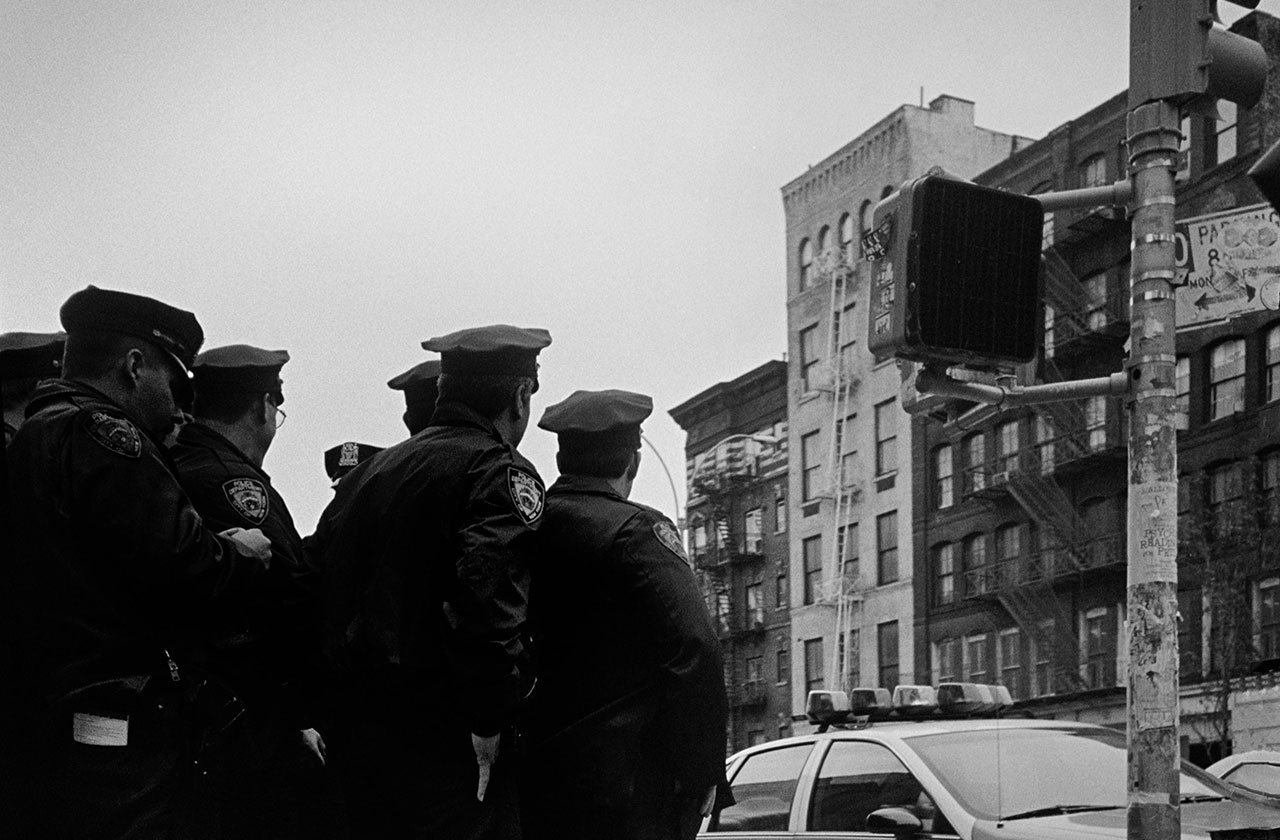
Systemic Racism and the Prison-Industrial Complex in the 'Land of the Free'

[Image by Keith Negley via NY Times]

By Holly Barrow

Following the tragic murder of George Floyd at the hands of Minneapolis police officer Derek Chauvin on 25th May, the world has erupted into protest to demand an end to the vicious racism which continues to infiltrate society. At the forefront of this crucial public discourse on race lies the criminal justice system as it has disproportionately targeted and traumatized BIPOC (Black, Indigenous and people of color) communities for decades.

Systemic racism and inequality is intrinsic to law enforcement in the US, with mass incarceration riddled with racial disparities. From the thirteenth amendment loophole to the War on Drugs, Black communities have suffered exponentially under this facade of ‘justice’, with families torn apart as a result. The War on Drugs is in fact one of the plainest and most brazen examples of heavily racialized laws borne out of a desire to incriminate Black communities. When looking at initial federal sentences for crack cocaine offenses, such inequalities within law enforcement become strikingly clear: conviction for crack selling - more heavily sold and used by people of color — resulted in a sentence 100 times more severe than selling the same amount of powder cocaine — more heavily sold and used by white people.

This is no coincidence and just one example of a system patently stacked against low-income, Black communities. We need only look at some key statistics to recognize how deeply this goes: African Americans are more likely than white Americans to be arrested, are more likely to be convicted and are more likely to experience lengthy prison sentences. Beyond this, African American adults are 5.9 times as likely to be incarcerated as white adults.

In light of such disproportionate arrest and convictions of Black people in the US, dismantling the current prison system - particularly the prison-industrial complex - is key in the fight against racism. The prison-industrial complex describes the overlapping interests of government and industry; essentially, it refers to the corruption at the heart of the criminal justice system in the use of prisons as a mechanism for profit.

This is a system that abolitionists and activists have been attempting to eradicate for decades as it has become increasingly clear over the years that there is a very real and dangerous incentive to incarcerate human beings. With the rise of for-profit prison systems has come further exploitation of predominantly African-American men and other ethnic minorities. With regards to class, this system additionally hurts low-income citizens at a significantly higher rate, with many recognizing the harrowing reality that, in the US, poverty is often treated as a crime.

Poor and minority defendants are typically unable to access the same level of protection and defense as their wealthier counterparts. Similarly, the state recognizes the likelihood of their inability to afford bail, with over 10 million Americans in prison as they await trial on low-level misdemeanors or violations simply because they cannot afford the bail set for them. This keeps prisons filled; a key proponent of the prison-industrial complex.

With police officers incentivized to make arrests as they are aware that police departments will not be funded adequately if there is no motive to do so, and billion-dollar corporations having stakes in the private prison system - from technology such as tagging to hospitality for inmates - incarceration has become a means to generate wealth and boost local economies. This comes at the expense of the most marginalized groups, namely poor people of color.

Regrettably, this line between ‘justice’, ‘protection’ and corporate interest is becoming comparably distorted across immigration removal centers. And again, it is BIPOC who largely fall victim to this. Detention, surveillance and border wall construction have all become big business, with approximately two-thirds of all detainees being held in for-profit facilities. Tech companies have thrived off of tracking migrants, with software company Palantir holding a $38 million contract with ICE (Immigration and Customs Enforcement).

To provide further insight into just how money-oriented the detention of predominantly vulnerable individuals - such as asylum seekers - has become, we can observe the distressing rise in shares in the largest prison company in the world. Shares in CoreCivic — which runs both private prison facilities and detention centers — spiralled by 40% when Trump was elected as president. This came following his promises to deport thousands and demonstrates a clear recognition that this would see private, for-profit immigration detention facilities boom.

To deny the concerning correlation between incarceration - both within prisons and detention facilities - and investment suggests willful ignorance. The treatment of prisons and detention facilities as money-making machines is of detriment to democracy and makes a mockery of those who hail America as the ‘land of the free.’

In fighting systemic racism, we cannot neglect to tackle the prison-industrial complex. Its roots and very mechanisms are rooted in the oppression of the most marginalized.

Holly Barrow is a political correspondent for the Immigration Advice Service; an organization of immigration lawyers based in the UK and the US

Capitalism, Fascism, and the Tactics of Terror

 (Courthouse News Service photo/Karina Brown)

By Kenn Orphan

“There are decades where nothing happens, and there are weeks where decades happen.” – Vladimir Lenin

Between 1973 and 1990 scores of people were disappeared by the US supported fascist regime of Augusto Pinochet in Chile. They were incarcerated, tortured and thousands were murdered. In fact, the official total of those killed by the regime is just over 40,000. But some critics suggest it was much higher. Pinochet was able to do all of this with the blessing of the CIA who assisted him in the coup against the elected President, Salvador Allende, and in his reign of terror afterward in Chile. The painful lessons of the Pinochet years have often been obscured under neoliberal historical revisionism, but with what is currently unfolding in cities like Portland, Oregon, it is urgent to revisit them.

When Donald Trump’s federal agents rolled into Portland last week, they began to employ classic police state tactics of intimidation. Tear gas was employed, “non-lethal” munitions, and the psychological terror of unmarked vans snatching protesters, and even those simply standing by, off the streets without arrest warrants and whisked off to undisclosed locations. The use of forced disappearance should not be underestimated because it is, perhaps, the most effective tactic at crushing dissent and eliminating political rivals.

Under the fist of General Pinochet, the state became a ruthless force of terror. In September of 1973, at least 10,000 people, many of them students, activists and political dissidents, were rounded up by the military shortly after he took the office of the presidency by a US supported and orchestrated coup.They were taken to the National Soccer Stadium in Santiago where they were subjected to torture or were massacred outright. Thousands of bodies were buried in mass graves. Thousands were never recovered as they were discarded in rivers and even in the Pacific Ocean. Even today, families await justice and the chance to bury their loved ones.

Forced disappearances are a crime against humanity according to the Rome Statute of the International Criminal Court. And there is no statute of limitations on this crime. But, as we have seen over the past few decades, the US government and military cares little for the international rule of law. Indeed, it has enjoyed impunity for its atrocities while those who violate these statutes in the Global South are often brought to trial and punished severely. The US invasion of Iraq, along with the occupation and atrocities are clear examples of this. And under Trump, the American Empire has divorced itself even more from international bodies that seek at least some regulation of state excesses or the management of crises. His withdrawal from the Paris Agreement on climate change and his recent withdrawal from the World Health Organization during a global pandemic point to a brazen disinterest in engaging with the international community.

Pinochet’s Chile was not alone in its use of forced disappearances. During the Dirty War in Argentina at least 30,000 people were disappeared and murdered by the US backed, rightwing military junta. In fact, under the US implemented and CIA backed and assisted “Operation Condor,” which targeted leftist or socialist political activists, student organizers, and academicians, the entire South American continent became a killing field from the 1970s well into the 1980s. Unsurprisingly, the genocidaire Henry Kissinger was deeply involved in these atrocities in much the same way as he was in Southeast Asia and on the African continent. And he assisted in marrying federal agencies, surveillance and state police, and paramilitary mercenaries and death squads to one another in order to carry out the crimes successfully.

It is not hyperbolic for there to be great alarm over Trump’s use of forced disappearances. Although there have been no deaths because of it, his flouting of the rule of law and use of this tactic of terror is not an accident. And the people under him have proven time and time again that they are ever willing to carry out his orders. As the election looms in November, we should not underestimate the timing of this either. Across the nation protests have arisen to confront the long legacy and continuing ruthlessness of racist, police state violence. The rage has been simmering for a long time, and the murder of George Floyd ignited and galvanized millions to take a stand. To Trump, who is one of the most overtly racist presidents to have taken office since Woodrow Wilson or Teddy Roosevelt, this represents the greatest threat to his legitimacy.

The US is now leading the world in cases of Covid-19 with over 140,000 deaths. Indeed, the pandemic is currently wreaking havoc on an American healthcare system which was already suffering from disorganization and beholden to the whims and will of merciless capitalist predation. When Trump came in, he literally threw out the handbook on how to deal with global pandemics, so the ongoing protests to police brutality provide him a perfect distraction from his colossal blundering and incompetence.

And of course, there are other ingredients to this recipe for disaster. Trump faces a weak candidate in Joe Biden, who cannot seem to form a coherent opposition to his blatant fascist impulses. If there is no meaningful alternative that represents real change in ordinary people’s lives then, like it or not, the people will not bother to vote. There is also the precarious economic situation, the elephant in the room that few wish to acknowledge. With millions unemployed and facing eviction or foreclosure, the elements of fascism may be coalesced even further. God help us if a climate change fueled catastrophe comes this summer or in the fall, because it will be the perfect storm for him to pull whatever levers necessary for him to quell dissent and remain in power. He has such mechanisms at his disposal thanks to the Patriot Act and the NDAA. He can detain any US citizen indefinitely by merely labelling them a terrorist, thanks to legislation designed and endorsed by George W. Bush and Barack Obama. And he has already begun branding anyone who opposes his tyranny, like Antifa and Black Lives Matter, with that spurious charge.

The uprisings taking place across the US are the stirrings of a global mass movement that shows great promise. That they are taking place in the most wealthy and powerful empire on the planet is an indication that this empire itself is beginning to unravel under the weight of its hubris and a long legacy of cruelty, racism and brutality. But no one should underestimate the tremendous pain a wounded giant can inflict as it falls. Its violence is unoriginal, but it will use the only tactics it knows. And we should remember that it is quite familiar with atrocities because it has visited them frequently on the Global South for decades. Portland is a portent. And, as Lenin inferred in the quote above, things can happen rapidly and in a short span of time. We would be wise to heed these urgent lessons before it is too late.

The Case Against the Fourth of July

By Ryan Wentz

In 1992, indigenous leaders succeeded in pressuring Berkeley, California to drop the Columbus Day holiday and replace it with Indigenous Peoples Day. Since then, hundreds of U.S. cities and a handful of U.S. states have followed suit. This shift is merely symbolic, but it does reflect a change in how the general public understands American history. Today, in 2020, a national uprising against anti-Black state violence has pushed the discourse into uncharted territory: all around the country, protesters are tearing down statues of notorious racists, from Christopher Columbus to Thomas Jefferson. This reckoning is long overdue; American exceptionalism, militarism, and patriotism must be challenged. Displays and celebrations of oppressive structures like settler colonialism and white supremacy must be put to rest. This year and each of the next, don’t celebrate the Fourth of July.

As it was in 1776, the U.S. today is a genocidal, anti-indigenous, and anti-Black settler colony;  the country’s anti-indigenous, anti-Black past has transformed into an anti-indigenous, anti-Black present. The U.S. government’s response to the ongoing coronavirus pandemic and national uprising against racist police violence illuminates how little it values indigenous and Black lives. For indigenous communities, coronavirus has been especially devastating. Navajo Nation has recorded more cases per-capita than any U.S. state, and had to sue the federal government to receive the funding that it was promised. Meanwhile, police forces across the country continue to terrorize Black communities. That this global pandemic has not been able to slow down state terror against Black people speaks volumes. In fact, authorities have cracked down harder; police murdered Breonna Taylor and George Floyd, among others, during this global pandemic. Additionally, it is stunning to compare how authorities have responded to protests for justice for Black people with protests demanding the U.S. reopen its economy. 

Considering that the Fourth of July is a celebration of the U.S. and its so-called “independence,” perhaps it’s important to relitigate why the so-called “Founding Fathers” fought the British. In his 2014 book, “The Counter-Revolution of 1776: Slave Resistance and the Origins of the United States of America,” Dr. Gerald Horne asserts that the revolution was in fact a counterrevolution to preserve slavery. At the time, the British empire was inching closer to abolishing slavery, which scared American capitalists who relied on slave labor to accumulate massive fortunes. Thus, the following question must be asked: what is the Fourth of July actually celebrating, if not the creation of an inherently violent settler colony built on stolen land by stolen labor? 

These are the types of difficult questions that we must ask ourselves as we seriously interrogate U.S. history. It may be unpleasant, or even earth-shattering, to reconsider the narrative that we have been told about the U.S. But that is precisely what needs to happen; the public must grapple with the lies that it has been told to justify and uphold white supremacy, settler colonialism, imperialism, and capitalism. 

Every year on July 4th, it is nearly impossible to escape the flag-waving and fireworks. We can, however, reject everything that the holiday stands for and make the choice not to celebrate it. The U.S. government is currently terrorizing entire indigenous and Black communities both inside and outside of its colonial borders; we cannot go on ignoring these crimes.

In Bolivia, for example, last year’s U.S.-backed military coup forced Evo Morales, the first indigenous leader in a country with an indigenous majority, into exile. The coup regime and its supporters are explicitly racist towards Bolivia’s indigenous communities; in 2013, Jeanine Áñez, the unelected leader who has ruled the country since November, tweeted that “I dream of a Bolivia free of satanic indigenous rites.” Additionally, after the coup, its supporters declared: “Bolivia is for Christ.” Many burned Wiphala flags, a symbol of Bolivia’s indigenous majority. In the following weeks, the military massacred at least 18 indigenous protesters in Sacaba and Senkata. Protests against the unelected government continue to this day.

In addition, U.S. support for the Israeli occupation and colonization of Palestine illuminates how central anti-indigenous racism is to U.S. policy. In 1923, Vladimir Jabotinsky, an influential Zionist leader, wrote: “Zionist colonization must either be terminated or carried out against the wishes of the native population.” Today, as Israel moves closer to the annexation of the occupied West Bank, Zionist leaders share the same understanding. The U.S., meanwhile, enables Israel to colonize Palestine “against the wishes of the native population” by providing its military with $3.8 billion per year, approximately $10 million per day, to continue ethnically cleansing Palestine and entrenching the illegal occupation. 

Just as it has propped up anti-indigenous movements around the world, the U.S. has supported explicitly anti-Black regimes, like in Apartheid South Africa. In November 1973, the U.N. General Assembly adopted the International Convention on the Suppression and Punishment of the Crime of Apartheid (ICSPCA). The U.S., however, neither signed nor ratified the convention. Over one decade later, in 1984, Archbishop Desmond Tutu, one of the leaders of the anti-apartheid movement, declared that “apartheid is an evil as immoral and unchristian in my view as Nazism, and in my view the Reagan administration's support in collaboration with it is equally immoral, evil, and totally unchristian, without remainder.” The U.S., along with its Western allies, was one of the last states to officially cut ties with the apartheid regime in South Africa.

In the twenty-first century, the U.S.’s assault on Black lives on the African continent has continued. The U.S. has been meddling in Somalia for over three decades, and continues to drone bomb the country with impunity. Meanwhile, the U.S., with the support of N.A.T.O. and Western-backed rebels, overthrew Libyan leader Muammar Gaddafi in 2011. By 2011, Libya was atop the African continent in Human Development Index; nearly 85% of Libyans were literate, while the average life expectancy hovered around 75. Yet because Gaddafi refused to completely submit to Western imperialists, he was deemed a threat that needed to be taken out. Today, Libya is a collapsed state where Black people are being sold in open-air slave markets.

The U.S.’s horrific treatment of indigenous and Black communities abroad is a reflection of the crimes it has committed against both communities at home. It is essential that we understand that anti-indigenous and anti-Black racism is foundational to the existence of the U.S.; without them, there would be no U.S. empire. Thus, celebrating the U.S. is celebrating anti-indigenous and anti-Black racism. It is celebrating settler colonialism, ethnic cleansing, slavery, genocide, and imperialism. Ultimately, what Christopher Columbus represents is no different from what the U.S. represents.

Ryan Wentz (any pronouns) is a Los Angeles-based field organizer for Beyond the Bomb, a grassroots organization committed to preventing nuclear war. Ryan has experience in the anti-war and Palestine solidarity movements, and has in the past worked at the American Friends Service Committee and CODEPINK. 

Yes, the U.S. Response to COVID-19 is a Genocide

[PHOTO CREDIT: Aaron Ontiveroz/MediaNews Group/The Denver Post via Getty Image]

By Alex Harley

Republished from Emphasis Added.

A Yale epidemiologist was castigated for equating the virus to a genocide in a series of tweets. Why? The answer lies in a foundational understanding of white supremacist capitalism: death for profit isn’t murder.

gonsalvestweet.png

As hundreds of thousands, if not millions, of people living in the U.S. protest racist police violence in all fifty states, another act of racist violence is being perpetrated through governmental policy and business practice: The COVID-19 Genocide.

While scientists agree that the virus itself was a natural, and not lab-created phenomenon, its handling in the US is an unequivocal disaster. As of June 29, 2020, the crises is forty-two times the size of 9/11 casualties: 128,000 deaths. So where are the calls for accountability and justice?

It is not despicable to characterize the U.S. response to COVID-19 a genocide. It is imperative. It is an assertion that clarifies U.S. behavior. Unfortunately, MacLeod’s hesitance to call it genocide is no outlier. It is the default reaction from defenders of the status quo.

One British legal authority agrees that the case for genocide is weak, citing “specific intent” (Heieck, 2020).

But it is no insult to victims of state and vigilante violence to call it genocide. It is the acknowledgement of historical record.

The capitalist ideological foundations of the U.S., and all modern states built on settler-colonialism, do not frame death through exploitation as a crime. It’s the price of doing business. They’ve been in excess of deadly business for over four centuries now, and it hasn’t stopped.

When one individual inflicts bodily injury upon another such that death results, we call the deed manslaughter; when the assailant knew in advance that the injury would be fatal, we call his deed murder.

But when society places hundreds of proletarians in such a position that they inevitably meet a too early and an unnatural death, one which is quite as much a death by violence as that by the sword or bullet; when it deprives thousands of the necessaries of life, places them under conditions in which they cannot live — forces them, through the strong arm of the law, to remain in such conditions until that death ensues which is the inevitable consequence — knows that these thousands of victims must perish, and yet permits these conditions to remain, its deed is murder just as surely as the deed of the single individual; disguised, malicious murder, murder against which none can defend himself, which does not seem what it is, because no man sees the murderer, because the death of the victim seems a natural one, since the offence is more one of omission than of commission. But murder it remains.

- Fredrich Engels, The Condition of the Working-Class in England

The (predominantly white) federal government and the (predominantly white) business elites are both guilty of sacrificing working people to profit from and during the COVID-19 crisis. Their (predominantly white) adherents, with their anti-lockdown demos, anti-mask violence, victim blaming, hoax conspiracy theories, and scapegoating of China, are equally culpable.

The rulers of the U.S. do not recognize their own extant record of mass murder: not in illegal military operations; not at the hands of police; not in the workplace; not in the streets. The nation socializes its citizens to normalize systemic murder, successfully. It is a critical piece of settler-colonial ideology. Deception is another key piece.

From “Heroes” to Fodder

Early on in the crisis, front-line workers were heralded for their bravery. They were called “heroes”. But in reality, the fanfare was a just nice way to say “Get back to work!” And this, of course, was reserved for those who weren’t laid off.

Corporations were quick to slash their rosters as soon as the crisis reared its head. The Federal Government acted just as quickly to “bolster the economy” by pouring trillions directly into corporate pockets. Corporations, and especially their rich executives, made out handily.

Between March 18 and April 10, 2020, over 22 million people lost their jobs as the unemployment rate surged toward 15 percent. Over the same three weeks, U.S. billionaire wealth increased by $282 billion, an almost 10 percent gain. (Institute for Policy Studies, 2020)

To secure the fortunes of the wealthy, businesses must stay open, with severely reduced staff (and overhead!). Retail and service employees must relent to exposing themselves to infection by interacting with large, diverse segments of the population. They must take on new duties, including enforcing social distancing measures, which exposes them to violent reaction. Doctors and nurses must work without enough equipment, beds, or sometimes even space. And all the while, protests against police violence must be brutally repressed with the billy club, rubber bullet, sound cannon, and tear gas canister. In some cases, the police have directly targeted children and the elderly. And, the police continue to murder civilians.

The connection between racist policing and racist capitalism must be highlighted. They are thoroughly enmeshed.

COVID-19 in Racial and Ethnic Minority Groups, CDC

COVID-19 in Racial and Ethnic Minority Groups, CDC

Nationally, hospitalizations show a rate 15 times higher for oppressed nation’s peoples as opposed to whites. The statistics of death rates among them are equally disparate (Ford, 2020).

Race gaps in COVID-19 deaths are even bigger than they appear. Brookings.

Race gaps in COVID-19 deaths are even bigger than they appear. Brookings.

Reservations have been some of the hardest hit areas in the nation. But instead of aid, the federal government sent body bags to the Seattle Indian Health Board (Grande, 2020).

What is this brazen attitude, if not dripping with intent? The intent is to make money, whatever sacrifice working and oppressed people must make.

How do you characterize a nation which denies its people access to a functional, modern health system by means of predatory business practices and fiscal austerity? And when centuries of racist capitalist underdevelopment magnify the crisis within the oppressed and working class communities of the US?

This is not by accident, but design. Uneven capitalist development and sheer disregard for human life have proven “profitable” time and time again; and, will continue to do so. Theft and murder are profitable. But who are the murderers? Can we see them clearly?

Responsible Parties

The virus is not the main agent; willful, deliberate neglect is; the result of governmental policies and business operations which have identifiable delegates. There are responsible parties. We must not lose sight of that.

Working solutions were and are available to solve this crisis. This is illustrated by the disparity in how effective certain responses have shown to be across the globe. Nations who took the crisis seriously have fared demonstrably better than the US. They mustered human and material capital to create solutions, during the time they bought through strict containment policies.

Instead, the U.S. flouted scientific consensus and advice from other nations. The U.S. eventually locked down, but did nothing substantial with the time bought. All of the states which re-opened under business and right-wing popular pressure have all surged again (Hawkins, 2020). The infection curve should look like a bell by now; instead, it looks like an insurmountable mountain. And until a vaccine is found, it will continue to do so, if the U.S. ruling class continues its regime of denial.

They withheld vital aid through confiscation of protective equipment and economic sanction. They continued high-tech military operations during a global viral outbreak. In May, the U.S blocked a vote in the UN for a global ceasefire (Borger, 2020). The rulers of the U.S. do not seek peace, but war. War with the world’s oppressed people, domestically and abroad. War for profit.

At every turn, American bourgeoisie will try to make money, no matter how insidious it may seem. As reported by Qiao Collective, US corporation Gilead’s vaccine is slated to cost the American public “$3,120 per [patient] with private insurance.” If China finds a vaccine, they will make it a “global public good” (Qiao Collective, Twitter).

While the ruling class can largely isolate themselves in their lavish homes, padded from infection by layers of workers, the crisis outside is just a complication. The deaths of workers are simply inconvenient, when there is a surplus of unemployed laborers from which to draw. Our deaths truly mean nothing to them. If a guardian‘s charge dies by neglect, it is considered murder. What about when a nation allows its subjects to die?

We should consider it murder.

Taken independently, the historical abuses perpetuated by the leaders and ruling class of the United States are reprehensible. When viewed as a singular phenomenon, they amount to genocide. COVID-19 is just another blood-soaked chapter in the American project of unlimited exploitation.