



Marxist Studies

Reclaiming Hope in a Neoliberal Age

[Photo credit: Joe Brusky]

By Yanis Iqbal

In the second declaration of Havana - delivered on February 4, 1962 - Fidel Castro said, “It is the duty of every revolutionary to make the revolution.” Piercingly clear and searingly sharp - this statement demystifies our coldly scholastic and meek attitude toward socialism. In a world where leftists submissively mold themselves to the contingencies of history, Castro invites us to collectively dare for a firmly definite objective: overthrowing the bourgeoisie state. Such lucidity and precision - apart from organically integrating the ultimate goal of socialism into the planning of concrete action - foregrounds the little explored territory of hope - hope that love and solidarity will survive in the face of barefaced barbarism; hope that the masses will indignantly demand what is theirs; hope that the spirit of revolution will seep through the cracks of hunger and poverty.

Hope

The globalization of capital, the move toward post-Fordist economic arrangements of flexible specialization, and the consolidation of hyper-individualized culture has resulted in a shift from a politics of hope to one of despair. The drastic weakening of the Left has heralded a new age of defeatist literature, absolutely incapable of battling with shifting conjunctural equations. In sum, a historically informed understanding of capitalism and the immense power possessed by the wretched of the earth has given way to theoretical abstractions devoid of any sense of class struggle. What is urgently needed, therefore, is a re-affirmation of the potentialities for liberation and the crystallization of hope as an important element in the entire panorama of endless efforts.

In his book Pedagogy of Freedom, the great Brazilian educator Paulo Freire noted, “our being in the world is far more than just “being.” It is a “presence”…that can reflect upon itself, that knows itself as presence, that can intervene, can transform, can speak of what it does, but that can also take stock of, compare, evaluate, give value to, decide, break with, and dream.” Insofar that we constitute a living “presence”, we are capable of understanding structural conditionedness in depth, in its essence, detaching it from its contingent factuality, from its sheer concrete “being there”.

As human beings, we are conditioned by social relations, not determined by them; the past influences us and our actions, but does not determine those actions or what the future will bring. As soon as we grasp this fact and emerge out of our submersion in reality, we start to treat obstacles as problems rather than as givens and thus, gain the ability to act to change them as well as reflect on the consequences of that action. When we reclaim human agency, our day-to-day interaction with the existential universe acquires an element of hope: since the future is open-ended rather than closed, what we want to create always exists as a true possibility within the womb of our present society. The tomorrow which we want to see has yet to be fashioned by the transformation of today, the present reality. It is something not yet here but a potential, something beyond the barriers we face now, which must be created by us beyond the limits we discover.

Hope acts as the bond between the utopia we desire and the obscenely harsh reality we live in. It is a response to an existential reality that pushes a person forward in anger, indignation and just rage, forcing him/her to negate the ugliness of everyday life. Without hope, there is no possibility for resistance, dissent, and dialogue. It is the prerequisite for all forms of critical agency which aim to radically reconstitute our society. Hope expands the space of the possible, and becomes a way of recognizing and naming the incomplete nature of the present while providing the foundation for informed action. While despair is passive - we are the objects, closed in on by time in a way that we see as inevitable, hope is active - we exercise agency, piercing through time by seeing the alternatives, the possibilities available to us in moving beyond a particular obstruction.  

In Pedagogy of Hope, Freire says, “We need critical hope the way a fish needs unpolluted water… After all, without hope there is little we can do. It will be hard to struggle on, and when we fight as hopeless or despairing persons, our struggle will be suicidal. We shall be beside ourselves, drop our weapons, and throw ourselves into sheer hand-to-hand, purely vindictive, combat.”

Hope can never be divorced from practice and action. It is effective only when undergirded by struggle. Freire writes: “Hope, as an ontological need, demands an anchoring in practice. As an ontological need, hope needs practice in order to become historical concreteness. That is why there is no hope in sheer hopefulness. The hoped-for is not attained by dint of raw hoping. Just to hope is to hope in vain.” Thus, hope, rigorous and intellectual, requires struggle and action. It is not naïve optimism; it is critical and reflective action.

Hope must be concrete, a spark that not only reaches out beyond the surrounding emptiness of capitalist relations, anticipating a better world in the future, but a spark that also speaks to us in the world we live in by presenting tasks based on the challenges of the present time. In The Utopian Function of Art and Literature, the German philosopher Ernst Bloch argues that hope cannot be removed from the world. Hope is not “something like nonsense or absolute fancy; rather it is not yet in the sense of a possibility; that it could be there if we could only do something for it.”

The inseparability of hope from concrete struggle necessitates that it always be social in nature, rather than individual. Hope is not about individual aims, desires, or ambitions; it is beyond simply dreaming of a better day and into consciously thinking about how to work toward a collective vision. Hoping is not tied to having hope-for something, a state of mind that is closer to desire. Hope is concerned with a collective act of hope-in something, rather than with an individual future. It must be capable of producing people willing and able to expand and deepen their sense of themselves, to think of their socio-economic environment critically, to imagine something beyond their own self interest and well-being, to serve the public good, and struggle for an egalitarian future.

Utopia

Without hope, humans would despair in the face of their unfinishedness and would become immobilized. It is hope that helps in leading the incessant pursuit of the oppressed towards humanization. It is hope, in other words, that drives us ever onwards as travelers, wayfarers, seekers, in pursuit of completeness. In this pursuit of completeness, in this hope-driven search for fully realized humanity, education is extremely important. For Bloch, hope left to itself is undisciplined and “easily led astray”, taking the form of wishful, magical “meaningless hope” or, when manipulated by the bourgeoisie, a domesticated, privatized and “fraudulent hope”.

Hope may also manifest itself as passive patience while on the other it may take the form of an unfocused rebelliousness. Since such impatient hope is at risk of turning into defeatism, it needs to be bolstered by careful attention to and analysis of material data. A reckless false hope, an over-zealous hope fails to consider counter-acting forces and ends up in a welter of immobilizing frustration.

Education is, therefore, required in order to provide “contact with the real forward tendency into what is better”. By means of utopian images, hope can be educated, taught, “trained unerringly, usefully, on what is right”. Freire, too, argued that undisciplined, naïve, spontaneous hope needed education in order to connect it tightly to the project of humanization - to sharpen, clarify and illuminate its objective. The need for utopian, humanizing education is rendered all the more important because of the continual operation of dehumanizing forces. As the dominators “have nothing to announce but the preservation of the status quo”, they invariably try to cage the future and make of it “a repetition of the present”. In this context, “the struggle for the restoration of utopia [is] all the more necessary. Educational practice itself, as an experience in humanization, must be impregnated with this ideal”.

In The Politics of Education, Freire outlined what such a utopia can look like: “Revolutionary utopia tends to be dynamic rather than static; tends to life rather than death; to the future as a challenge to man's creativity rather than as a repetition of the present; to love as liberation of subjects rather than as pathological possessiveness; to the emotion of life rather than as cold abstractions; to living together in harmony rather than mere gregariousness; to dialogue rather than silence; to praxis rather than ‘law and order’; to men who organize themselves reflectively for action rather than men who are organized for passivity; to creative and communicative language rather than empty verbosity; to reflective challenges rather than enslaving slogans; and values which can be lived rather than to myths which are imposed.”

Informed by utopia, the language of hope becomes a medium of struggle of those who refuse to lose their grip on reality. This is the language of sound and sober hope, an educated hope grounded in a careful study of material conditions. Educated hope demands that the fact in which it believes be abandoned the moment concrete experience is against it. This method requires continual alertness to indicators that call hope into question and entail a change in praxis.

Faith in Class Struggle

In his book Beyond US Hegemony: Assessing the Prospects for a Multipolar World, Samir Amin states: “There are no ‘laws of capitalist expansion’ that assert themselves as a quasi-supernatural force. There is no historical determinism prior to history itself. Tendencies inherent in the logic of capital encounter the resistance of forces that do not accept its effects. Real history is therefore the outcome of this conflict between the logic of capitalist expansion and other logics stemming from the resistance of social forces that suffer the effects of such expansion.”

As is evident from the quotation, capitalism is not an essentially closed and immutable phase of history, standing above the vagaries of class struggle. Rather, it is a hegemonic arena of constant push-and-pull, open to the possibility of hope. When that hope is recognized by socialists, there emerges a “weak teleological force of open possibilities” - the belief that the collective struggle of the masses will steer the undecidedness of the world process toward a better future. Today, we need to reclaim hope so that we can navigate through the indeterminacy of history and prepare the working class for a revolutionary upheaval.

Yanis Iqbal is an independent researcher and freelance writer based in Aligarh, India and can be contacted at yanisiqbal@gmail.com

From Neoliberalism to Nowhere

By Thomas McLamb


From 1932-1945, FDR responded to the Great Depression by way of the New Deal to temporarily put a bandage on the crises of capital. This creation of the American Welfare State served as the response to the occasional short-term downturns of capitalist expansion. From FDR’s term until the Oil Crisis in the early 70s, the United States capitalist system enjoyed a period of steady growth and a stable rate of profit, whose occasional declines were solved by way of a variety of government programs that sent one clear message; the government existed to serve the people.

When Nixon took office, the processes of persistent economic inflation became apparent, indicating that this long period of economic expansion and stability was changing. That said, Marxist analyses of economic patterns of expansion, contraction, and long-term growth should stray away from the use of inflation as an economic pattern. Inflation is merely the process by which bourgeois economists summarize the degeneration of working-class buying power and strengthening of capitalist class buying power. In one short phrase – the dollar is fundamentally worth less to the worker than it is to the capitalist. While the capitalist is able to purchase more money with less, an exponential process depending on how much capital has been accumulated, the worker is dependent on purchasing essential life commodities, healthcare, food, housing, etc. with their dollar; the worker does not enjoy the luxury of purchasing more money with less, a process that inevitably leads to the phenomenon neoclassical economists refer to as inflation. Regardless of the actual relationship of inflation and the working-class, the aforementioned cycle of profits and growth from the post-war periods came to an end with the ’73-75 recession. The long wave of capitalist expansion had begun to wane, signaling the forthcoming period of long-term stagnation of working-class wages still underway today.

The end of the doctrine of the Welfare State led directly into a new doctrine of economic policy. The dominant economists of the period suggested that government welfare was wasteful and inefficient, that the occasional patterns of economic recession could be solved by allowing the markets to regulate themselves. The general assumption of these economists, i.e. Friedman et. al., was that government welfare resulted in an exponential process of inflation that could be remedied by a revival of liberal economics. This renascent adoration of laissez-faire capitalism came to serve as the genesis and framework of neoliberalism – the doctrine of cutting government expenses by any means necessary. Following the birth of neoliberalism, austerity quickly set in. The government responded to crises by allowing the bottom to hit the bottom, and externalizing and outsourcing previously domestic forms of labor that had now suffered from a declining rate of profit.

Alongside the externalization and outsourcing of labor from the United States, a process that signaled the shift of the U.S. to a strictly service and information economy, came a renascent nationalism and patriotism within the United States. This renascent nationalism served as the popular justification for the endless oil wars in the middle east, the incessant and undemocratic CIA-backed military coups in Latin America, and the continuous starving acts of tariffs and embargoes against foreign governments who refused to kneel to the imperialist war cry of neoliberalism. In industries where the rate of profit waned in the United States, the government merely cut popular welfare programs to fund the imperialist war machine to appropriate resources, governments, and economies of foreign governments, continuing the accumulation of capital and comfortable seat of influence of America.

Away from the wars, coups, and starvation acts outside of American borders, American workers waded through an ever-changing industry of employment in the United States. The neoliberal response to the discovery of ‘inflation,’ better understood as another symptom of the declining rate of profit, resulted in the same outcome the neoliberal economists and politicians believed they would be avoiding – a period of long-term stagnation of working-class wages and the devaluation of the buying-power of the working-class by large-scale privatization and imperialist efforts to sustain the total economic growth of the U.S. economy. Of course, these solutions worked to create more wealth than ever and higher profitability that ever before in the United States, but the measure of the total economy and its exponential growth ignores the continuous struggle of the non-propertied class. Marx’s theories of surplus value provide us with the truth that all profit is derived solely from labor. With that understood, wherever labor costs can be reduced, they will be, and profits will increase. Additionally, the buying-power of those wages themselves have been structurally diminished long-term by the neoliberal doctrine. This process of the stagnation of working-class buying power can be observed in the history of wages since the beginning of the neoliberal period. Real per capita wealth in the U.S. has more than doubled since 1964 while average real wages have barely increased. From 1964 to 2018, the buying power of the average worker in the United States increased by only 11.7% while the actual average wages themselves have increased by 806%. This mass rate of inflation is not an aberration of capitalist market economies – it is precisely a function of the long and short waves of capitalist development; all of which is accelerated and exaggerated by neoliberal austerity.

Over the past 50 years, over 90% of all growth in income has gone directly to the top 5% of households in the United States. Just short of 3% of total economic growth went to the bottom 20% of households, while more than half went to the wealthiest 20%. Wealth inequality from the late sixties throughout the development of the neoliberal period can be described in one sentence – the rich got richer and the poor get poorer.

mclamb1.jpg

The bottom 95% of families have experienced within themselves disproportionate rates of economic growth relative to productivity. While workers are producing more than ever for their bosses, hikes in productivity in the neoliberal period haven’t resulted in higher wages at all. Drew DeSilver has pointed out in his work through the Pew Research Center that while productivity amongst workers has increased by 80% over the past 30 years, the data will show that the buying power of the wages those workers earned has moved up barely a percent and a half.  Despite this near doubling in productivity, neoliberal austerity and market purism have made more money than ever for those at the top, and stolen more than ever from those at the bottom. The general tendency of money to move upwards on the capitalist market has resulted in exponential gains for the ultra-rich, which as mentioned before, creates an exponential increase in the buying-power of the rich and a stagnating or decreasing buying-power of the poor.

Alongside the hikes in productivity and slow growth of wages, nearly 80:1 from 1987-2017, there has been a drastic shift in employment by major industry sector amongst the total workforce. From 1948-1975, the total employees in the United States increased by 65.67%, around 2.43% annually. From 1975-2017, total employees increased by 79.23%, or 1.89% annually. Even though productivity and total wealth increased exponentially over the neoliberal period, employment decreased in growth year after year.

mclamb2.jpg

Amongst the general change in total employment, specific industries saw drastic changes during the neoliberal period compared to the period of government intervention policy stemming from the FDR era. Manufacturing jobs have disappeared in mass numbers since the beginning of the neoliberal era. Manufacturing has been pushed abroad to keep up with the ‘cutting costs’ doctrine of neoliberalism, while more workers than ever are forced into low-paying service and information jobs, since these are the only jobs that exist anymore. Retail positions have increased proportionally with total employment, but many of these positions are occupied by formerly well-employed manufacturing jobs. The shift in employment by major industry sector can be observed as a primary vehicle for the slow-growth of working-class buying power, as well as an expression of ever-disappearing manufacturing jobs.

In terms of buying power of the working-class, the numbers represent a similar transformation of shares of economic expansion, though the buying-power can illuminate a more concrete examination that accounts for the bourgeois notion of inflation and market behaviors.

mclamb3.jpg

From 1967 to 2017, the buying power of the lowest 80% of families grew at a similar rate to the actual dollar amount in the previous data set. From a sliding scale of the least to most wealthy in terms of economic expansion, the buying-power of the poor increased by around half compared to their dollar-amount wages while the buying-power of the wealthiest percentile classes increased by around 2.1 times. Though these numbers from the census do adjust buying power to examine the market behaviors and adjust the wages to paint a more accurate picture using consumer price indexes, these numbers are not adjusted to account for factors that only affect growth amongst the ultra-rich, i.e., debt, investments, property, etc. Furthermore, the tendency of capital upwards results in exponential increases in the buying-power of those at the top, but commodities can only grow so expensive before those at the bottom can no longer pay for them, thus the tendency of the rate of profit to fall despite exponential levels of expansion for the most-high spheres of capital.

Of course, the most wealth 5% of households in the United States have enjoyed economic expansion that dwarfs that of those at the bottom, a near 60-40 split. This is largely due to the existing ownership of the means of production and investment spheres by the ultra-rich maintaining their positions through one of the largest hikes in productivity in the history of capital itself.  The bureau of labor statistics provides us with a catalogued measure of productivity increases by major industry sector, though some catalogs only go back as far as 1987. Despite this, the numbers are still useful to examine the production and profitability levels of economic industry relative to real wage increases.

mclamb4.jpg

There are data series on productivity in the manufacturing sector using the same measuring scale as the data set above, though the historical series only date back to 1987, presenting several problems, but the data itself is still very useful. The data is included in the above chart, though 1967-1986 are omitted for mentioned reasons.

Referring to the real average household incomes of the same time-set discussed above, we can build a relationship by percentile class of the wage-productivity increase from 1967-2017. Listed below are both the data from 1967-2017 as well as a smaller section from 1987-2017 to include manufacturing data relative to the other major industry sectors.

mclamb5.jpg

Regardless of year and industry, there is a general tendency both within the latent capitalist mode of production as well as the neoliberal tendency for exponentially disproportionate ratios of growth to productivity depending on income class. Since 1987, there has been a harsh stagnation of wages especially amongst the poorest 20% of households in the United States that was not shared in years prior. Following the tendency of the income-productivity relationship upwards can illuminate the fact that the neoliberal period has resulted in the richest few in the United States have received the overwhelming majority of money and buying-power from the bottom. The philosophy of trickle-down economics combined with the furthering development of the capitalist tendency towards class-monopoly has resulted in both the longest period of wage stagnation in the history of American capitalism as well as the largest wealth inequality in the history of this country. Hikes in productivity are useful for examining the rate at which working-class wages are outpaced by economic growth, but these productivity measures also help illuminate the mass-level of accumulation and theft that the billionaire class has taken part in over the past 50 some-odd years.

In all industries, sans manufacturing, the highest 20% of household incomes have reaped the rewards of the increased productivity of the bottom 80%. The outsourcing and evisceration of American manufacturing deals primarily with the need for a higher profitability from labor by those who own the manufacturing means, as well as the systemic decline in union membership and labor solidarity from Reagan to present. Furthermore, the top 5% of families have almost exclusively reaped the rewards of hikes in productivity, being the only percentile class in the country that has achieved a level of economic growth that is even barely comparable to the growth of productivity. Again, this wage-productivity relationship only grows more dramatic and exponential as you examine those higher and higher up on the wealth ladder. For those at the very top, their economic growth makes that of those of the bottom 99% seem like raindrops in the vast open ocean.

In the period of FDR, there were three solutions to the crisis of capitalism across the world – Bolshevism, fascism, and social-democratic government policy. If the policy of FDRs social-democratic platform was to sustain the rate of profit through bailing out the worker through mass government programs, the policy of neoliberalism was to simply allow the economy to bottom out, so that the rate of profit could be restored organically in the market. The neoliberal period which proceeded from the welfare state allowed for mass accumulation of capital by the ultra-rich at exponential levels. In the early 20th century, bailing out the ultra-rich would not allow for an organic recovery of the rate of profit since the raw inequality between the rich and poor paled in comparison to that of the 21st century. However, in 2020, the capitalist system has been able to sustain its profits by doing precisely what couldn’t be done 100 years ago – bailing out the 1% of the 1% time after time. The capital that has been accumulated in disproportionate amounts over the past 100 years has facilitated this very process of the reintroduction of mass government programs that serve the market, only this time, they serve those at the top instead of those at the bottom. The program of neoliberalism is the death knell of capital, whose only defense is to consume its very mechanism of its own creation and sustenance.

The rate of profit is in decline. There are two paths forward from neoliberalism. The first path is the possibility that capital can save itself through the false-promises of several decades of social-democratic reform, recreating the conditions that led to the development of neoliberalism. The second path is the dissolution of capital by its own hand. Capitalism has dug its own grave through the doctrine of neoliberalism, resulting in the greatest wealth inequality in the history of capital and the ever-growing contradictions of labor and productivity. The path forward from the death knells of capital cannot be understood as some sort of communist eventuality. Capital will certainly die, but what takes is place is certainly indeterminate.

Neoliberalism has wreaked havoc on the worker for half a century now. Corporate tax cuts, the starvation of the worker, and the greatest wealth inequality the country has ever seen – these are the legacies of neoliberalism. Its doctrine has been nothing but the largest heist in the history of capitalism, with the ultra-rich stealing more every day from the pockets of the worker. The path forward must address these concerns, lest we allow the economy to bottom out, and leave authoritarianism and failed bourgeois economics to dominate the world as it has for the past century.

Thomas McLamb is a Lebanese-American Marxist writer, historian, and graduate student residing in the so-called United States. Thomas has spent the last few years researching historic wages, economic expansion, recession, and the currents of capitalism both in the so-called United States as well as internationally.

Militant Anti-Imperialism and Liberal Anti-Imperialism: A Demarcation

By Will Griffin

The term “anti-imperialist” gets thrown around so much today that the very definition of it is muddled up. Does opposing the wars abroad make you anti-imperialist? What about the wars here at home? Are there different kinds of anti-imperialists? Can we oppose military/political interventions while supporting economic interventions? How would they be different and how can we draw lines of demarcation between these differences?

First, let’s make clear what demarcation means. J. Moufawad-Paul describes drawing clear and decisive lines of demarcation as a militant philosophical approach to distinguish between competing interpretations within “the zones of praxis through which it cuts (Demarcation and Demystification, 2019).” In a nutshell, to be as precise as possible in our understanding of our own praxis and theory, it behooves of us to draw clear and distinct lines of differences between particular strategies and interpretations. 

In the book, Philosophy of Antifascism: Punching Nazis and Fighting White Supremacy (2020), Devin Zane Shaw draws a clear line of demarcation of militant antifascism and liberal antifascism. This book provided a clear framework for me to apply the same to the anti-imperialist movement. 

The term “militant” is another word which has been thrown around a lot. Today, it often gets associated with some kind of unnecessary violence, an incorrect usage of the term due to liberal propaganda. Dr. Martin Luther King Jr. practiced militant nonviolence. We can confidently say that a militant is someone who is willing to face antagonistic contradictions head on. Whether a militant uses the tactic of nonviolence or armed struggle to face an antagonistic enemy is not the question as both are militant. A labor strike can be militant. A sit-down protest can be militant. Anything can be militant as long as they are willing to face their oppressors. 

In order to understand anti-imperialism more clearly, we must demarcate a split within anti-imperialism itself. The two main trends within any anti-imperialist movement are militant anti-imperialism and liberal anti-imperialism. Both types of anti-imperialisms stand against imperialism, undoubtedly. Yes, I believe liberal anti-imperialists genuinely want to end imperialism; it is just their framework of understanding imperialism is incorrect and therefore their strategy to end imperialism is most certainly wonky. This wonky framework and strategy used by the liberal anti-imperialist could potentially lead down the road of capitulation to the imperialists, which is one reason we need to draw a distinct line of demarcation between liberal and militant anti-imperialism. Wherever liberal anti-imperialists fail, militant anti-imperialists can pick up the ball and continue pushing forward. 

Liberal anti-imperialism tends to funnel resistance back towards the institutions which are practicing imperialism, mainly the capitalist State. Essentially, they believe this State is neutral and can be won over to an anti-imperialist line. For those of us familiar with Marxist history, especially V.I. Lenin’s work in State and Revolution, understand the capitalism-imperialist state can never be won over as it is ultimately tied by a thousand threads to the capitalists and imperialists. So, liberal anti-imperialists are essentially begging a body of parasites to stop being parasitic. This is akin to requesting a human to stop drinking water or for the Earth to stop revolving around the Sun. 

The liberal anti-imperialists tend to denounce nearly all militant forms of resistance to imperialism, such as People's Wars in the Global South, when black and brown people destroy property or march with weapons or anything that they construe as "too far" or "too militant.". In the end, liberal anti-imperialists adhere to a faith in the institutions of government. Much of their faith relies on voting imperialism out of existence. The typical pattern for them is to not only denounce imperialism, but also stigmatize the militant anti-imperialists. How can one say no to the oppressor but also say no to the oppressed? Anyone who opposes liberal ways must be opposed against themselves; this is the liberal mentality.

A fundamental and detrimental mistake made by liberal anti-imperialist is taking the tactic of nonviolence and upholding it as a principle. This is the reason why liberals sit on the sideline as people are murdered in the street and bombed by drones from the sky. Kwame Ture taught us a valuable lesson in a speech where he said, 

“We must not confuse tactics with principles. This is an error that Dr. MLK made, and it also helps to confound the error. Dr. King took nonviolence, which is a tactic, and made it a principle. Being an honest man he came to compound his error because being an honest man he couldn’t compromise this principle, so he was forced to say ‘at all times, under all conditions, we must use nonviolence’. Malcolm X was correct. Malcolm said ‘nonviolence can only be a principle in a nonviolent world’, as MLK’s death came to prove.” (Kwame Ture speech at Florida International University, 1992)

Militant anti-imperialism uses direct action and does not rely on the capitalist State for any kind of policy change. We support movements who practice revolutionary militancy. We understand the necessity of fighting back physically in order to defend oneself from the horrors of imperialism. Militant anti-imperialists tend to realize that imperialism cannot be voted out of existence, it must be stepped on, forced out and overthrown. Militant anti-imperialists place their faith in the people, not the imperialist state; a huge fundamental difference from liberal anti-imperialists. 

The purpose of demarcation here is to force open the terrain of a radical, even revolutionary, militant left that goes beyond a parliamentary struggle. Also in doing so, we can mark the terrain for effective movement building. Despite having some gains in exposing the brutality of imperialism, liberal anti-imperialism will ultimately fail. When it does fail, a militant anti-imperialist movement will offer a new option for people to compete against this failure. 

We should not transform this non-antagonistic relationship between militant anti-imperialist and liberal anti-imperialists into an antagonistic contradiction. Many of the liberal anti-imperialists can, and should, be won over. We must oppose dogmatically applying this demarcation but hold true to it. Liberal anti-imperialists, at least some of them, can be shown the failures of their framework and strategy eventually winning them over to supporting militant anti-imperialist struggles. After all, were any of us born a militant anti-imperialist? No, we had to work our way up to this level of consciousness. 

I want to stress the importance in one of the differences in these trends. Liberal anti-imperialists deny the existence of militant struggles against imperialism, here and abroad. This fundamental outlook leads to the whitewashing of history and current movements around the world. It explains the limitations and failures of the mainstream “anti-imperialist” movement. They disconnect from the militant struggles and, therefore, are demarcating themselves from actual and effective anti-imperialist movements. In my experience, it’s often the pacifists who are the first to censure, and even condemn, movements which choose to pick up the gun, burn a facility down or even dress up in military fatigues. This is intrinsically tied to the idea of holding nonviolence as a principle. 

Is it really anti-imperialist? Anti-imperialism is just as much about opposing the Coca-Cola factory in Iraq as it is in opposing the bombs being dropped. Economic intervention is just as important as a military/political intervention. Imperialism is primarily an economic system, where the more powerful nations exploit, or super-exploit, the less powerful nations. Often, it is about stealing resources but also other reasons like geopolitics. Nonetheless, imperialism maintains an unequal economic, cultural and territorial relationships between nations and capitalist enterprises, often in the form of empire, based on domination and subordination. 

In our universities, the bourgeois academics develop the ideology for the imperialists. One method involves disassociating politics from economics. To understand more precisely and in a more holistic manner of our world, we require the more accurate term, political economy. Politics and economics are intrinsically tied to each other. The military intervention invades in order to protect the economic system of exploitation and super-exploitation. In our era, the Global North exploits the Global South for its resources and to play on the grand chessboard of hegemony. This is only made possible with a powerful capitalist state. 

Liberal anti-imperialists lack a clear idea of imperialism by limiting it to military/political interventions only, leaving out the possibility of economic interventions. When transnational corporations intervene in a poor and oppressed nation in order to plunder its resources, is this not a form of imperialism? The military/political intervention is dependent upon the economic intervention. In fact, the State intervenes in order to protect the economic interests of the ruthless and exploitative corporations. This fractured framework of the liberal anti-imperialists weakened their resolve in opposing imperialism. The clarity around the nature of imperialism can only strengthen the anti-imperialist movement. Drawing this line can help to offer clarity on where each one of us may stand. It helps us to develop a more effective strategy in order to defeat imperialism. Militant anti-imperialists hold true to the power of the people, to combat imperialism in an assertive yet principled manner, and to overcome the weaknesses in our strategies and tactics. 


Will Griffin is a veteran of the Iraq and Afghanistan wars who is now an anti-imperialist and a content creator at The Peace Report, a militant anti-imperialist media collective. 

Voting Doesn't Beat the Far Right

Photo: Manuel Balce Ceneta

By Ezra Brain

Republished from Left Voice.

The Far Right, emboldened and egged on by Donald Trump, stormed the U.S. Capitol Building yesterday with little resistance from the police. Their occupation of the Capitol — which came while Congress was in session ratifying the electoral college vote — is a far cry from the tear gas, rubber bullets, and mass arrests which took place during the Black Lives Matter movement last summer. But, this isn’t too surprising: we’ve always known that the cops will treat the Right with kid gloves and even aid and abet them, just like we saw during last year’s anti-lockdown protests and in Charlottesville. What these mobilizations reveal is, once again, that voting and elections won’t defeat the Far Right — especially not when the alternative is the Democratic Party, a capitalist party that helped fuel its rise. 

During the 2020 presidential election, figures from Barack Obama to Noam Chomsky to Angela Davis were telling everyone who would listen that voting for Joe Biden was necessary because it would defeat the Far Right forces that Trump has been stoking for more than four years. Many members of the Left bought into this argument and voted for Biden against their better judgement because they wanted to put a stop to Trump’s authoritarian and right-wing tendencies. In some sense, this is understandable — after all, if Trump is the one emboldening this right-wing movement, why wouldn’t getting rid of him help kill it? The events that transpired over the last few days clearly show that this is mistaken thinking. Whether in the White House or out of it, Donald Trump and his far right-wing base will continue to mobilize and play a role on the political stage. In fact, a staggering 75 percent of Republicans believe that the elections were rigged, highlighting the widespread influence of Trumpism. It is naïve to believe that these folks will just go home on January 20th.

Further, the idea that elections can defeat Trumpism misses  that politicians can’t create movements in a vacuum — they tap into existing sentiments and give political expression to them. The global rise in right-wing extremism is a response to the dire conditions created by the economic crisis. The current spike is a more direct result of the decline in living conditions for ordinary Americans over the past few decades, culminating in the 2008 financial crisis, which the capitalists resolved by implementing devastating austerity that robbed millions of social services, education, job opportunities, and health care. This created a deep polarization which had left- and right-wing populist expressions. 

In this context, right-wing extremism emerged because it spoke to the despair of (typically) white men. By tapping into the racism that capitalism is built on, right-wing extremism channels anger at the establishment and converts material struggles into xenophobia, racism, and neo-fascism. And Donald Trump was the political expression of this right-wing polarization, strengthening, giving voice to it, and, now, mobilizing it on a larger scale. This movement rallied around Trump because it believed that he represented a challenge to the established order and, now that he has been defeated by yet another neoliberal, it is mobilizing to defend him. 

But we should be clear: this rise in right-wing radicalization is a product of the Obama years as well as the escalation in the Trump years. Given this, it is not only incorrect but deeply dangerous to think that Biden’s warmed-over neoliberalism in the midst of a devastating economic crisis will do anything but escalate the problem.

Indeed, the escalations from the right that we saw on Wednesday come less than 24 hours after the Democrats won both senate elections in Georgia and took control of Congress. Trump was defeated at the ballot box in November and then again in January, but the social base of Trumpism is emboldened, not diminished. With Trump out of office, it provides him with a bigger platform to speak to this right-wing base, not smaller, because he will no longer be held back by having to work within the established structures. The “adults in the room” are gone, and full-fledged right-wing populism can reign at Trump rallies, on Trump’s Twitter feed, and the vast network of right-wing media outlets. 

So if the solution to defeating the Right isn’t voting for the Democrats, what is? 

The way to defeat the organized Right is with an organized Left independent of all capitalist parties. There are no shortcuts, no substitutes for the organizing we need to do. We need to build powerful and militant worker organizations in our workplaces and in the streets that can resist the Far Right, all the politicians who cater to them, and the neoliberal austerity that creates them. This resistance will involve both openly confronting the Far Right in the streets but also using our power as workers to resist them. For example, workers in DC could go on strike to protest the Far Right occupation of the Capitol building, forcing the government to evict them from the streets.

Strong Left organizations are also important because they can fight back the ideological advance of the Right. Many young people are drawn to the Far Right because they believe that it offers solutions to their struggles. If there were Left organizations that were putting forward a strong message against both the Far Right and neoliberalism, it could help to prevent some of these people from being drawn into right-wing extremism, thus preventing these movements from growing. It is vital in the fight to defeat the Right that we provide a real and meaningful alternative. And for people who become fascists, we agree with Trotsky when he said, “If you cannot convince a Fascist, acquaint his head with the pavement.”

In this, the failure of leftist leaders like Chomsky and Davis becomes clear: not only were they wrong that defeating Trump at the polls would defeat the Far Right, but they also sewed false illusions in Biden. Chomsky and the other leftist leaders who asked us to support Biden told us that he could keep us safe from the Far Right. He can’t — and he won’t. By funneling the energy of the Black Lives Matter movement into support for Biden, these leaders intentionally or not worked to undermine what could have been the foundations of the type of mass social movement we need to protect against the Far Right. Voting for Biden got us further away from defeating the Right, not closer.

History is littered with examples of this. From Franco in Spain to Hitler in Germany, the liberals always choose to side with the fascists over the socialists because fascism is less of a threat to the capitalist order than socialism is. So we can’t be fooled when liberal politicians wring their hands about the rise of the Far Right — they aren’t on our side, and we cannot support them in their elections, even when they are running against a representative of the Far Right. Liberal victories at the voting booth will not defeat the Right — but class struggle and worker organizing will. And given the right-wing mobilization yesterday, it’s clear that we need independent organizing in the current moment. 

The Fascist Farce on Washington

By Josh Lees

Republished from Red Flag.

Far right protesters forced their way into the Capitol Building in Washington, DC, on Wednesday to support Donald Trump’s failed attempt to cling to a second presidential term in the face of his election defeat. Many people, from across the political spectrum, labelled the event a coup, or an insurrection. It is the exact threat, apparently, that the pro-Biden establishment and the major US TV networks have been warning about: a major attack on US democracy.

But far from some serious “coup” or “insurrection”, this was a pathetic display highlighting the weakness of Trump and the right. The outgoing president won 74 million votes in November. He has spent nine weeks campaigning to overturn the election result. The rally in Washington was supposed to be the culmination of these efforts. Trump urged his supporters to attend the rally and he spoke at it. Yet the turnout could be counted only in the thousands. The rally was a flop—the “popular” equivalent of a Rudy Giuliani press conference.

Trump failed to win any institutional support for his bid. No section of the military has backed him, nor any other section of the US state apparatus. He has lost every court case filed. Fox News has distanced itself, along with the bulk of the Republican Party establishment. Even those, like Senator Ted Cruz, who objected to accepting the electoral college votes from Arizona, made clear that they were not trying to prevent a Biden presidency. Even Trump’s closest political allies seem to have abandoned him, while they nevertheless try to hang on to his supporters. Trump failed to mobilise any serious numbers on the streets and eventually called on them to go home.

The “storming” of the Capitol was hardly the stuff movies are made about (although I’m sure someone will try). A few windows were broken, and the only person killed was one of the far-right protesters. No real damage to the building was done. Someone sat in House Speaker Nancy Pelosi’s chair (the horror!). To call it a riot is generous. Perhaps “theatre” would be a better word.

Their success in gaining entry had more to do with the sympathy that the cops and other security agencies have with the far right than the protesters’ actual strength. While Black Lives Matter protests have been met with thousands upon thousands of riot police and the National Guard, tear gas, flashbang grenades, beatings, mass arrest and shootings, the fascists were met with very few cops, some of whom took selfies with the protesters as they wandered around not really knowing what to do now that they had miraculously gained entry.

We should be clear: the US state backs Biden. Besides their sympathy with the far right, this is the other reason the security apparatus was unprepared for the protesters entering the building—authorities knew that there was no coup, so they were quite relaxed. They will be ruing that it got out of hand—but in the same way all police departments are embarrassed when a protest gets out of their control when they weren’t expecting it. In the wake of the protest, Trump, having encouraged his supporters, is now more isolated than ever. 

The pathetic death-throes of his presidency does not of course mean that the far right in the US is finished. It is much weaker than the Democrats make it out to be (to cynically herd the broad left into supporting their right-wing corporate candidates). But it has certainly grown under Trump. It may grow into a more serious force still. Even if the far right doesn’t grow, its isolation and demoralisation could push some in its ranks in the direction of terrorism, as we saw with the wave of fascist shootings in the wake of successful anti-fascist mobilisations following Charlottesville. So there is a need to build movements against fascism in the US, and it would be great if there were mass protests in the coming days in response.

But a myopic focus on the far right is misorienting—a result of the highly successful campaign by the US liberal establishment to focus on Trumpism as a unique threat to the working class and people of colour, and ignore the structural features of US capitalism that the Democrats uphold and against which so many rebelled in 2020.For the last four years we heard that it was the Democrats versus fascism. Perhaps that broken record is going to play for a little while longer, albeit while the Democrats control the executive and both branches of the legislature.

The main political outcome of the far-right farce in Washington is likely to be a strengthening of Joe Biden and the Democratic Party and an attempt to use these events to rally the population around all the key institutions of US capitalism and imperialism that have copped such a battering in recent times.

The US ruling class and its state apparatus backed a Democrat presidency to better “rebuild trust” in US institutions, “unite the nation”—i.e., co-opt and crush internal resistance—and rebuild US imperial might abroad. The Democrats agree with the bulk of Trump’s policies and have often legislated worse themselves, from neoliberal attacks on workers, to racist border policies, killer cops and launching or backing wars. Hence why they have opposed Trump as an aberration—a result of Russian interference and the uneducated “deplorables” who fell for his fake news—who is weakening and dividing their otherwise wonderful country and its institutions. Biden is the saviour to, essentially, make America great again.

The main enemy in the US remains the US state, US capitalism and the new imperial presidency of Joe Biden and his Democratic majority. The more liberal wing of the Democrats is doing its best, as it has all along, to play the role of herding left-wing opinion behind Joe Biden. 

Congresswoman Ilhan Omar, celebrated hero of “the squad” among the pro-Democrat left, responded to the events by tweeting, “We will not let our Constitution be trampled on by a mob and threatened by a tyrant. Democracy will prevail”. This is nationalist blather. She and her fellow squad member Alexandria Ocasio-Cortez have now called for Trump to be impeached, a laughable manoeuvre to keep the focus off the incoming Biden administration.

You would be hard-pressed to come up with a duo who more personify everything that is rotten about capitalism than Joe Biden and Kamala Harris. One has spent his life getting rich off a political career based on campaigning to lock up as many of the poor and people of colour as possible. The other has carried out that agenda as the top cop of California. They are loyal servants of the rich and enemies of the working class, and their key mission is to strengthen the bloodiest empire the world has ever suffered. We cannot forget this amid the breathless talk of imagined coups by small fascist groups.

Three Lessons From the World’s Biggest Worker Uprising

By Aayaan Singh Jamwal

The Kisan Ekta Morcha (Farmers United Front) is a mass movement of 100,000+ farmers, youth, workers and allies from India and the diaspora. For the past 27 days, Satyagrahis have occupied all but one highway leading into Delhi, the capital of India. 1.5 million union members in Canada have declared solidarity with KAM. Protestors say that people of the country and world are with them. They are determined and equipped to occupy Delhi’s border roads until the government repeals three farm bills that were made into law in September 2020. The significance of this ultimatum by the country’s working-class peasantry is twofold: first, they are mounting an uncompromising opposition which is salient in an age of police violence forcefully suppressing anti-capitalism protests worldwide. Second, the farmers are publicly renouncing their faith in an elected ruling class whose actions do not display any care for their wellbeing.

The world’s largest general strike


On November 26, 2020 Indian workers organized the world’s largest general strike.(1)  Why did 250 million workers strike? Members of national trade unions struck from work to protest a number of the central government’s policies, such as the “dismantling [of] protective labour laws, refusal to negotiate an increase in minimum wages, [and] selling off several public sector units to private entities'' (Varma 2020). This government promises “empowerment” and keeps unilaterally passing laws to make extraction and exploitation easier for wealth-hoarding billionaires. How is the Kisan Ekta Morcha peasant uprising connected to the general strike? Peasant-farmers (at the time largely from neighboring states of Punjab, Haryana and Uttar Pradesh) called for a march to Delhi to show their solidarity with striking workers. As farmers approached, the police sealed border roads to try to prevent them from entering Delhi. The farmers overturned barricades and continued to march. They were injured by cops who assaulted them with tear gas and water cannons. It’s important to note that tear gas is internationally classified as a chemical weapon that is illegal to use in war as per Geneva Protocol 1925, yet nation-states continue to use tear gas domestically to harm and deter popular revolutions.

Farmers have strong precedent to believe that laws deregulating agricultural markets will create yet another profiteering mechanism for Modi’s capitalist friends.(1)(2) Narendra Modi has been the Prime Minister of India since 2014 and his party (BJP) currently has a majority in the Parliament. Despite the fact that the BJP’s dubious leadership has been sinking India into insecurity for the last 6 years, the party’s politics still have sympathetic right-wing, “anti-communist” supporters. However, KAM has also ignited many people across the world who were previously indecisive to BJP’s regime to proactively oppose its blend of economic incompetence, fascism, nationalism, and caste supremacy politics. What began as a kisan-mazdoor ekta (farmer-worker solidarity) day march on that day is now an ongoing occupation and mass movement challenging the legitimacy of harmful governance.


Down with capitalist monopolies

Modi’s collaborative relationships with India’s richest person Mukesh Ambani and with coal mining billionaire Adani are well known. Organizing unions say  The Bharatiya Janata Party says that replacing regulatory laws with “free markets” based on “freedom” and “choice” are the “revolutionary reforms” that will make “a new India”. Certainly, the claim that capitalism is the best/only structure for growth or “development” is propagated widely, and not just by the BJP, but largely by the very capitalists funding the political campaigns of all major parties. In reality, sympathizers of capitalist governance find it hard to explain why a single corporate overlord should be free to hoard billions of dollars. The middle classes say, “It’s his wealth, he earned it”-- forgetting that no wealth in the world can be created without laboring workers, farmers, and unpaid care-workers. Protestors say that increasing private monopolies instead of improving existing local structures (1) (2) is not only the opposite of balanced governance but so unethical that they will not stand it. There is now also an international campaign to boycott all products sold by Ambani and Adani’s companies (1) (2) in India and internationally. You can go to asovereignworld.com to find a developing list of their products, businesses, and investors.


The ethics this revolution works on

Even as climate change is accelerating, political elites continue to use public institutions to strengthen empires of capitalists. 2020 is the time for an ethics of care, a politics of support. However, since the prime minister’s government has refused to consider repealing the laws, despite a number of experts pointing out its flawed assumptions and the farmers’ case for its potential to harm. Farmers and youth are done watching modern empires try to pass off their destructive extraction [from People and Planet] as “goodness,” “growth” or “empowerment.” The farmers’ uprising is a non-partisan issue: the farmers are frustrated with slimy political elites writ large: they have prohibited any party’s politicians from taking the stage at their protests. Since a lot has been written and propagated about the farm laws, here I want to focus on the working-class politics of unity that are at the heart of the Kisan Ekta Morcha. Here are three key lessons about the ethics behind revolutionary actions that are fueling one of modernity’s most well sustained mass uprisings. I pay special attention to present practices of care and the power of working-class led collectives in bringing revolutionary theories to life.


1. Our love for all beings terrifies fascist mindsets.

“Love is the weapon of the oppressed. Revolution is carried through our embrace.”

- Nisha Sethi


Hand in hand with an ignorance of the structural barriers that prevent the working-poor from accessing capital and ownership of land/resources, pro-government stooges also steadfastly believe that some lives are of more value than others. On the other hand, the Sikh and Punjabi organizers of this agitation can be repeatedly heard leading with chants such as, “Nanak naam chardi kala, tere bhane sarbat da bhala!” This prayer approximately translates to “Nanak, with your name we stay in high spirits, with your blessings may all beings be well!” The first Guru (divine guide) of Sikhism was Guru Nanak Dev Ji, a legendary figure loved by Indians. At the age of 14, he repudiated his caste-privileged birth and refused to be marked as a Hindu Brahmin. Instead, he created a framework that is the 4th most-followed in the world today, a faith that tells its followers to eliminate social hierarchies. While forms of hierarchy still exist within Sikh communities, like all others, they also continue to collectivize radical protest practices like serving langar and creating free, open schools. Nobody at or near the border sites is going hungry. Since the occupation began, thousands of farmers have arrived with rations and cooking utensils. Volunteers doing langar seva (service) have been serving vegetarian food to everyone. You can eat as much as you like, and payment is not part of the equation. Langar is the Sikh practice of sitting down on the floor to eat in community. What makes KAM langars even more radical is that unhoused people and working-poor children who live nearby are regularly joining langar with protestors.

On the matter of schooling and education for all, protestors Navjot Kaur and Kawaljit Kaur were the first to initiate ‘Phulwari’ (lit: flower garden) when they noticed that young children at Singhu Border were not attending school. Navjot Kaur has a Bachelor’s in Education and believes that awareness is the cornerstone of revolution, so they began teaching them with the help of volunteers. Activists have also created libraries on-site with revolutionary texts in Punjabi and Hindi, two of the languages most spoken among protestors. Everyone is welcome to take books to read, and contribute books they want others to have. The ecosystems I’ve described that people power has created resemble what anarchist Murray Bookchin described as a free municipality. A comrade told me that the Delhi Government refused to respond to their appeals for more portable toilets, so they reached out to their own networks, and a friend’s family contributed suction trucks. Their capacity to safely manage the waste on-site has now increased. Despite the chilling cold and an uncaring regime, farmers and their comrades are well-prepared to eat, debate, sleep, dance, pray, sing, and read on these streets until their demand is respected.

2. Creating communities based on care, not hierarchy, is an ancestral commitment.

 I’m a community organizer who experiences life at the intersection of systematic advantages I was accorded through no goodness of my own and multiple systemic disadvantages. So when I began actively creating an ethic of care to bring into the spaces I was helping to build, I started to notice that it is not as an individual that you unlearn patriarchal, colonial, or capitalist tendencies. The process of taking responsibility for change around you happens in community with people who’ve cared for you, and those you care for. Revolutionizing social relations requires seeing those dominating ways that have lived within your community as house guests for so long that unless you look closely, you would not be able to tell where the hierarchies end and the furniture begins. The farmers uprising has reaffirmed something for me about creating post-capitalist visions for a life where we get respect and support instead of violations and terror. It’s that capitalist mindsets can’t swallow the realities of these protestors being friends, families. Singhu and Tikri Border are places of ancestral reverence, where protestors as young as 4 and as old as 90 reify their commitment to sharing love and building futures that prioritize well-being.

Predominant portrayals of modern protests in which working people occupy the streets to demand more life-affirming material conditions most often depict able-bodied men as the orchestrators of action. When farmers first reached borders and news of their agitation began circulating, women were said to be largely absent from the ranks of protestors. Hearing this, some organizers acted with a class and gender consciousness uncritically and began centering testimonies from women. Shergill writes that “according to Mahila Kisan Adhikaar Manch (MAKAAM) [Women’s Farmers Rights Forum], 75 percent of all farm work is conducted by women yet they own only 12 percent of the land.” This land ownership statistic will prove even more harmful for women if these laws are not repealed. The only “choice” they will be left with to earn a living, will be contracting out their bodies to Ambani Agro and Adani Agri Logistics.

3. Opposing one unjust hierarchization means discarding all in/visible forms of hierarchy.

Punjab is the place of my birth and ancestry. Our communities are large-hearted, and they are also rife with caste, patriarchal, and land-based degradation. Radical love is less a theory to be explained and more the undeniable bond we form in fleeting moments, and shared connections with our comrades who persist, despite the despair of our times. Radical love can look like accompanying uncomfortable exchanges, such as when a young protestor shared an image she took of two men: a Hindu priest and a Sikh elder who were engaged in conducting a ritual together, despite being from different religious backgrounds. Her caption said, “I wonder if they know the kid watching them and taking this photo is bisexual.” People who create revolutions and uprisings from the ground up have not forgone all prejudices within themselves. But they have taken a monumental risk; the risk to arrive within a public where they may be faced with forms of difference that they cannot immediately resolve. It is by intimately and carefully accompanying the tendency to distance ourselves from our own prejudices that we begin to circulate an ethic of care, a more considerate way of relating than one’s will to harm or hurt.


Author’s notes:

If you’d like to track on-ground updates, I recommend the following:

  1. Trolley Times Official (IG: @trolley_times_official) - the protest’s own newspaper!

  2. Instagram: Sikh Expo

    To hear more testimonies from the agitation:

  1. Youtube: Scoopwhoop Unscripted (English subtitles available)

  2. Videos: Aljazeera English’s coverage on the basics, including Shergill’s piece.

  3. Web reportage: Newsclick.in, especially this (half-satirical but fact based) piece.

  4. Kisan Ekta Morcha: the unions’ official handle on all social media platforms.

For thoughtful analyses of the farm laws:

  1. P. Sainath, agricultural expert, for the Tribune, Newsclick, and the Wire.

  2. Dr. Sudha Narayanan for the India Forum.

Corporate Dictatorship, Mass Incarceration, and Imperialism: The Nature of the American State

© Susan Walsh/AP Photo

By Yanis Iqbal

Republished from Dissident Voice.

“Settle your quarrels, come together, understand the reality of our situation, understand that fascism is  already here, that people are already dying who could be saved, that generations more will live poor butchered half-lives if you fail to act. Do what must be done, discover your humanity and your love in revolution.”

-George Jackson

USA’s President-elect Joe Biden’s cabinet picks have already deflated the hopes of lesser-evilists. Filled with deep-dyed neoliberals and unswerving imperialists, Biden’s cabinet will try its hardest to competently revive the murderous American empire. Externally, it would mean the professional management of an imperialist, interventionist and hyper-militarized foreign policy in the name of “humanitarianism”. Internally, it would signify the discursive re-packaging and ideological invisibilization of an interminable domestic war against Black communities. Whereas Donald Trump politically publicized this war as part of his white chauvinist campaign, the Democrats will cleverly cloak it in the hollow language of national unity and multiculturalism.

When confronted by the reality of Democrats openly defying some leftists’ expectation that they will be minimally better than Trump, we need to re-think our political categories and mode of conceptualization. One major concept in need of rectification is “fascism”. Through its repeated use by corporate democrats to create the Trumpist bogeyman, the word has totally lost any analytical value within the US political discourse. In opposition to the ruling elite’s propagandistic obscuration of fascism, we need to theorize it from a Marxist perspective which allows us to use it for revolutionary, tactical purposes. 

In his book Blood in my eye, the Black Panther party leader George Jackson wrote:

“One has to understand that the fascist arrangement tolerates the existence of no valid revolutionary activity. It has programmed into its very nature a massive, complex and automatic defense mechanism for all our old methods for raising the consciousness of a potentially revolutionary class of people. The essence of the U.S.A. totalitarian socio-political capitalism is, concealed behind the illusion of a mass participatory society. We must rip away its mask. Then the debate can end, and we can enter a new phase of struggle.”

From the above quotation, we can understand the structural nature of fascism in America. Instead of being confined to a right-wing faction of the political elites, fascism represents a superstructural tendency of capitalism, which helps the bourgeoisie to overcome the resistance of various social forces. Democrats and Republicans utilize these fascist tendencies in varying degrees to perpetuate the unending brutality inflicted on revolutionary forces through methods such as mass warehousing, repression and racist policing.

While Democrats and Republicans are firmly situated within a fascist framework, they are not wholly identical. While the former utilizes fascist tactics in an unobtrusive manner, the latter amplifies and foregrounds it as a central strategy. If the Democrats reproduce a dual system of political subjects - one group with “rights” and another consigned to zones of non-being - Republicans politically intensify it. Under Republicans, marginalization of those traditionally ghettoized by the former nominally “liberal” state is noticeably extended, giving a “visible” and “spectacular” character to the silent, structural violence of Democrats’ governmental apparatus.

As Gabriel Rockhill has written:

“While it is certainly true, from a tactical organizing perspective, that dealing with the histrionics of the good cop [Democrats] is usually far preferable to the barefaced barbarism of the bad cop [Republicans], it is strategically of the upmost importance to identify them for what they are: partners in capitalist crime.”

Thus, it is not the case that Democrats signify a radical break from the fascism of Republicans. Rather, both are concrete embodiments of a single phenomenon: fascism.

Whereas, the liberalism of the Democrats bases its administrative operations on an officially unannounced state of emergency (fascism) for dissident forces, the authoritarianism of the Republicans merely does the task of proclaiming aloud that state of emergency. Trump, for example, did nothing more than the aggressive declaration of a preexisting fascist formation through the creation of alliances with different social sectors - neo-confederates, declassed lumpenproletariat, socio-economically destabilized petty bourgeois and a historically privileged segment of white proletariat facing the specter of downward mobility.

Glen Ford, executive editor of Black Agenda Report, writes,

“the corporate Democrats…are the most dangerous because so few people conceive of them as fascists, despite their abject subservience to corporate dictatorship, the carceral state, and endless warfare.”

With the election of Biden, the “inconspicuous” fascism of Democrats has re-gained power, promising to return America back to its “natural” conditions of dehumanization: low-intensity, oligarchy-controlled democracy for whites; guns, prisons, murder and war for blacks. In a situation like this, it is of utmost importance that we comprehend the true nature of fascism in America.

Black Power in China: Mao’s Support for African American “Racial Struggle as Class Struggle”

By Ruodi Duan

Republished from Fairbanks Center.

With funding from the Fairbank Center this past summer [2017], I visited four archival and document centers in greater China: the Beijing and Shanghai Municipal Archives, the Guangdong Provincial Archives, and the University Services Center at the Chinese University of Hong Kong. Through official state memos and event proceedings, my aim was to reach a more nuanced understanding of Third World internationalism as performed and construed in local, post-1949 Chinese contexts.

My earlier research of Chinese newspapers and other periodicals from the 1960s and early 1970s suggested that — contrary to Frank Dikötter’s argument — racial difference in Maoist China did not merely become subsumed under class categorization: it crystallized and defined it. As my research develops, however, I am beginning to see a more complex reality of rhetoric and action during the era.

The archival sources I examined this summer, for example, indicate that even as the Chinese state — in print, culture, and through performed acts of solidarity — fleshed out the dynamics of racial hierarchy within the U.S. and presented itself as a champion of anti-imperialism and racial nationalism, it ultimately threw its weight behind a strategy of “race struggle is class struggle.” In effect, the People’s Republic publicly acknowledged and denunciated the salience of race to world politics while attempting to harness that insight to a broader campaign for global socialism. The achievement of global socialism would therefore be the sole and inevitable path towards dissolving racial inequities.

The annotated itinerary of African American leftist leader Robert F. Williams’ 1964 trip to China most tellingly sheds light upon this dynamic; Chinese party officials kept detailed tabs on Williams’ “ideological progress,” remarking that a previous visit had first opened his mind to the correct notion that “[white] racial nationalism cannot be countered with [black] racial nationalism.”

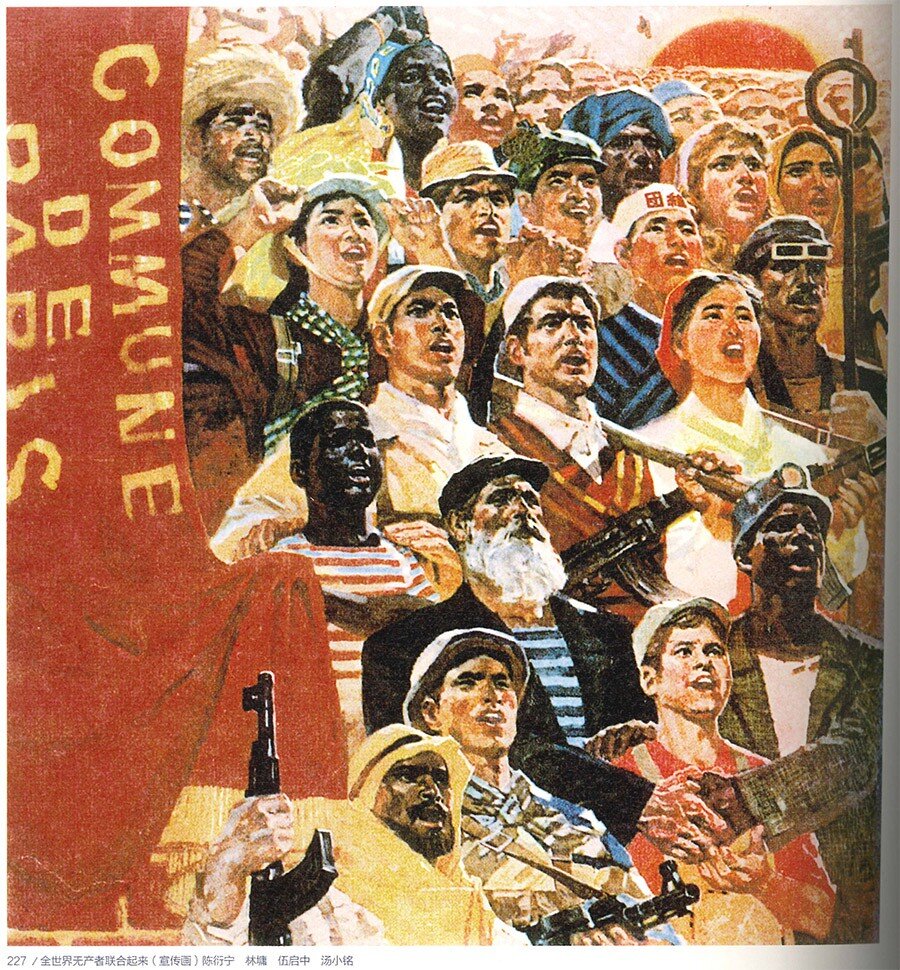
“Proletariat of the world, unite,” propaganda poster by Chen Yanning, Lin Yong, Wu Qizhong, and Yang Xiaoming, 1968

“Proletariat of the world, unite,” propaganda poster by Chen Yanning, Lin Yong, Wu Qizhong, and Yang Xiaoming, 1968

At the Shanghai archives, the 144 pages of microfilm on a 1964 all-city conference to commemorate the one-year anniversary of Chairman Mao’s “Statement Supporting Black Americans in Their Just Struggle against Racial Discrimination”— featuring drafts of speeches from worker, student, and women leaders — also proved illuminating. This motley collection of speakers drew explicit parallels between Chinese historical experiences of semi-colonialism and contemporary black American movements; they decried race-based discrimination and lauded national liberation movements but nonetheless, frequently harkened back to Mao’s dictum that “racial struggle is fundamentally a matter of class struggle.”

This may not be as paradoxical as it might initially seem. Indeed, it was practical for China’s internationalist strategy to espouse deeply sensitive readings of racism in world affairs and history while advocating non-racial solutions. The inferences to racial semi-colonialism in pre-revolutionary China as a condition comparable to contemporary black America only heightened the desirability and efficacy of a certain political trajectory: working-class revolution as the antidote to the abuses of racial capitalism. It is precisely the yoke of racial oppression that would spur African Americans to take dominant roles in the anti-capitalist, anti-American campaign. The success of such an effort would allow for race to disappear in the U.S., just as it purportedly had in China. In effect, black nationalism would be refashioned into a weapon of international class struggle.

Robert F. Williams meeting Mao Zedong in 1964.

Robert F. Williams meeting Mao Zedong in 1964.

The Chinese endeavor to cultivate political alliance with the African American left was meticulous, targeted, and effective. In Inner Mongolia, Williams expressed his amazement as students and workers gathered to perform African American fight songs for him in factories and on the streets. At the National Minorities Institute in Beijing, he asked to be photographed with sacred Tibetan texts as testament that the Chinese way would continue to tolerate, if not honor, religious traditions. He and his wife made arrangements for their two children to study in China, and Robert carried on extensive political discussions with senior Chinese officials on the role of Cuba in the Sino-Soviet Split.

Members of the Black Panther Party hold up Mao’s “little red book.”

Members of the Black Panther Party hold up Mao’s “little red book.”

Huey P. Newton meeting with Premier Zhou Enlai in September 1971.

Huey P. Newton meeting with Premier Zhou Enlai in September 1971.

Moving forward, I plan to continue charting the depictions and functions of China in African American social movements for civil rights and Black Power, with sensitivity to the complexities and nuances within the Chinese receptions to black nationalism. This is a dynamic, ever-evolving story that roughly paralleled but did not absolutely correlate with either political currents within China (such as the Cultural Revolution) or African American civil movements. Teasing out these multi-faceted dimensions of black nationalism in China will expand our broader historical knowledge of racial nationalism as a force in the Cold War international arena, and especially of the civil rights movement as an event of truly global inspirations and consequences.

Ruodi Duan is a Ph.D. candidate in Harvard’s History Department researching race and ethnic studies in the Cold War, with a focus on Chinese depictions of African American social movements. This article received an “honorable mention” in the Fairbank Centers 2016 Travel Essay Competition.

The Rise and Fall of Trump and What It Means

(PHOTO CREDIT: Gage Skidmore/Flickr)

By Youssef Shawky Magdy


After Donald Trump won 2016 elections, many theorizations emerged about the rise of the right in the capitalist West. This was exacerbated by Boris Johnson's victory in Britain, and the vision became clear that there would be a tug of war between a US-British economic and political alliance against Europe under the leadership of Germany.  In addition to the rise of the right-wing movements in many European countries as Germany itself and France (some expected Marie Le Pen would win or that Le Pen will succeed Macron).  But what does the rise of the right mean basically?

Since the end of the nineteenth century, the period of competitive capitalism ended and capitalism has been entering the framework of monopoly capitalism, which was characterized by the close union of financial and industrial capital.  Lenin wrote about that stage, stressing its close connection with imperialism, and we still live in the highest stage of capitalism with the change of imperialism from a national situation to a globalized one.  The question here is when does "fascism" — or what can be called more broadly the "savior right" — rise?

The savior far right rises as a response to a comprehensive social crisis represented by an economic decline in the rate of capitalist profit that cannot be compensated for by "more foreign imperialism"(imperialism against others),  in addition to a political crisis represented by the dissolution of the ruling-class coalition and the collapse of its hegemony.  Besides the ideological crisis represented in the collapse of the principles and myths supporting the status quo. 

This is accompanied by an increase in the pace of progressive movements of a left-wing nature that offer popular and progressive solutions to the crisis, such as fair wages, a fair distribution of the surplus, and an increase in workers' power and authority within productive enterprises. Perhaps the solutions become more revolutionary that try to change the entire social system.

And when those progressive movements fail for subjective (strategic and tactical) and objective reasons, the fascist right rises up as the representative of the bourgeois class, which is in crisis.  So the right tries to fix the situation in favor of monopoly capitalism, but in a populist fashion.  So, the crisis is emptied of its content and the process of displacement is installed, which projects the problem to any demographic or cultural phenomenon, such as projecting the crisis on immigrants, for example.  The right represents the middle class but in a deceitful manner.

And now, after we knew the conditions and aspects of the savior right, are these conditions and appearances fulfilled in the current capitalist West?

Of course, the capitalist West has been going through an economic crisis since the 1990s, and the Iraq war was a temporary attempt to alleviate the crisis, but the opposite happened.  The goal of securing the oil wells was achieved, but the return was serious economic and political losses.  The crisis reached a dangerous stage in 2008, and with Covid-19 crisis, the severity of the crisis increased in several situations. The profit rate reached very low rates.

Regarding the political crisis, the United States has been suffering since the Iraq war from a decline in its hegemony over the world and the consumption of exorbitant resources in its wars, which has led to Trump's tendency to reduce those interventions and limit the intervention only to very necessary situations such as threatening to intervene in Venezuela or Iran.  In Western countries themselves, liberal democratic governmentality suffers from a deep problem represented in the vulgarization of the meaning of democracy and its focus on the representative type only.  The public’s distrust of that governmentality has been increasing.

Regarding the ideological crisis, liberal democratic values ​​are proving their failure day after day, from their forced application on the third world countries within the framework of pushing them towards economic openness (which is failing for various reasons, the most important of which is that these projects are completely unpopular) to the failure of that values in the West to achieve the desired happiness.

In addition to the neoliberal ideology that fuels religious and ethnic conflicts.

As for the signs that indicate the rise of the right, we find that they are available to a large extent; for example, Trump tells us that he is “the president of the peasants and workers!” Right-wing nationalism is spreading again, in addition to anti-immigrantism.  Racist crimes are increasing day by day.

The question here is whom the rising right represents now?

In the pre-globalization era, the right "truly" represented big monopoly capitalism that was still associated with "nation-state". That link was largely structural. So we find that the laws and rules regulating the economy were related to the framework of the nation.  The economic production cycles were deeply related to the state’s economic cycles, such as the payment of salaries, allowances, official holidays..etc. In addition, industrial capitalism prevailed, not financial capitalism.  The first, of course, needs an organization and a specific context in which to work.  In one word, capitalism was capitalist "statism". Consequently, when fascism escalated, it rose in a context that made it easier for it to perform its rescue tasks, and the statism turned into hyper-statism. The bailout has come in a national context to represent monopoly capital of a national character.

But in our time, the era of globalization, capital divorced from the national context; the globalized economic cycle, in all its complexities, has separated from the national context and Financial capital prevailed.  In fact, the crisis of global monopoly capitalism needs a solution of the same size and level of complexity, that is, it needs a global solution.

The savior right cannot provide solutions but national solutions, and thus its representation in that era is limited to capital, which is not so large as to leave the context of the nation-state.  In general, there is a conflict with those small capitalist strata, and the globalization project led by big capitalism, which seizes and controls the market and has relatively little production costs.  The protectionist measures (of all kinds) promoted by the right contradict the globalization project.

Even if an extremist right-wing project succeeds in a western country, it will be overthrown by the global system, as happened in the Second World War as When the right fails to manage the crisis, it turns to violence that is forcefully defeated.

This is how we should understand Trump's rise and fall.  The rise was a response to the crisis but an inadequate response. The new US administration is more homogenous with the world order.  Therefore, it will participate in the global solution to the crisis.

Biden's victory and the defeat of Trump have not signified the success of any progressive coalition, as some liberals think.

Some believed that Trump's rise would result in a counter-left movement, and that did happen with the rise of Bernie Sanders, but that movement was defeated. Ultimately Biden does the same job as Trump, but in a more understanding and rational way.

The Revolutionary Potential of Hope and Utopia

By Yanis Iqbal

We live in disconcerting times. The wealth of USA’s 643 billionaires has soared by 29% since the start of the Covid-19 pandemic. On 13 August, 2020, the top twelve US billionaires had surpassed a combined wealth of $1 trillion. This year, the world’s 500 richest people have grown their fortunes by $871 billion, a 15% increase. All this while, the misery of the oppressed people has been increasing.  Due to the Coronavirus-caused intensification of income inequalities, an additional 132 million people will go hungry than previously predicted this year. Moreover, by the end of 2020 12,000 people per day could die from hunger linked to COVID-19, potentially more than will die from the disease itself. Brutally indifferent to the hunger of the oppressed masses, the transnational capitalist class has instead opted to maximize its profit. Between January and July 2020, eight of the biggest food and drink companies paid out $18 billion to shareholders - ten times more than has been requested in the UN COVID-19 appeal to stop people going hungry. While looking at the present-day conjuncture, one can’t help but remember Karl Marx’s incisive description of capitalism: “Accumulation of wealth at one pole is at the same time accumulation of misery, agony of toil, slavery, ignorance, brutality, mental degradation, at the opposite pole.”

The progressive deterioration of socio-economic conditions has created a situation which is objectively revolutionary. By forcing the subalterns into a state of semi-starvation and perpetual precarity, the ruling class is producing a chain of circumstances whose ultimate result will be the aggravation of capitalism’s protracted crisis. In order to understand the objective damage done to capitalism through the hyper-exploitation of the lower classes, the phenomenon of income squeeze can be briefly studied. Reduction of the working class’s income leads to a crisis of over-production since the purchasing power of the workers is not able to keep up with the pace of production. Consequently, the lack of money on the part of the working class results in a decrease in aggregate demand since the ratio of consumption to income is higher for wage earners than for those living off the surplus. Demand-reducing effects arising from the consumption side reduce output, capacity utilization and lower investment over time, further exacerbating the initial crisis of neoliberal capitalism.

Need for a New Narrative

Objective conditions in-themselves, however, don’t possess the capacity to bring about a revolution. To take an example, capitalism has temporarily and unsustainably fixed the crisis of overproduction-under-consumption through credit expansion and debt-financed spending. The fact that capitalism has continued to patch up its contradictions - in however an instable way - proves that objective conditions are inadequate for replacing capitalism. Therefore, objective conditions need the presence of another major element to produce the prerequisites of a revolution.

Proper objective conditions need to cohesively combine with subjective conditions to bring forth a revolution. Subjective conditions refer to the attainment of class consciousness by the proletariat and the consequent construction of hegemony. Class consciousness and the construction of hegemony together constitute the subjective dimension of a revolution through which bourgeoisie ideological apparatuses are subverted. Presently, the Left is primarily waging a battle on the subjective plane in order to build counter-hegemonic bases of resistance and refine the embryonic consciousness of the oppressed masses. While doing this task, it has encountered the hegemonic force of right-wing populism which is culturally re-defining the status of the subalterns and utilizing emotively expressive symbolic methods to over-power the ideological efforts of the Left. In order to institute the hegemony of socialist forces in the civil society, new cultural strategies need to be devised which can combat the influence of the ascendant Right.

Right-wing populism denotes a politico-cultural force capable of emotionally expressing the discontent of the subaltern classes with neoliberal globalization and simultaneously consolidating the power of capitalism. To do this, the Right uses a variety of tactics. It initiates a personalized politics of muscular leaders; divides society into ethnically polarized groups; and uses extra-institutional street violence and mobilizations to infuse politics with raw emotions. All these political methods share a common feature: they aim at aestheticizing politics. In his seminal essay “The Work Of Art in the Age of Mechanical Reproduction”, Walter Benjamin, a German Marxist, had lucidly explained the relation between aesthetics and politics while talking about fascism: “Fascism attempts to organize the newly created proletarian masses without affecting the property structure which the masses strive to eliminate. Fascism sees its salvation in giving these masses not their right, but instead a chance to express themselves. The masses have a right to change property relations; Fascism seeks to give them an expression while preserving property.”

Right-wing populism’s emotionally energetic and politically persuasive practices are able to symbolically soothe the psychological wounds of neoliberalism. The Right’s visceral strategies stand in contrast to the emotionally dry politics of the Left. In its singular pursuit of emphasizing the economic defects of capitalism, socialist politics has renounced the effective use of varying emotions. While pointing out the contradictions of capitalism and focusing on economic issues, socialists tend to forget that the human being is incomplete, unfulfilled and laden with unrealized potentials which are the motor of human activity. Since humans are unfinished, they take recourse to repositories of subjective support comprising of emotions and ethics.

Bertolt Brecht, a communist and one of the most influential playwrights of the 20th century, had famously said: “Food comes first and then morality”. Today’s Left has misinterpreted and dogmatically followed this dictum and forgotten the dialectical unity in which food and morality co-exist. A lack of dialectical thinking on this issue has led leftists to believe that a person can exist without the presence of vivid emotions. Refuting this point, Ernst Bloch, a famous Marxist philosopher, had stated: “Human beings do not live by bread alone, particularly when they have none.” By not unifying the scientific critique of capitalism with the power of emotions, the Left has allowed the subalterns to be swindled by the expressive politics of right-wing populism which symbolically re-activates unfulfilled pasts and unrealized futures.

To counter-act the hegemony of right-wing populism, a new narrative of hope needs to be built which can soak the critique of capitalism in emotions, affections and feelings. Bloch had theorized this synthesis of critique and emotions in his magnum opus “Principle of Hope” where he made a distinction between two dominant strains of Marxism: cold stream and warm stream. The cold stream is concerned with the scientific critique of capitalism and the unmasking of mystifying ideologies. The warm-stream is concerned with a utopian revolutionary imagination which utilizes the power of emotions to produce a commitment to emancipation.

Both cold stream and warm stream should operate in a dialectical unity and the ruthless critique of capitalism should always be warmed up in the fire of emotions and affects, a fire that turns “reasons to act into imperatives to act.” As soon as both the streams are unified, a new knowledge structure is produced wherein reason speaks through the heart and guides the latter. The dialectical unification of heart and reason can be completed through the introduction of hope and utopia which produce a captivating vision of a desirable alternative, rooted in anger at the injustices of the world in which we live and infused with confidence about human possibilities.

Hope and Utopia

Utopia is omnipresent in capitalism. It is concentrated in works of mass culture and the bourgeoisie political system which many Marxists tend to flatly dismiss as concerned with “false consciousness” and thus, “manipulative”. Instead of such a uni-dimensional critique, a nuanced analysis of politico-cultural artifacts reveals that they are explicitly utopian. Fairy tales, films, theater and jokes not only mystify the consciousness of an individual but also express in abstract and idealist fashion the potentialities for a better future. On the political level, the bourgeoisie concept of citizenship not only blocks the emergence of class identities but also functions as a vision of a classless society where everyone would be politically and economically equal. A nuanced ideology critique, therefore, “is not merely unmasking…but is also uncovering and discovery: revelations of unrealized dreams, lost possibilities, abortive hopes - that can be resurrected and enlivened and realized in our current situation.”

The omnipresence of utopias in capitalism means that the oppressed classes have been silently struggling for a better world. Socio-cultural and political utopias are imperfect yearnings for what is more fully developed in Marxism and socialism. Leftists have to work with this contradictory subaltern consciousness which contains within itself the seeds of communism. By refining the nascent consciousness of the subalterns, leftist activists can form the utopia of communism. This form of constructing hegemony works with the pre-existing thought-systems to sharpen its edges and subvert it from within.  A letter from Marx to Arnold Ruge dated 1843 explicitly supports this method of constructing hegemony: “Our motto must therefore be: reform of consciousness not through dogmas, but through the analysis of mystical consciousness which is still unclear to itself. It will then become apparent that the world has long possessed the dream of a matter, of which it must only possess the consciousness in order to possess it in reality. It will become apparent that it is not a question of a great thought dash between past and future, but of the carrying-through of the thoughts of the past.”

The formation of a communist utopia is inevitably accompanied by the institution of hope as an important axis of struggle. A communist utopia anticipates a new future and rejects the existing state of affairs. Correspondingly, to maintain a conviction in the new future and keep on struggling against the status quo, hope needs to be firmly established as the fluid which constantly flows throughout the matrix of the communist utopia. Hope in a communist utopia is not synonymous with naïve optimism. If that was case, hope would merely become another form of voluntarism. In contrast to voluntarism, hope in a communist utopia is intertwined with the knowledge of material conditions and reaches out for a new global future while taking full account of all the pressures towards a civilizational collapse. Consequently, hope denotes a terrain of constant striving where the communist activists are familiar with the indeterminacy of their class struggle which has not yet been defeated but likewise has not yet won. In spite of this indeterminacy, communist militants continue to maintain a commitment to emancipation and derive hope from the immense power they posses. Their power emanates from a fundamental flaw at the heart of any system of domination: the dependence of the dominator on the dominated. Recognizing this fact, subaltern classes believe that they have the capability to challenge capitalism and steer historical processes in the direction of communism.

When communist utopia and hope are used as the cultural tools of a revolution, a resilient environment of social sensitivity and emotional energy is produced. In this environment, the rhythms of revolution are composed of a critique of capitalism and a forward-looking, hope-infused conceptualization of a communist society. By highlighting the obscenity of capital accumulation through a scientific critique of the existing system, rage, fury and indignation are generated among the masses. John Holloway, a Marxist sociologist, powerfully expresses the sentiment of “refusal” which is created as a result of fury and indignation: “We are the fury of a new world pushing through the foul obscenity of the old. Our fury is the fury of refusal, of stifled creation, of indignation. Who are these people, the politicians and bankers who think they can treat us like objects, who think they can destroy the world and smile as they do it? They are no more than the servants of money, the vile and vicious defenders of a dying system. How dare they try to take our lives away from us, how dare they treat us like that? We refuse.”

The loud refusal of capitalism is accompanied by the soft glow of revolutionary hope which moulds the anger of the masses into a communist utopia. With the help of this communist utopia, subaltern classes are suffused with the echoes of emancipation and act on the basis of what Marx had designated as “the categorical imperative to overthrow all conditions in which man is a debased, enslaved, neglected and contemptible being.” The act of overthrowing capitalism, therefore, becomes ethically grounded and rooted in the everyday emotions of subaltern people.

In the contemporary period, a re-invigorated leftist strategy – combining emotions and scientific critique – is indispensably needed as the Right intensifies its cultural techniques and effectively aestheticizes politics to satisfy the demands of the oppressed classes.  Today, more than ever, we need the presence of revolutionary hope and a well-built communist utopia capable of emotionally articulating the repressed desires and existential needs of the masses. A poem by Vladimir Mayakovsky, the poet of the Russian Revolution, beautifully expresses the revolutionary imagination which is needed to revitalize the global Left:

“We will smash the old world
wildly
we will thunder
a new myth over the world.
We will trample the fence
of time beneath our feet.
We will make a musical scale
of the rainbow.

Roses and dreams
Debased by poets
will unfold
in a new light
for the delight of our eyes
the eyes of big children.
We will invent new roses
roses of capitals with petals of squares”