


Policing and Palestine

[Photo credit: Jessica Rinaldi/Reuters]

By Erik Jacobson
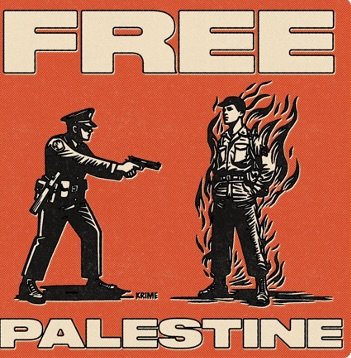
For many people, the security guard’s infamous actions during Aaron Bushnell’s protest in front of the Israeli embassy illustrated the stark division between the police and those who fight against multiple forms of state-sponsored violence. While Aaron was sacrificing his life to call attention to the ongoing oppression of Palestinians, the guard’s first response was to draw and aim his weapon. Unarmed and on fire, Aaron was still considered a threat that needed to be neutralized. In this way, what took place is emblematic of broader connections between policing and the struggle for Palestinian freedom.


Suppressing Dissent

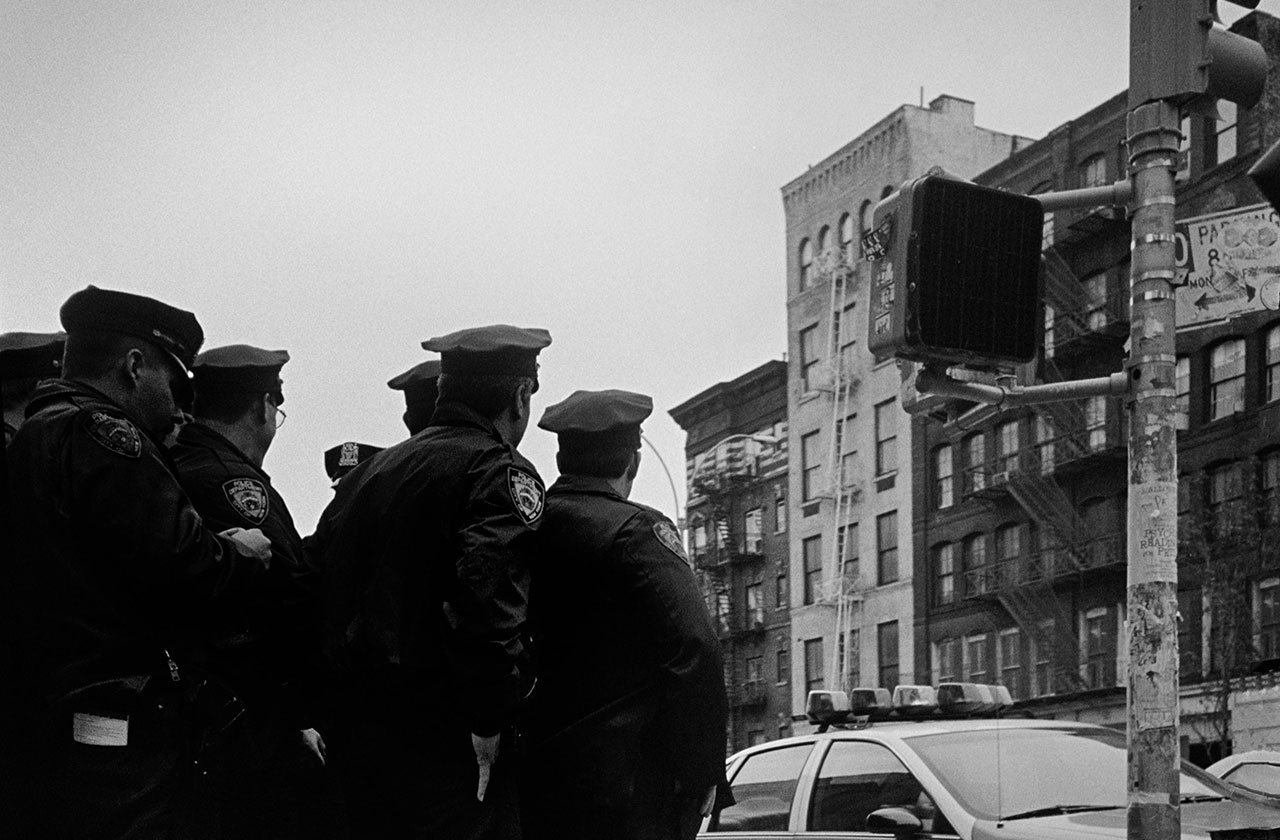
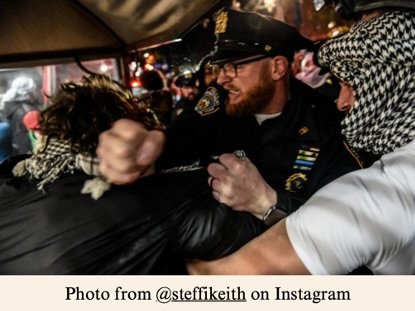
Since the beginning of Israel’s latest assault on the people of Gaza, multiple protests have taken place across the United States. In many cases, police have been called out to violently shut down demonstrations and arrest large numbers of people. For example, on November 10th, police were called in to arrest students at Brandeis University who were calling for a ceasefire. On November 15th, 2023, police violently assaulted people protesting at the Democratic National Committee’s headquarters. Often times, and consistent with historical precedent, these deployments turn into police riots. Recent examples include NYPD swarming and tackling protestors getting on the subway at the conclusion of an event (March 8th, 2024). This was carried out by the NYPD’s Strategic Response Group, who are called upon to do this kind of work. Indeed, the NYPD has been captured initiating hand-to-hand combat with people who oppose the status quo. The message is clear – they are prepared to suppress dissent by any means necessary.
In addition to physically attacking protestors, New York also has a Joint Terrorism Task Force. This legacy of the post 9/11 “war on terror” surveilles the internet, looking for words that would trigger an investigation of someone who might be inclined to protest. This tracking actually goes beyond the borders of the United States. The NYPD has a Tel Aviv office that it is in regular contact with, particularly since October 7th. In fact, the NYPD has shared intelligence and carried out surveillance in the city at the request of partners in Israel.

The use of police to suppress dissent is not limited to the United States. In Israel itself, protestors are often violently attacked and arrested for simply calling for an end to the war on Gaza. There have been a number of such protests in Tel Aviv, and the scene is likely to keep repeating itself. Merely expressing sympathy for people suffering in Gaza on FaceBook was enough to get social studies teacher Meir Baruchin arrested. He is not alone in this, and police have come to people’s houses to arrest them for what they have shared on line. In the words of Israel's Police Commissioner, Yaakov Shabtai, “Anyone inciting against the State of Israel, its government symbols, elected officials, military personnel and police, should be aware that the Israel Police will respond firmly and without leniency.” In the days after October 7th, police in Jerusalem rounded up over 100 people and arrested 63. Across the country, hundreds more have been arrested for social media posts critical of the government.

Riot police officers arrest a demonstrator at Hermannplatz, Berlin on October 11, 2023 at a pro-Palestinian gathering. John MacDougall /AFP via Getty Images.

European countries have followed suit. England, France and Germany have limited or outlawed expressions of support for Palestine. In Paris, police issued a ban on the "presence and circulation of people that present themselves as pro-Palestinian." To date, they have issued over 1000 fines and arrested more than 40 people. In the UK, protestors calling for a cease-fire are routinely arrested, often without being told what the charge is. In Germany, officially equating anti-Zionism with antisemitism has meant that large numbers of Jewish protestors have been arrested. In fact, although Jews make up 1% or less of the German population, they represent more than 50% of the people who have been arrested and charged with antisemitism. The group Jewish Berliners Against Middle Eastern Violence were not granted permission to even hold a public rally. Not surprisingly, the police have used supposed antisemitism as a pretext to surveil and harass other groups that are involved in the struggle for social justice. For example, in December 2023, they raided the offices of the feminist group Zora and seized materials. Zora’s offense? Making pro-Palestinian public statements. Across all of these cases, the message is the same. Dissent will not be tolerated, and the police are the means to punish those who ideologically step out of line. That means the fight for Palestine and the movement towards abolition are inseparable.

The Power of Language

Billy clubs and guns are one way of suppressing dissent about policing and Palestine, and controlling the language we use to talk about the situation is another. This does not mean there is a small cabal in a room somewhere engaged in some nefarious plot. Indeed, that type of assertion is often revealed to be informed by long-lasting antisemitic tropes about Jews controlling the media. Rather, as Herman and Chomsky make clear in Manufacturing Consent, it is a question of what filters have been put in place that direct our use of language before we even consider why we chose the words we did. In this way, no one person or group of people needs to be scheming behind the scenes – routinized use of language does the necessary ideological work to maintain the status quo.  

In the US, the media often uses what has been called the past exonerative tense (coined by William Schneider) to point to something wrong that happened without naming or blaming the people responsible. This includes the passive voice (“Mistakes were made”), but it also includes removing human agency in other ways. Here are a few examples of how the past exonerative frames the narrative when talking about police violence.

In the first tweet, there is no mention of the police who used the pepper spray. It just happened. While the second tweet features other commonly used wording. In this case, the bullet is somehow responsible on its own, rather than the officer that fired the gun. Sadly, this was the majority of coverage of the murder of Breonna Taylor - “It is tragic that that bullet found her sleeping in her bed.” By shifting the focus to the bullet, the police are not held responsible. In fact, the very term ‘officer involved shooting’ is a means of dissembling the reality of the situation – a police officer shot somebody. This framing is powerful. A recent study found that readers were “less likely to hold a police officer morally responsible for a killing and to demand penalties after reading a story that uses obfuscatory language.”

SUPPORT OUR WORK BY MAKING A DONATION TODAY!

This same exonerative tense is used in reporting about Palestine. Consider this example that notably pre-dates the events of October 7th.

Inexplicably, the protesters “received” bullet wounds instead of being shot. There is no mention of who shot them. This is a consistent pattern. When Israeli forces murdered journalist Shireen Abu Akleh, the Washington Post stated - “Yet Another Palestinian Journalist Dies on the Job.” When Israeli dropped a missile on a café in Gaza, the New York Times reported, “Missile at Beachside Gaza Cafe Finds Patrons Poised for World Cup.” Thus, it is not surprising that the same language is being used to describe the ongoing genocide in Gaza and the West Bank. When 4-year-old Ruqaya Ahmad Odeh Jahalin was killed by Israel forces who shot a hail of bullets at the van she was riding in, SkyNews reported it as, “A bullet found its way into the van and killed a three or four-year-old young lady.” Again, a tragedy in which a child was killed by a bullet that wasn’t fired by anybody.

It is also worth noting the description of a 4-year-old girl as a young lady. This is also consistent pattern. At one point, The Guardian reported, “The [Israeli] hostages to be freed are women and children, and the Palestinian prisoners are also women and people aged 18 and younger, both sides have confirmed." Why is it that Israelis under 18 are children and Palestinians are not? One possible reason is that this use of words is a way to reduce empathy for Palestinians by removing the image of innocence associated with being a child. Calling Ruqaya a young lady might even suggest that she had some level of agency in this situation. There are clear parallels in the United States.

In the AP’s Today in History, 18-year-old Michael Brown, killed by a policeman, is a Black man. In their coverage of a racist massacre in Buffalo, the 18-year-old white shooter is a teenager. Language matters, and we must be vigilent in our critiques of the filters that naturalize oppression and make oppressors unacccountable.


Palestine as a Laboratory for Policing Techniques and Tools

Gaza has been called a laboratory for policing training and technology, as resources and strategies developed there are then exported to the rest of the world. In the current attack on Gaza, Israel is deploying LANIUS quadcopter drones. These devices can be used for surveillance, but also to attack. On January 11, 2024, on Al-Rasheed Street, one such drone was used to remotely fire on a crowd that had gather to wait for aid trucks. Dozens of people were killed. The developer, the Elbit Corporation, notes that “LANIUS is a highly manoeuvrable and versatile drone-based loitering munition designed for short-range operation in the urban environment.” The drone can carry up to 64 shots, which can be released quickly.

Elbit also explains that LANIUS “can autonomously scout and map buildings and points of interest for possible threats.” Mayor Adams of New York City has said he was interested to learn how the IDF was using drones for this purpose. In fact, since October 7th, the NYPD has been using their own drones to surveil protestors. They have illegally used footage obtained by the drones to arrest people. The NYPD is actually going beyond taking picture of people in public. The Queens District Attorney Melinda Katz has signed a contract with the Israeli company Cobweb Technologies to use their software to profile people via social media mapping. The hope is to be able to capture the “complete” digital lives of people.

Israel has also helped develop other hardware for surveillance. For example, the Tohono O’odham reservation is bisected by the border between the US and Mexico. The US Border Control patrols the area, by vehicle and from 160 feet tall watchtowers. These structures, built by the US branch of Elbit, have night vision scopes, thermal sensors and ground-sweeping radar with a radius of 7.5 miles. The Tohono O’odham are monitored as they move about in their own land, and there is no limit to the data that can be collected. Similar watchtowers are in place along other parts of the US-Mexico border, and the US- Canada border. Elbit advertises that these towers have been “field proven” on Palestinians.

Such “field testing” is happening right now during the assault on Gaza. Israeli forces have deployed robot police dogs developed by Boston Robotics. The company had insisted that they would not be used against people, and so their use now suggests that Palestinians in Gaza do not meet their criteria for protection. It is hard to imagine that once they have had their trial by combat, they will not be used in the United States for similar purposes. It is worth noting that Israel is not only supporting surveillance and state-sponsored violence in the US. Recently, it has supplied drone technology and cruise missiles to Morocco, currently illegally occupying Western Sahara. This is not an isolated incident. As just one example, Israel supported the violent right-wing government in Guatemala in the 1970’s and 1980’s by providing weapons and helping train their forces.

The same is true of the United States. Police leadership, including chiefs, assistant chiefs and captains have gone to Israel to train with the IDF on issues like crowd control, use of force and surveillance. Hundreds of police from 12 states and Washington, DC have participated in this training.  This is certainly problematic, given the fact that the IDF’s record in these areas is terrible. They have a long history of abuse, torture and extrajudicial killings, with little or no accountability. Their consistent abuse of human rights has been documented and condemned by Israeli activists (e.g., B’Tselem) and international organizations (e.g., Amnesty International). While in Israel, according to the organization Researching the American-Israeli Alliance (RAIA), US police witnessed “live demonstrations of repressive violence in real-time, in protests across the West Bank, patrols in East Jerusalem, and visits to the Gaza border.” Not surprisingly, rather than changing the direction of policing in the US in a positive direction, it appears that such displays have emboldened police to be even more violent. A report on Baltimore police, a force that has participated in the training, found that they often escalate encounters and then use excessive force. In another analysis, police in San Diego were found to increase their racial profiling activities after the training. And yet, since 2002, the Anti-Defamation League, the American Jewish Committee’s Project Interchange and the Jewish Institute for National Security Affairs have covered the cost of these trips. However, more people are paying attention to the existence and impact of this training. Jewish Voice for Peace in Durham, North Carolina, was able to get the city to ban these trips for their officers. This victory demonstrates that it is possible take successful action if people are well organized and persistent. Hopefully resistance will spread to other municipalities.


Policing and the Creation of the Oppressed Other

Given the long history of police violence against Palestinians and those who support them, why has there not been more outrage? It is likely because at a fundamental level, policing is doing what it was intended to do - establish and maintain oppressive social and economic structures. Consider how the Palestinian experience parallels the Tohono O’odham. Palestinians have been driven off their lands, had their water and crops confiscated and continue to have their movement restricted. To go anywhere, they need to pass through multiple checkpoints, and while walking or driving are constantly surveilled. Thousands of Palestinians are seized and left to suffer in in overcrowded prisons without even being charged with a crime. Families of Palestinians accused of a crime face the collective punishment of having their houses razed. No such fate awaits the family of settlers who attack and kill Palestinians. In this way, the laws of Israel and the police who enforce them explicitly create a Palestinian community that is without rights or equal status.                          

Just as important are the extrajudicial actions of Israeli police. They spread terror by breaking into Palestinian homes at night to grab people, regardless if they have committed or even been accused of committing a crime. The openly abet those settlers who are killing Palestinians and seizing their land.

In Gaza and the West Bank, Israeli forces have videotaped themselves taking the possessions of the people who they have forced to flee. They kill civilians with impunity, including children and the elderly. There are documented cases of them killing non-neurotypical people because these individuals didn’t respond to the orders they gave them in the expected way. This also happened with at least one person who was deaf.

Of course, much of this is familiar to the people living in the United States. From the beginning, police in this country have been used to control the movement and freedom of Black communities, and they continue to bring both judicial and extra-judicial terror. Police continue to kill people with impunity, particularly those who are Black or Brown. In addition, non-neurotypical individuals are at much higher risk of being a victim of police violence. And again, this is not the result of policing being broken. This is what police do – they create the very existence of separate and oppressed communities. Thus, for freedom in Palestine or Pittsburg, Germany or Germantown, the abolition of policing is a necessity. There is no other way forward if we are to have a chance at saving ourselves and a world on fire.

U.S. Imperialism Creates Refugees, then Criminalizes Them at the Border

By Gregory E. Williams


Republished from Struggle La Lucha.


With Nikki Haley out of the race, Trump and Biden are officially facing off in a presidential rematch. Both of these deeply unpopular politicians are attempting to get ahead by scapegoating migrants and refugees at the U.S.-Mexico border. In dueling publicity stunts, they both went to the border on Feb. 29., hundreds of miles apart in Texas.

Despite the polarized rhetoric, there is little substantive difference between their approaches to immigration. Biden seeks to present himself as a uniter who can “reach across the aisle” and get the job done, courting a supposedly reasonable section of the Republican Party less beholden to Trump. Trump depicts Biden as overseeing an open-border policy.

The reality is that the Biden administration has continued many of the more repressive Trump-era immigration policies.

Biden was Obama’s vice president from January 2009 to January 2017. Immigrant rights groups labeled Obama the “Deporter in Chief,” having deported three million people by the time he left office. Ultra-bigot Ron DeSantis even used these facts to try to make himself look more vicious than Trump, saying that he would deport more people than Trump, whose deportation stats trailed Obama’s.

Immigration legislation has been held up in Congress for months as different factions fight over the exact ways to manage U.S. imperialism’s borders. The legislation has been tied to funding for U.S. proxies in Ukraine, for example, which some Republicans oppose.

They do not oppose Ukraine funding on anti-imperialist grounds but rather because they represent the interests of different factions of the bourgeoisie who want to emphasize different theaters of conflict. Both parties are still absolutely united on continuing the U.S.-Israeli genocide of Palestinians and provoking China, risking World War III.

The bipartisan bill that has been held up – the showpiece of Biden’s “reaching across the aisle” – would enact further violence against asylum seekers. The bill would institute a trigger mechanism to shut down the border if an average of 5,000 people per day in a given week (or 8,500 in a single day) attempted to enter the U.S. outside the woefully inadequate legal channels.

The bill would involve pumping billions more of our tax dollars into the border police apparatus at a time when Kellogg’s CEO is telling us to just eat cereal for dinner because food and everything else is so expensive.

Sources close to the Biden administration have said that Genocide Joe is considering executive action to implement aspects of the immigration bill, bypassing the congressional morass.

In a special congressional election in New York, Democrat Tom Suozzi just won the House seat formerly occupied by George Santos. He scored this victory by bashing immigrants, calling the situation at the border an “invasion,” in fascistic, dehumanizing language reminiscent of Trump.


Biden’s racist edge

Immigration was a focal point in Biden’s March 7 State of the Union address, which marks the beginning of his campaign in earnest. Biden used racist terminology, referring to human beings as “illegals.”

Marjorie Taylor Greene put on her own show – wearing a shirt that read, “say her name” – and disrupting Biden by yelling this slogan, which came from the Black Lives Matter movement. Greene and other Republicans are capitalizing on the tragic killing of 22-year-old University of Georgia nursing student Laken Riley. A Venezuelan national is being charged with the crime.

SUPPORT OUR WORK BY MAKING A DONATION TODAY!

The Republican narrative, of course, is that this incident is part of an epidemic of immigrant crime and violence and that the Biden administration’s policies are too lax. The immigrant crime wave is a pure myth. Very good data has come from multiple studies showing that there is no correlation between crime rates and immigration.

Stanford University economist Ran Abramitzky has even found that, since the 1960s, immigrants are 60% less likely to be incarcerated than people born in the U.S. – and that’s not because immigrants are treated more lightly. If anything, the opposite is probably true, as immigrants are criminalized in every aspect of their lives.

Since Greene and others have chosen to use the phrase, “say her name,” we should note a huge, glaring difference between what she and her cohorts are doing and the BLM movement. While the immigrant crime wave narrative is a big lie, the constant murder of Black people by police is not. All the data backs this up.

Overall, the political situation for immigrants continues to worsen, with both parties relying on this tried-and-true method of dividing up the working class by pitting one group of workers against another.


Who are the migrants?

But who are the migrants, and why are they coming in increasing numbers? U.S. Border Patrol claims to have had a record-breaking 250,000 encounters with migrants at the southwest border in December 2023. Books have been written on this topic, but the short answer is that it is because of U.S. imperialism.

Forty-seven thousand Venezuelans were encountered in December. Washington has dealt Venezuela’s economy deadly blows for many years, with sanctions that have increased dramatically since the Obama years. On March 8, 2015, Obama signed Executive Order 13692, declaring Venezuela an “unusual and extraordinary threat to the national security and foreign policy of the United States.”

As with Cuba, the “threat” represented by Venezuela’s Bolivarian Revolution was simply that they pursued national sovereignty, making it more difficult for Wall Street to plunder the country’s natural resources and exploit the people; they were pursuing a non-capitalist direction. The Venezuelan people held on firmly to the gains they had made and resisted repeated Washington-backed coups, but the sanctions were devastating. The country’s economy contracted 24.7% between 2013-16.

Trump’s administration pursued a “maximum pressure” campaign, especially targeting Venezuela’s leading industry, oil and gas. As with all U.S. sanctions, from Venezuela to Cuba to Iraq, the goal was to immiserate the population, leading to social collapse. The Biden administration let up just a little bit when it comes to Venezuelan oil exports but is threatening to ramp up sanctions again.

In 2021, the largest proportion of migrants came from Honduras, some 200 families a day, according to Border Patrol. The Obama administration – remember, Biden was vice president – orchestrated a coup in Honduras in 2009, sending democratically elected President Manuel Zelaya into exile.

For years, the country was plunged into economic chaos and violence. Politically, Honduras is just now getting back on its feet, with progressive President Xiomara Castro being elected in 2022 – much to the dismay of Washington.

The Border Patrol claims to have encountered 76,100 Haitians in the 2023 fiscal year. Haiti is in the news now because of the political and economic crisis following the assassination of President Jovenel Moïse in 2021. The bourgeois media typically depicts Haiti’s troubles out of context rather than talk about the history of colonialism and slavery and the U.S. imperialists’ domination of Haiti. The U.S. occupied Haiti militarily from 1915 to 1934.

SLL writer Stephen Millies says:

“The super-rich have never forgiven the Haitian people for overthrowing slavery. More than two centuries of revenge followed with the U.S. military occupying Haiti for 20 years, followed by support for the Duvalier family dictatorship.

“It was the CIA which was behind the coup that overthrew democratically elected President Jean-Bertrand Aristide in 2004. Trump called Haiti, which helped liberate Latin America, a ‘sh–hole country.’”

Politicians like Trump and Biden orchestrate the poverty and violence that drive people from their homelands, and they repress them when they come to the U.S. out of desperation. Sanctions and coups are only the tip of the iceberg. Capitalist imperialism is a global system. Exploitation and oppression are structural. It is not defined by one policy or another.

But it is important that we grasp that it is the capitalist class – the filthy rich like Jeff Bezos and Elon Musk – who create these inhumane situations to amass more wealth, that is, to accumulate capital. The politicians work for capitalists. Workers have no interest in upholding their system or going along with the scapegoating campaigns.

Why Do We Oppress Women?

By Wonder Louis


Since the dawn of civilization, women have been treated as second-class citizens. This condition pervades every stage of history and virtually every culture and region. Under capitalism, the phenomenon of gender inequality is observable through tangible acts of oppression such as unequal pay, fewer educational opportunities, domestic violence, and more. However, these observable acts are not exclusive to capitalism, as they were prevalent in different modes of production. To understand capitalist gender inequality specifically, we must examine the social relation and position that women hold under capitalism. 

Marxist analysis reveals that, just as capitalism divides bosses and workers, it treats men and women differently based on their relationship to production. The sexual division of labor both in and outside the household is caused by and produces gender inequality in all aspects of life. As Marxism informs us, the base of society is its economic system. In our current order, everything flows from capitalism and the asymmetric social relations it demands. 

Under capitalism, people — especially women — lose their humanity and become commodities. Workers  must sell the only commodity the bank can’t take from them, their labor, to not just accumulate wealth but survive. Granted, most female labor falls outside the commodity market and is instead directly consumed. But women are also often reduced to their exchange value. Sex trafficking and dowries are examples.

The view that capitalism encourages gender inequality is hardly universal.  Some argue that capitalism promotes female wellbeing through technological advancements in women’s health. Others claim capitalism must encourage gender equality because women are supposedly worse off in “traditional… non-capitalist societies.” These cultures are usually quite religious. People believe that their women are worse off because they suffer from lower life expectancy, poverty, and stricter gender oppression. Capitalism allegedly improves these maladies via constant and rapid technological innovation. It is the best system for social innovation, its proponents say. No other structural arrangement better facilitates social mobility or individual rights.

Whatever capitalists say, the fact remains: gender inequality exists under capitalism, and we must change that. This can occur in a number of ways. But lasting, fundamental change requires targeting the structure of the economy and superstructure of society. By altering these two elements of social life, women can defeat gender oppression once and for all.

Addressing the economy calls for more affirmative action. These policies can ensure minorities receive equal occupational and educational opportunities. Affirmative action has helped many women access institutions they wouldn’t have been able to otherwise. In 1995, for example, female employment increased by  15% at jobs with affirmative action requirements compared to 2 percent at jobs without. 

The second task is changing traditional gender culture. We can do this through education — namely, by introducing egalitarian concepts to children at a young age.  Curricula should teach how harmful sexist and gender stereotypes are. Educators should be prepared to call out and challenge misogyny whenever it arises in the classroom.   

Capitalism is driven by the accumulation of wealth and capital. It lays waste to all other values — chief among them, gender equality. Under capitalism, women face financial  and cultural oppression, physical violence, and lower living standards than men. To combat these inequities, women need fair treatment in the workforce, especially equal pay, and in society as a whole, free from misogynist norms.  

Wonder Louis is an aspiring historian and political theorist. Holding a Bachelor of Arts in History, Wonder aims to promote revolutionary thought and educate the masses on all forms of social inequality.

Nazis! The Fraught Politics of a Word and a People Besieged

[Pictured: Palestinian women cross an Israeli checkpoint, outside of the West Bank city of Ramallah, on April 15, 2022. (Flash90)]

By Gary Fields

Republished from Jadaliyya.

Like many highly-educated individuals in Palestine today, Mohammed Q. cannot find work in his field of computer engineering, despite a master’s degree in computer science from Birzeit University, and as a result, he relies on the tourist industry to earn a living, drawing on his fluent English and knowledge of the fraught politics of the region.  In the aftermath of October 7th he was working in Ramallah at the same hotel where, by fate, I found myself as the only guest on a sabbatical that began October 6th.  Over coffee, he recounted to me an experience leading a group of German tourists to Yad Vashem, the Holocaust Museum in Jerusalem.  As a West Bank Palestinian, Mohammed would normally be barred from entry to the Israeli capital, but because of his role on this occasion in shepherding a German tour group through the Holy Land, he was able to obtain the mandatory permit from Israeli authorities to enter the Holy City.  While at Yad Vashem, the group had a tour from one of the Museum docents who explained in detail the suffering endured by Jews at the hands of the Nazis 

As Mohammed recalls the episode, the guide described how the Nazi regime forced Jews to wear a yellow badge as a mark of identification that enabled Nazi authorities not only to stigmatize them, but to monitor and control their movements.  Alongside this measure, Nazis eliminated the rights of Jews to German citizenship, insisting that only those with “pure” Aryan blood could be Germans.  Bolstered by mobs of fascist-supporting vigilantes, Nazi authorities orchestrated modern-day pogroms against Jews including the ransacking of Jewish businesses and the theft of Jewish property designed to force Jews out of Germany.  Those Jews who tried to remain, the guide explained, fell victim to the night raids of the Nazi SS in arresting Jews and sending them to concentration camps.  In areas outside Germany under Nazi rule, Nazi policy ghettoized Jews as a prelude to a genocidal campaign of eliminating them as a people, and the guide spoke admiringly of the heroism of Jews from the Warsaw Ghetto who resisted these measures.  “I did not know about all of this suffering,” Mohammed admitted to me, “and I felt sorry for these Jewish victims of Nazism.” At the same time, he could not help but reflect on the parallels with his own experience as a West Bank Palestinian living under Israeli military rule. 

Mohammed thanked the guide and admitted that he had not been fully aware of the suffering of Jews at the hands of the Nazis.  He then commented to the docent that many details in his story of the Jews resonated for him as a Palestinian living in the West Bank.  After Mohammed made this admission, however, the guide became angry and demanded to know how he was able to come to Jerusalem and gain entry to the Museum.  Mohammed explained that he had received the necessary permit from Israeli authorities to chaperone the German tour group at which point the guide became extremely irate and called Museum security.  “Security personnel from the Museum came,” he explains, “and took me to the exit of the Museum where they ousted me from the building.”  In this way, Yad Vashem evicted a Palestinian from its premises for sympathizing with Nazism’s Jewish victims while explaining how, in his own experience, Israeli rule over Palestinians resembled some of the same practices attributed by the Museum to those used by the Third Reich on European Jews.  Replete with irony, Mohammed’s eviction from Yad Vashem, in the context of the forced displacements and carnage unfolding in Gaza, recalls a traceable historical arc.

Nazis Among Us?

On December 4, 1948, the New York Times published an open letter penned by a group of Jewish luminaries including Hannah Arendt and Albert Einstein who were protesting a visit to the U.S. by Menachem Begin, founder of the Herut (Freedom) Party of Israel.  Herut would later emerge as the foundation of the ultra-nationalist Likud Party of current Israeli Prime Minister Benyamin Netanyahu.  Authors of the letter made note of “Fascist elements in Israel” and objected to Begin’s visit because, according to them, Herut was “a political party closely akin in its organization, methods, political philosophy, and social appeal to the Nazi and Fascist parties.”  

In support of its claim, the letter referenced the massacre in the Palestinian village of Deir Yassin committed earlier in 1948 by the paramilitary predecessor to Herut, the Zionist Irgun, labeled even by many Zionists of the time a terrorist militia.  The Irgun had come into the village, which had harbored no animus toward its Jewish neighbors, and “killed most of its inhabitants—240 men, women, and children—and kept a few of them alive to parade as captives through the streets of Jerusalem,” revealing a practice of cruelty toward Palestinians eerily similar to what Nazis did to the Jews.  Arendt was already on record as warily critical of exclusionary tendencies in the Zionist project, writing in “Zionism Reconsidered” (1943) how the Zionist movement stood for a kind of ethno-state in which Palestinians would have only “the choice of voluntary emigration or second-class citizenship.” In the end, Arendt, Einstein and co-signers of the 1948 open letter proffered a warning about Herut and its Fascist roots: “from its past actions we can judge what it may be expected to do in the future.”

Apart from the reference to Deir Yassin, the letter did not specify what this kinship might portend but Fascism’s past practices highlight three themes.  First, Fascism is a mass movement animated by an extreme nationalist ethos whose adherents share a sense of collective victimhood caused by “outsiders” who are considered to have illegitimate claims of belonging to the nation and who emerge as the cause of collective national suffering. Second, Fascism channels this shared outlook of victimhood into collective hostility toward these outsiders whom Fascists consider as enemies seeking the nation’s demise.  Finally, Fascism enlists its backers to support liquidation of these enemies which drives it to untold levels of brutality and toward territorial expansion to ensure the completeness of the liquidation process, while keeping outsiders safely distant from the bounded space of the nation and those who belong to it. 

In the case of the Nazis, some of the signature behaviors that emerged from these contours and resonated so profoundly with Mohammed at Yad Vashem included Nazism’s exclusionary citizenship laws; its pogroms against Jewish businesses and property; night raids by the Nazi SS of Jewish homes along with arrests and deportations of Jews to concentration camps; and the ghettoization of Jews and their liquidation in these confined spaces. Although Mohammed recounts these practices as part of his own experience, it has become anathema, and in some places illegal even to raise the question suggested by his story:  How could heirs of those claiming to be Nazism’s most hapless victims assume the role of those who brutalized them, or in the words of Edward Said, how did Palestinians become “the victims of the victims”? 

It turns out that insight into this vexing puzzle beckons to two contemporaries from the nineteenth century with vastly different political persuasions. In his celebrated work, The Ancien Régime and the Revolution (1856), Alexis de Tocqueville asked how the luminaries of the French Revolution, with their “love of equality and the urge to freedom” ultimately crafted a system of authoritarian rule little different from the absolutism they so passionately set out to overturn.  In seeking to explain this paradox, de Tocqueville signaled a beguiling truth about these revolutionaries who he insists, “were men shaped by the old order.”  These individuals may have wanted to distance themselves from the ancien regime they so fervently wished to destroy, but years of conditioning under French absolutism had influenced their outlook and behavior.  Try as they might, these revolutionaries, “remained essentially the same, and in fact…never changed out of recognition.” Four years before de Tocqueville’s Ancien Regime, Karl Marx famously wrote how human beings make their own history, but they don’t make it as they please. They make it “under circumstances directly encountered, given and transmitted from the past.”  In this way, both de Tocqueville and Marx emphasize how human actors emerge from the circumstances around them, and this history conditions and weighs upon them as they seek to remake the world of the present.  What kind of “dead weight” did the Nazi Holocaust cast on Zionism, Jews, and the State of Israel? 

Lords of the Landscape

As early as 1904, Zionists in Palestine associated with the Second Wave of Jewish immigration were already signaling the future character of the State of Israel when they promoted the idea of “Hebrew Land, Hebrew Labor.” Central to this slogan was an effort to build an exclusionary Jewish society by evicting Palestinian tenants from lands they purchased, and preventing Palestinian labor on Jewish-owned land. In this way, early Zionism was seeking to create a landscape of Jewish spaces free of Palestinians. What Zionism ultimately created to fulfill these exclusionary impulses, however, took shape after 1945 in the crucible of the long shadow cast upon world Jewry by the experience of the Holocaust when the State of Israel came into being. Its signature practices with respect to the Palestinians reveal a striking, if unsettling set of parallels with what was done to Jews by the Nazis. Two seminal moments in the evolution of the State of Israel are paramount in marking the development of these exclusionary behaviors.

The initial moment encompasses Israel’s early years, 1947-50 and focuses on three defining practices designed to create Jewish ascendancy on the land and render Palestinians a subjugated people. First, during this period, the “Jewish State”—a moniker that is something of a mischaracterization since that State contains a 20% Palestinian population—evicted 750,000 Palestinians from homes within its boundaries, and in a Cabinet decision of July 1948 declared that it would never allow these evictees to return. Second, was what the Israeli Government did to Bedouins from the Naqab desert who managed to remain in their ancestral homeland following the end of hostilities in 1949. The Israeli military rounded up the 13,000 remaining Bedouin and confined them in a prison-like encampment near Beersheva known as the Siyaj (Enclosure Zone) where they were without basic services, forced to obtain permits to enter and exit the Siyaj, and prevented from building permanent housing for themselves. Finally, in the early 1950s, the Israeli State passed a series of laws on property rights, notably, the Absentee Property Law (1950) that dispossessed refugees of their lands on the grounds that they were “absentees,” no longer living in their domains. This law, however, also confiscated the property of roughly 50% of Palestinians in the new state through a macabre legal designation for Palestinians temporarily displaced from their homes who were classified as “present absentees.” In effect, what the State of Israel did in its infancy in seeking to make the Jewish State free of Palestinians by evicting, dispossessing, and confining them, had an uncomfortable resonance with the aim of the Third Reich in making Germany and the Reich Judenrein, free of Jews.

The second historical moment focuses on the aftermath of the June War in 1967 in which the State of Israel sought to extend its domination over Palestinians into territories conquered in the 1967 campaign by settling those areas with Jewish Israelis – a clear violation of Article 49 of the 1949 Geneva Convention. This practice expanded Jewish presence within the conquered space while shrinking Palestinian presence by confiscating an ever-expanding inventory of Palestinian property for settlement-building and limiting the territorial spaces accessible to Palestinians in the occupied areas. In this way, the Jewish State created a constantly growing Hebrew landscape in the areas under its military control.

Not surprisingly, the State of Israel has taken draconian measures to fortify its project of land confiscation and settlement, and to this end has created a carceral-like regime for control over a population that it perceives as hostile to Jewish supremacy on the land. In pursuit of this aim, the Jewish State has not only intensified a system of actual incarceration in which thousands of Palestinians fill Israeli jails as political detainees. The State of Israel has created a massive prison-like environment on the Palestinian landscape dubbed a “Matrix of Control,” for the subjugation of Palestinians. This “Matrix” consists of an elaborate system of checkpoints, including several large checkpoint terminals, diffused throughout the West Bank to control Palestinian circulation; guard towers situated at major transport junctions to monitor Palestinians and their movements; and a massive Wall built along a 450-kilometer route across the West Bank where Palestinian circulation is pre-empted and the territory partitioned in much the same way that Michel Foucault has described the attributes of modern prisons. These features on the land have imbued the Palestinian landscape with the unenviable moniker of “The Biggest Prison on Earth.” More critically, as Palestinians encounter these elements in queues of regimented bodies under the gaze of armed soldiers, the echoes of Nazi landscapes seem inescapable.

Added to this carceral environment is the effort of the Jewish State to weaken Palestinian presence on the land by destroying one of the primary anchors affixing Palestinians to place, the Palestinian home. At any one moment, a Palestinian home is routinely demolished, usually on the pretext of being built “illegally,” without permission, but the State of Israel also destroys Palestinian homes as retribution against entire families of alleged perpetrators of “terror” against the Jewish State. Complementing this destruction is the longstanding practice of Israeli military “raids” into Palestinian homes, casting a pall of terror over the Palestinian landscape. These raids not only witness the arrests of Palestinians who disappear into Israeli jails as political prisoners, but also the ransacking and vandalism of the Palestinian home. Such destruction of Palestinian homes and property, along with the arrests of Palestinians in these actions find resonance in the way Jews were subjected to raids by the Nazi SS and sent to prison camps while their homes were ransacked and looted in Nazi versions of the pogrom. 

In February of last year, the world witnessed a particularly savage outbreak of this kind of violence in the Palestinian town of Huwara perpetrated by settlers from nearby Israeli settlements who set fire to cars, businesses, and homes of Huwara residents and killed one resident by gunfire as Israeli soldiers looked on and even assisted the perpetrators in this mayhem. So depraved was this rampage that the Israeli military commander in the West Bank, Yehuda Fuchs even used the word, “pogrom,” to label this carnage, a word choice by an Israeli official that was especially poignant. The implication was that the Jews who perpetrated this violence possessed the same kind of racist animus as perpetrators of Christian and Nazi pogroms against Jews, and enlisted similar types of brutality against Palestinian civilians. At the time of events in Huwara, however, the uprooting of Palestinian croplands and the destruction of rural homes, livestock pens, and farm equipment by Jewish settlers in an effort to evict and drive out Palestinians had already become commonplace on the Palestinian landscape—with nary a condemnation by Israeli officials, and virtually no effort by Israeli authorities to prevent and punish this criminality. As it turned out, Huwara was but a prelude to the much more sweeping campaign of carnage visited on Palestinians in the aftermath of October of the same year. 

Final Solution

In a riveting documentary, 1948: Creation and Catastrophe (2016), members of the Zionist Haganah militia interviewed in the film who were active in the military campaign of the period recounted their encounters with Palestinians during that critical time when the Jewish State came in to being. Hava Kellar, a Haganah veteran, spoke glowingly about her role in the expulsion of Palestinians from Bir-es Saba, seemingly oblivious to the expulsions of Jews during the Shoah. “I came to Beersheva, she recalls, and the commander said to me: ‘tomorrow we are going to throw out the Arabs from Beersheva.’ I said ‘wonderful, of course I’m going to help.’ Next day I got a gun, and we prepared 10-12 buses. We called all the Arabs from Beersheva to come to the buses and I was standing guard to make sure they went into the buses to go to Gaza—and they are still in Gaza today.” 

What we are witnessing in Gaza is another instance of, “Once Again,” only this time it is Zionist Jews who are wielding the guns and are the keepers of the camp, while it is Palestinians such as Mohammed who are being locked up, dispossessed, and face death.

Another Haganah veteran, Josef Ben-Eliezer, is even more explicit in admitting to the parallels of what he did as a solider and what he experienced as a boy at the hands of the Nazis. “I saw masses of people going through the checkpoint that we were ordered to oversee,” he says, “and they were searched for valuables. It reminded me of when I was a child. We were doing the same thing that people have done to us as Jews.” 

A common belief among defenders of Israel is that Jews, and all things associated with the Jewish people—including the State of Israel—could not possibly do what Josef Ben-Eliezer described as Jews imitating the Nazis. To even imagine such a possibility is to transgress into forbidden terrain. Nazism is invariably associated with humanity’s worst-ever atrocity—the elimination of the Jews as a people—a crime given the name in 1944 of genocide, and codified in the 1948 Genocide Convention. Among the stated goals of Nazism, for which some of its leaders were prosecuted under this law, was the idea of making Germany and the areas it occupied Judenrein, free of Jews. That Jews could be a party to such an idea is for many, completely blasphemous if not worse. Events after October 7, however, reveal this longstanding Zionist conceit to be problematic.

On October 13 of last year, the Israeli Intelligence Ministry, an opaque governmental body that produces policy research for other Israeli Government agencies, authored a document in which it outlined three options for the Jewish State in response to the breach of the barrier confining the Gazan people, and the killing by Hamas and other allied groups of Israeli military personnel, law enforcement officials and roughly 700 civilians. In this document, the Ministry recommends the third option—transfer of the entire Gaza population to the Egyptian Sinai – which document authors point out is “executable,” and will yield “the most positive long-term benefits” for the Jewish State. These authors understood how transfer of the 2.3 million Gazans into the Egyptian Sinai would entail an untold level of brutality against the people of Gaza triggering violations of the laws of war and even more serious charges, and would likely elicit broad global condemnation if not indictments. Nevertheless, the document urges policymakers in Israel to forge ahead with emptying Gaza, despite these challenges, and count on its alliance with the U.S. for backing while waging the necessary public relations campaign of incessantly portraying the Jewish State as victim. 

If there was any ambiguity about what this campaign of depopulation would entail, such doubts were put to rest almost from the start of the violence by the Israeli Defense Minister, Yoav Gallant. On October 9 at a meeting of Israeli military commanders at the IDF Southern Command in Beersheva, Gallant, acknowledged: “I have ordered a complete siege on the Gaza Strip. There will be no electricity, no food, no fuel, everything is closed. We are fighting human animals, and we are acting accordingly.” An even more graphic specter of the motivation to eradicate the bare life of the Gazans came from Israeli Prime Minister, Benyamin Netanyahu himself at the end of October after the Israeli Military had already killed 8000 Gazans and had evicted 1.2 million Gazans from their homes in the North of the Strip and instructed them to move South. Likening the campaign in Gaza to an ancient Biblical struggle by the Jews in the time of the Exodus to eradicate the Amalakites, Netanyahu exhorts his military and the people of Israel to “Remember what Amalek did to you” and he continues: “Our heroic soldiers have one supreme goal: To destroy the murderous enemy.”

Two days after Netanyahu’s Biblical invocation, Israel’s Ambassador to the United Nations, Gilad Erdan, in a calculated performative spectacle, denounced the United Nations for supposedly failing to condemn Hamas and duly pinned a yellow star to his blazer, reenacting the Nazi practice of stigmatizing Jews with this disparaging emblem so that the Nazi regime could more easily monitor them and ordinary Germans could more easily harass them. But Erdan’s bizarre stunt, assuming the role of a Nazi himself in pinning the Yellow Star to his own clothing, had a more sinister propaganda aim. “Don’t forget, we are the victims”—was his unmistakable subtext. Such a message, however, is difficult to reconcile alongside images of some of the world’s most impoverished human beings, with no military, no planes, no navy, no tanks, no anti-aircraft batteries, being bombarded at will by one of the most powerful military forces in the world while trying to escape the carnage raining down on them in overcrowded wooden carts pulled by donkeys, or for those less fortunate simply walking disconsolately on bombed and destroyed roads in lines resembling Palestinian refugees of 1948. Indeed, the disconnect between what Israeli ambassador Erdan wants the world to believe, and what the world can see with its own eyes is starkly Orwellian.

In 1944, a Polish lawyer, Raphäel Lemkin coined the term, genocide to describe the campaign of the Nazis to exterminate the Jews, but he also intended the concept to be applicable to a range of other crimes against humanity committed prior to the Holocaust. Four years later Lemkin’s idea was codified in what is now known as the Convention on the Prevention and Punishment of the Crime of Genocide. Despite the European bias of the Convention, however, with its almost singular point of reference being the experience of the Nazis and European Jewry, and the absence in it of specific kinds of acts such as the ethnic cleansing of Palestine, the International Court of Justice (ICJ), which adjucates the law with respect to countries, has repeatedly emphasized that the Convention embodies general principles. It is for this reason that the State of Israel, arguably born at least in part as reparations for the Nazi Genocide against European Jews, now finds itself on the opposite end not as victim but indeed as perpetrator. 

In January of this year, South Africa as a signatory to the Genocide Convention to prevent the commission of this crime, duly filed a complaint with the International Court of Justice charging the State of Israel with genocide against the Palestinians of Gaza. In broad outline, genocide is defined in Article 2 of the Genocide Convention as “acts committed with the intent to destroy in whole or in part a national, ethnic, racial or religious group” and the Statute goes on to specify five scenarios in which the crime can be identified. Section C of South Africa’s 84-page document describes in detail the various campaigns of the Israel military in Gaza that conform to the definition of destroying in whole or in part Palestinian as a group. Among what is summarized in this section is the forced eviction of close to 2 million of the 2.3 Gazans from their homes; the destruction of 60% of the housing stock in the Gaza Strip; the deliberate and almost complete destruction of the health care sector including most of the hospitals; the destruction of schools and universities; and the targeting of food-producing outlets including farms and bakeries. Part of what has made genocide so difficult to prosecute, especially with respect to sovereign states, is proving intent on the part of alleged state perperators. In its document, the South African legal team has diligently gathered the various statements of the Israeli Defense Minister, Prime Minister, and other high-ranking Israeli Government officials that admit in plain language, to the genocidal intent of the Israeli military campaign. Taken together, the deeds of the Israeli military, and the words of Israeli officials testify to the aim of eliminating the Gazans from Gaza, that is, rendering Gaza free of Palestinians.    

For the past 17 years, Israel has imposed a blockade on Gaza, controlling the movement of people and goods that could enter and exit the territory, imbuing the Gaza Strip with the odious label of “the world’s largest open-air prison." Three years prior to the blockade, however, the State of Israel had sufficiently confined the people of Gaza in a walled and fenced enclosure to the point where former Israeli National Security Council Director, Giora Eiland conceded the territory to be “a huge concentration camp.” The choice of this descriptor by Eiland seems especially appropriate for a population blockaded and unable to circulate beyond the closed confines of the Strip and who are reliant on the whim of Israel for access to virtually all essentials for bare life. International law, however, suggests that a blockade imposed on a territorial space is an act of war. Even former Israeli Foreign Minister, Abba Eban endorsed this view in reference to the June 1967 war. “The blockade is by definition an act of war,” Eban announced at the UN on June 19, 1967 in describing the actions of Egypt that supposedly provoked Israel into its surprise attack.  Israel is thus trying to argue to the world that it is defending itself in a war it did not want. In reality, the war did not begin October 7.  Israel has been waging war against Gaza with its blockade since 2007—not to mention four major military bombardments since 2006 killing thousands of Gazans—and the Jewish State presents itself as victim when the Gazans have attempted to break the siege and fight back. 

In December of last year, author Masha Gessen, in a courageous article for The New Yorker provided a different approach to framing the carceral spectacle in Gaza. For Gessen, the metaphor of the open-air prison was incomplete, if not inaccurate. In the context of the unmitigated carnage being visited upon the Gazans by Israeli military, what the Jewish State is undertaking, Gessen argued, is nothing less than a genocidal effort at “liquidating the ghetto” they have created in Gaza—much like the Nazis liquidating the Ghetto they had created in Warsaw. In this way, Gessen signaled an alternative way of seeing not only the savagery being visited on the 2.3 million Gazans, but also what Gaza had become under the Israeli blockade and bombardment—a ghetto that Israel is trying to eradicate as the Nazis did. How else is it possible to interpret a military campaign demanding Gazans evacuate their homes and move South where they have become more concentrated, and where they are still being incessantly bombed and killed?

At the moment of this writing, the Israeli military has delivered what is perhaps a final ultimatum to the Gazans. Concentrated now in the southernmost enclave in the Gaza Strip, the city of Rafah, where they have been ordered to move after a series of orders that has essentially cleared most of Gaza of its inhabitants since October, the Israeli military has now ordered the Gazans to leave—but there is no place left for them to go. Israel, in effect, appears poised on the precipice of implementing the aim of the Intelligence Ministry Report by forcing the Gazans into Egypt, or alternatively if Egypt continues to deny Israel’s request to let the Gazans into the Sinai, Israel will continue liquidating them. This is indeed an effort on the part of Israel to empty the ghetto!

What the world is witnessing in this effort to liquidate the ghetto of Gaza is shocking in the degree of violence that the State of Israel has unleashed on a defenseless group of people, but at the same time, it is explainable. Although the idea of the Jewish State committing genocide is blasphemy to those who hold that it was born as the supposed antithesis of genocide and the Holocaust, both Alexis de Tocqueville and Edward Said remind us that there is at times a cunning aspect in historical outcomes in which the oppressed somehow take on the attributes of their oppressors. In an interview of 2011, the celebrated physicist and Holocaust survivor, Hajo Meyer made this connection between Zionism and Nazism explicit when he said: “I saw in Auschwitz that if a dominant group wants to dehumanize others, as the Nazis wanted to dehumanize me, these dominant groups must first be dehumanized themselves…They [Zionists] have given up everything which has to do with humanity, for one thing: the state, the blood and the soil – just like the Nazis.” To those who naively proclaim the idea of “Never Again,” sadly what is upon us is that Palestinians have become the Jews, along with all of the other groups from the Namibians to the Rohingya that have suffered genocide. In this sense, what we are witnessing in Gaza is another instance of, “Once Again,” only this time it is Zionist Jews who are wielding the guns and are the keepers of the camp, while it is Palestinians such as Mohammed who are being locked up, dispossessed, and face death. 

Claudia Gay and "First Ones" in an Empire of Lies and Annihilation

[Pictured: Harvard University. Credit: BLOOMBERG]

By Kwaku Aurelien


The January 2nd announcement of Claudine Gay’s resignation from the position of President at Harvard University has caused quite a stir in American society, especially in the context of our current historical moment and the immense pressure under which Gay made her decision. Black Americans of prominence such as Jemele Hill took to social media in the short aftermath of the news coming out to defend Gay’s credentials against those who would label her an “Affirmative Action hire,” someone who made it to their position on the basis of their race rather than on merit. There are also tweets such as the one by Marc Lamont Hill below, reading, “The next president of Harvard University MUST be a Black woman.”

In response, I have a few questions for Professor Hill. For one, after all the publicized scrutiny Claudine Gay was subject to, why should a Black woman, or any Black person for that matter, want to be President of Harvard University? Is it because of the name brand value of Harvard University? How much should that matter to Black people given the hell we just saw one of our own go through in what is supposed to be a position of power? But more importantly, what does a Black woman being President of Harvard University do for Black people, or for the Black student population at Harvard, one member of which wrote in this astounding piece for the Harvard Political Review how they’ve been questioned on how they got into the university, and on how they’ve called for Harvard to stop its commemoration of slave owners and profiteers.

Malcolm X is famous for saying, “The White man will try to satisfy us with symbolic victories rather than economic equity and real justice.” My question to Marc Lamont Hill is, will a Black woman being the President of Harvard guarantee real justice for its Black students by making it more inclusive and benevolent towards them, or will that Black woman be nothing more than a symbol? 

The below clip is from a 1992 lecture delivered at Florida International University by Kwame Ture. If you don’t know him by that name, you may know him by his original name, Stokely Carmichael. In the clip, Ture — a member of the Student Nonviolent Coordinating Committee (SNCC) and Black Panther Party, a founder of the Lowndes County Freedom Organization (LCFO) during the Civil Rights Movement, and a member of the All-African People’s Revolutionary Party (A-APRP) upon moving to Africa — points out a gross contradiction within the Black community which persists to this day. Black people, who historically protest and battle against injustice as a mass, advance in American society strictly as individuals. Ture is adamant that if Black people struggle as a mass, the way to measure the progress of Black people in America is to evaluate whether or not the Black masses have advanced.

Advancement is measured qualitatively, not quantitatively; it is measured by the quality of life enjoyed by the Black masses, not by how many Black people do X or do Y. If the masses have not advanced, there is no progress at all. As Ture sees it, the advancement of Black individuals to prestigious jobs and positions has caused wool to be pulled over the eyes of those individuals. They become big-headed, and come to believe that by virtue of them being in their prestigious position, they are advancing the entirety of Black America.

At first listen, you might hear Ture say that there has been no progress for Black people since the 60s and think it’s a gross exaggeration of where we are and how far we’ve come. But what if I told you that, in 2008, PBS released a four-hour series called Unnatural Causes and an accompanying Health Equity Quiz, which showed that Black males in Harlem, New York had a lower life expectancy than males in Bangladesh, one of the poorest nations in the world? Or what if I told you that the median wealth of Black Americans may fall to zero by 2053 assuming current trends continue?

Taking those, among other, things into consideration, was Ture really that far off? Even if he was, the individualist way of thinking he criticizes falls apart under close inspection, and it is a way of thinking we must collectively abandon in this new year. If Claudine Gay’s experience has taught us anything it is that, in 2024, Black people still have no institutional power in America. Gay took office as Harvard’s first Black President on July 1, 2023, and by the second day of 2024, she resigned amidst the internal and external scrutiny levied her way. No Black organization in this country has power comparable to the Anti-Defamation League (ADL), which put its own tweet endorsing Gay’s departure from Harvard. With no institutional control, there is no way for Black people in positions of power to effectively own those positions. The position is not a right, but a privilege that can be yanked away at a whim. A good example I can provide is the wave of corporate diversity, equity, and inclusion (DEI) initiatives which came about as a direct consequence of the racial justice protests in the summer of 2020. Those initiatives are largely getting rolled back, corporations’ alibi for their withdrawal being that they have come under economic and political pressure from the right wing. I say none of what I say as an indictment of Claudine Gay, but rather as a call to action for my Black readers to demand better alternatives for themselves. Or alternatively, to put our heads together so that we may create better alternatives for ourselves.

There are Black faces in high faces worth condemning; however, therein lies the meaning of the title of this article: “Claudine Gay and ‘First Ones’ in an Empire of Lies & Annihilation.” Amidst a genocide in Gaza armed and funded by the United States government, within that government are the First Black Woman Vice President; the First Black Secretary of Defense, a Raytheon board member supposed to have been recused from the company for four years; and the First Black White House Press Secretary.

Palestinians, who have demonstrated solidarity with Black Americans against police violence on numerous occasions amidst their ethnic cleansing, had to listen to Linda Thomas-Greenfield, a Black woman and President Biden’s Ambassador to the United Nations, say that Boycott, Divestment, and Sanctions has no place at the UN, and more recently to veto a UN resolution calling for an immediate ceasefire in Gaza with an unconditional release of all hostages on behalf of the United Empire. They have had to watch Karine Jean-Pierre attack Benjamin Netanyahu and AIPAC when it was convenient only to now be the one of the most visible spokespeople for an administration whose belligerence against them is finally making Americans pay attention to their plight.

It behooves us to care about the Palestinians’ plight, because the violence visited on them comes back to do us harm here at home. Black activists in Atlanta against the construction of “Cop City” have for years highlighted the relationship between the Atlanta Police Foundation and the Georgia International Law Enforcement Exchange (GILEE) program. GILEE is a policing exchange allowing for training between various sects of Georgia police and the IDF. One of the grosser tactics the IDF has exchanged with Georgia police under GILEE is firearm “racking.” To inspire fear, Israeli officers will draw the slide on their gun all the way back and then quickly release to send off a misfired round. This is what is being taught to Georgia officers, and you don’t have to be woke to know that Georgia’s Black residents are the ones who are going to be harassed the most with this behavior. Atlanta’s mayor, Andre Dickens, is a Black man, who identified as a progressive in the 2021 mayoral election, but who now pushes Cop City forward despite the sheer opposition to it from Weelaunee Forest communities, which are predominantly Black and/or low-income.

I tend to agree with the tweet below. The summer of 2020, which should have been an inflection point in this country’s history, became an opportunity upon which many Black people, middle class Black people especially, capitalized. “Black excellence,” which should have been a meaningful phrase illustrating the very best qualities of the Black community, became reason for Black individuals to perform acts they would nominally criticize White people for doing. These types will say that Black death has become commodified, and in the same vein become profiteers themselves.

“Black excellence” has become an effective tool in alienating Black individuals from the larger Black community. Take Claudine Gay; her role as university president effectively alienated her from the Black student population, members of which felt as though their right to free speech was unprotected and that they were easy targets of doxxing for their pro-Palestine advocacy. “Black excellence” has also made it exceedingly difficult for bourgeois Black folk to empathize with the plight of the Black poor and working class because they have developed opposing class interests and are unable or unwilling to put themselves in the shoes of those who don’t have what they have, and who bear the biggest burden of racism. I say this as a member of the Black middle class, mind you.

Too many of us have been or are all too eager to become Buffalo Soldiers for Empire, and we need to be called on it. Because if we intend on demonstrating true solidarity with Palestine, Congo, Sudan, Haiti and elsewhere, as so many are now claiming to do in their Instagram stories, it starts with us scrutinizing the role of Black faces in high places in perpetuating American imperial crimes.

We must acknowledge that our freedom fighters – which include names like Kwame Ture, Martin Luther King, Malcolm X, Huey P. Newton, Ida B. Wells, Ella Baker, Angela Davis, and Assata Shakur – never wanted this for us. These individuals opposed imperialism not only on the grounds that our struggle is interconnected with those the world over, but also on the grounds that making war is morally reprehensible. They understood that humanity is indivisible, and that one segment of humanity being discriminated against automatically diminished the rest. They fought to elevate us, so that we could elevate humanity. Proof of which, in his last book, Where Do We Go from Here: Chaos or Community? (1967), Martin Luther King stated, “The wealthy nations of the world must promptly initiate a massive, sustained Marshall Plan for Asia, Africa and South America. If they would allocate just 2 percent of their gross national product annually for a period of ten or twenty years for the development of the underdeveloped nations, mankind would go a long way toward conquering the ancient enemy, poverty.” This would represent a constructive use of the United States’ vast resources, and it is indicative of the type of work we should be fighting for in the modern day. It is up to us now to follow the path our ancestors laid out for us, but we can only do it by honoring what they truly stood for, rather than just paying lip service to it.

We have to have the courage to speak truth to power, without regard for the consequences we think it may have in our social and professional lives. After what just happened to Dr. Claudine Gay, President of Harvard University, what excuse do any of us have to be afraid?

Kwaku Aurelien is a student at UConn School of Law and an intern for Friends of the Congo (@congofriends on Twitter, Instagram, TikTok and Facebook), a Washington D.C. based advocacy organization for the Democratic Republic of the Congo (DRC).

Art and Artificial Intelligence: A Pivotal Moment for Unions

[Pictured: Striking writers and actors picket outside Paramount studios in Los Angeles on Friday, July 14, 2023. Credit: AP Photo/Chris Pizzello)

By Bavand Karim


Last summer, the premiere episode of Marvel's Secret Invasion featured opening credits crafted by artificial intelligence. While reviews were mixed, the credits were objectively effective for exploring AI’s potential as a storytelling tool. Perhaps more importantly from the studio’s perspective, the production costs were likely much less than an agency like The Mill or an artist like Daniel Kleinman would demand.

It’s no coincidence that Marvel’s use of AI occurred amid union-led strikes by Hollywood’s writers and directors. And as studios were negotiating with creative unions, they were simultaneously rolling out the tools that might eventually replace many of those creatives. At the time of the negotiations, it was unclear what impact AI would have on the entertainment industry. But the prevailing wisdom seemed to support the general anxiety among insiders that an industry-wide shift was coming.

By November 2023, Dreamworks co-founder Jeffrey Katzenberg predicted that AI will replace 90% of artists on animated films within three years. It may even be sooner. In December, Google released Gemini, its most advanced AI tool to date. One of Gemini’s advancements is the ability to process up to an hour of video and 11 hours of audio in mere minutes. Although Google warns that processing times vary, their demonstration of long-context understanding analyzes a 44-minute video in under one minute. Earlier this month, OpenAI released Sora, a powerful new tool that generates one-minute video clips based on text prompts. Sora is what is known as a diffusion model. It converts text to videos that resemble static noise, and then removes the noise over several passes. While these emerging AI video tools are not perfect, they are compelling enough in their first-generation iterations to provoke meaningful questions about the future of all creative industries.

It was less than a year ago that we began speculating whether AI visualization tools would disrupt the artistic foundation of Hollywood. Now, it appears the event horizon is upon us.

Last year’s strikes were a watershed moment for unions who were forced to acknowledge the wide uncertainty that the looming threat of AI has introduced into Hollywood. The Association of Motion Picture and Television Producers’ (AMPTP) agreement with the the Director’s Guild of America (DGA) defines AI as “not a person” and clarifies that it will not replace the role of any DGA member. However, it allows studios to use AI as long as a “consultation” takes place with the director, which has stirred debate around the validity and integrity of the agreement.

The Writer’s Guild (WGA) similarly resolved their dispute with new guidelines prohibiting the use of AI in creating written source material such as scripts for films or TV shows.

No other artistic guild or technical union has yet defined how AI will be regulated within their respective domain. The Art Director’s Guild (ADG), which represents title and graphic artists, one of hundreds of International Association of Theatrical and Stage Employees (IATSE) chapters nationwide that could potentially be impacted by AI, released a statement expressing concern over AI video generators, but the path forward remains unclear. While animation industry professionals are unionizing at a record rate, IATSE Local 839 — the Animation Guild — still has fewer than 10,000 members, meaning that the vast majority of the animation industry’s workforce of more than 200,000 artists, assistants, coordinators, and managers are not unionized.

As more major studios utilize AI, the inevitable result will be a wave of disenfranchised and marginalized artists. This industry shift will produce a flood of new independent content as those artists attempt to find their own audiences. While studios like Dreamworks and Pixar are cutting costs in the short term by exploring the benefits of AI, they are also creating a new generation of pissed-off indie competitors.

It feels nefarious of Disney, which owns Pixar, to use the stories most beloved by audiences to sideline workers. The most popular tentpole story franchises like Marvel and Star Wars likely won't be impacted too seriously by viewer backlash. Diehard fans love those stories and they pass that love through generations. So audiences will continue to watch those films and TV series even if they incorporate AI. Disney is surely hoping so. And they probably don't consider those disenfranchised artists, taken independently or collectively, to pose any kind of real economic threat to their business model.

Can human artists use AI to produce their own creative work? Sure. But they can't sell it in the same way. The independent market is nothing like a studio job, which typically offers long-term stability, training, networking and advancement opportunities, health and retirement benefits, and — most importantly — an audience. Copyright laws prevent indie artists from accessing the most desirable story franchises without the impending doom of litigation, and the privatization and monopolization of distribution outlets prevent all artists, disenfranchised or not, from ever being compensated equivalent to the true value of their labor. 

The next three years will be pivotal for the entertainment industry and will test the power of America’s labor unions. Will Disney’s move toward AI produce a greater awareness of, if not a fully-fledged social movement against, these AI tools exactly because of the threat that they pose to human labor? Right now, there is little stopping major studios like Disney from engaging AI across the range of artistic disciplines involved in media production — titles, graphics, story generation, script writing, character design, 3D modeling, environment design and lighting design, editing, visual effects, sound design, music composition — potentially impacting hundreds of thousands of people around the globe.

Disney’s strategy is nothing new. Corporations have always primed consumers to accept socially deleterious but profitable change. During the Industrial Revolution, automobile manufacturers sold individuals on independence and freedom, and gave them an entire infrastructure built around private individual transportation with little regulation resulting in disconnected, unwalkable, traffic-plagued communities. At the dawn of the information age, technology companies promised us enhanced efficiency, connectedness, and socialization. Now it’s apparent how modern electronics and software invade our privacy, harvest and sell our personal information, micromanage our productivity, and erode democracy. The proliferation of AI into mainstream life — even through such an innocuous injection point as entertainment — has the potential for much more destructive erosion of our personal freedoms. Will society nonetheless embrace it, only to later realize the damage done? Or is Disney betting that, as in the past, we will grow to love the chains that bind us?

Make no mistake: once major corporations establish a model for displacing human labor with AI, it will be a global phenomenon. Workforce reduction will occur in every industry to satisfy capitalism’s demand for infinite growth. The Big Four consulting firms will justify it and The Wall Street Journal will report that it was great for the economy while thousands of Americans find themselves unemployed. As they have throughout history, the powers that be are reforming the economy to their own benefit. The rest of us will be left to deal with the consequences.

Multinational corporate monopolies determined to undermine workers’ and human rights in the name of profit must be met with equivalent, equally resolved multinational resistance. Indie artists should leverage as much power as possible and cooperate with unions across the globe to foster government support against the ongoing exploitation and oppression of the working class. Society’s hope may be that in the face of continued oppression, America is able to form a new political party that represents and protects workers, and promises them an equal share of a company’s revenue as if they were shareholders.

We must fight for a world in which technology, including AI, is liberatory — socially and economically — and not corrosive. AI must be a tool for the greater good, not for the profit of the few at the expense of the many.

For an industry that markets and congratulates itself for telling authentic human stories, the result of film’s shift to AI will ironically be narratives about humanity produced with minimal human input through a process that economically disenfranchised as many humans as possible for the sake of profit. This cataclysm will force us to question not just the impact of late-stage capitalism on human creativity but whether creation is a uniquely human trait at all.

Soon, audiences will pack theaters to watch a film produced exclusively by AI. On the screen, a long-deceased Harrison Ford will star as a young Indiana Jones. As he holds up a copy of the original Raiders of the Lost Ark, written by a human and produced with practical effects, the AI Indy flashes a sardonic smile and says, “This belongs in a museum.”


Bavand Karim is a creative executive and academic residing in Los Angeles, California. He is the founder and chairperson of CINE and Lost Winds Entertainment, and co-director of the film program at the College of the Canyons.

The Stranglehold of Capital and Why We Must Break Free

[Photo Credit: Doug Mills / AP]


By Nathaniel Ibrahim


The village of Yellow Springs, Ohio, like much of the United States, has an affordable housing shortage. To address this, the Village Council considered rezoning 53 acres for higher-density homes. This was controversial among Yellow Springs residents including comedy superstar Dave Chapelle, who threatened to pull his investments from the town:

”If you push this thing through, what I’m investing in is no longer applicable… I am not bluffing. I will take it all off the table.” 

It was never guaranteed that the Village Council would pass the rezoning without Chapelle’s interference, or that the plan would even make housing more affordable. But it was hardly a fair fight. Losing millions in investment dollars would transform the economic landscape of Yellow Springs. Municipal representatives could never consider the housing project on its own merits.

Strongarm tactics by capital happen on the national stage too. Shortly after Barack Obama won the presidency on a platform of “hope and change,” Emerson Electric CEO David Farr said his company would only expand in the United States if government got “out of the way.” 

Barclays CEO Robert Diamond claimed corporations wouldn’t “have the confidence to hire in the United States… until we… believe… the government, the private sector, and financial institutions are working together and connected again.” 

Bausch + Lomb CEO Brent Saunders warned that, because of Obama, multinationals are “more tentative on whether… to…invest.” 

The Wall Street Journal synthesized these sentiments, lamenting that Obama wasn’t doing enough to encourage “U.S. businesses to unleash the $2 trillion in capital they are holding.” 

Republican Speaker of the House John Boehner summarized it well the following year:

“Job creators in America basically are on strike.” 

It isn’t novel to point out the political influence of the wealthy. Even former president Jimmy Carter called the United States an “oligarchy with unlimited political bribery.” Research shows that better-funded candidates generally win. There are basic fundraising thresholds candidates must meet to have a chance of winning. This allows the wealthy to influence who runs and wins. Even when donations don’t outright guarantee electoral success, candidates still value them and allow donors to influence policy. 

Just as ultra-wealthy benefactors control elections, a handful of companies dominate our media. “Big Tech” dictates culture by moderating the flow of information and “marketplace of ideas” that informs our political process. Corporate giants make it more difficult for voters to make informed decisions and allow relatively few people to curate and regulate public discourse. 

These problems are serious, and make our political system less democratic. They reinforce the privileged interests of the white and wealthy while disenfranchising the non-white and poor. This inequity is rooted in the undemocratic nature of our economic system, which grants certain groups not mere influence or political advantage but the ability to wield pure, unchecked power.


Who Controls Capital?

In the United States, the three richest white men hold as much wealth as the bottom 50% combined. Capital, which refers not to personal property but investment assets, is also unequally distributed. The top 1% of Americans own a majority of the country’s stocks and private businesses. The poorer you are, the more of your resources you must spend on your needs, and the more fully you rely on other people’s capital to have a job. 

Within individual companies, if an investor controls over half the voting shares, they fully control the company, rendering other investors’ capital powerless. Capital is where the real power lies, and it is controlled by a miniscule group. 


How Does Capital Work?

This tiny class of capitalists will only invest capital under certain conditions. Generally, profits are the fundamental precondition for investment, but it’s ultimately down to the investor. They can choose to do nothing with their capital or invest it in some other market, thereby exercising tremendous leverage on the rest of society.

To maintain access to goods and gainful employment, electorates are under pressure to placate capital. This immediate pressure often conflicts with voters’ long-term interests, or any political priorities beyond meeting their basic needs. Thus, politicians under capitalism must serve their constituents’ short-term demands by serving owners and investors. Otherwise, their constituents will suffer, blame them, and vote them out. 

Capitalists directly affect government activity too. First and foremost, tax revenues are almost entirely dependent on investment. Jobs are needed to generate income taxes, while businesses must sell goods and services in order to generate sales taxes. Investment is required to maintain property values and thus property taxes. When governments cannot fund their activities through taxation and turn to borrowing, they become dependent on banks and other potential creditors.

SUPPORT OUR WORK BY MAKING A DONATION TODAY!

Often, private capital directly pays law enforcement to do its dirty work. Major corporations funnel millions of dollars into police activities through police foundations. Companies including DTE, Meijer, The Home Depot, and AT&T all have representatives on the board of the Detroit Public Safety Foundation. Across the country, the largest companies in finance, tech, fossil fuels, and other industries funded the police and were represented in the institutions that raise private funds for them. 


The Power of Capital in Action

When a group of capitalists forego investing together — a capital strike — they can quickly cripple the economy. When they have common interests, and frequently voice their concerns through the business press, little direct coordination is required to set off a chain reaction of capital flight.

“Capital strike” and “capital flight” are not commonly used terms, and they almost never come up in election discourse. Capital flight is recognized as an economic phenomenon, one that can often come about as a reaction to political developments, but its political implications are rarely discussed. Some economists characterize capital flight as a “symptom of macroeconomic mismanagement” to be solved with “sensible, credible” policies.

This straightforward narrative is actually quite common when it comes to businesses’ reactions to policies. The policies are never “not what businesses prefer.” They are simply “bad policies,” which “lead to bad outcomes.” Capitalists are treated like they bear no responsibility for the consequences of their actions. The class character of capital strikes is completely mystified and ignored. While it’s possible for certain policies to be bad for both the rich and the poor, that is not always the case. 

There are numerous examples of large-scale capital strikes forcing national governments to abandon progressive, widely-supported policies. The aforementioned strike against the Obama administration strike is one such example. Other capital strikes happened under Franklin D. Roosevelt. 

Capital strikes are not limited to the United States. In the 1970s, the Swedish Trade Union Confederation and members of the Social Democratic Party sought to transcend social democracy via the Meidner Plan, which would have taxed corporate profits to achieve workers’ ownership of major corporations. Fearing a capital strike, the Social Democrats diluted the plan. The plan’s namesake, economist Rudolf Meidner, described the implemented version as “a pathetic rat.” 

In France, after decades of uninterrupted conservative rule, Socialist Party leader Francois Mitterand was elected president in 1981. He was allied with the French Communist Party, called for a “rupture” with capitalism, and embarked on a radical program of nationalization, wage hikes, and union empowerment. Displeased investors pulled their capital, punishing the French economy. Mitterand abandoned his radicalism, purged Communist ministers from his government, and pursued more conservative policies. 

A similar thing happened in Chile. In 1970, Salvador Allende — Latin America’s first democratically elected Marxist head of state — became president. Over the next three years, wealthy Chileans and international businesses reacted with capital strikes, capital flight, and hoarding to destabilize the government and protect their own power. Allende responded with concessions to the Right but was eventually overthrown in a US-backed military coup that was justified as a response to economic instability. 

In Venezuela, the election of Hugo Chávez in 1999 was followed by dramatic increases in quality of life. Chávez lifted nearly one fifth of the population from poverty. Even opponents like the Washington DC-based Organization of American States recognized this achievement and “the eradication of illiteracy… and the increase in access by the most vulnerable sectors to basic services such as health care.”

The massive wealth held by Venezuela’s elite was being slowly redistributed, and the oil revenues that the country had relied on for decades were being directed toward the poor. As this happened, Venezuelan and international businesses began pulling their capital out of the country or holding back certain economic activities. The current Venezuelan economic crisis is, of course, complex, with an overreliance on oil, imperialist sanctions, and political instability of various origins all playing a role. However, capital flight preceded and contributed to these issues, starting at a time when the lives of Venezuelans were improving at the expense of capitalist profits and power.

Of course, national capital strikes are the exception — a “nuclear option” of capitalist control. 

Every day, capitalists and their managers make decisions regarding where to allocate resources within their businesses, or who to do business with. Whether by reflexively chasing profits or strategically leveraging their wealth, they shift wealth toward those who serve their interests.

Voters may begin to “learn their lesson,” and vote in ways that investors will reward them for, even if they end up voting for policies they do not ultimately prefer. Voters may blame some inherent flaw in leftist policies, saying things like “socialism is great in theory, but doesn’t work in practice.” And while left-wing governments have in many cases brought improvements for their people, capital strikes negatively affect their track record.

Others may recognize the power of capital over the economy, but believe it to be justified or necessary, and consciously vote in a way that reinforces this power. When left-wing governments make concessions to capital, their supporters may see it as a betrayal of the policies they ran on, and become politically inactive or shift their allegiance to another party, as happened in Sweden and France. Whether they blame the failure on economic realities, unreliable politicians, or the business owners themselves, voters will respond rationally to actions by capital, and vote in ways that avoid offending investors in the first place.


Legalized Bribery

The coercive power of capital strikes is extremely important in explaining why the rich and large corporations often get their way. But they have numerous other tools at their disposal for directing the political process:

  • Rent out a lavish compound to a sitting president (or let him stay for free

  • Spend hundreds of thousands of dollars at businesses owned by politicians

  • Loan politicians’ companies hundreds of millions of dollars

  • Pay politicians millions of dollarsf or speeches

  • Hire lawmakers and top officials as lobbyists or consultants

  • Give politicians seats on corporate boards

  • Give them a high-paying job at a think tank

  • Sign massive book deals with Supreme Court Justices, or give them free trips

  • Take a powerful judge on multiple luxurious vacations,

  • Buy their mother’s home and let her live in it rent-free, pay their family member’s expensive boarding school fees, pay for their wedding reception, give them VIP access to sporting events, fund the dedication of a library wing in their honor, and fund a hagiographicmovie about them (This is all the same person)

  • Own stocks while being a politician, and reap all the benefits if your political actions favor your stocks or investors at large


What Can We Do About it?

To recap, capitalism results in a tiny minority of the population controlling the means of production and distribution. This control is leveraged to reward or punish voters and governments based on how accommodating their policies are toward capital. These capitalists coordinate not just through institutions and relationships, but need not coordinate at all when their interests align. If a government threatens their profits, they will remove their capital from the government’s jurisdiction, even if the people believe they should sacrifice their profits for the benefit of society. The bounds of what is politically possible are set by the corporate sector.

Those who control wealth use it in more targeted ways to shore up this power. They systematically direct their wealth to individual politicians, or the political class as a whole, to buy their loyalty and give the politicians a stake in the power of capital.

Private businesses control the media that we consume, and the wealthy bend political campaigns, think tanks, charities, and universities to their will with donations. These institutions allow the wealthy to mask and justify their economic power, and articulate their demands to a target audience. They also give them the tools to act even when their economic power is effectively curbed.  

Considered fully, the power of capital appears unassailable, and if we work within the mainstream definition of politics, it is. Our ability to exercise political power is often reduced to participating in elections. However, electoral politics are, in many ways, a manifestation of power wielded by people outside of it, and any movement that devotes all its energy to the electoral sphere will ultimately fail when they are outmaneuvered in the economic sphere. However, understanding the ways that this capitalist power works is the first step to breaking it. 

In order to fight back against this system, ordinary people need to expand their definition of politics and operate in the same fields that the wealthy do. Recognizing that democracy is still something worth achieving is vital. Winning political power will be a bottom-up struggle. Radical labor unions will be a necessary tool for workers to challenge capital in an effective way and wield material leverage toward their political goals.

The specifics of overcoming capitalist power are far from clear. The people of this planet will have to organize themselves and develop plans for effective resistance through international collaboration and dialogue. What’s clear, however, is that no form of capitalism will allow us to experience genuine democracy. Whoever controls economic production and distribution controls everyone dependent on that production and distribution. Self-determination and democracy therefore require economic democracy.


Nathaniel Ibrahim is an organizer and elected leader in the Young Democratic Socialists of America at the University of Michigan.

Biden or Trump: No Road Ahead

(AP Photo/Jeff Chiu, File)


By Sudip Bhattacharya


“I am your retribution,” said Donald Trump, the king of the sunlight-challenged, the prophet of those hollering through dried and cracked lips.

It’s been months since the presidential race officially began, although electioneering never really ends. The United States thrives on political circus, with a mass media uninterested in the issues, save for gas prices and whether a candidate is sufficiently patriotic. 

Trump is set to be the GOP nominee. He humiliated Ron DeSantis and is on track to overwhelm Nikki Haley, the so-called moderate. As his popularity has grown among the Republican base of bootlickers and crypto-fascists, with segments of the disaffected sprinkled in, there’s been reasonable fear and anxiety surrounding his potential return to the White House. 

“It will be the end of democracy, functional democracy,” Bernie Sanders stated recently.  

In his sole and hopefully only term in office, Trump relished cruelty. From separating families at the southern border to his explicit support for law enforcement, Trump’s agenda is clearly a destructive one, steeped in white supremacy, a conspiracy-charged and anti-human American exceptionalism, and an extreme pro-business posture. Trump’s coalition was a ragtag assortment of Christian evangelicals eager to eradicate transgenderism, whites who view racial equality as a threat to their identity, and a rainbow coalition of the greedy, selfish, and insecure. 

Still, it would be a gross oversimplification, and dangerously naive, to attribute all oppression and anti-democracy to Trump. His Republican rivals are hardly paragons of compassion — especially as it relates to people of color and trans folks. Currently, the DeSantis regime in Florida is committed to dismantling educational equity. DeSantis and his braindead allies are vigorously repelling any challenge to Eurocentric or otherwise whitewashed humanities curricula, accusing his truth-seeking opponents of pushing “indoctrination.” Oh the irony. 

Haley too is a bottomless well of the very right-wing insanity that outlets like Fox News have fought hard to normalize. Although now Fox has been outpaced in its cravenness and conspiracy theories by other far-right blogs and “independent” news sources. 

But what about the #Resistance, led by Joe “Anti-Busing” Biden and Kamala “Don’t Come” Harris? It bears repeating that Democrats and Republicans are not mirror images. Republicans are worse. At least there are progressives in the Democratic Party. But, at the leadership level, the average Republican and average Democrat are remarkably similar. 

Both refuse to challenge the very undemocratic electoral college system. And both are doing nothing to stop the Supreme Court from laying waste to reproductive and voting rights. Sending fundraising pleas doesn’t absolve Democrats’ failure to combat these severe infringements on freedom and autonomy. 

When it comes to the very nature of the American economy, leaders of both major parties insist that basic necessities — whether it’s housing, healthcare, or clothing — must be distributed through the private sector. Both parties expect Americans to rely on business interests for their daily bread. And they call that precarious dependency “freedom.”

SUPPORT OUR WORK BY MAKING A DONATION TODAY!

To wake up each day when it's still dark, then prop yourself behind a desk or stay on your feet until they’re swollen. To return to your apartment exhausted but with another dozen emails in your work inbox, many written in the passive-aggressive tone typical of managers and their paranoid bosses. Is that what it means to be free?

Claudia Jones, the foremost theoretician of the Communist Party USA, didn’t think so. More than anyone, she understood the shortcomings of American capitalism.

“American monopoly capital can offer the masses of American women, who compose more than one-half of our country’s population, a program only of war and fascism.”

Jones made this remark following the end of World War II — just as Democrats were advocating a return to “normal.” By the war’s end, the Harry Truman administration began intensifying the Cold War and concomitant anti-communist purge within the country’s major unions and mainstream politics. Jones warned her comrades this wasn’t just a phase. With Truman’s blessing, major companies were firing their female employees and ordering them home to work for far less as domestic laborers. Jones saw that the Democratic Party was itself a vessel for the same retrograde policies the country allegedly fought in the war. 

Much like Biden’s current support for the far-right regimes in Israel, Saudi Arabia, and India, the United States, following World War II, continued to develop ties to anti-communist, anti-democratic, and arguably neo-fascist regimes across the world. Though the United States portrayed itself as somehow anti-colonial, it sided with anyone willing to build a world safe for counterrevolution — from white supremacists to Islamists. As Charlotta Bass, the first African-American woman on a presidential ticket, stated in 1952:

“Yes, it is my government that supports the segregation by violence practiced by a Malan in South Africa, sends guns to maintain a bloody French rule in Indo-China, gives money to help the Dutch repress Indonesia, props up [Winston] Churchill’s rule in the Middle East and over the colored peoples of Africa and Malaya.” 

In 1952, Bass was the vice presidential nominee of the Progressive Party — an attempted vehicle for channeling the radicalism of the interwar period to challenge the duopoly. It was the right strategic move. What followed, however, was more purging of radicals and communists from major institutions and intensified suppression of the Left broadly.

This cycle repeated in the early to mid-1970s when groups like the Black Panther Party faced attacks from law enforcement and the labor movement itself, which had become just another coalition partner of the Democrats — a party that hated labor unrest. Soon, the labor movement, or what was left of it, would descend into a hollow business unionism that aligned itself with some of the worst elements in American political life. 

Despite inevitable and often overwhelming resistance, the American Left still needs to cultivate a socialist constituency — a social base of people willing and able to move beyond the two-party system and replace capitalism with something far more humane and just. What’s required is a constituency that is pro-socialist, pro-Palestine, pro-humanity, against climate change, against the companies that command us to use paper straws while they pollute the water we drink, and against the scourge of American empire and the various monsters its money and weapons empower. 

But there’s a problem. The commitment necessary to do this, the capacity and leadership that’s so foundational to such a daring agenda, is lacking. The American Left has no Bass or Jones to guide it. Sanders is better than most but he too, along with Alexandria Ocasio-Cortez, still supports Biden, despite the bodies piling high in Gaza. Both Sanders and Ocasio-Cortez have criticized Biden. But how far can that criticism travel when neither has been willing to use any type of leverage against the Biden administration regarding Palestine?

There are insightful and brave voices scattered across the United States. But many of them are too consumed by meeting the daily demands of living, waking up, sipping stale coffee, and grinding their teeth while riding a bus stuck in traffic. 

Not to mention that building an independent social force will involve heartbreak. Some challenges will trounce us before we conquer them. Who amongst us is willing to sacrifice their time and energy? Who amongst us is willing to fail many times before they succeed? 

Look to the streets. You’ll find many people expressing the same commitment to basic humanity. These are the people who fight for $15 and against a genocide their tax dollars are financing. But it takes organic, transformative leaders to cohere those miniature uprisings into a tidal wave of undeniable resistance. 

Yet, where is our Bass? Where is our Jones? Where is our soul? 


Sudip Bhattacharya is a doctoral candidate in political science at Rutgers University. He’s written for outlets such as Jacobin, Black Agenda Report, Protean Magazine, Truthout, and Current Affairs, among others.

The Leninist Theory of Imperialism and Misconceptions of the "Imperialist Pyramid" Theory

[Photo: Paolo Gasparini/PHotoESPAÑA Press]


By Gabriel Gonçalves Martinez


Currently, one of the great debates going on within the international communist movement is the debate about how to characterize contemporary imperialism . In order to have a correct understanding of the subject, it is necessary that we demarcate the field with “leftist” and rightist interpretations that, unfortunately, enjoy a certain popularity. Having a correct understanding of what contemporary imperialism is will help us to fight US imperialism, the main enemy of the people, more correctly. In this article, in addition to presenting in general terms the central elements of the Leninist theory of imperialism, I will also present a brief critique of the conceptions that are being developed by the Communist Party of Greece about the existence of a call “imperialist pyramid”. This article is a modified and expanded version of an article originally written in 2014 and published in the Brazilian marxist magazine Nova Cultura.


Imperialism as the highest stage of capitalism

The Leninist theory of imperialism, distorted by revisionists of the most varied shades, constitutes a great contribution by Vladimir Ilich Lenin to the development of scientific socialism. The main work in which the Russian revolutionary addresses the problem is the book Imperialism, the highest stage of capitalism. Making extensive use of general data provided by bourgeois statistics and statements by bourgeois intellectuals from the main capitalist countries, Lenin presents an “overall picture” of the capitalist world economy on the eve of the first world war. In this book, Lenin demonstrates how the world conflict of 1914-1918 was an imperialist war, which would be the wars of conquest, plunder and robbery. A “ warfor the partition of the world, for the division and redistribution of colonies, of the “spheres of influence of financial capital, etc”.

According to Lenin, capitalism has become a universal system of colonial subjugation and financial strangulation of the immense majority of the planet's population by a handful of 'advanced' countries. The world is shared by “ three rapacious powers, armed to the teeth”, which at the time would be the United States, England and Japan. This movement on the part of these three imperialist powers would drag the entire planet into their war for the sharing of their loot. In economic terms, the old competitive phase of capitalism gave way to monopoly. The growth of industry and the concentration of production become one of the most characteristic features of capitalism. Big monopoly capital exercises its dominion in the economic, political and ideological spheres. The concentration of capital rises to a gigantic level, giving rise to monopolies. Imperialism is seen by Lenin as the “last stage of capitalism”; it is dying, decaying capitalism and the threshold of the socialist revolution.

In Imperialism, the highest stage of capitalism, Lenin determines the main economic traits of imperialism. They are: 1st ) Concentration of production and capital reach such a high level that they give rise to monopolies, which play a decisive role in economic life. 2nd ) The fusion of banking and industrial capital gives rise to finance capital and the financial oligarchy. 3 ) The export of capital, unlike the export of goods, acquires special importance. 4th) International monopoly groups are formed that divide up the world among themselves. 5th ) It culminates the process of territorial distribution of the world among the capitalist powers.

Contrary to what some theorists said, imperialism is not a system apart from capitalism, but preserves all the foundations of such a regime. The general bases of the capitalist economy continue to exist. The means of production belong to a handful of capitalists, and the working masses continue to be exploited and oppressed. Profit is still the main objective of the capitalists and the anarchy of production continues to exist under the influence of spontaneous economic laws. The law of surplus value continues to operate under imperialism. As the title of the Lenin’s book in question suggests, imperialism is the highest stage of capitalism. Lenin also characterizes imperialism as parasitic capitalism or decaying capitalism. In imperialism, where the monopolies that pursue high monopoly profits dominate, there is a tendency towards the stagnation and decay of capitalism. Monopolies are no longer interested in the application of technical innovations in production, keeping important scientific discoveries secret by controlling the patents of such inventions. Even though this is a tendency of imperialism, it does not mean that in certain periods and sectors of the economy there is no type of development and growth of technology. Thus, in imperialism two opposite tendencies inevitably prevail: the tendency towards the growth of production and technical progress and the tendency towards the putrefaction of the economy and the containment of technical progress. According to Lenin: “ It would be a mistake to think that this tendency to putrefaction precludes the rapid growth of imperialism; in certain branches of industry, certain strata of the bourgeoisie, certain countries manifest, in the epoch of imperialism, with greater or lesser force, now one, now another, of these tendencies ”. Under imperialism, the development of technique and capitalist production proceed in an uneven and contradictory manner, causing an ever greater delay in relation to the possibilities generated by modern science. A clear militarist orientation develops in the imperialist states.


Parasitism, rentiers and militarism

In imperialism, capitalism acquires a clear parasitic character . Parasitism is one of the greatest expressions of the decomposition of the capitalist system. Under imperialism, capitalists increasingly lose ties with the production process. The vast majority of the bourgeoisie and landowners become rentiers, who are nothing more than capitalists who live off the income generated by share securities. The growth of parasitic consumption by the exploiting classes grows exponentially. The export of capital becomes an ever-increasing part of the national wealth of imperialist countries and of the profits made by the ruling classes. In the imperialist phase, the bourgeois countries become rentier states, which, through leonine loans, extort the enormous income of the debtor countries, which end up submitting themselves economically and politically to the imperialist countries. The exploitation of dominated and dependent countries is one of the main sources of obtaining high monopoly profit. A handful of capitalist countries parasitize the bodies of oppressed peoples.

Imperialist countries allocate an ever increasing part of their national income to support huge armies whose objective is to conduct imperialist wars. Militarism is a clear expression of the parasitic nature of capitalism. Imperialist wars are one of the main means that imperialist countries use to continue maintaining their high monopoly profits. The exponential growth of gigantic masses of men, who separate themselves from socially useful work to engage in the service of the exploiting classes, in the state apparatus and in the inflated sphere of circulation, is also a great demonstration of the parasitism. In imperialist countries, the dominant classes use the profits obtained by exploiting dependent countries, they systematically use bribery and the payment of high wages to corrupt a small layer of workers, qualified workers, giving rise to a bourgeoisie working aristocracy, the support base of opportunism within the working- class movement.


The division of the world in the age of imperialism

We cannot understand the Leninist theory of imperialism without understanding that at this stage of development, the world inevitably divides into a handful of oppressive nations and the vast majority of nations remain under the reins of dependence on these oppressors imperialist countries. Lenin asserted that imperialism meant the overcoming, by capital, of the milestones of national States, as well as an expansion and aggravation of the national yoke on a new historical basis. It is true that the Great October Socialist Revolution spurred a huge wave of anti-colonial struggle. Under the influence of the October ideas, millions of men and women in the dominated countries rose up to overthrow imperialist oppression. This bloody struggle for the freedom of the popular masses culminated in the emergence of popular democratic regimes in Eastern Europe and Asia , which later moved towards socialism, the Chinese Revolution being the most emblematic case. The disintegration of the colonial system also occurs and several national liberation movements, especially in Africa, had a Marxist -Leninist orientation.

Even with the end of the colonial system and the advance of the anti-imperialist struggle, at no time did the dominant capitalist countries stop attacking the people. They used all possible means in order to defeat the socialist countries, promoting the counterrevolution. Finally, they achieved an enormous victory with the dissolution of the USSR and the disappearance of the socialist regimes in Eastern Europe, which were eroded and destroyed thanks to the sabotage activity carried out by the revisionists who led the communist parties of such countries. The world would enter a new period of imperialist struggle for the partition of the world. The African countries that had gained independence fell into the clutches of neocolonialism and imperialism also intensified its offensive against Latin America and even against Russia after the dissolution of the USSR.

SUPPORT OUR WORK BY MAKING A DONATION TODAY!

It is good to remember that the countries of Latin America, with the honorable exception of Cuba, never obtained genuine national independence, even though they were no longer colonies, as was the case of African countries. After the emergence of imperialism, Latin American countries were subjected to the domination of imperialist monopolies and lost their precarious national independence. The dominance of imperialism deformed the development of dependent countries, making the emergence of an “autonomous capitalism ” unfeasible. For example, American imperialism, from 1930 onwards, intensifies its action in Brazil; it came to control – and still controls today – the main branches of the country's economy . Even if there are still some sectors that are free from its total control, given the reactionary and pro - imperialist character of the State and the ruling classes, as well as the influence of neoliberalism, little by little, such sectors being definitively controlled by the imperialist monopolies. In general terms, even though the country has recently experienced government experiences that tried to break with this trend, Brazil continues to be a dependent country.


Some misconceptions about imperialism

There is a very popular misconception about imperialism, which identifies it as something different from capitalism. Imperialism would be a “new” system that distorts the foundations of “ true capitalism”, putting the economy at the service of banks and businessmen and promoting wars. It is true that these are also characteristics of imperialism, but we can by no means claim that imperialism is something different from capitalism. All the disastrous phenomena that manifest themselves in our days and give rise to economic crises, wars, etc., are consequences of the very development of the capitalist system. The forces that defend such conceptions generally tend to deceive people by boasting about the possibility of building a “humanized capitalism” or a “ popular capitalism”. At the present time, a party that represents this trend is the Podemos of Spain and Syriza in Greece. In Brazil, there are also leftist political forces that defend similar concepts, among them, the ruling tendencies of the Workers Party of Brazil (PT) and the Socialism and Freedom Party (PSOL).

On the opposite side, there are those misconceptions that refuse to recognize that the main representative of imperialism in our time is US imperialism. I will use more space in the text to address this type of deviation. The parties that defend this conception argue that imperialism is a world system – an assertion that is not wrong – but reach the conclusion that all countries are imperialist, since they form part of the “imperialist pyramid”. The world chain of imperialism, which inevitably engenders the existence of oppressive and oppressed nations, is interpreted as just an opposition between “ strong capitalisms ” and “weak capitalisms”. Among those who defend such a conception are the comrades of the Communist Party of Greece (KKE). The KKE is a party with combative revolutionary traditions, which even after the counterrevolution that overthrew the socialist countries, continued to affirm Marxism-Leninism. It is one of the largest Communist Parties in Europe and one of the only European communist organizations that play a prominent role in the country in which it operates. While not the only communist and Marxist-Leninist organization in Greece, it is certainly the largest and most significant.

Let us take as a starting point for our analysis the text The KKE's Leninist Approach to Imperialism and the Imperialist Pyramid , published originally on the official website of the party, written by the International Relations Section of the Central Committee of the KKE. The KKE criticizes the mistaken use of the term “imperialism” by some right-wing opportunist organizations of European social democracy. KKE draw attention to the ability of these social-democratic parties to feed illusions among workers and other groups of the popular masses. When we make an objective analysis of the theses and conceptions of the European social-democratic parties of their most different tendencies - and here we also include parties and groups that emerged in a more recent period, initially promoting a discourse "anti-capitalist ” and “ anti-neoliberal” - we cannot but agree with certain aspects of the KKE theses. The big problem is that, despite making a more or less correct diagnosis of the erroneous nature of the positions of these parties, the conclusions reached by the Greek communists are also wrong. For the KKE, opportunism, by repeating outdated positions, “identifies imperialism as military aggression against another country, with the policy of military interventions, blockades, with the effort to revive the old colonial policy”. It is true that reducing imperialism to these positions is something too one-sided, which can engender certain misunderstandings. However, the KKE's criticism is extremely superficial, since the party forgets to point out that the opposite is also true, that is, failing to recognize that wars of aggression are intrinsic to the imperialism is also an opportunistic and dangerous position. To briefly illustrate, the KKE criticizes opportunist parties that consider Germany a danger, while labeling the Obama administration as “progressive ”. The KKE, at first, is not wrong to criticize parties that think in this way. The problem is that from this position, the KKE seems to set aside and completely abandon the problem of the existence of imperialist control by Germany in other European countries, underestimating the problem of the intensification of imperialist control about various countries , including Greece itself. Here, it is natural that the attacks of the Greek communists are aimed at the new social democracy, represented by the petty-bourgeois party, Syriza. According to KKE:

“The troika of representatives of the EU, ECB and IMF, which oversees and determines the management of internal and external debt and fiscal deficits, is seen as the main enemy, in addition to Germany itself (…) They accuse the country's bourgeois class and governing parties of being traitors, unpatriotic, subordinate and subservient to Germany, creditors and bankers. Of course, now that SYRIZA, as the new social-democratic force, has taken over the government, there is no problem in negotiating with the troika, Germany and signing new anti-people agreements.”

The problem with the above conception is not that it condemns SYRIZA 's social democracy, but rather the arguments used to condemn the reformist organization. Now, it is clear that the troika (European Commission , ECB and IMF) supervises and determines debt management. It is also evident that the Greek big bourgeoisie, allied with imperialism, as well as its parties, are traitors, not patriots and subservient to Germany, creditors and bankers. Although Germany itself is an imperialist country in a subordinate position to the United States, in the European context it is not entirely wrong to emphasize the critique of the role played by German imperialism within the European Union, although it is necessary to point out that US imperialism is the leader of the imperialist coalition that dominates not only Europe, but the entire world. Communists, by making this kind of agitation, can present themselves to the popular masses of their own countries as the true defenders of independence and national sovereignty. It is worth remembering that the consequent forces of the International Communist Movement have long recognized that the bourgeoisie has thrown away the banner of independence and national sovereignty. Stalin spoke about this in his famous speech to the XIX Congress of the CPSU already in the distant year of 1952:

“Before, the bourgeoisie believed itself to be the leader of nations , whose rights and independence it defended and placed “ above all ” . Today not even a trace of this “ national principle ” remains : the bourgeoisie sells the rights and independence of nations for dollars . The banner of independence and national sovereignty was thrown away. There is no doubt that it is up to you , representatives of the communist and democratic parties , to collect it and carry it forward, if you want to appear as the patriots of your countries and make become the leading force of nations . There is nobody else who can do it.”

By not finding necessary mediations - and there the national question could be an important vector in this direction - that put the seizure of political power by the working class and the consequent construction of socialism, the KKE ends up transforming the problem of the struggle for socialism into something merely abstract.Therefore, we can conclude that denying the national question will not help the KKE to fight the opportunist parties. It is not because the revisionists manipulate around this concept that it is necessarily wrong. In countries that suffer more intensely from the pressure of imperialism, the national question is something totally present, being an important flag to be raised by the party of the proletariat .

SYRIZA's problem is not in acknowledging these concepts – formal recognition, by the way – but in accepting to be a mere administrator of the bourgeois order, which in Greek conditions, inevitably, will be an order built so that things are exactly the way they are today, that is, so that imperialism continues to exercise its control and domination. As a petty-bourgeois force, SYRIZA does not make any criticism of the Greek bourgeois state and sowed the illusion that it would be possible to break with the condition of dependence on Greece by electoral and orderly means, respecting the norms of the European Union, without a true democratic and popular revolution led by the Greek proletariat together with its fundamental allies. For SYRIZA, it would be enough to reach the management of the bourgeois state for things to be straightened out. Unfortunately, things are not as simple as these incorrigible reformists think. Such are the correct criticisms that must be made of SYRIZA.

The KKE continues its analysis by talking about the forces that “arbitrily” use the correct Leninist thesis that in imperialism a small number of States plunder a large majority of States throughout the world. According to the Greek communists, this “arbitrary” (actually this is a Leninist definition) interpretation would make such forces identify imperialism as a reduced number of countries, while all others are subordinate, oppressed, colonies , etc. In fact, the recognition of this correct Leninist thesis has as a consequence the identification of imperialism as a world system where there are oppressor, dominant countries and dependent countries. The number of dependent and imperialist countries may change according to the development of the class struggle on a world level, but fundamentally this is exactly how things look. The countries that are “victims of powerful capitalist states ” (terms used by the KKE in it’s article) are precisely the dependent countries, while the countries that are not victims of these states these are the countries that managed to sustain some kind of sovereign position.

The Greek communists continue their article arguing that the opportunist forces present Brazil and Argentina as countries that are a positive example for overcoming the crisis. Now, any study of the general state of the economy of these countries, mainly Brazil, would easily verify that both are countries dependent on imperialism. If the opportunists, in Greece or elsewhere, use them as an example, it only demonstrates that they propose to their peoples the continuation of imperialist domination. Once again, the KKE make a mistake in the arguments used to criticize the opportunist forces. The KKE could very well point to this fundamental error of the opportunists, while demonstrating its solidarity with the people of these two Latin American nations that have suffered under imperialist rule for years .

In the same way as the right-wing opportunists of social democracy and revisionist parties, the KKE also believes that the countries of Latin America are countries that have already overcome their condition of dependence on imperialism, however, contrary to what the revisionist and social-democratic parties preach, for the Greek communists these nations would have already reached the stage of imperialist development. The KKE even puts regional economic blocs such as UNASUR, ALBA and the European Union in the same boat, even though it recognizes that the capitalist countries that form the latter are “stronger” . 

It is common knowledge that, from the mid- 1990s onwards, with the election of Hugo Chávez as president of Venezuela, several countries in Latin America began to elect leaders of nationalist and leftist parties and organizations, in a political and social phenomenon that developed as a result of various anti -neoliberal struggles that were being conducted on the continent. Countries like Brazil, Argentina, Bolivia, Ecuador, Nicaragua , etc., also started to have governments that, in levels of radicalism and different transformations, expressed in a contradictory way the demands progressives of the popular masses of the region. The KKE, by denouncing the social-democratic and reformist character of many political forces that direct these transformations, loses its hand and starts to condemn en bloc the whole movement of an objectively transforming and progressive character that followed and still follows the struggles that are waged by different types of left organizations in Latin America, in their different levels of depth and radicalism. More than that, for the KKE, the Latin American countries, by reinforcing initiatives of mutual coordination, would be shaping a new imperialist economic bloc, so that it would be wrong for the communists to try to dispute and influence the course of progressive transformations initiated by nationalist and left-wing governments (even if we are still talking about a bourgeois left). 

To justify such a position, the KKE put forward its concept of “imperialist pyramid”. The conception of the “ imperialist pyramid ” , as it is presented by the KKE, is a anti-leninist and false conception, which is in contradiction with Leninism. As already stated, it denies the fundamental fact that in the world chain of imperialism there are oppressor nations and oppressed nations, as well as in practice it ends up generalizing all countries as imperialists (since they are part of of the world system of imperialism) sustaining that the contradictions would only be between the “strong and weak ” capitalist States. The KKE asserts that the strong capitalist countries divided not only the colonies, but also the non-colonized countries, hiding the fundamental fact that, from the moment these countries were divided among the strong capitalist countries (imperialist countries) they also became dependent nations. And it is precisely because they are deeply dependent, oppressed countries that their capitalism is “ weak ” compared to the capitalism of imperialist countries; not to mention that the overwhelming majority of dependent countries , especially in Latin America, Africa and Asia, still coexist with strong remnants of modes of production prior to capitalism.

Lenin stated, under imperialism the division of nations into oppressors and oppressed is inevitable.This is one of the characteristics of contemporary imperialism, although after the disintegration of the imperialist colonial system, this division has acquired new contours and configurations derived from the disintegration of the old colonial system and the emergence of the neocolonial type of domination. Evidently, since the time when Lenin formulated his theses on imperialism, this system has undergone important transformations. Obviously, such changes and transformations, far from denying and being a counterpoint to the positions developed by Lenin, actually confirm and deepen several of the trends and characteristics presented in his time by the great leader of the October Revolution. However, it would be completely wrong to recognize that the imperialist system has no undergone transformations. One of the most evident transformations is that, especially after the end of the Second World War, the previous situation marked by the parallel coexistence of several imperialist countries (USA, Japan, Germany, etc. .), was replaced by the sole hegemonic dominance of the United States as the lead country of the imperialist coalition. Countries like Germany, Japan and England, at the end of the Second World War, left fragile positions thanks to the blows that their economies suffered due to the consequences of the international conflict. The United States, on the other hand, rises by taking advantage of the fragility of its former adversaries, placing them under its tutelage through the reconfiguration of the imperialist exploitation system. Such a system is based on US financial control through the imposition of the dollar as the main reference currency in the capitalist world and the creation of a military bloc controlled by US imperialism. The KKE, stuck in the situation prevailing in the period prior to the outbreak of the First World War, is incapable of seeing such changes, oscillating, at the same time, in a merely formal defense of Lenin's reading of that time, with the misrepresentation of the essential and basic characteristics of imperialism presented by him.

Finally, we know that phenomena in the world advance and are constantly changing. A country, which is independent today, may tomorrow become a country oppressed by imperialism, just as a country oppressed by imperialism, when carrying out its anti -imperialist national democratic revolution, it can become an independent country and even move towards socialism. The KKE make a serious mistake by adopting certain views which that are diametrically opposed to the imperialist theory of Leninism.

Colonialism and Capitalism as Determinants of Modern Health

By Cory Bhowmik


“The truth, the whole truth, and nothing but the truth” is an ideal we try to espouse, but the field of medicine can be rightly accused of not telling “the whole truth” on many occasions throughout history. The Tuskegee syphilis study [1] and the involuntary sterilization of Native American women [2] are a couple examples. A particularly damning example is when we invoke “social determinants of health” upon encountering disparities healthcare that are based on race, sexuality, gender, etc. This invocation—though a statement of fact—is not “the whole truth”, as it doesn’t identify the reason why social determinants of health exist. In fact, the term “social determinants of health” is a placid moniker for the violent systems that have resulted in today’s healthcare disparities.


The advent of colonialism and capitalism

When we start a family, we make appropriate accommodations to ensure everyone is fed, housed, and taken care of. Even non-human animals do the same. So, it isn’t surprising that many societies throughout history have been based in community, with communal systems of food distribution, housing, and education. [3] Of course, there have been empires and kingdoms that have invaded other peoples and sequestered wealth—but not as pervasively as in today’s society. [4]

Today’s shift away from communal society is attributed to the system, originating in western Europe in the 16th century, wherein a small group of the elite can rule over a lower class. Upon the creation of a system in which there were virtually no bounds on individual profit, European merchants began a violent race for spices, minerals, and other goods—including people. And so western Europe began to plunder civilizations around the world, instituting hierarchies that forced indigenous people into the lower class—thus beginning the brutal era of colonialism. [5,6]

Colonialism was made possible by the economic system of exploitation that is capitalism. Capitalism, by definition, requires the existence of a lower class. [7] That fact, regardless of any other, should allow us to abolish it. But, of course, capitalism continues to be promoted by the promise of innovation, even though innovation has since been shown to occur at similar rates in socialist societies. [8] It should be noted that another key piece of propaganda in the promulgation of colonialism and capitalism is God. Colonialism was justified by branding indigenous people as uncivilized and unChristian. For example, the pursuit of religious freedom for western Europeans was used to justify their original settlement into the 13 colonies of the United States. [9] And “manifest destiny” was used to justify their westward expansion and continued genocide of Native American people. [10]

For capitalism to thrive, it requires a source of people to serve as the lower class. And so, it is not surprising that western Europeans invented the concept of race science, which led them to enslave millions of people from Africa. [11] Indigenous people in other colonies were also seen as less-than-human, resulting in indentured servitude and isolation from resources. This concept of racism and capitalism being mutually beneficial for the purpose of exploitation is called racial capitalism, and it has been vital to the violence of colonialism. [12]

Unfortunately, there is a system that can rival the violence of colonialism—and that is settler colonialism: a brutal form of colonialism that involves settlers taking land and establishing residence in the occupied society, with the goal of expulsion and/or alienation of the occupied indigenous people. Examples of settler colonies include the United States, Australia, and New Zealand. [13]


Resultant Impact on Health

Descriptions—mere definitions, even—of colonialism, setter colonialism, capitalism, and racial capitalism should instill in anyone feelings of disgust, and it should be obvious how these violent systems result in adverse health outcomes, but let’s lay it out with some examples:

During the height of colonialism, many famines were levied onto colonized people. One example is the Bengal famine of 1943 in India (along with tens of other famines across South Asia), which resulted in adaptations of the body to a state of starvation. Today, this adaptation—within a mere 1-2 generations—has resulted in increased rates of cardiovascular disease in South Asian populations. Studies have shown that the presence of a famine in one generation doubles the subsequent generation’s risk of diabetes and obesity. [14,15] So, is this just a social determinant of health, or is this better described as a violent result of colonialism and capitalism?

In the settler colonies of Australia (where the Aboriginal people have been displaced) and New Zealand (where the Māori people have been displaced), both groups of indigenous people have less access to land, higher rates of discrimination, and higher rates of mental health related disease. [16,17] Is this just a social determinant of health, or is this a result of colonialism and capitalism?

In the settler colony of the United States, millions of enslaved people from Africa have been under brutal physical and mental stress for hundreds of years. Today, evidence shows that there are increased levels of stress in descendants of enslaved people, likely originating from the stress of oppression and slavery via a harrowing phenomenon called Post-Traumatic Slavery Syndrome (PTSS). [18,19] Is this just a social determinant of health, or is this a result of colonialism and capitalism?

SUPPORT OUR WORK BY MAKING A DONATION TODAY!

In the United States government, the Indian Health Service (IHS) exists to provide healthcare services for Native Americans. (Pause, for a moment, to consider how dystopian it is for the Indian Health Service to exist. This makes it seem as though it is a special service, for a people who are indigenous to this land.) In the 1970s, the IHS was responsible for the nonconsensual sterilization of more than 25% of Native American women of childbearing age. And in 2020, Native Americans had some of the highest COVID rates, partially due to the underfunding of federal reservations. [20] And so, is this just a social determinant of health, or is this a result of colonialism and capitalism?


What does this mean?

Food insecurity in predominantly Black areas, increased disease rates in prisons (which incarcerate 4 times as many Black people as are in the general population [21]), increased work hours to maximize profit, lower quality of healthcare due to insurance, and the creation of “third-world” countries secondary to resource extraction and servitude—it would not be a stretch to say that these phenomena, along with the above examples, and almost all “social determinants of health” are secondary to colonialism and capitalism.

Of greatest import, these systems have not disappeared. There are colonial (and neocolonial [22]) powers even today, and capitalism continues to perpetuate violent healthcare disparities. If we are to eliminate healthcare disparities—as medical school curriculum advocates—then colonialism and capitalism must go. Any lesser solution is mere symptom management.


References

1.       Centers for Disease Control and Prevention (2022). The untreated syphilis study at Tuskegee – Timeline. Centers for Disease Control and Prevention. https://www.cdc.gov/tuskegee/timeline.htm

2.       Blakemore, E (2019). The little-known history of the forced sterilization of Native American women. JSTOR Daily. https://daily.jstor.org/the-little-known-history-of-the-forced-sterilization-of-native-american-women/

3.       Taylor, I (2018). Pre-colonial political systems and colonialism. African Politics: A Very Short Introduction, Oxford Academic. https://doi.org/10.1093/actrade/9780198806578.003.0002

4.       Khilnani, S (2022). The British empire was much worse than you realize. The New Yorker. https://www.newyorker.com/magazine/2022/04/04/the-british-empire-was-much-worse-than-you-realize-caroline-elkinss-legacy-of-violence

5.       PBS NewsHour (2015). How the West got rich and modern capitalism was born. PBS NewsHour. https://www.pbs.org/newshour/nation/west-got-rich-modern-capitalism-born

6.       DuBois, WEB (1976). The world and Africa: An inquiry into the part which Africa has played in world history. Kraus Reprint Co.

7.       Marx, K (1991). Capital: A critique of political economy. London Penguin Books in Association with New Left Review.

8.       Rodney, W (1972). How Europe Underdeveloped Africa. Verso.

9.       Foster, J, Taylor, M, Boecklin, D, Tanner, M, & Luyken, J (1998). America as a religious refuge: The seventeenth century, Part 1 - Religion and the founding of the American republic. Library of Congress. https://www.loc.gov/exhibits/religion/rel01.html#:~:text=Beginning%20in%201630%20as%20many,far%20as%20the%20West%20Indies.

10.   Getchell, M (2023). Manifest Destiny. Khan Academy. https://www.khanacademy.org/humanities/us-history/the-early-republic/age-of-jackson/a/manifest-destiny#:~:text=Manifest%20Destiny%20was%20the%20idea

11.   ‌Harvard University (2022). Scientific Racism. Harvard Library. https://library.harvard.edu/confronting-anti-black-racism/scientific-racism

12.   Laster Pirtle, WN (2020). Racial capitalism: A fundamental cause of novel coronavirus (COVID-19) pandemic inequities in the United States. Health Educ Behav. 2020 Aug;47(4):504-508. doi: 10.1177/1090198120922942.

13.   Wolfe, P (2006). Settler colonialism and the elimination of the native. Journal of Genocide Research. 8:4,387-409. doi: 10.1080/14623520601056240

14.   Bakar, F (2022). How history still weighs heavy on South Asian bodies today. HuffPost UK. https://www.huffingtonpost.co.uk/entry/south-asian-health-colonial-history_uk_620e74fee4b055057aac0e9f

15.   Brown University (2016). Famine alters metabolism for successive generations. (n.d.). Brown University. https://www.brown.edu/news/2016-12-12/famine

16.   McGlade, H (2023). First Person: Aboriginal Australians suffer from “violent history” and ongoing “institutional racism”. UN News. https://news.un.org/en/story/2023/04/1135827

17.   ‌ Harris, RB, Cormack, DM, & Stanley, J (2013). The relationship between socially-assigned ethnicity, health and experience of racial discrimination for Māori: Analysis of the 2006/07 New Zealand Health Survey. BMC Public Health, 13(1). https://doi.org/10.1186/1471-2458-13-844

18.   ‌ Scott-Jones G & Kamara MR (2020). The traumatic impact of structural racism on African Americans. Dela J Public Health. 2020 Nov 7;6(5):80-82. doi: 10.32481/djph.2020.11.019.

19.   Halloran, MJ (2019). African American health and posttraumatic slave syndrome: A terror management theory account. Journal of Black Studies, 50(1), 45-65. https://doi.org/10.1177/0021934718803737

20.   Williams, R (2021). Native American deaths from COVID-19 highest among racial groups. Princeton School of Public and International Affairs. https://spia.princeton.edu/news/native-american-deaths-covid-19-highest-among-racial-groups#:~:text=After%20adjusting%20their%20data%20for‌

21.   Wertheimer, J (2023). Racial disparities persist in many U.S. jails. Pew. https://www.pewtrusts.org/en/research-and-analysis/issue-briefs/2023/05/racial-disparities-persist-in-many-us-jails

22.   Halperin, S (2020). Neocolonialism. Encyclopædia Britannica. https://www.britannica.com/topic/neocolonialism