


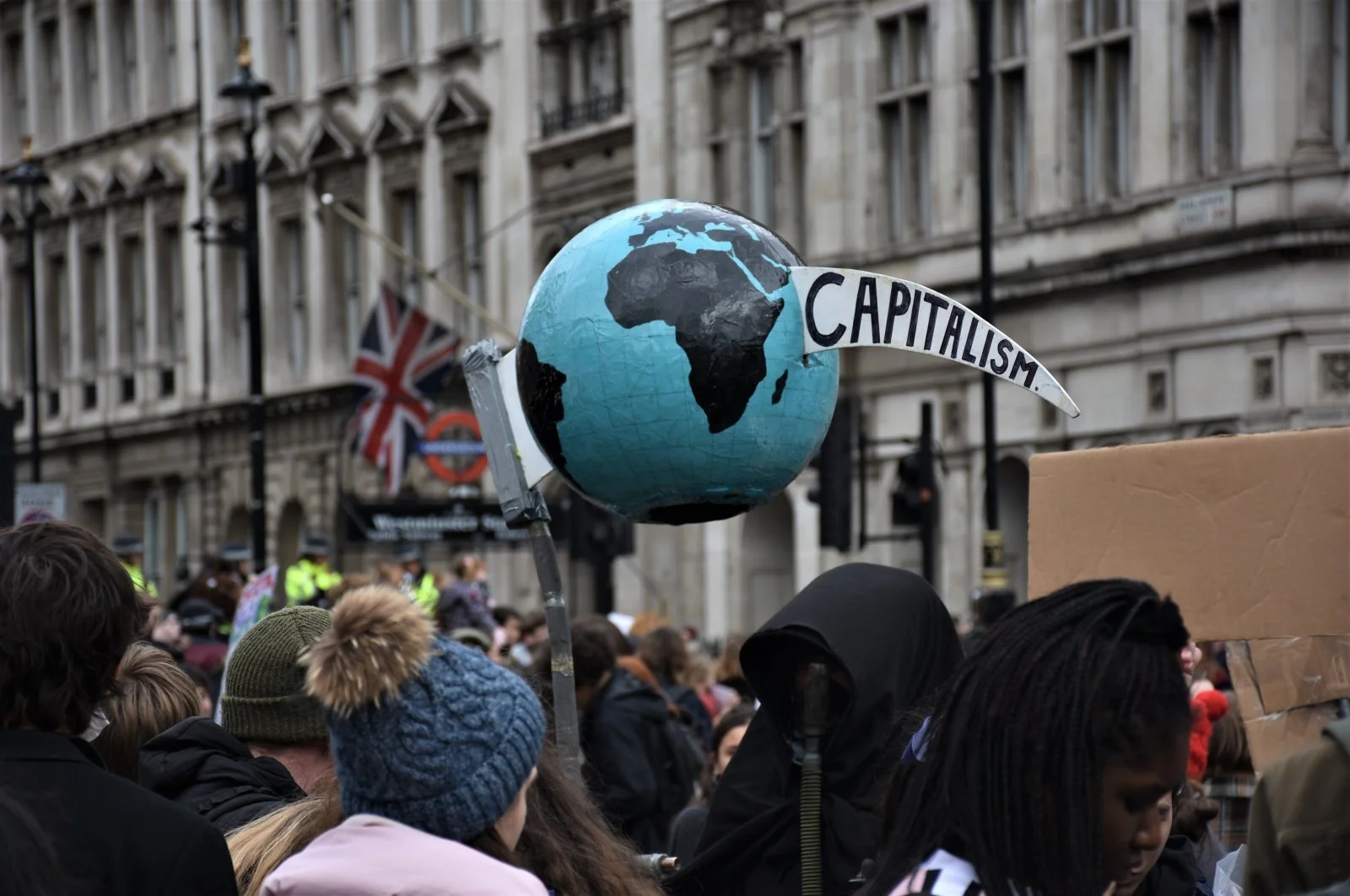


Social Economics

Women, Capitalism, and the Ongoing Attacks On Bodily Autonomy and Reproductive Rights

By Karina Garcia

This article was originally published in the Autumn 2019 issue of Breaking the Chains magazine, titled “Not a Moral Issue.”

Thirteen years ago, a speaker at a meeting, addressing the right-wing attacks on women’s rights in the context of the Affordable Care Act, also known as Obamacare, emphasized how important it was to elect pro-choice Democrats. The speaker gave no further explanation to the attacks.

At the time, the right-wing was attacking the ACA because it would expand abortion and contraception access. A couple years after it became law, the Supreme Court had already restricted access to birth control to “respect the religious beliefs” of corporations vis-a-vis reactionary owners. And to pass the ACA, the Democrats gladly compromised on reproductive rights. Obamacare ultimately continued to deny federal funds for abortion coverage and required that every state offer at least one insurance plan that did not cover abortions.

At the meeting, a young socialist woman spoke from the floor and criticized the speaker for not raising the “systematic” explanation. She said that capitalism was behind these patriarchal policies. She said that the bosses—the capitalists—want to restrict birth control and abortion because they want the working class to produce more workers and thereby drive down wages. On top of that, they want to pay less in healthcare costs to cover their employees. I remember nodding in the moment that indeed there must be a deeper cause. I knew capitalism as a system was implicated. What she was saying had a logic to it. But when I went home it started to make a lot less sense.

Do the capitalists really need more workers? Millions of people are unemployed as it is and they are incarcerating the “surplus” population. Is it really possible that the capitalists would conspire in this way to restrict abortion rights, but none of them would ever slip up and admit it? Why is it that some Democrats support abortion rights then? They too represent the capitalist class’s interests. It can’t just be about forcing women to produce more workers.

And as for costs and profits, the Affordable Care Act was going to make insurance companies, the healthcare sector, and the banks mega-profits with or without abortion coverage, so why try to tank the bill on that basis? It wasn’t really only about profit either.

She was right that the attack was “systematic” and that these sexist policies are linked to capitalism, but there seemed to be more to the answer than she’d presented. I dove into the Marxist and historical writing about the anti-abortion movement because I wanted to understand this and be able to explain it—for myself and others.

The Marxist approach to women’s oppression and liberation is often misunderstood or mischaracterized. In university settings it is portrayed as “economic determinism” or “reductionism” — asserting that Marxists reduce every issue to economics. In a way, that’s what the socialist speaking from the floor was doing in that meeting. But that’s not an accurate description of the Marxist method.

It is true that Marxists emphasize the importance of the economic system, in that the mode of production plays a critical role in shaping the economic system and the structures of society. Marxists start by looking at how a society produces and reproduces itself and the norms, laws and relationships under which production and reproduction take place. That is what “economics” really means anyway. At its base, every society is engaged in producing and reproducing.

The ideas, laws, formal institutions, religions that justify, strengthen, and stabilize those underlying processes and relations at the base of production and reproduction is what Marx called the superstructure.

The capitalist mode of production and the family

So for instance, under capitalism, there are some people who own the means of production (land, factories, technology, etc.), while others go to work every day and work on those means of production. They generate profits that go back to the owners. That exploitation is at the base of society. But that arrangement would not last a single day if it was not backed up by the laws, the courts and the police—which protect the owners and landlords—and by the schools, media, politicians, and religious institutions that have taught us since day one that this is the normal and perfectly natural way of things.

The capitalist mode of production developed historically out of previous modes of production, including slavery and feudalism. Capitalism represented a major change in the dominant form of property and labor and many other things changed as a result of that. Racism and white supremacy are part and parcel of the foundation of modern capitalism. In the case of the United States, colonial dispossession and racialized chattel slavery are the foundations for the accumulation of wealth within the capitalist mode of production.

Capitalism did not simply erase the pre-existing world and start with a blank slate. Patriarchy has existed since the dawn of class society and is part of the fabric of the capitalist system. In pre-class society, before private ownership of property there was a much more diverse set of family arrangements and women generally played a leadership role for the community as a whole.

After those pre-class modes of production were overthrown, and eventually the forms of social and family organization alongside them, women were held in a subordinate position and male supremacy became the law. For thousands of years, women’s basic conditions and status were confined to the home. Law, custom, and ideology held women to a dependent status and entirely subject to the whims of the leading male in the family. Housework and child rearing, in addition to ongoing work in the fields (in the case of agricultural societies), were delineated as “women’s work.” This was a central element to modes of production based on private property.

In the United States, today, the capitalist mode of production has changed in many ways, as has the shape and detail of the superstructure. Yet core historic features persist. While women can enter the wage workforce and women can legally own property and have independent political and civil rights, the basic unit of what has been called social reproduction is the nuclear family. In that family, women carry out the vast majority of the labor in the household, in child rearing, and in elder care. Because this family form has been carried over in its essential characteristics, all the values, traditions, and cultural norms that developed to explain and justify male supremacy have been largely carried over, too.

While capitalism has broken down many of the economic relationships that were at the heart of a nuclear family, the family has not been abolished or collapsed entirely. The family unit has changed, but the precarious existence of workers under capitalism makes it necessary for most workers to have a family to survive. One income is not enough. Take, for example, the conditions of so many LGBTQ youth who have been rejected by their families. To not have a family is, in these instances, to be subjected to the worst forms of deprivation, homelessness, and brutality that capitalism has to offer.

For the purposes of the capitalist system, the family unit is highly valuable—especially as it relates to the reproduction and caring for the next generation of workers. Lisa Vogel highlights this in her social reproduction theory [1]. Others have taken it in different directions, highlighting the other forms of labor that are often unpaid or underpaid, but are nonetheless essential for reproducing a workforce that is healthy and stable enough to continue to come into work.

Reactionary worldview explains economic shifts

How does this relate to the attacks on women’s rights and attacks on women’s growing assertiveness in challenging sexual violence and sexist rhetoric? These don’t present themselves as issues of the basic functioning of the mode of production. They can appear distinct and separate, so people fighting for women’s rights on these fronts might not see the linkage to capitalism. And yet more and more activists are talking about systemic patriarchy. The Party for Socialism and Liberation banners, “The whole system is sexist! Fight for socialism!” have been very popular in these movements.

Here we are talking about struggles in the world of politics and culture, the superstructure [2]. They appear as fights within capitalism—in the sense that you should be able to fight for and achieve full abortion rights and other reproductive services under capitalism. In some countries that already exists. You should be able to reduce sexual harassment or violence or eliminate it altogether under capitalism. At least, in theory, it is not pivotal to the mode of production.

But if that is the case, why are those gains so hard to win? Why do socialists insist a revolution would be necessary to really achieve them? It’s because the domination of women remains a pillar of the U.S. capitalist class’s form of rule.

Abortion access became a major political issue starting in the late 1970s as a cornerstone of an emerging reactionary trend. A reactionary is someone who says that things were better in society before they changed. “Make America Great Again” is a true reactionary slogan. It implies we should return to the past. Big sections of the ruling class turn to a reactionary agenda when they feel that their social control is slipping in the face of a powerful social movement, or when capitalism itself has destabilized the economy and when life seems more uncertain for big sections of the population.

In the late 1970s, both were happening in the United States. The mass uprisings of the 1960s and early 70s with the struggles for women’s liberation, Black liberation, LGBTQ liberation, and the anti-war movement were powerful challenges to the U.S. capitalist status quo. The Vietnamese anti-colonial resistance defeated U.S. imperialism, dealing it a major blow while imperialism was engaged in constant heated confrontation with the socialist bloc.

The U.S. economy also went into a period of recession during which layoffs and unemployment increased, consumer spending decreased. Capitalist recessions are cyclical and occur regularly because of overproduction. From 1979 to 1984, approximately 11.5 million workers either lost their jobs or shifted to lower-paying service jobs. Most of the jobs that were lost were in manufacturing industries such as steel, auto, mining, electronics, and more.

The reactionaries have a very powerful appeal and socialists should understand how it works. They say essentially, “Your life used to be better, right? You’re feeling less sure about your future right? Well, that’s understandable because look at how much has changed. We’ve lost our way. And now we’re going to hell in a hand-basket unless we turn back.” Then they link that to whatever issue, whether it be abortion, sex education, gay rights, and so on. The reactionaries sometimes blame the “weak” government, which has bent to pressure and refused to defend “our values, while at other times attacking the government for being “too big.”

Another example is how the economic ravaging of whole Black communities is laid at the feet of Black women for “having too many children out of wedlock,” or at the feet of “absent” Black males. This reactionary worldview builds upon the extreme racist character of the U.S. capitalist system along with thousands of years of ingrained cultural indoctrination that with a “strong” family—that is with men and women in their “proper place”—everything will be fine.

This sort of reactionary worldview offers an all-purpose explanation for general problems or unsettling changes. Politicians then conveniently avoid discussion of the actual causes of social and economic distress, i.e., capitalist instability. It furthermore coincides with and makes use of the explanations being cultivated in conservative religious institutions, which tend to focus on going back to a more moral time, and theorize the problems of modern society as a reflection of an absence of godliness and values. So these ideas and theories are already circulating and can easily be picked up on by a politician who wants to present himself as a champion of “family values” while not actually doing anything to change families’ material conditions.

And so the “New Right,” ascending in the Republican Party in the late 1970s, started to really focus on abortion in the 1980s and 1990s. Abortion rights were identified as a weak spot for the women’s movement because it had been secured in the Supreme Court in Roe v Wade, not via legislation. There was existing opposition on religious grounds that they could mobilize, and there were big parts of the country where abortion rights had become law but the movement was weak.

Evangelical mega-churches and televangelists were entering politics in a big way—most famously in the “Moral Majority”—and eventually became significant power-brokers that handpicked and groomed elected representatives. They delivered considerable resources and a captive audience to enterprising politicians, as long as they took on their issues and their framing. The whole Moral Majority movement became a target base of support for hard-right capitalists who personally did not care much about abortion or other moral issues, but who wanted to turn back government regulations, social spending, and the power of labor unions. Over time, this relationship produced a major pipeline of campaign funds and airtime.

In short, abortion became a preferred electoral issue, quickly moving from local and state to federal politics. Right-wing politicians could portray pro-choice Democrats as ‘baby killers’ and link them to the “decline of the family.” It is not so much that these issues in and of themselves threaten capitalists profits, but that they offered a way for one sector of the capitalist class—leaning on the powerful institutions of the superstructure in their areas to consolidate political legitimacy—to distract constituents from social and economic concerns that the politicians have no desire to address.

It became a central political strategy for the conservative right. The Republican Party used to be considered just the “pro-business” and “law-and-order” party. Some were actually liberal on “social issues.” But as the party moved further to the right, that has changed.

In the United States, where money controls so much of politics, the agenda is set by the highest bidder. With the near obliteration of campaign finance laws, this has become more overt. A few billionaires could say, “These are my political interests, these are my priorities and I’m gonna throw my money around only to those who take on my agenda and my interests.” When Karl Marx and Friedrich Engels wrote that “the ideas of the ruling class are in every epoch the ruling ideas, they meant that ruling-class ideas were dominant because the ruling class “has the means of material production at its disposal” and therefore “has control at the same time over the means of mental production” [3]. Today ruling-class ideas become dominant because of the direct and explicit intervention of the most powerful capitalists and their politicians. In the absence of a fight-back movement, the reactionary obsessions of some really rich men can set the tone of politics, and actually can determine major issues for hundreds of millions of working-class women in the United States and worldwide.

The anti-abortion billionaires are not spending their money because it will help their immediate profits. If anything, they are spending significant parts of their fortunes on these right-wing causes. That is where capitalism comes back in at the systematic level. It is not as a conspiracy for profits, but as a form of political rule based on disciplining and intimidating one section of poor and working people, distracting and confusing others, and finally winning over and satisfying other layers.

True rights attainable only with a new mode of production

No mode of production based on extreme inequality and exploitation would be able to last long if it did not have ruling institutions, political systems, ideas, traditions, and so on, that protected and rationalized those economic processes. The ruling class does not just get to extract wealth; it also has to find stable ways to rule.

Forms of patriarchy operate powerfully at the base of capitalism, in how the system produces and reproduces itself on a daily basis. It also is a cornerstone at this superstructural level, and in particular, as a central element of the reactionary agenda. So how could patriarchy be ended under capitalism if it is so embedded at every level of the capitalist system? It is impossible.

Socialism, by contrast, eliminates the economic dependence on the family unit. Simply by changing who controls and owns the vast means of production, every person can now be guaranteed housing, food, healthcare, childcare, retirement, and other human needs as guaranteed rights. The gender pay gap and undervaluing of “women’s work” could essentially be overturned overnight. A government in the hands of class-conscious workers would also remove from power the lackeys of the billionaire bigots, and instead launch bold initiatives to advance women’s equality and liberation in the world of culture, ideology, education and politics.

This would be an ongoing process, of course, but it would be fundamentally different from the battle for women’s rights under capitalism. In the present, we fight for rights inside a system that reproduces patriarchal economic relationships daily, and under a ruling class that defaults to a reactionary agenda as a way to protect its exploitative rule. That is why “smashing the patriarchy” often feels so impossible. Under socialism, by contrast, the battle will be to win an egalitarian superstructure that will harmonize with a new economic system based on meeting the needs of all.

References

[1]See Dickinson, Hannah. (2019). “Social reproduction: A theoretical framework with organizing potential.”Breaking the Chains4, no. 1.Also availablehere.
[2] Ford, Derek. (2021). “The base-superstructure: A model for analysis and action.”Liberation School, November 22. Availablehere.
[3] Marx, Karl and Friedrich Engels. (1964/1978). “The German ideology: Part I,” in R.C. Tucker (Ed.),The Marx-Engels reader, 2nd ed.(New York: W.W. Norton & Company), 172.

Unions Fight Back: The Transformation of Labor Law in the United States and its Impact on Union Organizing Strategy

[Pictured: Christian Smalls has become an instrumental part of a nationwide labor resurgence in the United States, heading up union efforts at Amazon]

By Noah Streng

The state of union organizing in America is intimately tied to the legal structures governing labor. Court rulings during the late-19th and early-20th century, for example, created a semi-outlaw status for unions and their activities. Nearly every time unions tried to get the political system to pass pro-labor legislation, their efforts were overturned by a reactionary Supreme Court that had the final say over labor law. A prime example of this was Lochner v. New York (1905).

In the case, the Supreme Court overturned a New York law that prevented bakers from working more than 10 hours per day, citing liberty of contract guaranteed by the 14th Amendment. Unions had fought hard to pass this and other protections for workers in the New York legislature. But, despite the public’s mandate via their elected representatives, the Supreme Court overruled them in favor of private property rights.

Cases like Lochmer were common in postbellum labor relations. The outsized influence of the judiciary left elected legislatures with little say over American labor law. Many unions consequently lost faith in the potential for winning reforms through the ballot box and adopted an anti-statist approach to labor organizing. These unions had never experienced a state that worked on behalf of the working class, so it was hard for them to envision one.

This disillusionment gave rise to the anarcho-syndicalist Industrial Workers of the World (IWW) and voluntarist American Federation of Labor (AFL). Both prioritized grassroots labor action over state intervention. But, despite this commonality, the two unions practiced very different kinds of anti-statism.

The AFL focused on upholding liberty of contract by fighting to remove the government from labor relations entirely. When the AFL participated in elections and legislative advocacy, it was typically to preempt judicial intervention in labor disputes. Meanwhile, the IWW sought to unite laborers across race and gender lines to overthrow capitalism. In their organizing, the IWW gained significant traction — especially among unskilled workers, immigrants, people of color, and women. Unlike the AFL, which organized along craft lines, the IWW ran industrial unions that united all workers in a given shop.

Despite early momentum, however, many judicial rulings stifled the IWW’s ability to organize across racial lines. In Hodges v. United States (1906), for example, the Supreme Court officially stripped black workers of equal labor rights. This — in tandem with other hostile decisions — divided the American working class, thereby frustrating the IWW’s universalist strategy.

The environment for labor improved significantly following the passage of the National Labor Relations Act (NLRA), which guaranteed many American workers the right to organize unions, engage in collective bargaining, and partake in concerted union activity such as strikes. The NLRA did this by expanding executive power over the judiciary, transferring power from courts in labor law cases to the National Labor Relations Board. This paved the way for much of the pro-labor legislation in the New Deal, which the Supreme Court almost certainly would’ve struck down had it been able. The NLRA thus redefined what was politically possible for unions. Now, they could plausibly build worker power through the organs of the state.

Nevertheless, the NLRA had its flaws. Following the precedent set by Hodges and other discriminatory cases, the bill excluded domestic, agricultural, incarcerated, and sex workers from its labor protections. This would be hard to reconcile if we interpret the NLRA as something intended to advance working-class liberation. But that arguably wasn’t its intention at all.

Indeed, the NLRA’s legality was based on the federal government’s right to regulate interstate commerce. The bill provided concessions to labor in order to achieve “labor peace” and ensure the stability of the capitalist economy. Nevertheless, the NLRA — coupled with other pieces of legislation like the Norris-La Guardia Act — was undoubtedly beneficial to workers. By shifting power over labor relations from courts to the administrative state, the NLRA opened new opportunities for radical pro-union reforms.

Despite gains in the previous century, however, we still find ourselves in an era where the federal government and judiciary are aligned with the interests of capital. As both continue to chip away at the progress made by the NLRA, organized labor in the United States needs to develop new strategies for our current context. That includes finding ways to work around — or, preferably, reverse — legal restrictions on union activities as enshrined by, for example, the Taft-Hartley Act and infamous Janus vs. AFSCME (2018) Supreme Court decision. Just as union leaders in the past had to adapt to rapidly changing rules governing labor, leaders today must strategize to meet the moment and revitalize class struggle in America.

One way to do this would be through rekindling the socialist labor movement in the United States. Organizations like the Democratic Socialists of America have already begun doing so by raising over $100,000 for strike funds, engaging in solidarity actions, and directly organizing workers into unions across the country. Labor is at its strongest when grassroots, militant, rank-and-file-led unions organize to radically change society. Part of this strategy should include capturing state power and wielding it to redefine labor law, empowering workers in their fight against the owning class.

Noah Streng is a member of River Valley DSA’s steering committee and a graduate student at the University of Massachusetts Amherst Labor Center.

Inventing Reality: Past and Present

By Youhanna Haddad

Capitalist countries like to claim that they have the freest media. President Joe Biden frequently reiterates America’s supposed commitment to a free press. In a similar vein, the British Broadcasting Corporation has repeatedly lauded the United Kingdom’s ostensible “freedom to publish.”

These statements often feature alongside denunciations of the alleged unfreedom in other countries — particularly those adversarial to Western hegemony. Such criticism tends to take on a certain form. Westerners claim that these adversarial powers tightly curate their media, only allowing information that reinforces state agendas. A recent (retracted) article in The Wall Street Journal, for example, accused China of “parroting lies” via their “solidified grip on information.”

But China is far from the only target. Whether it’s nations in Latin America and the Middle East, or Russia, the Global North’s prominent media institutions frequently remind viewers that information coming out of these places should be heavily scrutinized, with particular caution advised toward state-sponsored media. 

Since the Cold War, the imperial core has honed this rhetoric, which not only espouses the superior integrity of its media institutions but also attributes that integrity to a supposed respect for free speech rights. This narrative sounds good. But it rings utterly hollow upon closer scrutiny. In reality, free speech does little to keep the interests of capital from dictating the “news” Western media reports. As Lenin described over a century ago, “[In] capitalist usage, freedom of the press means freedom of the rich to bribe the press, freedom to use their wealth to shape and fabricate so-called public opinion.”

In the United States, just six corporations own a whopping 90% of the news media. This centralization demonstrates that, despite what seems like an abundance of options, the media is controlled by a tiny capitalist minority. And this minority is united by an overriding monolithic interest: profit. That means the media is only really free to report what doesn’t threaten the bottom lines of its owners.

But that is far from the only source of bias. Oftentimes, Western media institutions act at the direct behest of their governments. While the full extent of such collusion is often hidden in classified documents, what little has trickled into the public view vindicates the belief that “free” Western media is a fantasy.

The history of collusion between Western governments and media megacorporations is both storied and unsettling. Consider the 1975 Church Committee, which was organized by the United States Senate to investigate potential abuses by the CIA, NSA, and FBI. The Church Committee formed after several major news stories broke implicating the Department of Defense and CIA in the surveillance of civilians and covert assassinations of foreign leaders. 

One of the most disturbing findings was the explicit confirmation of CIA involvement in domestic and foreign media. The Committee confirmed at least “50 CIA relationships with U.S. journalists or employees of U.S. media organizations.” Additionally, it demonstrated that the CIA had control of two European press services — one of which was subscribed to by “over 30 U.S. newspapers.” With a notable lack of remorse, a senior CIA official told the Committee that, “Whether or not this type of overseas activity should be allowed to continue is subject to differing views and judgments… [in my opinion] we would be fools to relinquish it because it serves a very useful purpose.”

CIA defector Colonel John Stockwell corroborated this practice of media corruption. On his assignment to the Angolan Civil War, he allegedly headed a CIA campaign to disseminate news stories that slandered the Popular Movement for the Liberation of Angola and their Cuban reinforcements. According to Stockwell, a full third of his CIA personnel in Angola were career propagandists. One startling falsehood they reported was a totally fabricated execution of 17 Cuban soldiers for the rapes of Angolan women. Framed as an act of feminist liberation, the imaginary victims supposedly executed the perpetrators by firing squad. This tale made its way to the front page of the Toronto Star — Canada’s largest daily newspaper — the Globe and Mail, and local papers in Winnipeg, Halifax, and Montreal. 

More recently, a 2019 bombshell in The Washington Post revealed that — even in this century — United States’ military campaigns are shrouded in lies to make them more palatable to the American public. Generals, senior federal officials, an Afghan War czar, and a Bush-era secretary of defense all confirm that the war in Afghanistan was unwinnable while claiming that there was “no way” the United States could lose the war when interviewed. Federal officials faithfully chanted “steady progress” throughout the duration of the war despite knowing that their objectives were bound to fail via the means they were employing.

Today, the world's eyes are on Ukraine. Russian troops have been in the country for over nine months after Ukraine, against Russia’s repeated warnings, moved to join NATO. Since the invasion began, the United States has spent $68 billion to aid the Ukrainian government and military.  

While modern Russia is thoroughly capitalist, it's easy to see why NATO — the world’s preeminent imperialist alliance — views it as a threat. The country has the world's largest nuclear arsenal and its security interests are directly opposed to NATO’s objective of expanding eastward toward Russia’s borders. Russia’s invasion of Ukraine was not unexpected by any stretch of the imagination, Russian leaders have expressed for decades that their ability to defend their nation from invasion or global conflict would be severely compromised if NATO was permitted to expand toward its borders. 

Most infamously, declassified State Department documents confirm former Secretary of State James Baker promised Soviet President Mikhail Gorbachev that NATO would not expand “one inch eastward” in 1990. To the contrary, NATO has admitted 14 former Soviet or Soviet-aligned states since then.

From the billions in aid to Ukraine, it’s clear the United States is investing heavily in the outcome of the Russo-Ukrainian war. Much of that aid is designated for weapons that are not yet manufactured, suggesting the United States is ready to support the neoliberal Ukrainian government for years to come. This means that — just like in Vietnam and Afghanistan — the federal government is dedicated to a long-term conflict with little regard for any public resistance they may encounter. Ask yourself: When in its history has the United States heavily funded a fighting force that was trying to improve living standards for any group of working people?

Today, we face a nonstop barrage of pro-Ukrainian media. Major news outlets have been reporting optimistically on Ukraine’s war efforts, while Russian troops remain planted on Ukrainian soil since February. Western bourgeois media is clearly trying to make NATO’s investment in Ukraine seem worthwhile, as they have done to support the invasions of Vietnam, Iraq, and Afghanistan.

You don’t have to be a Putin apologist to understand that Western powers see Russia as a threat to their hegemony. Those with a deep respect for human life should hope to see an expedient and diplomatic end to the conflict, with no further expansion of NATO. Unlike the United States and her allies, we should not support the effort to include Ukraine in NATO at any cost. This position is nonsensical, and only remains publicly acceptable due to the tireless media campaigns of a supposedly “free press” in the Global North.


Youhanna Haddad is a North American Marxist of the Arab diaspora. Through his writing, he seeks to combat the Western liberal dogmas that uphold racial capitalism.

Elon Musk, Twitter, and the Power of Ownership

[Musk family wealth came from property ownership throughout Africa, including Apartheid South Africa and Zambia, where Errol Musk owned an emerald mine like the one pictured above]

By Carl Beijer

Republished from the author’s blog.

Last month, Elon Musk purchased Twitter and immediately disbanded its entire board of directors. This may have surprised you if you get your ideas about power from the populist right, who have been telling us that “power has passed from individual bourgeois business to a new ruling class” — the so-called “managerial elite.” Evidently, their “cultural power” with its full arsenal of “wokeness” and “cancel culture” couldn’t do a damn thing to save them in the end.

Even their enormous incomes couldn’t help them! These are no blue collar workers; these are multi-millionaires with astronomical salaries. “Heterodox economists” like Lévy and Duménil tell us that capitalism is over and we now live in the age of “managerialism”, in which “the main social split is nowadays between lower and higher wage earners, and increasingly so in conformity with the rise of managers”; but Musk had no problem whatsoever kicking some of the highest paid managers in the world to the curb.

Capitalist discourse loves to dismiss Marxist economics as a kind of obscurantist and contrarian analysis that no sensible person could possibly take seriously, but look at how everyone is talking about Musk right now and it’s obvious that we all know exactly what happened. He won because he took ownership of Twitter. That is what allowed him to crush the assembled power of the professional managerial class — Twitter’s corporate governance structure, the complex of NGO professionals and celebrities and academics who protested his takeover, all of it — on a whim. Taking ownership was his coronation, and the moment it happened everyone knew that his opponents would never prevail.

If you take one lesson from the Musk takeover, it should be this: capitalists can do this whenever they want. And even the highest-level managers and corporate executives know it, which means that they can only either defer to ownership or risk getting fired. This is a point I spelled out a few months ago when former WWE CEO Vince McMahon resigned:

Whether or not he has plans to exercise that power [majority ownership of the the WWE] is beside the point; at any given moment, shareholder Vince can decide to appoint a new board that will re-appoint him as CEO. And the very possibility that he could do this gives him the exact same power over management that shareholders have when Vince pleads that he only fired wrestlers because he’s a publicly traded company.

Private ownership confers a unique form of power unlike anything else in our politics. It matters more than professional titles, than academic degrees, than cultural norms and values, than the power of free speech and public reason. Even the state’s victory against it isn’t assured. And there is no form of power concentrated in fewer hands.

Nor is there any form of power that we meet with less skepticism. If you don’t believe me, just pay attention to how we talk about Musk’s power-play moving forward. You’re going to see a lot of talk about how Musk is a bad apple, one of those dreaded right-wing Silicon Valley billionaires. You’re going to hear about the rising tide of fascism, driven by vague hatreds of egalitarianism and freedom. You’re even going to hear some talk about “corporate” power, as if Twitter’s board would still be in control if it were structured slightly differently. But what you won’t hear is skepticism of the basic legal, political, and economic institution — private property — that actually keeps Musk in control.

Marx, Ecology, and Politics: An Interview with Dr. Derek Wall

By Devon Bowers

This is the transcript of a recent email interview I did with Dr. Derek Wall where we discuss, in greater depth, his article entitled “Imperialism is the Arsonist: Marxism’s Contribution to Ecological Literatures and Struggles,” about Marx’s contribution to ecological thought, where current socialist governments are acting regarding the environment, and how EcoMarxists interact with electoral politics.


Devon: Where does this idea that Marx can be applied to the environment originate from? Kind of, if you can, give me sort of a history of Marxist thought being applied to the environment.

Derek: The ‘idea that Marx can be applied to the environment’ I think it comes from Marx and Engels. While both wrote a huge amount, within their vast output of they produced numerous statements of environmental concern. Engels, for example, wrote The Condition of the English Working Class in the 1840s. While this is near to the beginning of his writings it was already indicating that air and water pollution were an environmental threat. His notion of social murder encompassed hunger and poverty and such the effect of poisonous pollution, social murder is a concept that might cover the deaths from extreme weather we are already encountering from climate change.

In his ‘Letters from Wuppertal’ written back in 1839 Engels notes both air and water pollution as serious ills, ‘Work in low rooms where people breathe more coal fumes and dust than oxygen — and in the majority of cases beginning already at the age of six — is bound to deprive them of all strength and joy in life.’ He observed that red colour of the river was a product not of battle but industrial pollution, the result ‘simply and solely to the numerous dye-works using Turkey red.’

At various points in Capital Marx addresses problems that might be identified by environmentalists today such as food additives and deforestation. Capital provides perhaps the clearest application of Marxist thought to the environment, when Marx notes in volume three of our duty to future generations:

Even an entire society, a nation, or all simultaneously existing societies taken together, are not the owners of the earth. They are simply its possessors, its beneficiaries, and have to bequeath it in an improved state to succeeding generations as boni patres familias [good heads of the household].

In turn Engels, while not using the then newly coined term ‘ecology’, reveals his understanding of the science, based on relationships between species, that can lead to unexpected effects. This is from his text The Part played by Labour in the Transition from Ape to Man:

‘Let us not, however, flatter ourselves overmuch on account of our human victories over nature. For each such victory nature takes its revenge on us. Each victory, it is true, in the first place brings about the results we expected, but in the second and third places it has quite different, unforeseen effects which only too often cancel the first. The people who, in Mesopotamia, Greece, Asia Minor and elsewhere, destroyed the forests to obtain cultivable land, never dreamed that by removing along with the forests the collecting centres and reservoirs of moisture they were laying the basis for the present forlorn state of those countries.’

I guess an early application of this Marxist ecology can be found via William Morris, the British poet, artist and revolutionary. Concerned initially with church conservation, which is perhaps far from radical environmentalism, he read Marx as a defender of the environment against the ravages of capitalism. Morris was active in Britain’s first Marxist organisation the Social Democratic Federation.

Also in Britain, excuse my bias as I live here, the Sporting organisation associated with the Communist Party undertook the Kinder Scout trespass in the 1930s. This was to demand that workers have access to countryside moorland that was monopolised by large landowners. 

During the 1950s and 60s rising awareness of global environmental problems, staring with atmospheric nuclear testing, led to a growing environmental movement. Organisations like Friends of the Earth and Greenpeace originated in the late 1960s or early 1970s along with Ecology Parties in the same decade. A minority of writers made the connection between capitalism and environmental destruction. While an anarchist rather than a Marxist, New Yorker Murray Bookchin, writing under the pseudonym of Lewis Herber, drew upon a critique of capitalism to explain the origins of environmental problems, publishing Our Synthetic Environment in 1962, and other works in the 1970s and 80s. Anti-Marxist in his politics, Marxism did paradoxically inform his analysis of ecological problems.

The Frankfurt school of Western Marxists including Marcuse also began to consider ecological problems in this period. Erich Fromm, the psychoanalyst, associated with the Frankfurt school, argued for an ecological politics, which drew upon Marx’s early Paris Manuscripts, showing how work under capitalism alienated us from the rest of nature. This is explained most clearly in his book To Have or to Be?

There are many individuals who have made some kind of link between Marx and Engels work and environmental concerns, however perhaps the most significant intervention in the late 20th century came from Fidel Castro at the 1992 environmental Rio conference. Castro was the first leader of a socialist country to stress the importance of ecological matters, and wrote extensively on the climate crisis and similar threats.


You quote John Kovel who notes that socialism, due to its thought occurring during industrialization, focuses on "the technological optimism of the industrial world-view, and its associated logic of productivism." In what ways do socialist states still perpetuate this idea? Or have some come to include the environment as a meaningful part of political thought?

I feel there is room for cautious optimism. The Soviet Union throw everything into rapid industrial development, often with ecologically damaging effects, a logic that would have continued if Trotsky had replaced Stalin. Having said this, the logic of productivism did provide the Soviet Union the material and technological resources necessary to defeat Hitler. Nonetheless on the whole one gets the impression that a race to outdo the USA in terms of economic growth inspired much Soviet economic development with negative results in terms of pollution and loss of biodiversity.

China is advocating a policy of promoting ‘ecological civilisation’. Mao’s war on the sparrows sounds like a foolish aberration from a Communist sensitive to contradictions and well versed in philosophy! I have never visited China and I am loath to analyse a part of the world I am largely ignorant of. However, it is clear that the present Chinese government and Chinese people at all levels of society, like Engels, are aware that ecological problems can strike where they are least expected. It is good that China has agreed to stop funding foreign coal plants and huge efforts are going into expanding renewable energy. China is the world’s largest producer of solar panels too. Perhaps though this is a version of ecological modernism, expanding technological solutions, without working towards an economy that rejects ever increasing production. Electric cars, whose production and consumption, are rising faster in China than perhaps any other part of the world, are imperfect environmental solutions. Nonetheless environmental considerations are at the core of economic development plans in the country. The rapid expansion of high speed rail, shames countries like the US and the UK, where the dominance of cars is unquestioned.

Cuba is perhaps the country closest to managing to create ecologically sustainable development on our planet, and is worthy of close study. Much has been written on this. During the special period in the 1990s when the fall of the Soviet Union made it difficult for Cuban to get cheap oil, a crash programme that reduced dependence on fossil fuels was instigated, with much success. Cuba shows that socialist countries potentially can achieve far more than capitalist states, when it comes to serious action on climate change.

Recently Salvatore Engel-Di Mauro's book Socialist States and the Environment: Lessons for Ecosocialist Futures has reassessed thinking about the environmental record of socialist states, suggesting that their record was much better than once thought. In the shadow of Cold War propaganda, everything was distorted, despite some serious environmental damage in the Soviet Union, there was also a programme of nature conservation. Just this week I have seen an interesting discussion of how Soviet scientists and planners in the 1970s responded to the Limits to Growth report, produced by MIT “Limits to growth” in communism? - cibcom.

In summary, while capitalism is innately ecologically destructive, for much of the 20th century Socialist States also engaged in environmentally damaging practices, however learning has taken place since, while not unproblematic the practices in China are encouraging and those in Cuba lead the world when it comes to climate change action.

You write "Marx and Engels’ sustained meditations on the sciences including biology, brought them to consider environmental issues." Talk about Marx' and Engels' focus on the hard sciences. I find this interesting as they're oft portrayed as people focused on sociology and economics.

Yes it is easily forgotten that they were obsessive in their concern to keep up with the most important developments in the natural sciences in their day. John Bellamy Foster has explored this topic in exhaustive detail in his book Marx’s Ecology. For Foster, ecology (even the exact term was not coined until later), is at the heart of Marx’s materialism. You can’t separate the science from the philosophy, perhaps there is more to the term ‘scientific socialism’ that is often assumed?


Noting that the Germany Green Party has left its original, radical roots and moved broadly over the decades towards a more center right line and how with the Dutch Socialist Party, too, has become a run-of-the-mill Social Democrat party, do you think that EcoMarxists or those who hold such sympathies should become involved with electoral politics or just shun it all together? In what ways are EcoMarxists interacting with mainstream political parties and electoral politics more generally?

West European Green and Left parties have indeed had limited success and often moved to the centre or the right. The trajectory of both the German Greens and, as you note, the Dutch Socialist Party, is perhaps particularly sobering, organisations moving from Marxist-Leninist roots to the center ground today. It is a sad irony that the German Greens were born out of the peace movement but are advocates of war, and even promoting fossil fuel extraction, at least, in the short term, to deal with the energy crisis caused by the conflict in the Ukraine. In Britain, things are a little different, the Labour Party here, despite a short respite under Jeremy Corbyn’s leadership has never been a radical party. Labour supported Empire, in the 1930s embrace the economics of austerity and at present under Keir Starmer are competing with the Tory government to show they are a pro-business party. 

I don’t think it is adequate to say abandon all electoral politics. Alternative socialist strategies haven’t been effective either in Western Europe, the generation that produced the German Greens were the generation involved in the Bader-Meinhof gang, which can hardly been seen as successful intervention. In other parts of the world, particularly Latin America, the left have made some progress through the electoral route. While this has not been uniform and has led to compromises, the success of left parties in Ecuador, Bolivia, Venezuela and more recently Colombia is encouraging.

Rudi Dutschke the German socialist, argued that there should be ‘a long march through the institutions’, in practice the institutions have generally marched over the left, crushing hopes…sadly this is largely the lesson of the German Greens. I am most inspired by the base building approach of groups like Philly Socialists and near to where I live the Welsh Underground Network. Building community revolutionary capacity through practical action and solidarity. Capacity building is also a means of creating community self-defence in the face of rising environmental crisis and the growth of the far right.

Ecosocialist engagement with electoral politics, where it has occurred, is varied. In Australia the Socialist Alliance have elected local councillors. The example of Nick Origlass, in the 1980s, a pioneering ecosocialists who left the Australian Labor Party, over toxic waste plans, has been an inspiration to such Australian ecosocialists. He was eventually elected Mayor of Leichhardt, Sydney. He defeated motorway building plans through a working class community, created participatory council meetings and reclaimed land for community use. There is a good account of his work in the Australian Dictionary of National Biography here.

So may be some progress is possible with electoral work but yes more often than not electoral politics has institutionalised those on the left rather than allowing institutional transformation. Some ecosocialists are involved in Green or Social Democratic Parties. The HDP in Turkey is a good example of where more radical electoral politics has been linked to popular struggles, although this mainly Kurdish Party has been subject to much repression. The situation is different in different parts of the world.


What are some of the responses of EcoMarxists to climate change, especially given the fact that we have very possibly hit the point of no return regarding major environmental changes? (For example, we hit that point with ocean temperatures in 2014.)

When I first became interested in green politics in the 1980s climate change seem to be a distant problem, now it is an immediate threat. Every day apparently brings news of more extreme weather, in the summer here where I live in Southern England, I witnessed the highest temperatures of my life time. The future is now.

One response from ecosocialists has been to go back to Lenin, if capitalism is destroying the world, a more strategic approach is surely necessary. Andreas Malm, Kai Heron and Jodi Dean and others have been arguing that Lenin provides inspiration in an age of climate crisis. There is a good outline of the debates around Lenin, climate change and ecosocialism here.

Andreas Malm in his recent book How to Blow up a Pipeline argues that the desperation of the situation demands that we take direct action against oil extraction.

There is perhaps an increasing realisation that climate change rather than being an accidental consequence of business as usual which can be approached with technocratic solutions is part of a war. With oil and fossil fuel companies on one side of the conflict and the rest of humanity and nature on the other. So, while not specifically ecosocialists the approach of the British organisation Just Stop Oil, using direct action against oil companies is to be applaud.

Of course, workers plans to convert ecological damaging mining and manufacturing into alternative sources of production is another element of ecosocialist strategy. The Lucas Plan in Britain and the Green Ban trade union campaigns in Australia are examples.

Where can people learn more about Ecosocialism? What are some good books, podcasts, or videos, you would recommend?

Kali Aukuno is a good source of ecosocialists activism, may be start with his interview here.

John Bellamy Foster, while he doesn’t use the term ecosocialism, feeling socialist traditions at least from Marx are innately ecological, has produced numerous books, articles, podcasts, etc. MR Online which he works with is a very good source for numerous articles on ecosocialism. Green Left Weekly in Australia and Climate and Capitalism are also excellent. 

Of the numerous books on ecosocialism, I still think, Alan Roberts The Self-Managing Environment from 1979 is the best, although a bit difficult to track down. People might also be interested in my biography of the great Latin American ecosocialist Hugo Blanco published by Merlin Press.

Finally I must mention Max Ajl’s work, rooting ecological socialism in the struggles of the South, breaking the Eurocentric and North American bias of much of the left. His book A People’s Green New Deal is essential reading. There is a useful interview with him from my comrades at Ebb Magazine here.

Of, By, and For the Elite: The Class Character of the U.S. Constitution

By Crystal Kim

Republished from Liberation School.

Contrary to the mythology we learn in school, the founding fathers feared and hated the concept of democracy—which they derisively referred to as “tyranny of the majority.” The constitution that they wrote reflects this, and seeks to restrict and prohibit involvement of the masses of people in key areas of decision making. The following article, originally written in 2008, reviews the true history of the constitution and its role in the political life of the country.

The ruling class of today—the political and social successors to the “founding fathers”—continues to have a fundamental disdain for popular participation in government. The right wing of the elite is engaged in an all-out offensive against basic democratic rights and democracy itself. This offensive relies heavily on the Supreme Court and the legal doctrine of constitutional “originalism”. Originalism means that the only rights and policies that are protected are ones that are explicitly laid out in the constitution, conforming with the “original” intentions of the founders. As the article explores, this was a thoroughly anti-democratic set up that sought to guarantee the power and wealth of the elite.

Introduction

In history and civics classrooms all over the United States, students are taught from an early age to revere the “Founding Fathers” for drafting a document that is the bulwark of democracy and freedom—the U.S. Constitution. We are taught that the Constitution is a work of genius that established a representative government, safeguarded by the system of “checks and balances,” and guarantees fundamental rights such as the freedom of speech, religion and assembly. According to this mythology, the Constitution embodies and promotes the spirit and power of the people.

Why, then, if the country’s founding document is so perfect, has the immense suffering of the majority of its people—as a result of exploitation and oppression—been a central feature of the U.S.? How could almost half of the population be designated poor or low income? Why would the U.S. have the world’s largest and most extensive prison system? If the Constitution, the supreme law of this country, was written to protect and promote the interests of the people, why didn’t it include any guarantees to the most basic necessities of life?

This contradiction between reality and rhetoric can be understood by examining the conditions under which the U.S. Constitution was drafted, including the class background of the drafters. Although it is touted today as a document enshrining “democratic values,” it was widely hated by the lower classes that had participated in the 1776-1783 Revolutionary War. Popular opposition was so great, in fact, that the drafting of the Constitution had to be done in secret in a closed-door conference.

The purpose of the Constitution was to reorganize the form of government so as to enhance the centralized power of the state. It allowed for national taxation that provided the funds for a national standing army. Local militias were considered inadequate to battle the various Native American nations whose lands were coveted by land speculators. A national army was explicitly created to suppress slave rebellions, insurgent small farmers and the newly emerging landless working class that was employed for wages.

The goal of the Constitution and the form of government was to defend the minority class of affluent property owners against the anticipated “tyranny of the majority.” As James Madison, a principal author of the Constitution, wrote: “But the most common and durable source of factions [dissenting groups] has been the various and unequal distribution of property” [1].

The newly centralized state set forth in the Constitution was also designed to regulate interstate trade. This was necessary since cutthroat competition between different regions and states was degenerating into trade wars, boycotts and outright military conflict.

The U.S. Congress was created as a forum where commercial and political conflicts between merchants, manufacturers and big farmers could be debated and resolved without resort to economic and military war.

Conditions leading to the U.S. Revolution

To understand the class interests reflected in the Constitution, it is necessary to examine the social and economic conditions of the time. In the decades leading up to the U.S. revolutionary period, colonial society was marked by extreme oppression and class disparities.

The economies of the colonies were originally organized in the interests of the British merchant capitalists who profited by trade with the colonies. These interests were guaranteed by the British monarchy headed by King George III. In the southern colonies like Virginia, Georgia and the Carolinas, a settler class of slave-owning big planters grew rich providing the cotton that fed Britain’s massive textile manufacturing industry.

In the northern colonies, merchant economies in the port cities and associated small manufacturing industries formed the basis for the division between rich and poor. In the countryside, huge landowners who owed their holdings to privilege in Europe squeezed the limited opportunities of small farmers.

In 1700, for example, 75 percent of land in colonial New York state belonged to fewer than 12 individuals. In Virginia, seven individuals owned over 1.7 million acres [2]. By 1767, the richest 10 percent of Boston taxpayers held about 66 percent of Boston’s taxable wealth, while the poorest 30 percent of taxpayers had no property at all [3]. Similar conditions could be found throughout the colonies. Clearly, there was an established ruling class within the colonies, although this grouping was ultimately subordinate to the British crown.

On the other hand, the majority of society—Black slaves, Native Americans, indentured servants and poor farmers—experienced super-exploitation and oppression. Women of all classes had, like their peers in Europe, no formal political rights.

With these growing class antagonisms, the 18th century was characterized by mass discontent, which led to frequent demonstrations and even uprisings by those on the bottom rung of colonial society.

Between 1676 and 1760, there were at least 18 uprisings aimed at overthrowing a colonial government. There were six slave rebellions as well as 40 riots like the numerous tenant uprisings in New Jersey and New York directed against landlords [4]. Many of these uprisings were directed at the local elite and not the British Empire.

This local elite in colonial society found itself squeezed between the wrath of the lower working classes, on one side, and the British Empire, on the other.

Following the 1763 British victory in the Seven Years’ War in Europe, which included the so-called French and Indian War in North America, the French position as a colonial power competing with Britain was seriously downgraded as a result of their defeat. The French did send troops and military aid to support the colonists in their war for independence from Britain a decade later.

Following the defeat of the French in 1763, George III attempted to stabilize relations with Native Americans, who had fought primarily alongside the defeated French, by issuing the Proclamation of 1763. This decree declared Indian lands beyond the Appalachians out of bounds for colonial settlers, thereby limiting vast amounts of wealth the settlers could steal from the indigenous people. Chauvinist expansionism thus became fuel for anti-British sentiment in the colonies.

Making matters worse for the colonists, the British Empire began demanding more resources from the colonies to pay for the war. In 1765, the British Parliament passed the fourth Stamp Act, basically increasing taxes on the colonists. The Stamp Act of 1765 incited anger across all class strata, including British merchants, and was ultimately repealed in 1766.

The struggle around the Stamp Act demonstrated a shift in power relations between the colonists and the British Empire. While the local American elites were in less and less need of Britain’s assistance, the British Empire was in ever growing need of the wealth and resources of the colonies.

In summary, there were at least four factors that would motivate the American “new rich” to seek independence from the British crown. First, the anger of the poor and oppressed against the rich could be deflected from the local elite and channeled into hatred of the British crown—developing a new sense of patriotism. Second, the wealth produced and extracted in the colonies would remain in the pockets of the local ruling class rather than being transferred to the British Empire. Third, the local ruling class would greatly increase its wealth through the confiscation of property of those loyal to Britain. And lastly, independence would nullify the Proclamation of 1763, opening up vast amounts of Native land.

Two points qualified the drive to independence, which ultimately manifested itself in the sizable “Loyalist” or pro-British population during the revolution. First, despite the conflict between the colonists and the British government over wealth, colonists and colonizers were united against the Native American population, whom both tried to massacre and loot. The revolutionary struggle was not against exploitation, but to determine who would do the exploiting.

Secondly, in spite of the disputes over who got how much of the wealth generated by the colonies, this wealth primarily depended on the integration of the economy with British merchant capitalism. While the revolutionists wanted political distance from the empire, they could not afford a complete break.

The leaders of the U.S. Revolution

Revolutionary sentiment among the lowest classes of colonial society was largely spontaneous and unorganized. Leadership of the anti-British rebellion, groups like the Sons of Liberty, originated from the middle and upper classes. Some poor workers and farmers did join their ranks, allowing their leadership to garner popular support.

These leaders were conscious of the fact that only one class would be really liberated through independence from Britain: the local ruling class. However, in order to carry this out, they would have to create a façade of liberating the masses.

This is why the 1776 Declaration of Independence—the document used to inspire colonists to fight against Britain—includes language that was so much more radical than that of the 1787 U.S. Constitution. In fact, Thomas Jefferson had originally drafted a paragraph in the Declaration of Independence condemning George III for transporting slaves from Africa to the colonies and “suppressing every legislative attempt to prohibit or to restrain this execrable commerce” [5]. Jefferson himself personally owned hundreds of slaves until the day he died, but he understood the appeal such a statement would have.

Instead, the final draft of the Declaration accused the British monarchy of inciting slave rebellions and supporting Indian land claims against the settlers. “He [the king] has incited domestic insurrection amongst us,” the final version read, “and has endeavored to bring on the inhabitants of our frontiers, the merciless Indian Savages.”

Sixty-nine percent of the signers of the Declaration of Independence held colonial office under England. When the document was read in Boston, the Boston Committee of Correspondence ordered the townsmen to show up for a draft to fight the British. The rich avoided the draft by paying for substitutes, while the poor had no choice but to fight.

Slavery existed in all 13 British colonies, but it was the anchor for the economic system in the mid-Atlantic and southern states.

Thousands of slaves fought on both sides of the War of Independence. The British governor of Virginia had issued a proclamation promising freedom to any slave who could make it to the British lines—as long as their owner was not loyal to the British Crown. Tens of thousands of enslaved Africans did just that. Thousands managed to leave with the British when they were defeated, but tens of thousands more were returned to enslavement after the colonies won their “freedom” in 1783.

Following the 1783 Treaty of Paris, which established the independence of the colonies, vast amounts of wealth and land were confiscated from Loyalists. Some of this land was parceled out to small farmers to draw support for the new government.

While most Loyalists left the United States, some were protected. For instance, Lord Fairfax of Virginia, who owned over 5 million acres of land across 21 counties, was protected because he was a friend of George Washington—at that time, among the richest men in America [6].

The drafting of the Constitution

In May 1787, 55 men—now known as the “Founding Fathers”—gathered in Philadelphia at the Constitutional Convention to draft the new country’s legal principles and establish the new government. Alexander Hamilton—a delegate of New York, George Washington’s closest advisor and the first secretary of the treasury—summed up their task: “All communities divide themselves into the few and the many. The first are the rich and well-born, the other the mass of the people… Give therefore to the first class a distinct permanent share in the government” [7]. Indeed, the task of the 55 men was to draft a document that would guarantee the power and privileges of the new ruling class while making just enough concessions to deflect dissent from other classes in society.

Who were the Founding Fathers? It goes without saying that all the delegates were white, property-owning men. Citing the work of Charles Beard, Howard Zinn wrote, “A majority of them were lawyers by profession, most of them were men of wealth, in land, slaves, manufacturing or shipping, half of them had money loaned out at interest, and 40 of the 55 held government bonds” [8].

The vast majority of the population was not represented at the Constitutional Convention: There were no women, African Americans, Native Americans or poor whites. The U.S. Constitution was written by property-owning white men to give political power, including voting rights, exclusively to property-owning white men, who made up about 10 percent of the population.

Alexander Hamilton advocated for monarchical-style government with a president and senate chosen for life. The Constitutional Convention opted, rather, for a “popularly” elected House of Representatives, a Senate chosen by state legislators, a president elected by electors chosen by state legislators, and Supreme Court justices appointed by the president.

Democracy was intended as a cover. In the 10th article of the “Federalist Papers”—85 newspaper articles written by James Madison, Alexander Hamilton and John Jay advocating ratification of the U.S. Constitution—Madison wrote that the establishment of the government set forth by the Constitution would control “domestic faction and insurrection” deriving from “a rage for paper money, for an abolition of debts, for an equal distribution of property, or for any other improper or wicked project.” During the convention, Alexander Hamilton delivered a speech advocating a strong centralized state power to “check the imprudence of democracy.”

It is quite telling that the Constitution took the famous phrase of the Declaration of Independence “life, liberty and the pursuit of happiness” and changed it to “life, liberty and property.” The debates of the Constitutional Convention were largely over competing economic interests of the wealthy, not a debate between haves and have-nots.

The new Constitution legalized slavery. Article 4, Section 2 required that escaped slaves be delivered back to their masters. Slaves would count as three-fifths of a human being for purposes of deciding representation in Congress. The “three-fifths compromise” was between southern slave-holding delegates who wanted to count slaves in the population to increase their representation, while delegates from the northern states wanted to limit their influence and so not count slaves as people at all.

Furthermore, some of the most important constitutional rights, such as the right to free speech, the right to bear arms and the right to assembly were not intended to be included in the Constitution at all. The Bill of Rights was amended to the Constitution four years after the Constitutional Convention had adjourned so that the document could get enough support for ratification.

As a counter to the Bill of Rights, the Constitution gave Congress the power to limit these rights to varying degrees. For example, seven years after the Constitution was amended to provide the right to free speech, Congress passed the Sedition Act of 1798, which made it a crime to say or write anything “false, scandalous or malicious” against the government, Congress or president with the intent to defame or build popular hatred of these entities.

Today, many people look to the Constitution—and especially to the Bill of Rights—as the only guarantor of basic political rights. And while the Constitution has never protected striking workers from being beaten over the heads by police clubs while exercising their right to assemble outside plant gates, or protected revolutionaries’ right to freedom of speech as they are jailed or gunned down, the legal gains for those without property do need to be defended.

But defending those rights has to be done with the knowledge that the founding document of the United States has allowed the scourge of unemployment, poverty and exploitation to carry on unabated because it was a document meant to enshrine class oppression. A constitution for a socialist United States would begin with the rights of working and oppressed people.

During the period leading to the second U.S. Revolution, commonly known as the Civil War, militant opponents of slavery traveled the country to expose the criminal institution that was a bedrock of U.S. society. On July 4, 1854, abolitionist William Lloyd Garrison burned a copy of the Constitution before thousands of supporters of the New England Anti-Slavery Society. He called it a “covenant with death and an agreement with hell,” referring to its enshrining of slavery.

The crowd shouted back, “Amen” [9].

Although slavery has been abolished, the property that is central to the Constitution—private property, the right to exploit the majority for the benefit of the tiny minority—remains. In that sense, Garrison’s words still ring true.

References

[1] James Madison, Federalist Papers, No. 10. Availablehere.
[2] Michael Parenti,Democracy for the Few, 9th ed. (Boston: Wadsworth, 1974/2011), 5.
[3] Howard Zinn,A People’s History of the United States(New York: Longman, 1980), 65.
[4] Ibid., 59.
[5] Ibid., 72.
[6] Ibid., 84.
[7] Cited in Howard Zinn,Declarations of Independence: Cross-Examining American Ideology(New York: Harper Collins, 1990), 152.
[8] Zinn,A People’s History of the United States, 89.
[9] Zinn,Declarations of Independence, 231.

Why Is The Global South Still Poor?

By Allen Myers

Republished from Red Flag.

In the years following World War Two, as numerous direct colonies won formal independence, there was a widespread belief, or at least a hope, that political independence would lead fairly rapidly to significant economic progress. No longer under the control of foreign exploiters, the ex-colonies would be free to undergo economic development like that which had occurred in the wealthy capitalist countries. With assistance from benign international institutions and former colonisers who had seen the error of their ways, the “underdeveloped” global south, renamed “developing countries”, would soon “catch up”, and the huge economic differences between countries would be overcome.

As is obvious today, it didn’t happen. In 2015, not quite 1 billion people in twelve “first world” countries had a per capita GDP of US$44,392; 6.2 billion people in 148 “third world” countries had a per capita GDP one-tenth that size. Why, and how?

The “why” is relatively easy, while the “how” requires a bit more detail and analysis. Despite the nonsensical propaganda they produced, European imperialists didn’t colonise Africa, Asia and the Americas out of noble motives. Their motive, pure and simple, was greed. When a combination of their weakening in the world war and the uprisings of colonised peoples forced them to grant political independence, that didn’t make them stop being greedy. It just made them modify their techniques of exploitation.

The underdevelopment of the global south was not some kind of natural misfortune, like a drought or poor soil or geographical isolation. It was something inflicted on the colonies by their Western colonisers—something concisely summarised 50 years ago by the Guyanese Marxist Walter Rodney in the title of his book, How Europe Underdeveloped Africa.

Of course, it was easier for imperialists to plunder the southern countries when they had direct political control over them. They could engage in what amounted to looting and piracy: forced labour or slavery, direct expropriation of land and other wealth, taxes remitted to the imperialist centres, destruction of industries that might compete against imperialist companies.

Forced to give up direct political control, the imperialists nevertheless continued exploiting the former colonies in more subtle ways. Capitalist competition, promoted as a pathway to growth, was in reality a deliberate dead end. The wealth extracted from colonies over decades or centuries had built large, technically advanced businesses in the imperialist centres. Conversely, the exploitation meant that the former colonies lacked the capital that would have been necessary to create industries that could compete with the imperialists.

No problem, declared the ideological servants of imperialism: the former colonies can borrow the capital they need in order to develop; then they can repay the loans from the profits of their new industries. One of several flaws in this argument was that many citizens of former colonies thought it a bit unfair that they should have to borrow money that had been stolen from them, and then pay interest to the thieves.

This is where international bodies such as the World Bank and the International Monetary Fund come in. They pose as independent, well-meaning sources of capital for the “developing” economies. In reality, they are, and have always been, controlled by the governments of the wealthiest imperialist countries. This ensures that loans go only to governments that don’t rock the boat—the boat that is carrying the enormous interest payments that poor countries must make to both bilateral “donors” and to the IMF/WB mafia.

These interest payments are transfers from poor countries to wealthy ones, and are a significant part of what keeps the global south poor. A 2020 study of 63 “impoverished countries” by the Jubilee Debt Campaign, based on IMF and World Bank figures, found that their external debt servicing in 1998 consumed an average 16.6 percent of government revenue. Partial debt relief for some of the most indebted countries reduced that figure to 5.5 percent by 2011, but it then started rising again, reaching 11.1 percent in 2018. The COVID pandemic will have undoubtedly raised it further. The World Bank notes of the pandemic’s impact: “Low- and middle-income countries’ external debt-to-GNI [gross national income] ratio rose to 29 percent in 2020 from 27 percent in 2019, and the debt-to-export ratio increased to 123 percent from 106 percent in 2019”.

These figures stand like an ironic commentary on the idea that “development” loans would make it possible for poor countries to build industries that increased their incomes and repaid the loans. Even if these countries were to do the impossible for a year and devote all of their export revenues—that is, every cent of export sales, not just the profits—they would still not be able to pay off their full foreign debts.

The owners of the imperialist economies of course never intended for their governments to help poor countries create industries that could compete against them; imperialist corporations are not suicidal. So “development” in the poor countries is restricted to fields that continue the transfer of wealth to the rich countries: direct imperialist investment, the profits of which of course go to the investing corporations; and natural resource extraction and industries characterised by low- or at best medium-level technology, which have correspondingly low rates of profit.

Capitalists in the global south are confined to the least productive, and therefore least profitable, fields. As a result, much of the value created in the south is transferred to the imperialist countries in the course of trade: the poor countries import overpriced goods and sell their own products for less than their real value. The amounts of money transferred in this way, called “unequal exchange” by economists, are staggering. 

A recent article in the journal New Political Economy attempts to quantify the sum for the years 1960-2018. The authors write: “Over the whole period, drain from the South totalled $62 trillion (constant 2011 dollars) ... Appropriation through unequal exchange represents up to 7% of Northern GDP and 9% of Southern GDP”. That is not a typo: the global south was deprived of $62 trillion. Such value transfers are the underlying cause of situations such as the current disaster in Sri Lanka.

If imperialist corporations seem to have arranged everything for their own benefit, it must be recognised that they can’t do it all on their own. Even in the time of direct colonies, to maintain control, the colonisers needed collaborators within the colonial population. After political independence, imperialism still required a social layer that would cooperate to keep the system ticking over profitably.

It found the components of that layer among local capitalists, large landowners and would-be capitalists. In some cases, they might have come from among the open collaborators. In others, they came out of the movements for independence, from those leaders whose visions didn’t go beyond a change of personnel at the top.

Because of the huge sums of value appropriated by the global north, the capitalists of the global south generally cannot compete with the major imperialist industries. Aside from situations of natural monopoly (oil, for example), capitalists in the poor countries have to rely on low-profit areas such as manufacturing consumer goods that northern capitalists have abandoned or assembling electronics for high-tech imperialist companies. In these labour-intensive industries, the poverty and low wages of the south allow them to compete, and they are driven to maintain those low wages as a matter of their own survival.

So, while southern capitalists might sometimes feel that they are oppressed by imperialism and, if they have the opportunity, might put some pressure on imperialist corporations for improved terms of their collaboration, they know well that they share class interests with the imperialists and have a common enemy in the working class. If Marx called competing capitalists a “band of warring brothers”, we might call imperialists and southern capitalists a “band of squabbling big brothers, little brothers and occasional distant cousins”.

This is why southern capitalists are never reliable allies of working people and poor farmers in any struggle against imperialism. It is why the possibility of a radical popular movement forming government in a third world country always arouses the threat of imperialist intervention against it, to ensure that the country’s capitalists remain in charge.

Hunger and Poverty In India: A Case Study on Capitalism, Privatization, and Misleading Statistics

By Prabhat Patnaik

THE Global Hunger Index (GHI) for 2022 has just come out, which shows India occupying the 107th position among the 121 countries for which the index is prepared (countries where hunger is not a noteworthy problem are left out of the index). India’s score on the hunger index is 29.1 which is worse than the score of 28.2 it had in 2014. (The lower the figure the less is hunger). One is so bombarded these days by official talk about India being among the fastest-growing economies of the world, India within sight of becoming a $5 trillion economy, and India being an emerging economic power, that news such as the GHI brings one down to earth. Ironically, the only country in South Asia that is below India on the hunger index, and that too only marginally, is war-ravaged Afghanistan (rank 109); the rank of crisis-hit Sri Lanka is 64, of Nepal 81, of Bangladesh 84 and of Pakistan 99.

The GHI news however should come as no surprise. The fact that hunger in the country is acute and growing, has been pointed out by several scholars. They have used data on per capita daily calorie intake, and per capita annual foodgrain availability to make this point. And they have argued that since growing hunger is a symptom of growing poverty, a proposition that the Planning Commission had originally accepted, the period of neo-liberalism which has seen secularly growing hunger culminating in this year’s GHI, despite the much lauded high GDP growth, must also be a period of growing absolute poverty.

The evidence on secularly growing hunger in the neo-liberal period is quite overwhelming. If we take 1993-94 and 2011-12, the first an NSS “large sample” year closest to the beginning of neo-liberalism, and the second the last NSS “large sample” year for which data have been released by the government, we find that the proportion of the population below 2200 calories per person per day in rural India increased from 58 to 68 per cent; the corresponding figures for urban India where the benchmark was 2100 calories per person per day increased from 57 to 65 per cent. The figures for 2017-18, another NSS “large sample” year, were apparently so appalling that the government decided to suppress them altogether, and even to discontinue the NSS in the old form. But leaked data show that per capita real expenditure for rural India as a whole had fallen by 9 per cent between 2011-12 and 2017-18.

There is however a powerful view among many researchers that this apparently growing incidence of hunger should not be taken as evidence of people becoming worse off over time. There are two strands of this argument. One states that because of pervasive mechanisation, the drudgery of manual work has declined over time, so that working people these days do not need as many calories as they used to earlier. They spend less on food than they used to, and diversify their spending towards other ends. The second strand does not mention the decline in the extent of arduous work, but simply states that people are voluntarily diversifying their expenditure away from such elementary goods as foodgrains, towards both more refined and sophisticated food items, and also towards other commodities like children’s education and proper healthcare.

On both these counts according to them, the decline in per capita foodgrain absorption is symptomatic not of a worsening living standard as of an improvement in living standard; hence to draw conclusions about growing poverty from what appears at first sight as growing hunger (but in fact is a voluntary reduction of foodgrain consumption as part of a better life), is entirely illegitimate. The incidence of poverty, it follows, is not growing but declining, as the government and the World Bank have been claiming (though the latter has recently talked of a rise in poverty during the pandemic).

To repeat, there is no dispute about the decline in per capita foodgrain consumption in India, taking both direct and indirect consumption together, the latter through processed foods and animal feeds; nor is there any dispute about the decline in per capita calorie intake. The real difference is whether this signifies growing poverty or a diversification of consumption away from foodgrains that is symptomatic of a fall in poverty. The fact that an increase in poverty would cause greater hunger is not in doubt; the point is whether the reverse is true, whether reduced ingestion of foodgrains can be taken as proof of growing poverty. The Global Hunger Index becomes useful here.

If reduced food intake was indeed a symptom of an improvement in the condition of life, then we should be expecting many more countries whose growth-rates appear impressive to join India at the bottom of the GHI table. But the countries in India’s neighbourhood on the GHI table, where our rank is 107, are Rwanda (rank 102), Nigeria (103), Ethiopia (104), Republic of Congo (105), Sudan (106), Zambia (108), Afghanistan (109) and Timor-Leste (110). All these are countries that are generally regarded as poor countries, so that their being at the bottom of the table is no surprise. By contrast, countries with which we would like our economic performance to be compared, such as China, are at the top of the table. China appears within the top 17 countries which are collectively, rather than individually, ranked. Its GHI score of less than 5 is way better than India’s 29.1.

The fact that not a single one of the so-called high-growth economies figures alongside India underscores the complete vacuity of the arguments that emphasize a change in tastes (greater keenness for children’s education) or a reduction in “drudgery” (through mechanisation) as being responsible for a (voluntary) reduction in foodgrain consumption. The reduction in “drudgery” owing to mechanisation, or the desire for children’s education, are not characteristics specific to the Indian people; they are universal phenomena. Then why should India alone among the high-growth economies figure near the bottom of the GHI table?

It may be argued that while the desire for children’s education and proper healthcare may be common to people everywhere, in India these are expensive services while in China they may be cheaper. Because of this, parents in India enrolling their children in the more expensive schools may have to cut back on their food consumption, while in China schooling being less expensive, there is no need to cut back on food intake for educating children.

But that is precisely our point, and it has nothing to do with any “change of taste”. Everywhere, parents are keen on their children’s education, but if in a particular country putting them to school requires having to forego food, then this foregoing is symptomatic of an increase in poverty. It indicates an increase in the price of one of the goods in the basket consumed by the people, and hence an increase in the cost of living which is not accompanied by a corresponding increase in money incomes, and leads to a cut in foodgrain consumption. This cut in foodgrain consumption, which means an increase in hunger, is therefore a reflection of a rise in cost of living and hence of a reduced real income; and that exactly is what one means by an increase in poverty.

Put differently, any increase in real income must mean some increase in the consumption of every good in a basket of goods on which this income is spent (or some substitute good for one of these goods). An increase in real income, as cross-section data within India and across countries show, invariably means a rise in foodgrains consumption, not direct consumption alone but direct and indirect consumption taken together. But if there is a decline in the total direct and indirect foodgrain intake, as has been the case in India, then that must mean a decline in real incomes of the majority of the people, and hence a rise in poverty. The link between growing hunger and growing poverty therefore remains valid.

The reason why poverty according to official and World Bank estimates appears to have declined in India, on the basis of which it is claimed that the link between poverty and hunger no longer holds, is because they use a “poverty line”, a particular level of per capita money expenditure below which people are considered poor, which is updated by using a cost-of-living index. But the index as constructed in India does not reckon with the rise in cost of living owing to the privatisation of services like education and health. Therefore the true rise in cost of living is not taken into account, and the poverty line that is updated by using it, keeps falling below what it should have been. This underestimates the magnitude of poverty and the elite laps up this estimated, supposedly-declining, poverty ratio. The Global Hunger Index exposes the falsity of such poverty estimates.

The Power of Pull-Over Prevention Clinics ("POPs")

By Joseph Lobodzinski

Throughout many leftist circles, debates are taking place over the best way to achieve police abolition. Some insist that the most realistic path is through an electoral struggle, wherein police abolitionists run for local, state, and federal positions. Once elected, they can slash police budgets and implement different policies that will bring us closer to a society without military-like “peacekeepers.” Others put their faith in community-based action such as, but not limited to, abolition read-ins and food/clothing donation events. These efforts seek to model a community wherein social ills are eradicated through basic human compassion, rendering a police presence unnecessary.

Abolitionist inquiry has yielded many great proposals addressing the destructiveness of America’s current police apparatus. As we continue this inquiry, we must take stock of all the meaningful ways people have advanced abolition within their communities.

One particular mode of abolitionist praxis has proved especially successful. It has shown an ability to protect marginalized people not just from cops, but immigration officers as well. Pull-over prevention clinics — or “POPs,” as they’re sometimes called — are free, volunteer-run repair shops. Crews of off-duty mechanics and community handymen help fix tires, install lights and booster seats, and refill essential fluids. This work, of course, allows people to safely conduct their required daily travel. But it also does much more than that. By ensuring compliance with legal standards, pull-over prevention clinics preempt “unsafe [and] discriminatory interactions with law enforcement.”

Ypsilanti, Michigan — located in the Huron Valley between Ann Arbor and Detroit — is a hotspot for this sort of mutual aid. In a remarkable display of solidarity, individuals from all walks of life are banding together to help protect the most marginalized members of their community.

The Ypsilanti Mutual Aid Network is one of many organizations in the Huron Valley region conducting POPs. They explain their reasoning as follows: 

“Police and immigration officers use minor automotive issues as reasons to stop, search, fine, and deport people. POP volunteers provide repair and advice for these issues, share repair skills, and promote access to local resources.”

Since 2020, some local chapters of the Democratic Socialists of America have also assisted hundreds of motorists in the Huron Valley through POPs. In those two years, POP events have grown significantly in both scope and frequency.

An increasing number of organizations in the Huron Valley go beyond car repair to provide other types of community-care work. Roughly once a month, residents of southeast Michigan can receive free COVID and flu shots, test kits, and masks provided by the Washtenaw County Health Department and Packard Health. Free lunches are given away by FedUp Ministries, free pet food and other supplies are provided by Pet Pals Mutual Aid, and clinics often have volunteer DJs and other entertainment for children to enjoy while their parents’ cars are being fixed. While not directly tied to policing, these services nonetheless help build the abolitionist project by drawing in more people who — whether they realize it or not — become part of an effort to eradicate social ills through community action rather than criminalization.

To increase accessibility, information on POPs is always published in both English and Spanish.  This allows word to travel quickly, increasing turnout and thus broadening the impact of POPs. That should encourage organizers, whose efforts will almost surely create positive ripple effects throughout their locale.

In a society with little sense of community, alienation is a staple of American life. It is therefore hard to organize aid efforts with quick, direct, and long-lasting effects — especially when the intended goal is abolition. While the notion of a society without police has gained traction since the murder of George Floyd, much of America is still tentatively supportive of the current approach to law enforcement. As liberal reforms continue to fail, and cities like New York shovel billions of dollars into their police departments, we must show those on the fence that there are better ways to promote public safety. Pull-over prevention clinics might be an integral part of an overall strategy to do just that.

A Marxist Concept of Politics

By Yanis Iqbal

Under capitalism, political violence is not constantly required for the extraction of surplus-value and the maintenance of capitalist social relations. The separation of direct producers from the means of production in capitalist social formations means that surplus-value can be appropriated by economic mechanisms without the repeated deployment or threat of deployment of politico-military force in the battle between classes. In Mute Compulsion: A Theory of the Economic Power of Capital, Søren Mau writes: “The characteristic thing about the power of capital is precisely that it has an ability to reproduce itself through economic processes, or, put differently, that the organization of social reproduction on the basis of capital gives rise to a set of powerful structural mechanisms which ensure its reproduction all by itself, as it were.” Capitalism constructs a new social relationship between the employer and the employed, one that allows the former to gain full control over the immediate environment of the latter. It needs workers to be “free” in a double sense: “free” to sell their own labor-power (not legally tied to a landlord or master) and “free” of any possession of the means of production, so that their material survival is dependent on becoming a wage-laborer. It is important to note here that the “freedom” to sell labor-power is rooted in “the mystified/mystifying moment of the wage contract and the freedom-of-contract rhetoric of nineteenth-century liberal individualism.”

Such a notion of “freedom” refers not to the actual independence of workers but to the ideological concealment of the coerciveness of the wage contract through a discourse of legal voluntarism. It denotes the process whereby proletarianized masses – separated from the means of production – are given the legal ability to enter the abstract sphere of bourgeois-juridical formalism and participate in the capitalist labor market. Thus, the economic power of capitalism exists as a form of exploitation that appears as the agential and self-driven decision of the individualized worker. This appearance is supported not only by the ideology of liberal contractualism but by the operational modality of economic power, which involves the application of indirect, structural pressures upon the material environment of subaltern classes. As Mau comments: “Whereas violence and ideology directly address the subject, economic power addresses it only indirectly through the manipulation of its socio-material environment. Economic power thus has to do with the way in which social relations of domination reproduce themselves by being inscribed in the environment of the subject.”

Insofar that the economic power of capital renders superfluous the need for political coercion in the labor process, there emerges a separation of the economic from the political. This concept of separation, while analytically true, applies to the individual labor process of capitalists, not to the social totality of the capitalist social formation. At the level of the individual capitalist, the need to simply survive, to avoid starvation, surely impels subalterns to join the rank of the proletariat. However, when we look at this issue from the collective standpoint of the capitalist totality, the process that institutes wage slavery as the only economic way of ensuring subsistence is brought about by a political closure of alternative employment options. This situation differs significantly from the one that prevails in pre-capitalist societies. In these societies, direct producers are not yet deprived of the means of production. Given this fact, the surplus labor of the exploited classes has to be appropriated in a form other than the economic coercion of the market found under capitalism. This form is provided by the political power and naked violence of pre-modern ideologies, which use religious prejudices and primitive attitudes to ensure subservience to the exploiters.

What is evident here is the fact that in pre-capitalist societies, individual owners of property have to continually use political violence to maintain control over property, a situation that is different from capitalism, where individual capitalists as capitalist property-owners do not have to use extra-economic force for the reproduction of their class status. But the capitalist class as a whole – in the form of the capitalist state – does utilize political and ideological violence to perpetuate the monopolization of the means of subsistence of the masses and the forcible destruction of non-capitalist livelihoods that may weaken the economic power of capital. Hence, both pre-capitalist and capitalist social formations are dependent upon political violence for their social reproduction. What differentiates the one from the other is the fact that capitalists, unlike pre-capitalist exploiters, don’t have to use violence at the individual level to ensure their dominance since that role is served by the economic compulsion of the market. However, the absence of violence at the individual level is propped up by the presence of violence at the collective level, embodied in the capitalist state. The systematic construction of public apparatuses that can perform repressive tasks for the bourgeoisie ensures that the working class has no choice not to work for a wage, being unable to choose between capitalist and non-capitalist employers.

This state of structural oppression – brought about through the political subjugation of non-capitalist subsistence options – demonstrates that in capitalism, what emerges is not so much the separation of the economic and the political but their functional division wherein individual capitalists possess economic power and the capitalist state possesses political power. Raju J Das writes: “the capitalist state and the capitalist class…are two arms of the social relationship called capitalist class relation. One arm signifies the exploitation of the majority and its (near) separation from property, and wealth-accumulation in the hands of the capitalists. Another arm signifies the political oppression/subjugation of the majority by the state. In other words, one arm signifies the capitalist class as a whole, and another arm signifies the state which is, above all, the coercive instrument to reproduce the capitalist class relations”. 

The capitalist relationship of dialectical mediation between the economic power of capital and the political power of the bourgeois state – distinguished from the sole presence of political power in pre-capitalist social formations – means that the immediate capitalist labor process appears to be free from violence and coercion. This appearance has a material basis in social reality because it reflects how the economic power of capital is structurally imbricated with the political power of the state. When acting as exploited workers in the capitalist civil society, it is only natural for proletarian human beings to perceive their engagement with the labor process as an economic one, as one that allows them to receive wages and satisfy monetary requirements.

Viewed from the perspective of the human imagination, which concerns itself with the affective workings of the senses, the capitalist civil society is a representation of the act of economic exchange and nothing more. The interconnection of this economic sphere with the coercive logic of the state is ignored because the ideas of the proletariat are interwoven with the material practice of wage slavery to such an extent that they are strongly limited by the horizons of the latter. Workers experience the economic mechanisms of capitalism as the immediate apprehension of objective forms that lie outside their subjective being, as mere methods of subsistence to which one has to conform. In this way, the proletariat’s material relation with the economic logic of the capitalist civil society is transformed into an ethereal relation to external forms. The visibility of the capitalist economy arises out of the structural invisibility of the political violence that generated its foundational framework, as well as of the overarching network of socio-cultural relations that serves the bourgeoisie through its manifold cruelties. This inability of human imagination to understand the interdependence of capitalist economy on the political violence of the state is part and parcel of the way in which ideology operates. It limits the mental capacities of human beings by socially constructing a collective sensorium that carries out processes of routinized sense-making and shapes comprehension, interaction, and practice. Gabriel Rockhill and Jennifer Ponce de León elaborate: 

Rather than there being a real, given world outside of ideology, that is then simply distorted through inversion, the world materially delivers itself to us upside down, and this is the primary datum of our ideological experience…material practice formats our perceptual matrix in such deep and fundamental ways that the world is “naturally” delivered to us through the lens of ideology. Instead of simply being a set of illusions or false ideas, ideology operates as an all-encompassing sensorium that emerges from the actual life-processes of homo faber. It composes an entire universe through the collective and historical production of a shared world of sense that is at one and the same time physical and mental. It is the collective historical life-process (der historische Lebensprozess) that forges this sensorium in such a seamless fashion that it is largely rendered imperceptible.

The human imagination is thus essentially entwined with an ideological imaginary i.e. “a collectively produced practical mode of intelligibility that assembles self-evident givens, being at one and the same time a way of thinking, feeling, being, perceiving, and acting. Far from remaining purely conceptual, it is affective, practical, perceptual, and axiological. An imaginary is thus the anchored modus operandi of social agents, which is flexible and varies across the social field depending on the agencies involved in its precise configuration.” In contrast to the ideological nature of human imagination, the rational faculties of human beings interact with reality by constructing adequate ideas that theoretically totalize the given facts through their contextualization in a historical movement of fluid social relations. This means that reason will comprehend the bourgeois political society as a necessary component of capital in which its essence as an exploitative dynamic is expressed, reinforcing the conditions of possibility of surplus-extraction through the repression of non-capitalist possibilities in the realm of civil society. Furthermore, reason understands that the one-sided representation of the capitalist civil society as a sphere of “free”, non-political wage contracts is essential for the continuous expansion of capital, for without this ideological illusion – that relationships in bourgeois civil society are representations of strictly economic exchanges – the commodity-form will fail in forcing subalterns into the entire circuit of capitalist reproduction that generates surplus-value.

Now, taking into account that the separation of the economic and the political under capitalism is primarily an ideological one, we need to examine what impact this separation has upon the logic of politics in a capitalist social formation. From the bourgeois viewpoint, politics actually functions as the invisible background of capitalist economics, as the violent underside of the abstract legalism of the market. The centrality of political violence to the field of economic production demands that it be ideologically mystified so that the dialectical linkages between the political power of the state and the economic power of capital can be broken and the character of the labor process can be normatively described as non-coercive and voluntary. This act of normative description is carried out by taking the capitalist separation of economics and politics at face value, without questioning the essence that lies beneath this appearance. As I have already noted, economic capital, unlike the ideological deployment of violence in pre-capitalist social formations, interpellates the subalterns in a matrix of subordination that works indirectly through the molding of their socio-material surroundings and conditions. Once the proletariat has been politically separated from the preconditions of its sustenance, the realization of its life can be carried out only through the presence of capital as a mediator. Thus, instead of an external power, the working class’s own interests with regards to survival force it to sell its labor-power. Todd McGowan writes:

“In the capitalist epoch, a bizarre inversion occurs: one’s obedience occurs through one’s isolated particularity…One obeys not by submitting to the domination of an authority’s command but by following one’s own self-interest…Capitalism does not eliminate obedience, though it does eliminate the act of submission to a structure of mastery. Individuals continue to participate in a structure that guides their existence, but they cease to experience it as a structure of mastery.”

The coincidence of the proletariat’s individual interest for sustenance with capital’s profit-driven interest for surplus extraction – rooted in the political separation of the immediate producers from their means of production – means that the economy comes to assume a veneer of depoliticized neutrality, with the state’s function of political violence in the capitalist market fading into the background. As soon as the appearance of the capitalist market as a technocratic arbiter of individual interests emerges, bourgeois ideologists discursively entrench this appearance by reconfiguring political society, so that it no longer signifies the coercive complement of capital’s economic power but a synthetic zone of abstract legalism that aids the ostensible market rationalism of bourgeois civil society. Politics no longer refers to the inner component of extra-economic violence that inevitably accompanies the economic power of capital but to a juridified political society that speaks only through the language of the formal equality of otherwise unequal citizens – a language that is itself a reflection of the capitalist market that organizes commodity exchange in terms of the abstract equivalence of qualitatively unequal market actors. The juridical concept of the equality of all citizens before the law, the equal respect for the life and property of each citizen, the equal freedom of association and contract, forms a necessary legal-institutional basis for a system of commodity production that posits materially unequal social agents as abstractly equal “rational” actors that are pursuing their individual interests through the medium of the market. Under a social structure of capitalist accumulation, the representative liberal state enforces this formal contractual equality only to cloak the very real inequalities that exist between the propertied capitalists and the property-less wage-laborers. 

For the proletariat, the natural-law contractualism that undergirds politics in a capitalist society – founded upon the ideological depoliticization of the economy and the technocratic erasure of the violent antagonistic social relations inherent to the field of production – results in the systemic delimitation of politics: in its status quoist version, politics sets its boundaries of intervention in an external fashion with regards to the field of production. It considers its area of operation to be the juridified political society of capitalism – a sphere of political existence that is wholly internal to the constraints of the bourgeois state and its institutional apparatuses, functionally bounded by the field of reproduction of the strategic political and social interests of the bourgeois class. Here, we can observe how the apparent alienation and separation of this sphere of bourgeois politics from the material intercourse that takes in bourgeois civil society actually facilitates their ever close intermeshing.

The claims of bourgeois political society to a juridical status of an abstract entity that can’t interfere with the market rationalism of civil society leads to a paradoxical non-interventionist stance: state-supported political violence consistently intervenes against opposition to the scientific pretensions of the market so that it can maintain the space within which the ostensibly non-political and self-sustaining mechanisms of the market can work. Political intervention creates the conditions of possibility for a supposedly non-political market that is touted as an entity capable of sustaining itself without further intervention. The lack of intervention of the capitalist state in the free market is based upon political interventions that create the conditions of possibility for that non-interventionism through the elimination of any form of opposition. Bourgeois ideologists want to drive out the paradoxical character of the political state by forgetting the political coercion that constitutes the condition of possibility for the self-regulating market and ideologically consecrating the bourgeois state as a legal guarantor of the rationalism of capitalist civil society. The proletariat demolishes this façade by showing how the rationalism of the market requires as its dialectical counterpart the irrationalism of the political state, how the realization of working class survival through market exchanges is produced by the destruction of non-capitalist options, how the juridified political society’s respect for the so-called scientific nature of the market is actually a mask for coercively eliminating the class antagonisms found in the capitalist labor process. From this, it is clear that the bourgeoisie’s hegemonic project is conflictual: to gain consent, the ruling class has to interact with the proletarian hostility arising from the class conflicts that are constitutive of capitalist society. In this process, the collective structures of civil society are given a bivalent character. On the one hand, they serve as the instruments through which the elite exercises economic and ideological power. On the other hand, insofar that the bourgeoisie has to maintain a power equilibrium through the creation of apparatuses that deal with subaltern opposition, the organisms of civil society also function as the principal vehicle for the actions of these oppressed classes.

The existence of this duality causes the emergence of two different conceptions of politics: bourgeois politics, which revels in the abstractness of legal contractualism, and proletarian politics, which constantly overflows the barriers of bourgeois politics to highlight the violence that forms an essential substratum of economic exchange. While the former resides in the realm of political society, unwilling to explore how the state is not a legal guarantor of juridical equality but a capitalist enforcer of material inequality, the latter resides in the connective terrain between political society and civil society, constantly highlighting the internality of the bourgeois state’s political violence to the supposedly “neutral” economic power of capital. This form of proletarian politics understands that the enrichment of the political equality promised by the bourgeois state cannot lead to the eradication of exploitation from the economic arena of bourgeois civil society. On the contrary, it reinforces the social legitimacy of the state institutions that are responsible for hiding the essentially violent and oppressive nature of the capitalist economy. Bourgeois ideologists have combatted the counter-hegemonic thrust of proletarian politics by portraying it as an unscientific remainder of pre-capitalism that attempts to politically disrupt the non-political stability of the free market’s invisible hand. As Etienne Balibar notes: 

The fundamental point is that from Adam Smith onwards, ‘economic’ discourse, by presenting itself as science and radically divorcing itself from ‘politics’, represented as a remnant of pre-capitalism, and thus instituting the distinction of civil society and the State, provides the different factions of the bourgeoisie with the means of considering, and thus of organizing the unity of their interests as just so many conditions of the accumulation of capital. Everything opposing their mutual interests is called ‘politics’, and everything which leads back to the logic of accumulation, that is, to the command of capital (or money) over labour, is called ‘economics’ At last this provides the means, albeit theoretical, of preventing the interests of labour, or rather of workers, from entering into the conflict of interests between different bourgeois factions, so as to disturb its ‘arbitrations’ (as we say nowadays) and to undermine the mass bases of the State. 

To summarize, from the standpoint of the bourgeoisie, there are two definitions of politics: one is the legalistic one that ideologically reflects the apparent alienation of political society from civil society and the other is the revolutionary one that emphasizes their real interdependence and interpenetration. While the former is based on legal respect for the market rationalism of supposedly scientific bourgeois economics, the latter is based on radical hostility to the scientific and rationalist pretensions of capitalist surplus extraction, highlighting their irrational interrelation with the coercive logic of state-sponsored political violence. These two forms of politics, however, don’t exist in neat separation from one another. To be more precise, revolutionary politics itself has suffered the ideological invasion of bourgeois elements, taking from the latter the notion of the separation of economics and politics under capitalism and radicalizing it in an anti-capitalist direction. This ideological hybridity manifests itself in the form of ultra-leftism, which opposes any form of participation in the movement for reforms. Such opposition emerges from the specific discursive order of that ideology.

The appearance of the division of the extra-economic state from the economic labor process – embodied in the ideological mystification of juridical abstractness – is accepted with a radical twist: the separation is now construed no longer as the juridical respect for market rationalism but as the violent subjection of civil society to the dictates of political society. In the case of bourgeois ideologists, the separation of economics (civil society) and politics (political society) is affirmed to maintain the hierarchical subjection of the former to the latter. In the case of ultra-leftwing ideologists, the same separation is affirmed in favor of civil society. It is said that the hegemonic perpetuation of the power of capital over labour requires a state machinery which is divorced from the mass of the people and beyond their democratic control, so the working class, in order to remove the bourgeoisie from their position of dominance and set up a Communist order, requires a form of government through which political society can be reabsorbed into civil society. The privileging of civil society produces a form of anti-politics that regards as futile any kind of participation in the political system of capitalism. In both the bourgeois and ultra-leftwing cases, the terms – economics and politics, civil society and political society – continue to exist in their static state of separation, only their relational ordering is changed.

Unlike these two ideologies, Communism destroys the strict isolation of state and society and points out how it is their particular dialectical nexus that constitutes the essence of the capitalist arrangement. Contrary to the propositions of ultra-leftists, capitalism does not involve the separation of civil society and political society, and the subjection of the former to the violence of the latter. Instead, it involves the inextricable intermeshing of the political power of the state and the economic power of capital – the former ensuring the preconditions for the continued existence of the latter. The role of proletarian politics consists in advancing a class struggle in such a way that the working class comes to expose the essential violence of the labor process, showing how it is tethered to the coercive closure of non-capitalist alternatives and is full of irreconcilable class antagonisms. In the normal conditions of bourgeois hegemony, the civil war between the proletariat and the bourgeoisie remains latent, or invisible, unavailable to the consciousness of the subaltern, which continues to think of economics and politics in terms of market rationalism and juridical equality, respectively.

When the normal exercise of bourgeois hegemony breaks down, when the apparent separation of economics and politics weakens, the confrontational edge of class struggle comes to the fore, with the proletariat openly criticizing political society and civil society as two moments of a dialectical whole, geared towards their exploitation. Politics in the Marxist sense refers precisely to the transition that is effected by the proletariat from one phase of class struggle to the other, the becoming visible of the latent struggle between the bourgeoisie and the proletariat through the destruction of the antinomies of politics and economics. To use the words of Balibar, for the workers’ movement, the reality of politics “is nothing other than the development of the contradictions of the economy...To transgress the limits of the recognized – and artificially separated – political sphere, which are only ever the limits of the established order, politics has to get back to the ‘non-political’ conditions of that institution (conditions which are, ultimately, eminently political). It has, in other words, to get back to the economic contradictions, and gain a purchase on these from the inside.” This “pattern of referring back to the material conditions of politics, which is in turn required for the internal political transformation of those conditions,” means that the proletariat cannot refrain from engaging with the political dynamics of capitalist society. On the contrary, to destroy the separation of economics and politics, the working class has to consistently build a mass movement that defends the living standards of workers and activates the latent class antagonisms in the field of economic production.

As part of this, the Communist Party has to also participate in elections so that it can displace the ostensible neutrality of bourgeois political society from within that sphere. Expressed in more general terms, while ultra-leftism privileges civil society and attempts to voluntarily proclaim a space of proletarian autonomy within that sphere, Marxism recognizes the structural embeddedness of subalterns in the dialectical nexus of political society and civil society and thus builds proletarian autonomy through a concrete movement of political practices that can dissolve that nexus. Bearing in mind how the apparent separation of economics and politics under capitalism weakens the independence of the proletariat, the Communist Party always tries to overcome this separation through all possible means. Insofar that Communism has as its goal the unification of economics and politics, it is both hyper-political, highlighting the intense antagonisms found in both political society and civil society, and anti-political, overcoming bourgeois restrictions to articulate an expansive notion of politics. Once this separation has been overcome, class struggle can replace the capitalist totality, whose dialectical moments are political society and civil society, with Communist totality, whose dialectical moments are formed by the free association of human beings working toward their self-actualization through democratically managed production.