


The Mask Has Slipped. Don't Let Them Put It Back On.

By Harry Z


In December 1964, in a fiery speech to the United Nations, Che Guevara undressed the hypocrisy of those who were attempting (unsuccessfully) to overthrow the Cuban Revolution: 

‘Western civilization’ disguises behind its showy facade a picture of hyenas and jackals … it must be clearly established that the government of the United States is not the champion of freedom, but rather the perpetrator of exploitation and oppression of the peoples of the world, and of a large part of its own population.

James Baldwin echoed Che, just a few years later:

All of the Western nations have been caught in a lie, the lie of their pretended humanism; this means that their history has no moral justification, and that the West has no moral authority.

The zionist assault on Palestine has once again exposed the dark underbelly of the west’s so-called free and democratic values. Their cynical idealism melts into hypocrisy with each American-made missile that obliterates a Palestinian neighborhood.

This hypocrisy proclaims the importance of the press while massacring scores of Palestinian journalists; extolls sovereignty in Ukraine while arming settlers in Israel; opportunistically “defends” women's rights in Afghanistan while bombing schools and hospitals in Gaza; cynically vetoes ceasefire resolutions supported by the vast majority of the world while supporting those who openly proclaim their desire to erase the Palestinian people from history.

The same self-righteous liberals who dutifully cheer on wars of aggression, from Iraq to Grenada, under the pretense of ”defending democratic values” — the same Americans who celebrate the slavers and perpetrators of a genocide who fought the British in a “Revolutionary War” — these hypocrites chastise the Palestinian people for resisting extermination with a revolutionary counter-violence of their own.

In their surrealist calculus, mass theft of land, concentration camp conditions, kidnapping and torture of political dissidents — these are valid, state-sanctioned violences.

But to throw a rock at a tank, to kill a settler, to dare protect your own dignity and humanity with violence of your own — that is terrorism.

A Yemeni blockade in support of a people on the brink of extermination is an unacceptable violation of international law, a terroristic campaign — yet the decades-long, murderously cruel blockades imposed on Cuba and Gaza, against the will of nearly all nations on earth, are barely worth a mention.

In these moments of heightened political consciousness, the empire stands naked, cowed, on trial before the world’s watchful masses. The stubbornness of the resistance brings an anxious sweat to their brow, the weight of a thousand genocidal lies forces their head to bow, and once again the mask slips.

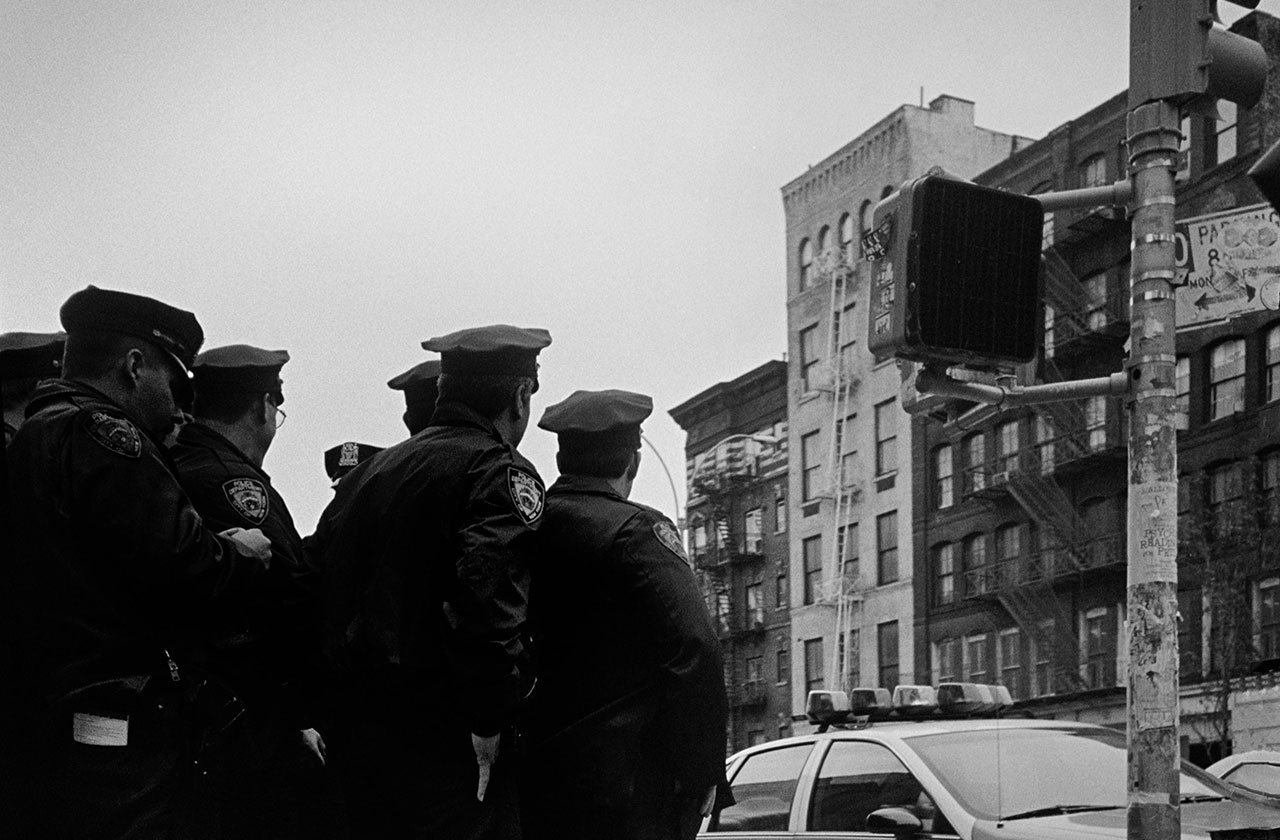
In June of 2020, the empire and its domestic foot soldiers, the police, were similarly unable to hide behind their usual pretenses. In the face of a mass uprising which threatened their very existence, the police could only respond by brutalizing, kidnapping and denigrating the very people they claim to “protect and serve.” For a brief moment, it was eminently clear to all pragmatic observers that the police were not acting out — they were fulfilling their function, as they always have, of protecting capitalist property and disciplining the poor and racialized populations who resist the quotidian (and spectacular) horrors of racial capitalism.

But while it burned bright, this moment of radical possibility was crushed, co-opted and liberalized almost immediately. Five months after George Floyd was lynched by the state, millions of the same people who flooded the streets in June took to the polls to vote for one of the chief architects of mass incarceration and the war on drugs. The revolutionary horizon of abolition, initially propelled by the justified rage of the Black masses, was sanitized and co-opted by liberal politicians, artists and opportunists. Corporate diversity seminars and police “reform” bills took center stage. In most places, police budgets increased after the uprising.

Similarly, in the 1960s and 1970s, the FBI and local police departments mobilized in a previously unheard of manner to infiltrate and sabotage Black and brown revolutionary organizations — and to kidnap, torture, harass, stalk and assassinate their leaders. It’s always telling which movements face the most severe state repression, for those are the movements which threaten the very foundations of empire. 

These organizations posed an existential threat — as Hoover famously wrote, “the Black Panther Party, without question, represents the greatest threat to internal security of the country” — not only because of their commitment to domestic revolutionary practice, but because they viewed their work as deeply interconnected with the global third world struggle against imperialism. They understood that the capitalist and colonial imperatives which cripple the dreams and life chances of poor, racialized communities in the United States are the same forces which maintain apartheid states like Israel. The violent techniques of repression and eviction we’ve witnessed in Sheikh Jarrah and in the West Bank settlements are the same forces (police and property) viciously gentrifying our cities. Palestinians and Black Americans are victims of the same fascist techniques of police brutality, torture and incarceration. It’s no accident that revolutionaries like George Jackson found inspiration and common cause with the Palestinian struggle.

To make these connections and to organize on their basis is to strike at the very foundations of empire. When the leaders of the Black power movement aligned themselves with the leaders of socialist anti-colonial struggles across the Americas, Africa and Asia, they marked themselves for destruction. Faced with this existential threat, the US police state did not hesitate to reveal its fascistic character.

SUPPORT OUR WORK BY MAKING A DONATION TODAY!

In both of these moments, the mask slipped. The state could not hide its true function as the violent organizing institution of racial capitalism.

But, due to a combination of factors, chiefly state repression and careful ideological maneuvering, the mask was re-made — often incorporating crass representation of the groups it sought to repress and shallow nods to the symbolism of the movements it had just ruthlessly crushed — and donned once more. Black power came to be more closely associated with Black capitalism than revolutionary political practice. Nixon invoked the specter of Black nationalism and communism to rally southern whites around his revanchist political project. As Fred Hampton’s blood stiffened in his mattress, the long arc of neoliberalism, white power and mass incarceration took its vengeance. 

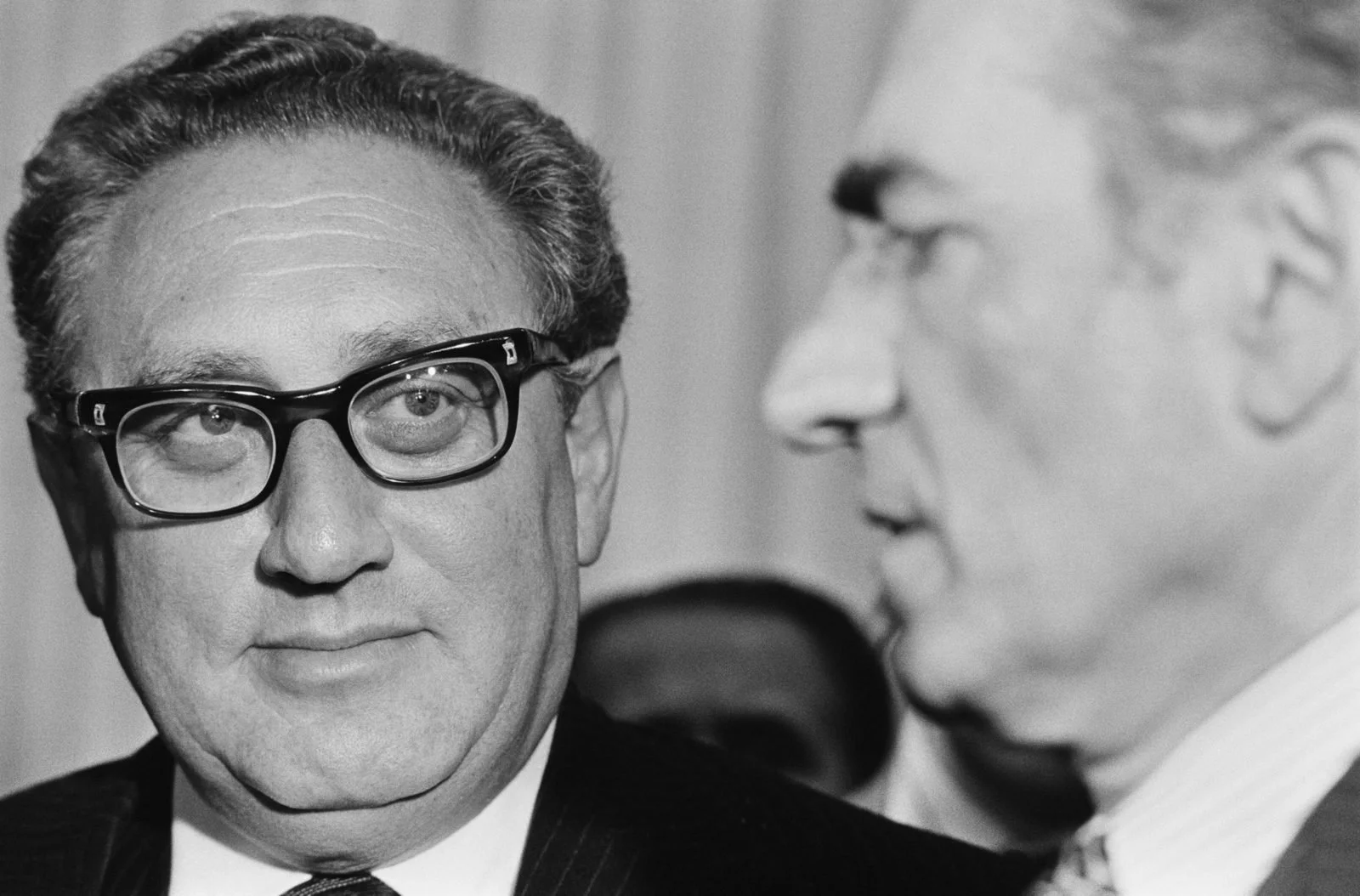
Armed with this history, we confirm that the death cult of empire is irreconcilable with our dreams of a just world. Its lofty ideals are no more than a charade, its claims to world leadership as fragile as Henry Kissinger’s rotting skeleton. 

With every stone, bullet and improvised bomb that the Palestinians hurl back at the occupying forces, with every market in Gaza that defiantly opens in the brief moments of quiet, with every doctor that works in the dark, against impossible odds, bandaging and stitching and mending while the occupation closes in, with every child that draws breath, in defiance of the wishes of the most powerful armies on earth —

With their humanity, their naked, honest humanity, the Palestinian people confirm that they — not the blood-soaked bureaucrats in Washington, nor the shameless journalists at the oh-so-revered New York Times, nor the murderous foot soldiers of global capitalism at NATO — are the true humanists, the real “leaders of the free world.” 

In Gaza, the empire faces its gravediggers.

And in each act of the resistance, a new world is born, kicking and screaming, fragile yet determined, beyond doubt, to survive. We don’t know what shape this world will take, or when it will mature, but we know that it will not emerge from Washington, London or Tel Aviv. Our new world will be nursed at a thousand sites of resistance, fed with the fruits of our labor which once swoll the bellies of our blood-sucking bosses, raised by freedom fighters in every corner of the world.

We owe it to the struggling masses of Palestine, of the Congo, of those in a thousand sites of resistance to the long tentacles of the US empire — and we owe it ourselves, to our domestic struggles for liberation — to never let those hyenas and jackals hide behind their false humanism again.

Before the forces of liberalism capture this moment, we must concretize our ideology, and hammer home that there is no reforming this beast which we are uniquely positioned to destroy. There is no humanistic mission to the US empire. There are no “mistakes” as we so often call our genocidal ventures into Vietnam or Iraq. 

To paraphrase the great Du Bois: This is not the United States gone mad; this is not aberration nor insanity; this is the United States; this is the real soul of empire — naked, drenched in blood, built by blood money; honest, for once.

The empire’s actions in Gaza are not tragedies or missteps but rather the predictable and historically consistent behavior of empire, from Wounded Knee to Jakarta, from My Lai to Attica — and with a Democratic president and “socialist” legislators in virtual lockstep with Israel’s genocide, we would be remarkably naive to pretend that the institutions of empire possess any capacity for reform. 

As just one example: we cannot return to a world in which The New York Times is regarded as the unbiased paper of record. The zionist mythology is nurtured and legitimized in their pages: the colonizer morphed into the victim, the colonized morphed into, at best, a historyless people, and at worst, a nation of terrorists. The ongoing Nakba — that ethnic cleansing by the Zionists, that cataclysm for the Palestinian people — erased from history, replaced with a collective amnesia about the violent foundations and maintenance of the Israeli state. And it doesn’t stop there:

From Korea and Guatemala in the 1950s, to Vietnam and Indonesia in the 60s, Nicaragua, El Salvador, Chile and Grenada in the 70s and 80s, Iraq, Afghanistan and the former USSR in the 90s and 2000s, Libya and Yemen in the 2010s — that deified rag has consistently ginned up support for US aggression and justified the tremendous violence we inflict on the rest of the world — crusade-like, in the name of anti-communism, democracy, human rights, “American interests” or whatever smoke screen our leaders and their loyal accomplices in the press concoct to distract us from the violence’s true function: the disciplining arm of global imperialism, the massacres, rivers of blood, tortures, loyally installed fascist dictators, carefully trained death squads, psychological warfare and sexual violence which puts anti-colonial, anti-capitalist movements to the sword for daring to challenge the profits and hegemony of Western multinational corporations.

These understandings have serious tactical implications. Our tactics must not, cannot stop with politicking and marches. As we have learned — including through the example of the Yemeni blockade — the cold heart of capitalist empire responds only to organized, frontal attacks on its economic organs and central nervous system. 

We cannot shame empire into a humanism it has never and will never possess. We cannot appeal to the conscience of a state which has none.

But we are uniquely positioned to strike at the soft underbelly of the beast. Israeli bombs, guns and tanks are designed by American engineers, who are trained in our schools and universities. These weapons are built by American workers, with American tax dollars, shipped through American ports and accrue huge profits to American capitalists. America’s vampiric financial institutions — Blackrock, Vanguard and State Street, namely — provide the blood money which fuels the US-Israeli war machine. It goes without saying that the Israeli Occupation Forces maintain bone-deep ties to both local American police forces and national intelligence agencies.. If we aren’t positioned to resist the American transnational war machine, who is? Our capacity to resist is a question of will, not opportunity.

And if we are to resist, if we are to truly call ourselves anti-imperialists, freedom fighters, workers and tenants and students in solidarity with the peoples of the third world — whatever our lofty aspirations may be — that must mean, we must accept, that we are not working to reform empire — we are at war with it.

The United States, as we know it, must die for the world to live.

Muslim and Arab-American Voters Show Black People How to Exercise Political Power

By Margaret Kimberley

Republished from Black Agenda Report.

Black voters feel trapped in the duopoly but other groups are giving a master class in political courage. The Abandon Biden campaign shows the way.

Face the Nation Host Margaret Brennan: Thasin, you did change your mind on the president. Why?
Thasin: I was a champion for Joe Biden until October 7. I feel he disowned us, disenfranchised us, with his stance on Gaza.
Brennan: What do you mean by that?
Thasin: He’s not listening to us. We’re asking for a cease fire at this time. It’s a humanitarian catastrophe in Gaza. Too many lives have been lost at this time. I was never a single issue voter and in fact I used to argue with people not to be single issue voters but for me this is a deal breaker. Way too many lives have been lost. 
Brennan: When you say “us” you’re Muslim, is that what you mean? You think the Muslim community here feels as you do?
Thasin: Yes. I think the vast majority of Muslims, Arab-Americans, progressives, I identify myself as a progressive, and many people I talk to in my circles are not going to be voting for Joe Biden.

- Michigan Voter Focus Group on CBS news program, Face the Nation

Historically, Black people in this country have allowed themselves to feel trapped by the racialized political duopoly. A feature of U.S. politics is to allow only two parties to play a decisive role in elections and for one of them to be designated as the white people’s party and the other as the Black party. 

Beginning after the civil war and until the 1960s, the democrats were the party of the segregated south, and thus the party for white people generally. Republicans, the party of Abraham Lincoln, became the de facto preference for Black people despite their willingness to shove Black interests under the bus when they felt the need to placate white voters. 

In 1872 Frederick Douglass spoke at the National Convention of the Colored People and famously spoke these words. “For colored men the Republican party is the deck, all outside is the sea.” Douglass and other Black people counseled continued support for the republicans, even when they made deals to withdraw federal troops from the south, or refused to codify the Civil Rights Act of 1875 into law after the Supreme Court declared it to be unconstitutional. 

Democrats were the party of the confederacy and thus could not be countenanced under any circumstance, even republican betrayals.

This dynamic played out for the next 100 years when the two teams made a switch which lasts until today. The last time a majority of white people supported a democrat in a presidential election was 1964. Ever since that time they have given a majority of their votes to republicans and Black people have done likewise with the democrats. 

Unfortunately the role that Black political action played in forcing democrat Lyndon Johnson to advocate for and sign the Voting Rights Act and the Civil Right Act of 1964 into law have been forgotten. Black people won legislative victory through their own efforts in creating a mass movement and a political crisis that brought about change. This era has been fetishized, without any understanding of its real importance and meaning. The truth has been turned on its head, and we are taught that Black people owe loyalty to democrats, when that party should reward loyalty with policies that Black people want to see enacted.

But every group in the country has not been cowed. Voters who identify as Muslims or who have Middle Eastern ancestry have put Joe Biden on notice that his aiding and abetting of Israel’s war crimes in Gaza will cost him politically. Michigan has the largest Arab-American community of any state and plays a pivotal role in presidential elections. Democrats take great care to mobilize voters in this key “swing” state. Hillary Clinton’s failure to do so in 2016 resulted in Donald Trump’s victory there by a small margin of 13,000 votes and he prevailed in the Electoral College when Pennsylvania and Wisconsin were also neglected by the democrats and flipped to the republican column. 

Joe Biden won in Michigan in 2020 by a 154,000 vote margin in a state where 200,000 registered voters identify as Muslim and 300,000 claim ancestry from the Middle East and North Africa. Michigan is not the only state Biden won by a small margin thanks to Arab and Muslim voters. In Arizona, Georgia, Minnesota, and Wisconsin he also owed his victory in part to members of this community.

A group of Muslim leaders in swing states are rightly using their electoral power with the #AbandonBiden campaign. They are not so frightened of a Trump presidency that they have allowed themselves to vote for the man who through his proxy Israel has killed some 24,000 people in Gaza and despite phony claims of “working behind the scenes” shows no inclination to change policy and save lives.

It is true that these communities do not share Black people’s history of enslavement and Jim Crow segregation. As such they have a greater willingness to show independence but there are lessons here for Black people in how to exercise their power.

Joe Biden and every democrat elected in the last 60 years owes his presidency to Black voters. The same is true of politicians in city halls, state legislatures, and in the Senate and the House of Representatives. Black people have political muscle but through a combination of misleadership chicanery and ignorance of the right lessons of history, act as supplicants instead of as political players.  

Arab-Americans have not forgotten Trump’s so-called Muslim ban, when citizens of Iran, Libya, Somalia, Sudan, Syria, and Yemen were barred from entering the country. Yet they do not act fearfully despite the fact that Trump is again a candidate for the office he once held and pledges to bring back the ban and even to deport people who protest U.S. policy towards Palestine.

Fortunately the #AbandonBiden campaign has shown no signs of letting up because its leadership knows how to get results and because they refuse to disrespect themselves and their people by rewarding a genocidaire with another term in the white house. How much could Black people achieve with similar determination?

In 2024 and beyond, the words “but Trump” should lose their power. How much has Biden done for Black people in the last three years? The covid era programs of small stimulus payments and the Child Tax Credit are over. Millions of people eligible for Medicaid and SNAP food benefits have been kicked off the rolls in many states with no intervention from the federal government. The pardon for federal marijuana convictions freed no one from jail. Police continue their killing spree with more than 1,300 victims in 2023. Mass incarceration continues as 1 million Black people are locked up, more than anywhere else in the world with the help of the most draconian sentences in the world. Of course Senator Joe Biden bragged about his role in the Clinton era Crime Bill which put so many Black people behind bars. There was good reason not to vote for him in 2020.

As it seems Black people have forgotten how to demonstrate political power, perhaps lessons from other groups are a means of regaining what has been lost. Black people can abandon Biden too, along with all of the democrats who owe their elected office to a group of people they routinely ignore or use for “dog whistle” politics appealing to white voters. 

Donald Trump is not the biggest enemy, he is just the loudest and the least refined. Abandoning Biden and his minions can be a reality which may produce some worthy result. Feeling trapped by the duopoly has been and continues to be a losing proposition.


Margaret Kimberley is the author of Prejudential: Black America and the Presidents . You can support her work on Patreon and also find it on the Twitter , Bluesky , and Telegram platforms. She can be reached via email at margaret.kimberley@blackagendareport.com

Why Are Intellectuals Divorced from Working People?

By Carlos Garrido

Republished in modified form from the Midwestern Marx Institute for Marxist Theory and Political Analysis.


The question we are exploring today — the divorce of intellectuals from the working class — is fundamental for assessing the crisis we face in the subjective conditions for revolution [1]. The first thing to interrogate is what is presupposed in formulating the problem in such a manner. When we say that there has been a split, a schism, between intellectuals and the working class, there is a specific type of intellectual we have in mind.

The grand majority of intellectuals, especially within the capitalist mode of life, have their lots tied to the dominant social system. They function as a necessary component of the dominant order, those who take the ideals of the bourgeoisie — the class enemy of most of humanity — and embellish them in language which opens the narrow interests of the ruling class to the consenting approval of their class enemies. In the same manner Karl Marx described the bourgeoisie as the personified agents of capital, the intellectuals have been the personified agents of capitalist ideology. They are tasked, as Antonio Gramsci taught us, with making these dispersed and unpopular bourgeois assumptions into a coherent and appealing outlook — one people are socialized into accepting as reality itself. Intellectuals have always, in a certain sense, been those who light the fire and move the statues which the slaves in the cave see as cave shadows embodying reality itself.

But these intellectuals — the traditional intellectuals — are not the ones we have in mind when we speak of a schism between intellectuals and workers. We are speaking, instead, of those who have been historically able to see the movement of history, to make slits within bourgeois worldviews, and who have subsequently thrown their lot in with the proletariat and popular classes — those forces which present the kernel for the next, more human and democratic, mode of life. Marx and Friedrich Engels noted that there is always a section of “bourgeois ideologists” who raise “themselves to the level of comprehending theoretically the historical movement as a whole” and “cut [themselves] adrift [to] join the revolutionary class, the class that holds the future in its hands.” We are talking about the W. E. B. Du Boises, the Herbert Apthekers, the Juan Marinellos, the Michael Parentis, and others who, while coming out of the institutions of the bourgeois academy, aligned their interests with working and oppressed peoples. They would become the theoreticians, historians, and poets which gave the working-class movement various forms of clarity in their struggle for power. 

What has happened to this section of intellectuals and its relationship with working people? Have they lost their thirst for freedom? Has their capacity for trembling with indignation at the injustices waged on working and oppressed people dissipated? 

It is important to note that any attempt to answer this question in this short timespan will always, by necessity, omit important aspects of the conversation. I would love here to speak at length about the campaigns of the Congress for Cultural Freedom, the formation of a fake anti-communist left, and the role imperialist state departments, bourgeois foundations, and other such outfits had in creating a left intelligentsia divorced from the real movements of working people, both within the imperial core and in the periphery [2]. I know my colleagues here will be paying due attention to such monumental components of answering the question we have before us. 

However, I’d like to instead focus on the practice of intellectuals; on the expectations and requirements set by the academy itself, which have already baked into its very structure the divorce of radical intellectuals from the struggles and movements of working and oppressed peoples. The first thing that must be noted is the following: We cannot simply treat this problem as one rooted in the intellectuals as a class, nor as one rooted in the subjective deficiencies of particular intellectuals. The Marxist worldview requires us to examine the system, the social totality, that produces such a split.

We are tasked with exploring the political economy of knowledge production, if you will, which structures the relations of its mental workers through forms which insularize them to the structures and needs of the academy. As Gabriel Rockhill would say, it is a political economy of knowledge that systematically reproduces radical recuperators, compatible Lefts, and pseudo-radical purity fetish outlooks that play an indispensable role in the reproduction of our moribund capitalist-imperialist system.

From the moment prospective radical scholars enter graduate school, they are integrated into this system. Their lofty hopes of being active participants as intellectuals in a class struggle are castrated by the demands the academy makes upon them qua scholars. They’re told that their writing should take a distinctively academic tone, that popular vernacular is frowned upon, that hyper-referentiality, the practice of citing all the intellectual gods in the cosmos who have commented on a topic, is a sign of good work, of proper scholarship.  

Truth and the struggle for human freedom are at best given a backseat, and that’s if they’re in the vehicle at all. Young scholars in the incubators of their careers are already indoctrinated in the aristocratic dogmas of writing for a select group of elite scholars, worshiping journal impact factors, and condescendingly dismissing those who use their intellectual capacities to work for the people, to actually, in proper Socratic fashion, engage in the radical quest for truth – those who seek to properly understand the world in order to work with the masses of humanity to change it.

Young scholars, burdened by tens of thousands of dollars accumulated in undergraduate studies debt, are told that — even with a PhD — they will have an extremely difficult time finding a job – at least one suitable for continued academic work that pays sufficiently enough to pay back the accumulated debt. They are told — specifically those with radical sensibilities — that they should focus on joining academic associations, network with people in their fields, familiarize themselves with the work published in leading journals so that they too, one day, can join the publication hamster wheel aimed at advancing these slaves through the tenure ladder. They are told they mustn’t waste their time writing for popular audiences, that doing broadcasts and media work — that reaches infinitely more people than the readers of ridiculously paywalled journals or university editorial books — is a waste of time. Every attempt at rooting their scholarship in the people, in the real movements of our day, is shot down. 

The gurus mediating their initiation into the academic capitalist cult ask:

“Do you know how this sort of work on your resume would look to hiring committees?”

“Do you think the scholars in charge of your tenure advancement will appreciate your popular articles for Countercurrents, your books from Monthly Review, your articles in low impact factor, or impact factor-less, journals?” 

At every turn, your attempts to commit yourself to the Socratic pursuit of truth, to playing a role in changing the world, is condemned as sinful to the gods of resume evaluations.

“Do you not want to finish your degree with the potential of obtaining gainful employment?”

“Do you want to be condemned to adjunct professorship, to teaching seven classes for half the pay of full professors who teach three?”

“Do you want to condemn your family to debt slavery for decades to come simply because you did not want to join our very special and elite hamster wheel? After all, who wouldn’t want to spend months writing an article to send it in to a journal that will reply in a year telling you, if you’re amongst the lucky ones, that it has been accepted with revisions rooted in the specific biases of the arbitrary reviewers? Doesn’t that sound fun? Isn’t this what philosophy, and the humanities in general, is all about?”

Eventually, material pressures themselves break the spirit of young visionary scholars. Re-proletarianized and unable to survive on teaching assistantships, they resign themselves to the hamster wheel, with hopes of one day living the comfortable lives of their professors. 

Their radical sensibilities, however, are still there. They need an outlet. They look around and find that the academic hamster wheel has a pocket of “radicals” writing edgy things for decently rated journals. They quickly find their kin, those who reduce radical politics to social transgressiveness, those who are concerned more with dissecting concepts like epistemic violence than with the violence of imperialism. 

Here it is!, the young scholar thinks. A place where I can pad my resume and absolve myself of the guilt weighing down on my shoulders — a guilt rooted in the recognition, deep down, that one has betrayed the struggles of humanity, that one has become an agent of the forces they originally sought to combat. 

Their existence, their lives, will always be rooted in what Jean-Paul Sartre called “bad faith.” Self-deception becomes their norm. They are now the radical ones, the ones enlightened in issues of language. The working class becomes a backward rabble they must educate — and that’s if they come near them at all. What hope could there ever be in the deplorables?

Sure, American capitalism could be criticized, but at least we’re enlightened, woke to LGBT and other issues. Those Russians, Chinese, Venezuelans, Iranians, etc., aren’t they backward? What are their thoughts on trans issues? Should we not, in the interests of our enlightened civilization, support our government’s efforts to civilize them? Let’s go deliver them some of our valued democracy and human rights. I’m sure their people will appreciate it very much. 

I have presented the stories which are all too familiar to those of us still working in the academy. It is evident, in my view at least, that the divorce of radical intellectuals from working-class people and their movements has been an institutionalized effort of the capitalist elite. This division is embedded, it is implied, in the process of intellectuals becoming what the system requires of them for their survival. The relations they occupy in the process of knowledge production presupposes their split with working people. 

This rigidity of academic life has intensified over the last century. Yes, we do have plenty of past cases of radical academics, those who have sided with the people, being kicked to the curb by their academic institutions. But where have they landed and why? A blackballed Du Bois got to teach at the Communist Party’s Jefferson School. Herbert Aptheker, following his expulsion from the academy, became the editor-in-chief of the Communist Party’s theoretical journal Political Affairs. Besides the aforementioned, what other factors make our day different from, say, the 1950s United States? 

The answer is simple: what counter-hegemonic popular institutions we had were destroyed, in part by the efforts of our government, in part by the collapse, or overthrow, of the Soviet bloc. Although some, like ourselves, are currently in the process of attempting to construct them, today we have nowhere near the material and financial conditions we had in the past. The funding and aid the Soviets provided American communists is, unfortunately, not something provided for us by the dominant socialist states of our era.

Ideology does not exist in a transcendental realm. It is embodied materially through people and institutions. Without the institutions that can ensure radical scholars are not forced to toe the line of the bourgeois academy, the material conditions for this split will persist. 

If I may, I would like to end with the following point. It is very easy to condemn the so-called radical academics we find in the bourgeois hamster wheel divorced from the people and their struggles. While condemnation might sometimes be justified, I think pity is the correct reaction. 

They are subjects of a tragedy. As G. W. F. Hegel notes, the essence of a tragedy is found in the contradictions at play between the various roles an individual occupies. Sophocles’ Antigone is perhaps the best example. Here, a sister (Antigone) is torn between the duty she has to bury her brother (Polyneices), and the duty she has as a citizen to follow King Creon’s decry, which considers Polyneices a traitor undeserving of a formal burial. This contradiction is depicted nicely in Hegel, who says that “both are in the wrong because they are one-sided, but both are also in the right.” 

Our so-called radical intelligentsia is, likewise, caught in the contradiction of the two roles they wish to occupy — revolutionary and academic. Within existing institutions, there can be no reconciliation of the duties implied in each role. This is the setup of a classical tragedy, one which takes various forms with each individual scholar. It is also, as Socrates reminds Aristophanes and Agathon at the end of Plato’s Symposium, a comedy, since “the true artist in tragedy is an artist in comedy also.” 

The tragic and simultaneously comedic position occupied by the radical intelligentsia can only be overcome with the development of popular counter-hegemonic institutions, such as parties and educational institutions like the Hampton and Midwestern Marx Institutes, the International Manifesto Group, the Critical Theory Workshop and others. It is only here where scholars can embed themselves in the people. However, scholars are humans living under capitalism. They, just like everyone else, have bills to pay. These institutions, therefore, must work to develop the capacity to financially support both the intellectual traitors to the traditional bourgeois academy, and the organic intellectuals emerging from the working class itself. That is, I think, one of the central tasks facing those attempting to bridge the divide we have examined today. 

Carlos L. Garrido is a Cuban-American philosophy instructor at Southern Illinois University, Carbondale. He is the director of the Midwestern Marx Institute and the author of The Purity Fetish and the Crisis of Western Marxism (2023), Marxism and the Dialectical Materialist Worldview (2022), and the forthcoming Hegel, Marxism, and Dialectics (2024). 

Footnotes

[1] For more on the indispensability of subjective conditions to social revolutions, see the last chapter of the author’s book, The Purity Fetish and the Crisis of Western Marxism.

[2] For more on imperialist efforts to create an inorganic left intelligentsia, see the author’s book, The Purity Fetish and the Crisis of Western Marxism, Frances Stonor Saunders’s The Cultural Cold War, and Gabriel Rockhill’s forthcoming book, The Intellectual World War.

[3] In the last couple of decades, scholars like Anthony Monteiro (fired from Temple University for not toing the bourgeois line of the African American Studies department) and Norman Finklestein (“unceremoniously kicked out” of Hunter College for his pro-Palestine work) have been blackballed from the academy for their anti-establishment views. 

[4] China here is undoubtedly the only one capable of filling the shoes of the Soviet Union. Yet it has failed to meet the Soviet standard of international proletarian solidarity

Charter Schools Will Desert and Violate Thousands In 2024

By Shawgi Tell


Privately-operated charter schools have been around for 32 years. They fail and close every week, abandoning and harming hundreds of parents, students, teachers, education support staff, and principals. Neoliberals cynically call this “free-market accountability.”

These closures, moreover, are often sudden and abrupt, revealing deep problems and instability in the charter-school sector. Parents, students, teachers, education support staff, and principals often report being blindsided by such closures and how they have to anxiously scramble to find new schools for students.

Officially, 2,315 charter schools failed and closed between 2010-11 and 2021-22 alone (an 11-year period). On average, that is 210 privately-operated charter school failures and closures per year, or four charter school failures and closures per week. The real number is likely higher. Over the course of 30+ years more than 4,000 privately-operated charter schools have failed and closed. That is a high number given the fact that there are under 8,000 privately-operated charter schools in the country today.

PLEASE SUPPORT OUR WORK BY MAKING A DONATION TODAY!

The top four reasons privately-operated charter schools fail and close every week include low enrollment, poor academic performance, financial malfeasance, and mismanagement. Thus, for example, every week the mainstream media is filled with articles on fraud, corruption, nepotism, and embezzlement in the charter school sector. Not surprisingly, arrests and indictments of charter school employees, trustees, and owners are common.

While fraud, corruption, nepotism, embezzlement, and scandal pervade many institutions, sectors, and spheres in America, such problems are more common and intense in the charter-school sector.

Despite all this, a dishonest neoliberal narrative keeps insisting that these privately-operated schools are superior to the public schools that have been defunded and demonized by neoliberals for more than 40 years. The public is constantly under top-down pressure to ignore or trivialize persistent charter school failures and problems.

In this context, the public should reject relentless neoliberal disinformation that public schools are a commodity or some sort of “free market” phenomenon. It should discard the idea that parents and students are consumers who should fend-for-themselves while “shopping” for a school. The law of the jungle has no place in a modern society. Such a ruthless survival-of-the-fittest approach to individuals, education, and society is outmoded, guarantees winners and losers, perpetuates inequality, and increases stress for everyone.

The public should defend the principle that education in a modern society is a social human responsibility and a basic human right, not a commodity or consumer good that people have to compete for. A companion principle is that public funds belong only to public schools governed by a public authority worthy of the name.

Charter schools are not public schools. They are privatized education arrangements, which means that they should not have access to any public funds that belong to public schools. Public funds should not be funneled to private interests. School privatization violates the right to education.

Currently, about 3.7 million students are enrolled in roughly 7,800 privately-operated charter schools across the country. The U.S. public education system, on the other hand, has been around for more than 150 years and educates about 45 million students in nearly 100,000 schools.


Shawgi Tell, PhD, is author of the book “Charter School Report Card.” His main research interests include charter schools, neoliberal education policy, privatization and political economy. He can be reached at stell5@naz.edu.

"Bourgeois Democracy": What Do Marxists Mean By This Term?

By Scott Cooper


Republished from Left Voice.


In 1947, Winston Churchill famously said that “democracy is the worst form of government except for all those other forms that have been tried from time to time.” Since he wasn’t talking about a democracy based on the organized power and rule of the great majority, perhaps he was correct. He meant what Marxists call bourgeois democracy.

Liberals have always been aligned with Churchill’s endorsement of the ruling-class version of “democracy,” but for more than a hundred years, many in the workers’ movement — including some who falsely claim the Marxist mantle — have insisted that reforming bourgeois democracy can be a way to achieve “socialism.” They are dead wrong, and the main reason is their refusal to acknowledge what genuine Marxism has always taught: all forms of government have a class character. When you look at the bourgeois form of democracy through the class lens, it’s clear that it is no pathway to overcoming the fundamental class antagonisms rooted in the capitalism system. To think otherwise is to fall into a trap.

On January 20, the U.S. government again conducted it ritual of transferring power from one president to another — each successive leader beholden to and serving the interests of capital and its bourgeois regime. Joe Biden has begun his presidency with a promise to restore bourgeois democracy and rebuild faith in its institutions. All manner of people on the Left, viewing democracy in the abstract, have already bought into Biden’s electoral victory as a counterbalance to right-wing “authoritarianism” and even incipient fascism. Like the reformists of old, they too ignore the fundamental class character of bourgeois democracy, which guides every action of those who run the system on which it is based.

The class character of a form of government is precisely why we differentiate bourgeois democracy from genuine rule by the majority that constitutes the working class. By “deceiving the people and concealing from them the bourgeois character of present-day democracy,” wrote Vladimir Lenin in late 1918, those deceivers end up doing the bidding of the ruling class — our class enemy.


Bourgeois Democracy and the Aims It Serves

In combination, the institutions of bourgeois rule the Biden administration aims to “restore” constitute a bourgeois state that exists as the governmental branch of an overall system that is predicated on capital’s exploitation of the great majority of people, who must sell their labor power to survive. As Friedrich Engels wrote in 1891, “The state is nothing but a machine for the oppression of one class by another, and indeed in the democratic republic no less than in the monarchy.”

We saw this just a few days ago, when police beat striking workers at the Hunts Point produce market in New York City. As if he were writing in 2021, Lenin had suggested, in another 1918 pamphlet, that if we want to understand the true role of a bourgeois democratic state, we should pay attention to “how the most democratic and republican bourgeoisie in America or Switzerland deal with workers on strike.”

Even the laws — indeed, the very concept of the “rule of law” in a bourgeois democracy — puts the lie to what the reformists would have us believe. Biden wants us to trust in those laws, but Lenin’s description of laws in a bourgeois democracy — which fits the United States to a tee — reveals again the trap of not seeing their class character:

Take the fundamental laws of modern states, take their administration, take freedom of assembly, freedom of the press, or “equality of all citizens before the law,” and you will see at every turn evidence of the hypocrisy of bourgeois democracy with which every honest and class-conscious worker is familiar. There is not a single state, however democratic, which has no loopholes or reservations in its constitution guaranteeing the bourgeoisie the possibility of dispatching troops against the workers, of proclaiming martial law, and so forth, in case of a “violation of public order,” and actually in case the exploited class “violates” its position of slavery and tries to behave in a non-slavish manner.

As the great German revolutionary communist Rosa Luxemburg made clear in 1902, “What presents itself to us as bourgeois legality is nothing but the violence of the ruling class, a violence raised to an obligatory norm from the outset.” [1]

In a bourgeois democracy, the operative principle is protecting the state and the bourgeois order. Everything is subordinated to that objective. We’ve had an opportunity to watch this principle unfold in the aftermath of the January 6 attack on the U.S. Capitol. Some Republican members of Congress, representing one wing of the U.S. ruling class, incited and abetted what the other wing has called an “insurrection.” And yet, on Inauguration Day only two weeks later, we saw a number of them — presumably “seditionists” against the bourgeois regime — being normalized as the traditions of the day were played out. They made speeches, presented gifts, bumped elbows, and generally reveled with Democrats. After all, they are all members of a “bourgeois party” — and thus worthy of “protection,” as Lenin wrote:

The ruling party in a bourgeois democracy extends the protection of the minority only to another bourgeois party, while the proletariat, on all serious, profound and fundamental issues, gets martial law or pogroms, instead of the “protection of the minority.” The more highly developed a democracy is, the more imminent are pogroms or civil war in connection with any profound political divergence which is dangerous to the bourgeoisie.

Every sign points to these two wings of bourgeois democracy uniting to enact a new “anti-terrorist law” that will be used to go after the “profound political divergence” they most fear: the political organization of the working class against capitalist rule.

PLEASE SUPPORT OUR WORK BY MAKING A DONATION TODAY!


Contrast with Workers’ Democracy

There is an alternative to bourgeois democracy. Marxists call it proletarian or workers’ democracy. History gives us a few examples.

A year after the Russian Revolution of 1917, what the great American writer John Reed described as a “highly complex political structure” had emerged in “all the cities and towns of the Russian land, which is upheld by the vast majority of the people and which is functioning as well as any newborn popular government ever functioned.” It was the Soviet state, based on councils (the word soviet means “councils” in Russian) of workers, soldiers, and peasants. They were elected by all those who “acquired the means of living through labor that is productive and useful to society” — in other words, by the very people a bourgeois state exists to exploit — and no one else, including employers, those in private business, and cops, all excluded.

These councils existed at both the workplace and municipal levels. Their decision-making was truly democratic, genuinely representing the majority — not the minority bourgeoisie, as in the United States. They decided, for instance, on what their factories would produce, based on human needs. And they were subject to popular recall at any time.

These local soviets elected representatives to a national assembly that helped guide the Bolshevik leadership as it wrestled with decisions for all of Russia, including foreign policy.

“No political body more sensitive and responsive to the popular will was ever invented,” wrote Reed of the soviets. His essay “Soviets in Action,” in which he gives examples of how they functioned, is well worth a close look.

Nearly a half century earlier, the Paris Commune had organized similar organs of workers’ self-rule. Like the Russian soviets, they were what Lenin described as “the direct organization of the working and exploited people themselves, which helps them to organize and administer their own state in every possible way.”

When workers have their own genuine democracy, the subordination of the working class to the bourgeoisie is smashed. Lenin gave a great example, drawing on one of the “rights” enshrined in the First Amendment of the U.S. Constitution: “Freedom of the press ceases to be hypocrisy, because the printing-plants and stocks of paper are taken away from the bourgeoisie.” And he described how even conducting foreign policy becomes transformed.

In no bourgeois state, not even in the most democratic, is it conducted openly. The people are deceived everywhere, and in democratic France, Switzerland, America and Britain this is done on an incomparably wider scale and in an incomparably subtler manner than in other countries. The Soviet government has torn the veil of mystery from foreign policy in a revolutionary manner [because] in the era of predatory wars and secret treaties for the “division of spheres of influence” (i.e., for the partition of the world among the capitalist bandits) this is of cardinal importance, for on it depends the question of peace, the life and death of tens of millions of people.

To revolutionary Russia’s soviets and the Paris Commune’s organs of workers’ self-rule can be added more contemporary examples. While certainly not at the state level, there are, for instance, the workers’ cooperatives that emerged in Argentina in the aftermath of a cataclysmic financial crisis in 2001, such as at the Zanon ceramic tile factory. And in Chile, during the time of the Popular Unity government, there were the cordones industriales, a grassroots movement formed by workers who occupied factories and other enterprises and ran them in the interest of the working class.

An even more recent example comes from the Mexican city of Oaxaca in 2006. When a teachers’ union went on strike, police fired on a peaceful protest and workers fought back — driving the cops out of the city. For several months, the working class and community groups, including the teachers’ union, ran the city through large, democratic assemblies as part of a broad movement known as the Popular Assembly of the Peoples of Oaxaca (APPO).

The general assemblies being held by striking workers at the Grandpuits refinery in France today, where the trade unionists are making the daily decisions about how to wage their struggle against the multinational oil and gas company Total that is trying to destroy their jobs, are the direct descendants of these earlier examples — and point the way forward for rank-and-file democracy and assemblies in unions and social movements throughout the world. 

“Proletarian democracy is a million times more democratic than any bourgeois democracy,” wrote Lenin. He continued,

Soviet power is a million times more democratic than the most democratic bourgeois republic. To fail to see this one must either deliberately serve the bourgeoisie, or be politically as dead as a doornail, unable to see real life from behind the dusty pages of bourgeois books, be thoroughly imbued with bourgeois-democratic prejudices, and thereby objectively convert oneself into a lackey of the bourgeoisie.


What Can Our Class Do with Bourgeois Democracy?

As in most other countries with such a system, the manifestation of bourgeois democracy in the United States is a tapestry of rights won through struggle — always subject to being denied by force or being taken away altogether — and explicitly undemocratic laws and conventions. These are “always hemmed in by the narrow limits set by capitalist exploitation,” as Lenin wrote. Socialists, and the working class more broadly, have a responsibility to protect those rights and seek to expand them, while at the same time advancing democracy — even in its bourgeois context — by fighting those narrow limits.

In this country, many of those limits are most explicit in the electoral sphere — and they provide a list of what we ought to be fighting for locally and nationally. This includes abolishing the racist Electoral College and the U.S. Senate, which gives disproportionate power to a small minority of the U.S. population. It includes demanding the end to the atrocious restrictions on the ability to vote (a right not even enshrined in the U.S. Constitution) and outright voter suppression. It includes fighting to dismantle all the obstacles to ballot access that make it nearly impossible for any party other than those of the bourgeoisie to run candidates. Together, these limits reveal the truly undemocratic nature of the U.S. bourgeois regime. It all adds up, as Marx is said to have noted, to a “democracy” in which “the oppressed are allowed once every few years to decide which particular representatives of the oppressing class shall represent and repress them in parliament!”

Today, living in a bourgeois-democratic country is the backdrop to all of our struggles. That is no less a fact in our daily fights against the ongoing social and economic assault of capitalism than it is when the bourgeois regime unleashes police brutality or helps throw us out of our jobs to protect the profits of the minority class. But that doesn’t mean we cannot use bourgeois democracy to our advantage, not only in the immediate sense but even to build a revolutionary movement. It depends on clarity and on not buying into the notion that reforming bourgeois democracy is the path to our liberation from capitalist oppression. As Leon Trotsky wrote in 1932:

In the course of many decades, the workers have built up within the bourgeois democracy, by utilizing it, by fighting against it, their own strongholds and bases of proletarian democracy: the trade unions, the political parties, the educational and sport clubs, the co-operatives, etc. The proletariat cannot attain power within the formal limits of bourgeois democracy, but can do so only by taking the road of revolution: this has been proved both by theory and experience. And these bulwarks of workers’ democracy within the bourgeois state are absolutely essential for the taking of the revolutionary road.

Lenin wrote in 1918 that bourgeois democracy “always remains, and under capitalism is bound to remain, restricted, truncated, false and hypocritical, a paradise for the rich and a snare and deception for the exploited, for the poor.” Anyone who tells you otherwise is, as Lenin noted, is “in practice” abandoning the proletariat and standing on the side of the bourgeoisie. Here, in the pages of Left Voice, we do our best to draw the distinction every time and stand firmly on the side of workers’ democracy. It is part of taking up the task that Trotsky spelled out for our time: take the road of revolution.


Notes

[1] Rosa Luxemburg, “Yet a Third Time on the Belgian Experiment,” Die Neue Zeit, May 14, 1902.

Capitalist Contradictions and Revolutionary Struggle: An Introduction

By Derek Ford


Republished from Liberation School.


Hearing or reading about the “contradictions of capitalism” in an article or at a rally might be intimidating, like a foreign language or a term only a certain group can understand. While the contradictions of capitalism are complicated, working and oppressed people can easily understand them for the simple reason that we all live with and negotiate any number of contradictions every day. The contradictions we deal with that are the most confining, that most constrain our capacities and that keep us oppressed are specifically the contradictions of capitalism.

On any given day, we find abundant evidence that makes it clear that the capitalist system doesn’t work in practice. Examining the contradictions of capitalism and demonstrating how they are inherent in the system, proves that capitalism doesn’t even work in theory. Understanding capitalist contradictions heightens our agitation and accelerates political consciousness by cutting through capitalist ideology and the various excuses of capitalists, politicians, and their media. Knowing capitalist contradictions better informs our tactics and strategies in any given struggle and serves as a bridge to socialist reconstruction in the U.S.

This series examines some of the primary contradictions of capitalism, including those between use and exchange values, private ownership and social production, and the interests of individual capitalists and capital as a whole. Each entry will break the contradictions down in an accessible manner, explaining some of their more intricate details, and showing how they relate to other contradictions. We provide some general and concrete examples of how they enhance our understanding of capitalism and our struggle to overthrow that system and replace it with a new one. The reason Marx dedicated so much time to studying and analyzing capital was not because it was “interesting” but because its contradictions were and are opportunities for working and oppressed people to advance and create the world the Earth and its inhabitants need and deserve.


The general and specific contradictions we navigate

Our personal lives are riddled with any number of contradictions—or tensions—that we have to deal with daily. The term “guilty pleasure,” for example, names the contradictory situations we face when we are both attracted to and repelled by the same thing at the same time. Our guilty pleasure might be a “reality” show, for example, or a certain genre of books, or any other activity we engage in that brings us both positive and negative feelings.

Many of us despise social media yet still pick up our phones or check our computers throughout the day to use various social media apps. We also deal with the contradictions of our basic life processes like going to sleep. If we stay up late—to catch the end of a sporting event or spend extra time with our friends—while fully knowing we will have to wake up at the same early hour, we’re wrestling with a contradiction. Whenever we have negative and positive feelings at the same time about the same thing (a show), relation (social media), or process (sleeping), we’re dealing with a contradiction.

We’re also familiar with political contradictions. How many of us and the people we know have zero faith in the ruling-class parties but still vote for them? How many of us live in communities that regularly experience the brunt of racist police violence but, at the same time, see the police as a kind of “necessary evil” to combat the regular violence in our neighborhoods, and even might support campaigns for more police or surveillance cameras?

We experience economic contradictions as well, like the tension between doing the quality of work we can be proud of and the quality of work we are paid to perform. As a teacher, I constantly grapple with this contradiction. I truly want to set up the best possible class to educate students in a way they deserve, which requires spending the time necessary to get to know each student, to find the right content to teach, and do so by crafting a plan for each unique class. To do this, however, means I have to work beyond my contract hours.

Even when we’re thrown out of a job, we search out new work for a paycheck to survive even though we know that paycheck will barely let us survive long enough to show up to work to collect the next one.


Philosophy and our understanding of contradictions

Not all contradictions are the result of capitalism. The oldest religious traditions and cultural customs, for example, provide guidance on dealing with contradictions, like those between love and hate or living and dying. Marx didn’t “discover” contradictions, but he and Engels, built on and critiqued theories of capitalism available at the time. By doing so, Marx and Engels found that, while the best political economists often asked the right questions (like what is the source of profit), they couldn’t answer them because they didn’t grasp the historical specificity of capitalism as a contradictory system. They showed that capitalist contradictions are not inevitable or permanent, only that they are unsolvable within the capitalist system. Similarly, neither Marx nor Engels envisioned socialism or communism as a utopian place free of any tensions or contradictions. The socialist struggle doesn’t aim to solve all contradictions, only those that are intrinsic to the capitalist system and that produce the widespread suffering of the world’s majority.

We all have experience with contradictions, yet how we understand them—and therefore how and if we respond to them—depends on our philosophy, which refers generally to “our world outlook.” Just as we have experiences with various contradictions, we have our own philosophical outlooks, even if we aren’t aware of it or familiar with philosophical language. Philosophies are grounded in material reality, which means “that the various systems of the philosophers also always express a class outlook” [1]. The ruling class is the group that controls not only “the means of material production” but also “the means of mental production,” we’re all raised with their world outlook.

The capitalist philosophy we’re taught maintains that the world is made up of independent and fixed entities. Here, contradictions are the same as paradoxes, like the riddle of what came first, the chicken or the egg? This is only a paradox if we think about both as separate things, but there cannot be one without the other. Marxist philosophy explains that the world is made up of interrelated matter that is always in motion. The chicken and the egg are not independent or fixed but interrelated and always in motion. The reason there is no answer to the riddle is because it asks the wrong question [2].

Consider the common refrain that contemporary injustices like war or poverty are merely the result of “human nature.” Under this conception, humans have a nature that is independent of the world and any given social conditions. Humans have always been independent, competitive, self-seeking, etc. Capitalist philosophy thus explains the “failure” of alternative social systems by claiming they are simply “against human nature.” Human nature is presented as a thing, a static object remaining the same regardless of time, space, or society; this lets capitalism off the hook.

Many of us are taught to think that “humans” and “nature” are independent entities and there was once a pure “natural world.” Marx and Engels, addressing one of their contemporaries who adhered to this view, held that even if there was a “nature that preceded human history…. It is nature which today no longer exists anywhere” [3]. We’re taught that capitalism is natural and the way it structures society is nothing but “human nature;” that we are naturally independent of each other, competitive, and out for our own interests; that we are individuals isolated from each other first before we enter into relations with others. It’s always been this way, the myth goes: we’re all free individuals who choose to be either lazy or hard-working, wasteful or frugal, make bad or positive life choices, or choose the “right” or “wrong” crowd to hang out with. That explains why some of us end up rich and the rest end up as workers, how some workers end up in apartments and houses and others end up homeless, employed or unemployed, etc.

PLEASE SUPPORT OUR WORK BY MAKING A DONATION TODAY!


Two worldviews in action: Education, testing, and the myth of meritocracy

In education, this myth takes the form of “meritocracy,” where the results of our test scores indicate how capable or incapable we are as individuals, how much time and effort we spent studying, etc… This assumes however, that standardized tests are “objective,” an assumption that, as educational theorist Wayne Au shows, allows the tests to be “used to compare students, teachers, and schools, and then make high-stakes decisions about being granted access to resources or subjected to punishment” [4]. These tests are far from value-neutral or objective because, in reality, test scores and educational outcomes are ultimately related to one’s zip code. Moreover, they are historically rooted in eugenics and racism.

In the U.S., IQ (or “Intelligence Quotient”) tests were based on the idea that one’s “intelligence” was static and based on their individual biology and heritage. IQ tests are still “used to sort and rank different people by race, ethnicity, gender, and class according to supposedly inborn, innate intelligence” [5]. The assumptions determine the results. If the language of the test is a certain kind of English, students from communities that speak a different kind of English or another language, like Spanish, will have less access to the questions. Regardless of the bias built into the test, however, those who can afford private tutors and do not have to work in the house or at a job, for example, are likely to perform better than those who can’t afford tutors and have to work to provide for their families, whether it be at a job or cooking dinner for their siblings while their parents are working three jobs.

If we understand the historical specificity of standardized tests, then, we understand they do not measure our “natural” or “individual” intelligence but our class standing. We then see that educational and economic success is not the product of an individual’s choices but rather the system that determines the choices available to us and our ability to access those choices. It disproves that we are “individuals” with our individual intelligence and shows that the very notion of “intelligence” is socially constructed under capitalism in a way that justifies capitalism’s inequalities as “human nature.” Individualism, as Marx showed in his critique of bourgeois political economists, was the product of “civil society” during a specific time and place that “appears as an ideal, whose existence [the bourgeois philosophers] project into the past” [6]. In other words, “intelligence” isn’t a static or independent thing but a process interrelated to social practices, including white supremacy, capitalism, racism, ableism, and other forms of oppression, as well as struggles against standardized testing.


Capitalism as an inherently contradictory process

When an economic crisis grips U.S. society, capitalists blame it on some external cause. They debate whether it is the individual characteristics of a president, a Federal Reserve policy or decision, “state intervention” or lack of legislative oversight. In some cases, they unite and blame it on another country.

Marx demonstrated that capitalist crises are the inevitable result of capital’s internal contradictions and, more fundamentally, that capitalism is defined by its contradictions. Capital is value in expanding motion, meaning that capitalism as a system is defined by the accumulation of more and more value.

The process of capital is, at heart, contradictory for at least two reasons. First, the value of any commodity is the social average of the time necessary for its production. Because capitalists compete with other capitalists for a limited market, they are forced to reduce their individual production time to remain competitive, yet eventually, this lowers the overall social production time and, hence, their ability to accumulate value. Second, surplus value for the capitalist is equivalent to the additional unpaid value produced by labor-power. Because capitalists must invest at least some of their surplus value back to expand their own productive capacity to accumulate more value, there is a constant disproportionality between the value produced and the value realized (or sold) [7].

As Marx puts it, “the ultimate reason for all real crises always remains the poverty and restricted consumption of the masses as opposed to the drive of capitalist production to develop the productive forces as though only the absolute consuming power of society constituted their limit” [8]. What he means is that the “absolute law of value” that drives the accumulation of capital expands both the wealth of the capitalists and the poverty of the masses. Even if our wages equal the value of our labor-power, it is impossible for our class to buy the total value we produce.


Capitalism can only move crises around and to higher levels

Contradictions push and pull us between the opposite ends of the same thing or process. Generally, most of these contradictions bubble below the surface. Every few years, however, they boil over into a crisis. To survive, capitalism must continually try to “solve” its contradictions, but can only shift them to different places, delay them, and raise their intensity.

For example, one way capital tries to “solve” the contradiction of surplus value is by extending credit to workers. With credit, we can purchase more commodities than our wages allow. At some point, of course, the debt must be paid. This increases the extent of the contradiction because credit comes with additional costs for us, which ultimately reduces our capacity to purchase goods or pay for the goods we already “bought” on credit.

Another example is how capital tries to “solve” the contradiction between its need to expand and the geographical limitations of the globe. Colonialism and imperialism provide capital with additional outlets to sell their commodities and provide capital with cheaper (often stolen) raw materials and labor-power. Imperialism resulted mainly from this contradiction because, once the capitalists had colonized the world, they could only gain access to extra markets by redividing “their” colonized territories through war. This explains why Lenin’s analysis of imperialism provided the real rationale for World War I [9].


The role of capitalist contradictions in building a revolutionary movement and society

As an inherently contradictory system, as capital grows its own power it, at. the same time, creates and increases its opposing power: the poor and working classes. In this series, we’ll explore some of the most pertinent contradictions of capitalism so that we can seize on them and finally resolve them through socialism.

Contradictions do not unfold in any predetermined manner nor is there any single one that is the most important for all time. Yet a foundational contradiction that is always helpful in raising class consciousness and clarifying the real source of many struggles is the contradiction between use value and exchange value. Under capitalism, all commodities are contradictory unities of both forms of value and capitalists only care about the exchange value of the commodities we produce for them The rest of us, however, buy commodities for their use value.

We rent apartments or take out loans for houses because we need to use them. Capitalists, however, only organize the production of houses for exchange value, or the profit they can make from them. Because capitalists compete for as much exchange value as possible, they end up producing another contradiction examined in the third entry: the absurd crisis of overproduction.

Whenever we struggle to make or keep something as a public good—whether it be education, our libraries, healthcare, water, or utilities—while the capitalists try to privatize it, we’re taking a side in the contradiction between use value and exchange value. We’re saying: “This is important to keep public because society uses and needs it, not because a small group of capitalists can privatize it and profit from it.”

This clarifies that the interests of the masses are directly opposed to the interests of the capitalists and imperialists. When our elected (or unelected) officials still sell them off to corporations despite our protests, it shows our class whose interests the state represents. It further reveals that capitalism doesn’t care about what we need or want to survive, and that they don’t see us as anything other than exploitable and expendable sources of value. Additionally, it helps unite our historically divided class around our common interests, as access to basic public necessities impacts all working and poor people.

On our path toward building a revolutionary movement and society, understanding the contradictions of capitalism helps us accurately identify the cause of the crisis, show the class struggle in action, unite the broad masses, and reveal our common interests and, in general, provides us with the knowledge necessary for our political, tactical, and strategic decisions. The contradictory developments in any society are numerous and it is important to look for the contradictions that will most likely cause intense social conflicts, determining where to put our time and energy, who to reach out to and build connections with, and more.

In this series, we’ll examine multiple fundamental contradictions of capitalism. After examining the contradiction between use value and exchange value in greater detail, we’ll see how that in turn contributes to the absurd crisis of overproduction in the next entry. The series will address other contradictions as well, including the contradiction between technology and living labor, constant capital and fixed capital, and the production and realization of capital. For each, we’ll discuss how we can use them to advance the struggles we’re engaged in daily, promote socialist consciousness, and spread the fact that another world and system is possible and absolutely necessary. That way, we can have enough numbers on our side to seize a revolutionary opportunity: when capitalism’s contradictions pile up high enough that “the ‘lower classes’ do not want to live in the old way and the ‘upper classes’ cannot carry on in the old way” [10].


References

[1] Maurice Cornforth,Materialism and the Dialectical Method(New York: International Publishers, 1953/1971), 7, 8.
[2] For more on this see Curry Malott, “What is Dialectical Materialism? An Introduction,”Liberation School, 04 April 2020. Availablehere.
[3] Karl Marx and Friedrich Engels, The German Ideology: Part One, with Selections from Parts Two and Three and Supplementary Texts, trans. C.J. Arthur (New York: International Publishers, 1970), 63; see also Sohrob Aslamy, “Marxism, Capitalism, and Nature-Society Relations: An Introduction,”Liberation School, 12 October 2021. Availablehere.
[4] Wayne Au,Unequal by Design: High Stakes Testing and the Standardization of Inequality, 2nd. ed. (New York: Routledge, 2023), 98.
[5] Ibid., 49.
[6] Karl Marx,Grundrisse: Foundations of the Critique of Political Economy (Rough Draft), trans. M. Nicolaus (New York: Penguin Books, 1939/1993), 38.
[7] For an explanation of the first reason, see Mazda Majidi, “Relative Surplus Value: The Class Struggle Intensifies,”Liberation School, 18 August 2021. Availablehere; for an explanation of the second reason, see Derek Ford and Mazda Majidi, “Surplus Value is the Class Struggle,”Liberation School, 30 March 2021. Availablehere.
[8]. Karl Marx,Capital: A Critique of Political Economy (Vol. 3): The Process of Capitalist Production as a Whole, ed. F. Engels (New York: International Publishers, 1894/1967), 484.
[9] V.I. Lenin, “Imperialism, the Highest Stage of Capitalism: A Popular Outline,” inLenin: Selected Works: Two Volume Edition (Vol. 1)(Moscow: Progress Publishers, 1916/1963), 634-731. Availablehere. See also Brian Becker, “From Inter-Imperialist War to Global Class War: Understanding Distinct Stages of Imperialism,”Liberation School, 20 July 2018. Availablehere.
[10] V.I. Lenin, “‘Left-Wing’ Communism: An Infantile Disorder,” inV.I. Lenin Collected Works (Vol. 31): April-December 1920, trans. J. Katzer (Moscow: Progress Publishers, 1920/1966). 85.

"I Don't Believe Capitalism Can Be Fair": An Interview with Clara Mattei

[Photo credit: AFP via Getty Images]


By Diego Viana


Where capitalism goes, austerity invariably follows. This phenomenon has puzzled intellectuals for generations. Why does the dominant economic system consistently adopt reforms that seem to destabilize its very foundations?

Dr. Clara Mattei is a renowned scholar and professor of economics at the New School whose research tackles this question. Her latest book, The Capital Order: How Economists Invented Austerity and Paved the Way to Fascism, argues that austerity isn’t “a policy mistake” but is instead a core feature of capitalism. 

Her analysis concentrates on Europe in the years immediately after World War I. Following the armistice, European workers had a rare moment of revolutionary fervor, spurred by the recognition that war governments were perfectly capable of managing the economy beyond the imperatives of profit.

Dr. Mattei argues that, from 1920 to 1927, austerity was instrumental in upholding European capitalism. It accomplished this via three tools: fiscal, monetary, and industrial policy. The trinity entails, respectively and roughly, cuts in social expenditures and regressive taxation, interest rate hikes, and labor suppression. Neoclassical economists like the United Kingdom’s Ralph Hawtrey and Italy’s Maffeo Pantaleoni worked hard to argue for these policies. Ultimately, though, implementation required the break from democracy and political violence that enabled Benito Mussolini’s fascist regime and the development of a fascist mindset which later spread across Europe.

Last month, Hampton Institute contributor and economic journalist Diego Viana interviewed Dr. Mattei about her thesis and worldview. Please enjoy the following transcript, which we have edited for clarity and length:


Diego Viana | Your book argues that austerity is central to the capitalist order. How do current mobilizations figure into this argument?

Clara Mattei | They make the book very topical! Look at the United States. People are mobilizing. And it's not just the strikes. Workers are questioning wage labor altogether. This happened after World War I, when the state politicized the economic realm by intervening in it as part of the war effort. And it’s happening, to a lesser extent of course, again today. Folks got a taste of life without exploited work during COVID when the government offered some social support. Why should they return to work in such horrible conditions now?

That’s where austerity enters the picture. It increases our dependence on markets. That’s typical and specific to capitalism. Most people only have rights if they have money in their pockets that they acquire through wage labor. By cutting social benefits and weakening workers' bargaining power, austerity seeks to ensure no alternative but to bend our necks and accept exploitative conditions.


DV | Nevertheless, mobilizing workers remains difficult due to precarity, reduced union density, etc. Is victory possible?

CM | Your analysis is accurate. It speaks to the “success” of austerity. A half century of hardcore measures has made labor precarious, with fewer union rights, less welfare, and more privatization. Interest rates are rising too, which limits ordinary people’s access to credit and produces more unemployment. Yet people are still mobilizing. True, unions are weaker now than they were after the Second World War — and definitely after the First. But our system is based on exploitation of the majority. So, whenever this majority mobilizes, it's a big deal.

This October the United Auto Workers secured a more generous and progressive wage structure following a 45-day strike. This victory is very serious. And it shows that — when push comes to shove — capital needs workers, who thereby have tremendous leverage to win demands. So —  wherever they are — if workers withhold their labor, that frightens capital.

My book talks about the weapons of the State and its political and economic elites to wage class war against the people. But the book is also optimistic. It recognizes that class struggle is ongoing and workers can win. Indeed, capital as wealth requires capital as a social relation — namely, wage slavery. This means that, so long as we have capitalism, the fight continues. Of course, there have been historical moments when workers were in retreat. But I think now we’re seeing that austerity doesn't mean the death of workers. Austerity is a tool to keep workers in check. In that sense, it acknowledges their power.


DV | Many American economists believe recent stimulus plans mean the age of austerity is over. You push back against this by conceptualizing fiscal, monetary, and industrial policy as a trinity of tools to enforce austerity. Explain how that trinity operates in our current milieu.

CM | The trinity is operating at all levels. Hiking interest rate disciplines workers by “loosening” a tight labor market, which simply means increasing unemployment. And that is exactly what the Fed aims to do. They want unemployment to keep workers desperate enough to accept low wages. That's a really powerful weapon right now. Even if it hasn’t worked yet, it will. The recession is coming. The recession is a short-term cost for a much longer-term gain, which is stabilizing class relations.


DV | How about the fiscal side?

CM | I try to break from mainstream definitions of austerity. People equate it to budget cuts and tax increases. This means nothing. It’s the typical practice of economists to look at the aggregate, disregarding the class dynamics of who wins and loses. But this approach leads to mistaken conclusions — like the idea that austerity is behind us. The state is spending a lot of money, after all! The crucial point is that austerity does not mean “small government” but it means that the government is actively intervening in favor of the elites and to the detriment of the many. 

So fiscal austerity is central, and Bidenonomics is a good example. The public budget expanded. But where did the money go? It went to war, the military-industrial complex, and  energy companies to incentivize them to go green — and, of course, bank bailouts. The state is spending money but giving it to capital owners while structurally defunding social services. For me, fiscal austerity is about social expenditures — not state expenditures generally.


DV | So austerity is compatible with considerable state spending?

CM | Yes! The point is where the state spends. And it’s spending not on the people but the market. It’s commodifying basic services. Joe Biden has done nothing in terms of social redistribution. And his fellow Democrat, Eric Adams, the mayor of New York City, has just announced massive cuts to social spending, spurred also by the fact that interest rate hikes make it more expensive — especially for local governments — to borrow.

So, there, we see the connection. The elements of the trinity reinforce one another. Monetary austerity is reinforcing fiscal austerity. And then there’s the other side of fiscal austerity, which is not just about social expenditure cuts but also regressive taxation. Who is paying the taxes? Again, we’re seeing constant increases in consumption taxes and a total unwillingness to tax capital, profits, inheritance, or any form of wealth. This is very structural. And it’s not unique to the United States. In Italy, Prime Minister Georgia Meloni is doing the same. It's worldwide.


DV | The third element is industrial austerity, particularly in the form of repression.

CM | Biden’s administration can try to give the impression of being pro-labor but it's able to do very little to combat privatization and labor deregulation. It has actually even intervened in a quite cooperative way to block railway workers from striking to achieve better rights last winter. The wins today are coming from organized labor — not the administration.

In other countries, industrial austerity is more present than ever and unions are suffering. Work is getting increasingly precarious. Austerity is really about class — it is about the state’s management of the economy in favor of the elites.

PLEASE SUPPORT OUR WORK BY MAKING A DONATION TODAY!

DV | Beyond explaining austerity, you put it at the core of the capital order — the very structure of capitalism itself. Is this a renewal of Marxian economic thinking?

CM | Yes. My work aims to use Marxian methodology, which understands economic relations as inescapably political. This naturally leads to a complete rethinking of austerity. I want to help people realize that the relationship between capitalism and austerity is structural. And this means that the state is constantly intervening to weaken workers and protect capital. Analyzing how austerity works in real time totally confirms this.

Now more than ever, we must heed the most important insight of Karl Marx's critique of political economy. Marx described how economic growth is founded on capital as a social relation. The majority of people must sell their labor for a wage and this is not at all a natural feature Value creation under capitalism ultimately requires exploitation. While a lot of people — even on the Left — take capitalism for granted, capital is based on a specific social relation. That means it’s not only very political but also inherently fragile. This is why it needs constant protection. There are certain historical moments in history in which that fragility emerges.


DV | You describe a change after World War I in which the spontaneous austerity of Gilded Age capitalism had to become managed and coordinated, hence the Brussels and Genoa conferences. Is this the bedrock of later institutions like the Bretton Woods system or the G7, the World Economic Forum, the World Trade Organization?

CM | Exactly. And I think the book doesn’t do justice to the ways in which political institutions prior to the War were actively preserving austerity. There's plenty of literature showing how the gold standard was not a natural mechanism. It was actually quite politically encased. What I argue in the book is that austerity became visible after World War I.

Austerity is always latent in capitalism and emerges when the system is most contested. When its pillars shake, institutions coalesce to protect the capital order. That's why I focus on 1919 and the period right after World War I. It was a moment in which indeed there was a lot of demand for economic democracy.

In Britain, besides universal suffrage, people demanded a greater say in economic issues. They understood the pretext of balancing budgets was purely ideological and no longer tenable. During the War, states spent all the money they wanted. So people were asking for a post-war reconstruction in which resources were utilized in their favor rather than for profit making.

In these moments of political crisis, austerity refines its tools. Many institutions sprung into action in the early 1920s — especially independent central banks — to insulate monetary decisions from democratic intrusion. I focus on this period in the book. But my next project is to examine how austerity operated after World War II. So austerity could be an angle to rethink the history of capitalism in the 20th and 21st centuries.


DV | The book’s subtitle is about austerity paving the way to fascism. In the case of Italy, the opposite seems to have happened. Fascism paved the way for austerity. What do you make of that?

CM | A common idea is that fascism emerges as a reaction to austerity. But you’re right. In Italy, something different happened. The original fascism — Benito Mussolini's fascism — swept to power because of its capacity to implement austerity. Fascism and austerity needed one another. The authoritarian state was able to enforce austerity much more effectively than any democratic government. Unlike its liberal counterparts, it could intervene directly to repress wages, curtail strikes, and implement a whole slew of social cuts and privatization while jailing opposition. That’s why, as I describe in my book, neoclassical economists were very excited about Mussolini. He imposed their pure models on reality. 

Mussolini was a response to the fact that, shortly before the March on Rome, there were full-blown factory occupations. Workers were gaining lots of rights and crumbling wage relations in favor of democratic management of industry via factory councils, of which Antonio Gramsci was a very important leader. The elite couldn’t have that. Fascism was a godsend. Montagu Norman, who was the governor of the Bank of England, said, “Fascism has surely brought order out of chaos… The Duce was the right man at a critical moment.”

Norman said this in 1926, when the regime had already shown what it meant to be a fascist regime — killings and all. But he liked that fascism was all about suppressing wages, defending private property and investment, and using the state to keep industrial peace to maximize profit above everything else.


DV | How do you see the link between fascism and austerity today?

CM | Today, a lot of fascist or authoritarian governments come to power promising no austerity. Indeed, people feel the economic violent impact of austerity on their daily lives and desire something different. However, because of austerity’s preeminence, people have lost class consciousness and believe they can trust bourgeois politicians — especially the lie that it's all the fault of migrants. So there's an inability to see what’s at stake, because class struggle is never discussed.

Italy today is emblematic. Citizens voted for Meloni’s far-right government because they promised change. However, there's complete continuity between the liberal technocratic governments of former prime ministers Mario Draghi and Mario Monti  and the current one. Meloni's Minister of Finance is Giancarlo Giorgetti from Bocconi University — the same guy who was there with Draghi! And Meloni’s budget for the coming fiscal year is pure austerity. She’s defunding hospitals and schools, eliminating the subsidies for the poor called reddito di cittadinanza, expanding regressive taxation, and privatizing while pushing for further labor deregulation. It's the whole austerity trinity — except for monetary policy, which is managed by the European Central Bank. This is no shock. Historically, when it comes to managing the economy, liberals and fascists have been allies. That's still true. Their authoritarian tendencies may surface in different ways. But, ultimately, the two camps are pushing in the same direction.


DV | Since WWI, has anyone defeated the drive toward austerity?

CM | Not to my knowledge. While 1919 was a really exciting year both for the reformists, who passed many welfare initiatives, and the more radical workers’ councils, who called for workers’ self-governance, this did not last long. Even in revolutionary Russia, Vladimir Lenin’s New Economic Policy basically acceded to some form of austerity. The Soviets had little choice. To compete globally in a capitalist system, they had to deflate their economy. From the 1920s onward, it’s been quite austere all around.


DV | Couldn’t that ingrain a sense of powerlessness? Recall Fredric Jameson's formulation. “It's easier to imagine an end to the world than an end to capitalism.”

CM | I hope the message of the book is actually the opposite. The fact that we think there's no way forward outside of capitalism speaks to the “success” of austerity. If you break out of austerity, you're breaking out of capitalism. We need to think big, but this doesn't mean that it's impossible. There's a huge amount of movements going on even now as we speak that are about achieving independence from market forces. Look at La Via Campesina, a movement that unites farmers throughout the South of the globe to demand workers’ sovereignty in food production or the neighborhood councils in Chile that mobilize to organize resources democratically and had a big role in the Chilean constitutional process before it was tanked by their supposedly left-wing government. Organizations like these are rekindling democratic engagement in the production process and ecological sustainability.

Now more than ever, we must rethink what type of state we want. The capitalist state is clearly one that must do austerity. And this is also clear for other systems that had to compete in the global order. Even globalization is unnatural and politically constructed. But everything that's actively constructed can also be actively deconstructed if people participate. And this is why I think those on top are constantly concerned. They know that the system is fragile. Although they’ve used neoclassical economics to convince us it isn’t. But I believe in the power of workers to think bigger and defeat capitalist realism.


DV | Economists in the last decade have become smitten with cash transfers, basic incomes, taxing capital flows, etc. as antidotes to economic malaise. These proposals are mostly encased in the framework of neoclassical microeconomics and liberals seem excited about them.

CM | I think those proposals are quite naive. They assume you can have the best of all worlds — a sort of “fair capitalism.” I don't believe capitalism can be fair. In a capitalist economy, the state’s ability to redistribute is necessarily limited — especially politically. These economists fail to see that. Otherwise they’d understand that a livable universal basic income would be a revolutionary measure. Society would cease to be capitalist. Some neoclassical economists, especially those who work at the Federal Reserve and International Monetary Fund, are perfectly aware of this. That is why they often block such policies.


DV | Have you debated other economists who criticize austerity, but consider it merely a bug and not a feature of capitalism?

CM | It's hard to have these debates. Economists generally believe the political and economic realms should be separate. They think I’m not really doing economics because the discipline is ontologically founded on that separation. But that’s an artificial, ideological divide. It’s ideological in the sense that it perpetuates illusions which help foster consensus for the system. Even colleagues at the New School, whose economics department is amongst the most radical, separate politics and economics. The dominant creed is that doing economics has little to do with the actual social relations of production.


DV | After World War II came the Keynesian era of the welfare state and managed capitalism, where wages and capital returns grew at similar rates. Why didn't we see the wave of austerity and fascism that followed World War I?

CM | This is a very important question and is indeed the guiding one of my next book project with the University of Chicago Press. I can start providing a very preliminary answer. The revolutionary spirit of 1919 was not as palpable after World War II. Workers became more integrated in the capitalist state apparatus. This was the great success of Fordism — the system of mass production and consumption characteristic of “developed” economies. Fordism got workers to accept exploitation in return for somewhat higher wages and moderate social benefits. In moments when political upheaval is weaker, states can undertake more ambitious redistributive efforts without risking subverting the entire system. By contrast as I show in my book, after World War I, reconstructionists tried to appease the population through welfare reform. But, in moments of more heated challenge to the pillars of the system, they weren't successful. Rather, their reforms instilled in workers a greater sense of possibility. Getting something caused the majority of citizens to demand more — perhaps even an overthrow of the whole system. Why just accept the lengthening of the leash? 

After World War II, the revolutionary surges weren’t as powerful. This enabled the reformist vision of giving a little without challenging capital accumulation as such. That’s their political project.

Consider the policies implemented after World War II. The term "austerity" was popularized by Britain’s Labour government in 1948. Why? Because they prioritized the inflationary threat. In the historical trade-off between inflation and full employment, they chose to tame inflation. This led to a huge wage freeze in 1964.

Policymakers in Britain, the United States, and Europe were always concerned with compressing wages to avoid diminishing profits and private investment. Monetary stability and international competitiveness were sacrosanct. Sure, profits were so high that real wages grew alongside them. But how much space was there for more structural distribution of resources?

All this makes you question the supposedly great divide between Keynesians and Hayekians that I intend to explore further. Neither John Maynard Keynes nor Friedrich Hayek theorized about exploitation or understood capitalism as the problem. That’s why Keynes sought to optimize the system rather than replace it with something better. Let’s not make the same mistake.

Muddled Interventions: Haiti, the UN, and Resolution 2699

By Binoy Kampmark


A country broken by constant foreign interventions, its tyrannical regimes propped up by the back brace of the United States (when it wasn’t intervening to adjust it), marred by appalling natural disasters, tells a sad tale of the crippled Haitian state. Haiti’s political existence is the stuff and stuffing of pornographic violence, the crutch upon which moralists can always point to as the end — doom and despair that needs change. Every conundrum needs its intrusive deliverer, even though that deliverer is bound to make things worse.

Lately, those stale themes have now percolated through the corridors of the United Nations to renewed interest. The staleness is evident in the menu: servings of failed state canapes; vicious, murderous, raping, pillaging gangs as the mains; collapse of civic institutions as the dessert. It’s the sort of menu to rile and aggravate any mission or charity. 

Since the assassination of President Jovenel Moïse in July 2021, the constant theme in reporting from Haiti is that of rampant, freely operating gangs. Sophie Hills, a staff writer for The Christian Science Monitor, offered this description last October:

“Armed gangs have immobilized the capital, Port-au-Prince, shutting down the already troubled economy and creating fear among citizens to even walk the streets.”

October 23rd, 2023, the United Nations special envoy to Haiti, María Isabel Salvador, reported to the Security Council that the situation had continued “to deteriorate as growing gang violence plunge[s] the lives of the people of Haiti into disarray and major crimes are rising sharply to new record highs.” These included killings and sexual violence — the latter marked by instances of rape and mutilation.  

To further complexify the situation, vigilante groups such as the “Bwa Kale” movement have responded with lynchings (395 alleged gang members are said to have perished in that gruesome way between April 24th and September 30th).  

Moïse’s opportunistic replacement, Ariel Henry, has served as acting prime minister, persistently calling for foreign intervention to right the worn vessel he is steering into a sunset oblivion. The last presidential election was in 2016, but Henry has opted not to schedule another, preferring the bureaucratic formula of a High Transition Council (HTC) tasked with eventually achieving that goal. When the announcement establishing the body was made in February, Henry loftily claimed that this was “the beginning of the end of dysfunction in our democratic institutions.” 

That rhetoric has not translated into credible change on the ground. The contempt for the HTC was when gang members posing as cops kidnapped its Secretary General.

In September, Henry addressed the United Nations hoping to add some mettle to the Haitian National Police, urging the Security Council to adopt measures under Chapter VII of the UN Charter to “authorize the deployment of a multinational support mission to underpin the security of Haiti.”

PLEASE SUPPORT OUR WORK BY MAKING A DONATION TODAY!

The measure can be read as a stalling measure to keep Henry and his Haitian Tèt Kale Party (PHTK) ensconced by using an external intervention to shore up a shaky regime. This is certainly the view of the National Haitian-American Elected Officials Network (NHAEON) and the Family Action Network Movement (FANM). In their September letter to President Joe Biden and Secretary of State Antony Blinken, the organizations warned that “[a]ny military intervention supporting Haiti’s corrupt, repressive, unelected regime will likely exacerbate the current political crisis to a catastrophic one.” The move would “further entrench the regime, deepening Haiti’s political crisis while generating significant civilian casualties and migration pressure.” 

In its eternal wisdom, the United Nations Security Council felt that an intervention force consisting of Kenyan police, supplemented by assistance from other states, would be required for this mission. Resolution 2699, establishing a Multinational Security Support Mission led by Kenya, received a vote of 13 in favor, with Russia and China abstaining, citing traditional concerns about Chapter VII’s scope in permitting the use of force. “In previous practices,” remarked Zhang Jun, China’s permanent representative to the United Nations, “there have been precedents of abusing Chapter VII authorization.”

Resolution 2699 would entail a co-deployment with Haitian personnel who have melted before the marauding gangs. Thus, in the words of Mark Twain, history continues to rhyme (the US occupation, 1915–1934 and the UN Stabilization Mission in Haiti [MINUSTAH] from 2004–2017).  

Armed gangs feature as a demonic presence in United Nations deliberations, regularly paired with such opaque terms as “a multidimensional crisis.” It is telling that the cliché reasons for that crisis never focus on how the gang phenomenon took root — not least those mouldering state institutions that have failed to protect the populace. Little wonder then that the Russian representative Vassily Nebenzia felt sending in armed elements was “an extreme measure” that unnecessarily invoked the provisions of Chapter VII of the Charter of the United Nations.

Undeterred by such views, the United States representative Jeffrey Delaurentis noted that the mission would require the “inclusion of dedicated expertise in anti-gang operations, community-oriented policing, and children and women’s protection.” That Washington approved the measure can be put down to endorsing a policy which might discourage — if only in the short term — the arrival of Haitian asylum seekers which have been turned away en masse.  

Despite claiming a different tack from his predecessor in approaching the troubled Caribbean state, President Biden has sought to restrict the influx of Haitian applications using, for instance, Title 42 — a Trump policy put in place to deport individuals who pose a COVID risk, despite any asylum credentials they might have. Within 12 months, the Biden administration expelled more than 20,000 Haitians — or as many as the past three presidents combined.

Resolution 2699 also suffers from another glaring flaw. Kenya’s dominant contribution to the exercise has raised searching questions back home. Opposition politician Ekuru Aukot, himself a lawyer who had aided in drafting Kenya’s revised 2010 constitution, saw no legal basis for the government to authorize the Haitian deployment. In his view, the deployment was unconstitutional, lacking any legal backbone.  

In granting Aukot an interim injunction, this point was considered by the Nairobi High Court worthy of resolution. Judge Enock Mwita was “satisfied that the application and petition raise[d] substantial issues of national importance and public interest and require[d] urgent consideration.” The judge accordingly issued a conservatory order “restraining the respondents from deploying police officers to Haiti or any other country until 24th October 2023.”  

On October 24th, Judge Mwita extended the duration of the interim order until November 9th, when an open session is scheduled for the petition to be argued. “This court became seized of this matter earlier than everyone else and it would not make sense for it to set aside or allow the interim orders to lapse.” The whole operation risks being scuttled even before it sets sail.  


Dr. Binoy Kampmark was a Commonwealth Scholar at Selwyn College, Cambridge. He currently lectures at RMIT University. You can email him at bkampmark@gmail.com.

Santa Claus and the Contradictions of Bourgeois Ideology

By Carlos Garrido


Republished from Midwestern Marx.


A comrade recently pointed my attention to a comedy skit by Foil Arms and Hog called “Santa is Captured by the Russians,” where for two minutes Mr. Clauss is interrogated by the Soviet police. Below are some excerpts from the conversation: 


​Santa:  I think there has been some sort of a mistake. You see I have a very busy night tonight.
Soviet Police 1: He was found attempting to hide in a chimney.
Soviet Police 2: Chimney? What were you doing in Russian airspace?
Santa: I've already told you…
(Santa gets slapped): Ho, ho, ho... That was naughty.
Soviet Police: We found a list of names.
Santa: Ah my list.
Soviet Police: These are American spies?
Santa: No, no…
Soviet Police: There was also a second list.
Santa: Oh you don't want to be on that list.
Soviet Police: You plan to kill these people.
Santa: No, no, they just get a bad present… It used to be a bag of coal… but the whole climate change thing...
Soviet Police: We intercepted a communication from one of his assets.
“Dear Santa, I have been a good girl. I would like a Silvanian Family Cosy Cottage Starter Home.”
Soviet Police: This is clearly code.
Santa: No it's not code.
Soviet Police: Then who is Santa?
Santa: That's me.
Soviet Police: You said your name was Father Christmas.
Santa: Yes, I'm known by very many names.
Soviet Police: So you are spy?... How do you know my children's names?... What are you doing in Russia?
Santa: Presents, I deliver presents.
Soviet Police: Presents? For who?
Santa: Well, to all the children in the world.
Soviet Police: All the children in the world? In return for what?
Santa: Well, nothing.
Soviet Police: Nothing? So...You are communist?
Santa: Da (Yes)… Why do you think I wear red comrade?
Soviet Police: Signals to officer outside “Comrade, two vodka, one cookies and milk.”

This captures wonderfully the gap between reality and the values and narratives enunciated by the liberal capitalist world. Father Christmas is said to be this selfless gift-bringer, someone who enjoys seeing the smile on kids’ faces as they receive – assuming they weren’t naughty – their new toys. Santa Claus gives, in the traditional narrative, to all kids, irrespective of class (but especially the poor), race, nationality, and sex. He gives these gifts, most importantly, for free. He does not give in exchange for money. His purpose, telos, is not profit. He gives gifts to meet the playful needs of children. His goal is social good, not capital accumulation. He gives so that kids can play, so that they may fulfill what it means to be a kid. He does not give so that parents’ pockets are hollowed, and his North Pole bank account inflated.

PLEASE SUPPORT OUR WORK BY MAKING A DONATION TODAY!

Santa Claus’s logic is completely antithetical to the capitalist system. A system premised on producing for the sake of capital accumulation and not social and common good is in contradiction with Father Christmas’s telos. Both the real St. Nicholas (270 – 342 AD) and the Santa Claus we consume in popular culture gift-give without any attempt at obtaining recognition. Unlike the charities in the capitalist West, Santa’s giving does not afford him major tax deductions, and neither does it boost his ‘humanitarian philanthropist profile’ through large, broadcasted events. Saint Nicholas’s giving was not some big spectacle, quite the opposite. He climbs in through the chimney when everyone is sleeping to leave gifts and go. He stands on the side of the poor and does his part in attempting to bring about social justice.

While this is the dominant narrative we operate with, the reality of our commodified Christmas, and of Santa Claus as the personified agent of such commodification, is directly opposed to the narrative itself. As Valerie Panne notes, modern capitalist Christmas has turned Santa Claus into a “decorative marketing tool…for hysterical shopping.” Santa’s commodified image – first used by Coca-Cola in the 1930s – has become instrumental in helping the capitalists realize profit. He has become an instrument used to, as Marx notes in volumes two and three of Capital, “cut the turn over time of capital… The shorter the period of turnover, the smaller this idle portion of capital as compared with the whole, and the larger, therefore, the appropriated surplus-value, provided other conditions remain the same.”

Here we see a clear gap in the enunciated values and the reality of capitalist society. At the ideological level, that is, at the level of how we collectively think about the story and figure of Santa Claus, we find heartwarming values of empathy, selfless giving, and community. However, this ideological level is rooted in the reality of a Santa Claus used to promote conspicuous consumption (as Thorstein Veblen notes), the commodification of family time, traditions, and relations, and the accumulation of capital in the hands of the few.

The ideological reflection of the real world provides an upside-down, topsy-turvy image of itself. This is the essence of bourgeois ideology qua false consciousness. It is a social order that necessitates the general acceptance of an inverted understanding of itself. We come to erroneously understand the “capitalist” Santa through the narratives of the “communist” Santa. Reality is turned on its head. But this is not, as Vanessa Wills notes, a problem of “epistemic hygiene”. The root of the ‘error’ is not in our minds, that is, in our reflection of the objective phenomena at hand. As I’ve argued previously, “it is much deeper than this; the inversion or ‘mistake’ is in the world itself… This world reflects itself through an upside-down appearance, and it must necessarily do so to continuously reproduce itself.” As Marx and Engels noted long ago,

If in all ideology men and their relations appear upside-down as in a camera obscura, this phenomenon arises just as much from their historical life-process as the inversion of objects on the retina does from their physical life-process.

To understand the gap between how Santa Claus (or Christmas) is understood and how it actually functions in modern capitalist society it is insufficient to see the problem simply as one of subjective ‘misunderstandings’ held by individuals, classes, or whole peoples. One must investigate the political economy which grounds, that is, which reflects that erroneous image of itself. The gap between the actual “capitalist” Santa and the ideological “communist” Santa is objective, it is required by the existing material relations of social production and reproduction. Capitalist ideology must disguise the cut-throat values of bourgeois individualism with the universalist values of Santa’s socialistic humanism.

But this is nothing new. Santa Claus is just another particular instant of a universal bourgeois phenomenon. The capitalist class has never been able to fully realize, to make actual, the values it enunciates with its appearance in the arena of universal history as a dominant force. Its universal appeals to liberty, equality, fraternity, etc. have always been limited within the confines of their class. As Marx had already noted in 1843, “the practical application of the right of liberty is the right of private property;” “the necessary condition for whose existence,” he and Engels write in 1848, “is the non-existence of any property for the immense majority of society.” The phrasing of ‘all men’ used to formulate rights under capitalism is always with the understanding, as Marx notes, of “man as a bourgeois,” it is “the rights of the egotistic man, separated from his fellow men and from the community.” Its values, and their reflection in their judicature, always present their narrow class interests embellished by abstract language used to appeal to the masses and obtain their consenting approval for a form of social life which they’re in an objectively antagonistic relation with.

The ideologues of the bourgeoisie always provide the masses with a “bad check,” as Dr. Martin Luther King Jr. would say. But eventually, as King notes, the masses will come in to cash that check somehow. They’ll notice that within the confines of the existing order, the prosperity that checked promised is unrealizable. Capitalism has never, and will never, fulfill the universal values it pronounces as it breaks out of the bonds of feudal absolutism. Only socialism can.

The values embedded in the narrative surrounding Santa Claus, Father Christmas, Saint Nicholas, or whatever else you want to call him, will never be actual within capitalist society. Only socialism can universalize the form of selfless relationality we have come to associate with Santa. 


Carlos L. Garrido is a Cuban American philosophy instructor at Southern Illinois University, Carbondale. He is the director of the Midwestern Marx Institute and the author of The Purity Fetish and the Crisis of Western Marxism (2023), Marxism and the Dialectical Materialist Worldview (2022), and the forthcoming Hegel, Marxism, and Dialectics (2024). 

Internationalism Today: An Interview with Paweł Wargan

By Daniel Benson


Republished from Monthly Review.


What does a progressive foreign policy look like today? How should we understand imperialism? What is at stake in reclaiming an internationalist political horizon for the left? What forms of organization are best adapted for a new international? Given the many contemporary global challenges—such as climate change, far-right extremism, pandemics, and the increasing threat of nuclear war—it is urgent to develop a strategic, organizational, and theoretical perspective for the international left. Paweł Wargan discusses these and other questions in the interview that follows. Researcher, activist, and coordinator of the secretariat of the Progressive International, Wargan is well suited to highlight the prospects for a new internationalism today. The interview is conducted by Daniel Benson, assistant professor of French and Global Studies at St. Francis College and the editor of Domination and Emancipation: Remaking Critique (Rowman and Littlefield Publishers, 2021).


Daniel Benson: I’d like to begin with a discussion of your overall political perspective and development. What are some of the main events or intellectual influences that have impacted your current writing and activism?

Paweł Wargan: I worked in public policy when the last great wave of climate activism emerged. Every Friday, I would make my way through crowds of protesting schoolkids to get to work. Occasionally, some would block the roads. What struck me was that the ideas expressed in these spaces carried a clarity, a creativity, and an urgency that I never saw at work—where ideas were staid, unambitious, never coming close to addressing the urgency of the moment. So, I took to the streets.

You learn through struggle. You build confidence through struggle. You begin to articulate the reasons for your struggle and develop a feel for the possibilities it opens. The great challenge, I learned over time, is that it’s not enough to have good ideas. In large parts of our movements, demands for “system change” resolve into a politics of advocacy that focuses on appealing to existing institutions rather than building new ones. The very form of these protests—they are often held outside government buildings—speaks to that relationship of supplication. We entreat our ruling classes to deliver something that is not in their power to deliver. And we become despondent when we fail. This reflects a poverty of imagination, which has been carefully cultivated by the ideological machinery of capitalism.

Not long after, I had what you might call a eureka moment. I was working on a long report that envisioned what a green transition might look like in Europe. One day, I was editing a section submitted by an Italian architect. In it, he argued that to build sustainable cities Europe needed to shift to prefabricated, high-rise apartment blocks surrounded by parks and public amenities. I was living in Moscow at the time, on the fourteenth floor of a prefabricated high-rise apartment block surrounded by parks and public amenities. I looked out the kitchen window and wondered: What was this society that, many decades ago, began to build the future we are only now envisioning? That led me to study processes of socialist construction.

Fidel Castro once said that when he first read The Communist Manifesto, he began to find explanations for phenomena that are typically explained in terms of individual human failings—moral failings. He began to understand, he said, the historical processes and social processes that produce both great wealth and terrible immiseration. You don’t need a map or microscope to see class divisions, he said. I think about that often. What Castro meant—and what you learn from reading revolutionaries like Karl Marx, Frederick Engels, V. I. Lenin, Walter Rodney, and others—is that there are observable processes of contradiction and class antagonism that shape the world. The job of the left is not to hover above these processes and preach progressive ideas. This is the domain of idealism, of liberalism. You can’t build the future with ideas. You can’t repair the environment with ideas. You can’t feed the hungry with ideas. Our job is to build power through struggle, at every step seeking to institutionalize that power, building structures that can realize the aspirations of the people. That is what the great processes of socialist construction—past and present—teach us.


DB: I agree that building institutions on the left is vital. I think there is an increasing consciousness among left-leaning thinkers, activists, and scholars of the need to focus on organizational issues, on strategy, on building power, and not merely on symbolic gestures or purely theoretical problems. But recent history has shown the difficulty of creating lasting institutional change: from the anti-World Trade Organization protests of 1999 in Seattle to the Iraq War protests of 2003 to the Occupy movements of 2011. Moreover, even when leftist parties can organize and achieve political power at the national level (for instance, Syriza in 2015), they have proven incapable of challenging dominant global institutions. Or, turning to the Global South, progressive projects have struggled to freely develop (Venezuela, Bolivia, Cuba, among others) in large part due to U.S. imperialism.

I’d like to turn, then, to the question of internationalism and how it relates to building power on the left. I feel that many individuals, students, and even progressive activists see international politics as distant from their everyday life or local struggles. This is very different from, say, the long 1960s, where resistance to the Vietnam War, decolonization, and socialist construction were seen as interrelated and part of the same struggle. Could you explain, first, why internationalism is important to building progressive, leftist institutions? And, second, why you propose the Third International, or Communist International, as an important resource to rebuild internationalism in the contemporary moment?

PW: There is a story I have heard repeatedly—the cast changes, the setting changes, but the story stays roughly the same. Moved by the exploits of Che Guevara, an enthusiastic U.S. socialist travels to Nicaragua. He visits the encampments of the Sandinista movement, which is waging armed struggle against the U.S.-backed Somoza dictatorship. “I want to join your struggle,” they say. “What can I do to help you?” The response is blunt: “Go home and make a revolution in the United States.”

The answer tells us two important things about internationalism.

First, the struggle of the Sandinista movement does not occur in isolation. It takes place against the backdrop of overwhelming U.S. imperial violence, which is the international extension of its oppressive, racist, and colonial politics at home. In the 1980s, Nicaragua was subjected to an economic and military blockade. Its harbors were mined. The Contras—a fascist force that massacred hundreds of thousands of people across Latin America—were covertly armed and trained to destroy the aspirations of the people. There was a very real need to sever the threads that bound Nicaragua’s brutal immiseration with the prosperity of the U.S. ruling classes—and that necessitated building a revolution in the United States.

Second, the construction of a revolutionary process is in itself an internationalist act. What can you do for the people of Haiti, or the people of Cuba, or the people of Western Sahara, or the people of Palestine, or the people of Venezuela as an individual, without first building power? Can you send them a tanker of oil? Can you send them a container of medical supplies? Can you help them build modern industrial capacities—or support their green transition? The degree of our collective power at home, and the political orientation of our movements, dictates the shape of our commitments abroad.

In 1918, Lenin wrote a piece railing against those who sided with their governments in the First World War. In privileging the “defense” of their countries over the overthrow of those responsible for the war, he wrote, these forces substituted internationalism with a petty nationalism—backing a predatory capitalist and imperialist leadership against the imperative of peace and social revolution. In the end, Lenin said, the position of the Bolsheviks was vindicated. The October Revolution generated the ideas, strategies, and theories that came to power a global revolutionary movement. Like messengers from the future, the Russian people pierced through the terrors of capitalism, and revealed a path forward.

Turning that path into a highway was, to a great degree, the mission of the Third International. Through it, Lenin said, the nascent USSR would lend a “helping hand” to peoples seeking emancipation from colonialism. That mission was born from a thesis that echoes in our story from Nicaragua. The thesis is that European capitalism draws its strength not from its industrial prowess, but from the systematic looting of its colonies. That same process both feeds and clothes the European working class, suppressing their revolutionary aspirations, and generates the material power that sustains their exploitation. The police forces, prisons, weapons, and tactics tested and honed in the colonies are always, after all, readily turned against workers back home. The primary duty of internationalism, then, is to strike at capitalism’s foundations: colonialism and imperialism.

These ideas carry great weight in our time. Whenever we—ensconced in the comforts of the imperial world—advance ideas for the reform of the capitalist system, we are effectively saying: “We don’t care that over two billion people go to bed hungry. We don’t care that hundreds of millions already live in a wrecked climate. We don’t care for the people who suffocate under the weight of our sanctions. Their plight doesn’t concern us.” The theories of the Third International teach us that the power of our ruling classes is the mirror image of the immiseration of the great planetary majority. Now, as countries and peoples begin to assert themselves against U.S. hegemony and its drive towards nuclear and environmental exterminism, our task is to build power with the grain of that historical process—not against it. Now, more than at any point in human history, is the time to build a revolutionary struggle grounded in clear anti-imperialist politics.

PLEASE SUPPORT OUR WORK BY MAKING A DONATION TODAY!

DB: Let’s turn to concrete organizational questions of how to build such a revolutionary movement. The late Marxist scholar and activist Samir Amin was an active participate in organizing across borders and bridging the divide between the Global North and Global South. Amin called for launching a “Fifth International” in 2006 or a “New International” just before his death in 2018. The latter call generated important discussion among scholars, theorists, and activists about how best to “do” politics in the context of neoliberal globalization. Much of the debate revolves around two issues: (1) the longstanding debate on the left of finding the right balance between a “horizontalist” perspective (democratic, pluralist, non-hierarchical, open to various ideological tendencies) and a “verticalist” one (strict criteria of membership, centralized decision-making); and (2) what is the right or appropriate level (local, national, international, global) at which to organize.

What are some of the organizational challenges and successes you’ve encountered in your own experience building left internationalism today?

PW: Organization is simply the way in which we store and instantiate our collective capacity to act—coming into contact with others, forming communities, building confidence, and making the strategic and programmatic decisions about the future that we want to build.

How helpful is the distinction between the “horizontal” and the “vertical”? In my mind, those who reflexively privilege the “horizontal” over the “vertical” cling to the view—cultivated to a great extent in the anti-communist project—that the outcomes we want can spontaneously materialize without us actively pursuing them. That when things become bad enough, the anger of the masses will translate into change. Instead, as movements have repeatedly learned, a commitment to extreme “horizontalism” operates as an obstacle to unity and provides fertile ground for the emergence of invisible hierarchies that immobilize and breed discontent. Equally, organizations that are sometimes derided as “vertical” made tremendous leaps in what we might now call inclusivity. For the first time in history, Lenin’s Comintern brought the demands of women, anticolonial movements, national liberation movements, Black liberation movements, and others under its banner—translating diversity into collective power grounded in a shared analysis of the political situation.

We need to build institutions prepared to address the profound challenges that confront humanity. What are these challenges? In his proposal for a new international, Amin described the U.S.-led imperialist system as totalitarian. I side with Domenico Losurdo in questioning the integrity of that concept, but in this case it is perhaps uniquely appropriate. Capitalism and imperialism sever our connection to the productive process, to nature, to other human beings, and to our own imaginations. We become trapped in a world of imposed ideas, imposed structures. The history we learn, the clothes we wear, the possibilities that we ascribe to the future—these are not ours. They form through the operation of capital accumulation at the global scale, a process that we sometimes euphemistically describe as “globalization,” but which is more accurately understood as imperialism. Extreme violence has been wielded—and continues to be wielded—to preserve this system. Its primary function, as Amin reminds us, is to preserve the “historical privilege” of the colonizers to pillage the resources and exploit the workers of the Global South. But the system is not inevitable.

Marx and Engels devoted their lives to showing that historical processes are not arbitrary. They have motor forces that can be studied and whose movements can be charted. The interaction of these forces generates tensions, or contradictions, that manifest in different ways at different times in our history. Revolutionary processes that ended the enslavement of human beings gave way to a new system of economic organization in which the primary contradiction was between workers and factory owners, or, elsewhere, peasants and landlords. History has shown that these contradictions can be overcome, but only through the collective efforts of the people. This cannot happen spontaneously, and it cannot happen if we cling to the false belief that the previous system can be redeemed or reformed—that a fairer slavery is possible, or that a fairer imperialism is possible. So, one of the primary tasks—and challenges—of the internationalist is to break through the structures of alienation that imprison our minds, our bodies, and our societies.

What does that mean in practice? It means creating the conditions by which peoples and movements from disparate parts of the world can learn from one another and become aware of one another’s fundamental interconnection—overcoming, for example, the idea that the struggle of the Amazon warehouse worker in the United States is separate from the struggle of the garment worker in Bangladesh. When we buy a pair of jeans on Amazon, we wear the labor of the textile weaver in Dhaka. And in that labor, we find the sources both of our collective power and of Amazon’s monopoly power. Our power exists in the socialization of production, in the fact that manufacturing is a collective process and a set of social relations that can be disrupted or captured by the organized working class. Amazon’s power is born of the surplus value generated by its capacity to exploit, dispossess, and plunder, both at home and abroad—a “historical privilege” currently protected by the North Atlantic Treaty Organization, the 800 U.S. military bases that circle the globe, a sanctions regime that suffocates states seeking to embark on paths of sovereign development, and other infrastructures of economic and military coercion.

But understanding is one part of the puzzle. Sloganeering, however radical, can only take us so far. How can we help build the trade unions in Bangladesh, who are resisting international capital and its agents in government? And how do we politicize the popular movements in the United States that hold the capacity to sever imperialism’s grip on the rest of the world, but largely eschew anti-imperialism as a political horizon? There is a dynamic interplay here between the local sites of organization and action, the transnational networks that seek to unite and coordinate that action in a programmatically coherent way, and the global horizon, where the framework of imperialist globalization reveals to us the threads by which our struggles are connected. The geographic scale of action must dynamically respond to the conditions it confronts. That is why, to me, an International must be a laboratory of political action—grounded in a comprehensive theory of the political and economic conjuncture, faithful to the historical tradition it builds upon, but not dogmatically wedded to this or that organizational template.


DB: I’d like to ask you a question about language and terminology. Specifically, the difficultly in effectively framing and articulating a left internationalist laboratory you describe. Since the rise of neoliberal globalization, which kicked into high gear after the dismantling of the Soviet Union, the very vocabulary of internationalism itself has given way to terms like global justice, global citizenship, transnationalism, and cosmopolitanism. These terms are all palatable to a world in which nation-states have become subordinate to global finance. Such terms have seeped into progressive social movements, NGOs, institutions of higher education, and United Nations entities, at least in part to disengage and disassociate from, or simply reject, an entire history of internationalist struggle that you touched on earlier. What is at stake in reclaiming internationalism as a political horizon today?

PW: The Polish journalist Ryszard Kapuściński—among my earliest political influences— compared history to a river. On the surface, he said, the water moves quickly. Beneath the surface, the flow is steadier. Similarly, events pass us by quickly, but in their multitude we can observe stable structures and patterns of thought, which change over long historical epochs. I start here because internationalism carries within it concrete traditions of thought and action that we derive from Marxism, which contain within them a view of the river’s slow undercurrent.

The most important of these is dialectical and historical materialism, an analytical method that teaches us to train our eye not on individual events, but on the movement of history. The dominant philosophy of our time compels us to see only the surface of the river, only the quick succession of events. But these events pass us by with astonishing speed. We struggle to discern patterns, we become overwhelmed. Unable to situate developments in the world within their proper context, we begin to suffer from amnesia. We forget our history. Our creativity is imprisoned because we lose the ability to relate our actions to reality. And our politics resolve into idealism: we believe that a just world can be imagined into being; that our system can be transformed by gradual reform; or that nothing can really be done. Rodney outlined three features of this bourgeois perspective. First, it purports to speak for all of humanity rather than a particular class—the logic that says, “we are all in this together.” Second, it is highly subjective, claiming universal truths while concealing its ideological commitments—just look at the entire field of economics! Third, it refuses to acknowledge contradictions.

Marxism repudiates these notions. It teaches us that historical movement is a product of contradictions between and within things. You cannot have poverty without wealth, a proletariat without a bourgeoisie. The position of these classes reflects their relationship with the material world, with the means of production. The ideas that each group subscribes to also relate to their material environment, to their class position. Idealism is the philosophy of the bourgeoisie, while communism is the philosophy of the workers and oppressed peoples. And central to the communist tradition is the idea that collective human effort can resolve contradictions in favor of the oppressed. In his eleventh thesis on Feuerbach, Marx wrote that “philosophers have only interpreted the world; the point is to change it.” Marx was not just a thinker. He founded the International Workingmen’s Association, the First International, which emerged in part from textile workers’ opposition to British involvement in the U.S. Civil War. At the time, Lord Palmerston’s government was plotting to intervene on the side of the Confederacy. The workers of Britain saved Western Europe, Marx said in his inaugural speech to the First International, from plunging into “an infamous crusade for the propagation of slavery on the other side of the Atlantic.” The conviction that we have the capacity to change the world—that it is our duty to change the world—is inseparable from the tradition of internationalism, which is a communist tradition.

Today, with their imaginations stymied by old, unchanging ways of thought, many organizations do not set out to change the world, because they do not exist in the world. They do not exist among children who struggle to eat, or the workers who struggle to make ends meet, or the peasants dispossessed from their land. They are bourgeois in their makeup. So, they subscribe to categories of thought that hold little relevance for the hungry, the poor, or the dispossessed—and the institutions they build do not serve the interests of those for whom the world must change. The language they use is a product of their class commitment, and one that has been carefully cultivated: the substitution of movements for liberation with NGOified sloganeers is an instrument of demobilization. It shields the status quo by institutionalizing bourgeois ideology.

In a sense, then, everything is at stake in reclaiming internationalism as a political tradition—and I have a very optimistic view of our prospects. Liberalism has not, cannot, and will not find answers to the complex crises facing humanity. But, from the violent, ceaseless flow of events that confront us, internationalism helps us recover sight of history’s laws of motion, and of the peoples and movements that are its engines. It reveals to us the ways in which our struggles and experiences are connected across borders, and the class dynamics that shape them. Even if they have yet to take hold, the ideas of internationalism, of socialism, are alluring to many precisely because the prevailing ideology is not ours. But, where bourgeois thought fails us, socialism shines a light through capitalism’s darkness, reclaims the past from its amnesia, and recovers hope from its futurelessness. These are our traditions, and we have nothing to fear in proclaiming them.


DB: My last question is on how to formulate a progressive, anti-imperialist foreign policy. At the end of Marx’s inaugural address you mentioned, Marx affirms that the working classes recognize “the duty to master themselves the mysteries of international politics; to watch the diplomatic acts of their respective governments; to counteract them, if necessary, by all means in their power.” Today, a lot of mystery, or deliberate mystification, swirls around international politics, not least the Russia-Ukraine conflict.

Among the anti-imperialist left, the debate tends to turn on how to understand imperialism. Should imperialism be seen in the singular, as predominately U.S.-led; or are there multiple, competing imperialisms, such that Russia, China, and the United States would all be equally imperialist powers? How does this debate impact the development of a coherent foreign policy for the internationalist left today?

PW: What is imperialism? In the intellectual tradition of the left, it refers to a situation in which capitalist economies mature, the rate of profit falls, and corporations begin to look abroad for resources to extract and labor to exploit. This is the same dynamic that sees small “Main Street” businesses grow into chains, then regional conglomerates, and then into national and ultimately international monopolies. The laws of capitalism demand that expansion. Companies that fail to grow are pushed out of business or bought up by others. Then, state power is wielded to turn sovereign nations into export markets, sources of cheap resources and labor, and outlets for investment for these corporations.

Today, the United States has a degree of power that is incomparable to any empire in human history. This is a product of a particular historical moment that I situate at the end of the Second World War. Having lost 27 million lives to defeat Nazism, the Soviet Union was in tatters. Europe was ruined. China, having faced an even longer war at the heel of a century of colonial subjugation, faced a desperate situation. But the United States emerged not only unscathed, it emerged economically and militarily strengthened, cloaked beneath the terrible aura of the atomic bomb, giving it something resembling omnipotence in the international arena.

How has it wielded that power? From the very beginning, it has wielded it to suffocate humanity’s aspirations for sovereignty and democracy. In the late 1940s, the people of Korea rose up against feudalism and the brutal U.S.-backed dictatorship of Syngman Rhee, which operated death camps for suspected communists. In response, the United States destroyed the north of Korea, killing roughly a quarter of its population and destroying 85 percent of its buildings. It threatened to use nuclear weapons on several occasions. This holocaust has largely been written out of history—and its victims are now the subject of vicious and routine derision by those who sought to erase them. If you ever wondered what the world might look like had fascism prevailed, look no further than the U.S. destruction of Korea.

Then came Iran in 1953, Vietnam in 1961, Guatemala in 1954, Congo in 1956, Vietnam in 1961, Brazil in 1964, Indonesia in 1965, Chile in 1973, Nicaragua in the 1980s—the list goes on and on. Wherever the United States arrived, its parasitic capitalist model of globalization followed like a cancer, suffocating states’ capacities to respond to the needs of their people. Tens of millions of lives have been claimed by direct or proxy violence instigated by the United States, and many more from the effects of being subordinated to the U.S.-led imperial system. Roughly five million people die each year because they do not have access to adequate healthcare—a problem that socialist projects have largely eliminated. But socialism is not allowed in the U.S. template for humanity.

We may ask a counterfactual, then: How might the world look if the United States had not picked up imperialism’s mantle after the Second World War? The defeat of Japanese imperialism and the German colonial project in Eastern Europe—and we must insist on its recognition as a colonial project—severely weakened the colonial powers. It set off a process that saw the British and French empires shrink dramatically. It inaugurated a new, modern consensus for humanity, with the adoption of the UN Charter and the pursuit of decolonization. It gave great prestige to the project of state socialism. The United States pushed against these currents—against the movement of history—and built a global system through which it exerts, at the barrel of a gun, near-total financial, cultural, and political power over the vast majority of humanity. No country in history has a comparable military footprint or proven capacity for destruction.

Attempts to downplay or relativize this violence are an insidious form of apologia. More often than not, accusations of, say, “Chinese imperialism” are rooted entirely in the hypothetical: “China is building infrastructure that could allow it to become a new imperial power.” In this case, the “twin imperialisms” thesis serves to put on equal footing an unsubstantiated conjecture with the actual violence of imperialism—it puts a moral claim on equal footing with an empirical fact. As the historian Vijay Prashad has remarked, we are afraid of Huawei’s 5G towers because we are told they could be used to spy on us, but we are unconcerned by the actual spying that is carried out by the U.S. government, which Edward Snowden and others have revealed. What is this but another red scare, scaffolded in our culture by the increasingly virulent Sinophobia manufactured by the United States and its allies? There are also more surreptitious forms of this on the left: attempts to “redefine” imperialism and cleave it from its analytical tradition to make it more suitable to the particular moral commitments of the day.

This phenomenon—the denial of imperialism—is infantilizing. It confuses left strategy, because it severs our ability to relate to the actual processes of history. It immobilizes, because in a world where everything is bad, nothing is possible. And it risks producing a moment in which, as U.S. violence against China escalates, forces on the western left will side with their own blood-soaked ruling classes rather than build power against them. Guarding against these impulses is among the most important tasks of the day. The moment has arrived for us to heed Lenin’s call to turn the imperialist war into a war on the bourgeoisie that suffocates us.


Note: A French version of this interview was published by the Association Nationale des Communistes on September 18, 2023.