



Education

Why Are Intellectuals Divorced from Working People?

By Carlos Garrido

Republished in modified form from the Midwestern Marx Institute for Marxist Theory and Political Analysis.


The question we are exploring today — the divorce of intellectuals from the working class — is fundamental for assessing the crisis we face in the subjective conditions for revolution [1]. The first thing to interrogate is what is presupposed in formulating the problem in such a manner. When we say that there has been a split, a schism, between intellectuals and the working class, there is a specific type of intellectual we have in mind.

The grand majority of intellectuals, especially within the capitalist mode of life, have their lots tied to the dominant social system. They function as a necessary component of the dominant order, those who take the ideals of the bourgeoisie — the class enemy of most of humanity — and embellish them in language which opens the narrow interests of the ruling class to the consenting approval of their class enemies. In the same manner Karl Marx described the bourgeoisie as the personified agents of capital, the intellectuals have been the personified agents of capitalist ideology. They are tasked, as Antonio Gramsci taught us, with making these dispersed and unpopular bourgeois assumptions into a coherent and appealing outlook — one people are socialized into accepting as reality itself. Intellectuals have always, in a certain sense, been those who light the fire and move the statues which the slaves in the cave see as cave shadows embodying reality itself.

But these intellectuals — the traditional intellectuals — are not the ones we have in mind when we speak of a schism between intellectuals and workers. We are speaking, instead, of those who have been historically able to see the movement of history, to make slits within bourgeois worldviews, and who have subsequently thrown their lot in with the proletariat and popular classes — those forces which present the kernel for the next, more human and democratic, mode of life. Marx and Friedrich Engels noted that there is always a section of “bourgeois ideologists” who raise “themselves to the level of comprehending theoretically the historical movement as a whole” and “cut [themselves] adrift [to] join the revolutionary class, the class that holds the future in its hands.” We are talking about the W. E. B. Du Boises, the Herbert Apthekers, the Juan Marinellos, the Michael Parentis, and others who, while coming out of the institutions of the bourgeois academy, aligned their interests with working and oppressed peoples. They would become the theoreticians, historians, and poets which gave the working-class movement various forms of clarity in their struggle for power. 

What has happened to this section of intellectuals and its relationship with working people? Have they lost their thirst for freedom? Has their capacity for trembling with indignation at the injustices waged on working and oppressed people dissipated? 

It is important to note that any attempt to answer this question in this short timespan will always, by necessity, omit important aspects of the conversation. I would love here to speak at length about the campaigns of the Congress for Cultural Freedom, the formation of a fake anti-communist left, and the role imperialist state departments, bourgeois foundations, and other such outfits had in creating a left intelligentsia divorced from the real movements of working people, both within the imperial core and in the periphery [2]. I know my colleagues here will be paying due attention to such monumental components of answering the question we have before us. 

However, I’d like to instead focus on the practice of intellectuals; on the expectations and requirements set by the academy itself, which have already baked into its very structure the divorce of radical intellectuals from the struggles and movements of working and oppressed peoples. The first thing that must be noted is the following: We cannot simply treat this problem as one rooted in the intellectuals as a class, nor as one rooted in the subjective deficiencies of particular intellectuals. The Marxist worldview requires us to examine the system, the social totality, that produces such a split.

We are tasked with exploring the political economy of knowledge production, if you will, which structures the relations of its mental workers through forms which insularize them to the structures and needs of the academy. As Gabriel Rockhill would say, it is a political economy of knowledge that systematically reproduces radical recuperators, compatible Lefts, and pseudo-radical purity fetish outlooks that play an indispensable role in the reproduction of our moribund capitalist-imperialist system.

From the moment prospective radical scholars enter graduate school, they are integrated into this system. Their lofty hopes of being active participants as intellectuals in a class struggle are castrated by the demands the academy makes upon them qua scholars. They’re told that their writing should take a distinctively academic tone, that popular vernacular is frowned upon, that hyper-referentiality, the practice of citing all the intellectual gods in the cosmos who have commented on a topic, is a sign of good work, of proper scholarship.  

Truth and the struggle for human freedom are at best given a backseat, and that’s if they’re in the vehicle at all. Young scholars in the incubators of their careers are already indoctrinated in the aristocratic dogmas of writing for a select group of elite scholars, worshiping journal impact factors, and condescendingly dismissing those who use their intellectual capacities to work for the people, to actually, in proper Socratic fashion, engage in the radical quest for truth – those who seek to properly understand the world in order to work with the masses of humanity to change it.

Young scholars, burdened by tens of thousands of dollars accumulated in undergraduate studies debt, are told that — even with a PhD — they will have an extremely difficult time finding a job – at least one suitable for continued academic work that pays sufficiently enough to pay back the accumulated debt. They are told — specifically those with radical sensibilities — that they should focus on joining academic associations, network with people in their fields, familiarize themselves with the work published in leading journals so that they too, one day, can join the publication hamster wheel aimed at advancing these slaves through the tenure ladder. They are told they mustn’t waste their time writing for popular audiences, that doing broadcasts and media work — that reaches infinitely more people than the readers of ridiculously paywalled journals or university editorial books — is a waste of time. Every attempt at rooting their scholarship in the people, in the real movements of our day, is shot down. 

The gurus mediating their initiation into the academic capitalist cult ask:

“Do you know how this sort of work on your resume would look to hiring committees?”

“Do you think the scholars in charge of your tenure advancement will appreciate your popular articles for Countercurrents, your books from Monthly Review, your articles in low impact factor, or impact factor-less, journals?” 

At every turn, your attempts to commit yourself to the Socratic pursuit of truth, to playing a role in changing the world, is condemned as sinful to the gods of resume evaluations.

“Do you not want to finish your degree with the potential of obtaining gainful employment?”

“Do you want to be condemned to adjunct professorship, to teaching seven classes for half the pay of full professors who teach three?”

“Do you want to condemn your family to debt slavery for decades to come simply because you did not want to join our very special and elite hamster wheel? After all, who wouldn’t want to spend months writing an article to send it in to a journal that will reply in a year telling you, if you’re amongst the lucky ones, that it has been accepted with revisions rooted in the specific biases of the arbitrary reviewers? Doesn’t that sound fun? Isn’t this what philosophy, and the humanities in general, is all about?”

Eventually, material pressures themselves break the spirit of young visionary scholars. Re-proletarianized and unable to survive on teaching assistantships, they resign themselves to the hamster wheel, with hopes of one day living the comfortable lives of their professors. 

Their radical sensibilities, however, are still there. They need an outlet. They look around and find that the academic hamster wheel has a pocket of “radicals” writing edgy things for decently rated journals. They quickly find their kin, those who reduce radical politics to social transgressiveness, those who are concerned more with dissecting concepts like epistemic violence than with the violence of imperialism. 

Here it is!, the young scholar thinks. A place where I can pad my resume and absolve myself of the guilt weighing down on my shoulders — a guilt rooted in the recognition, deep down, that one has betrayed the struggles of humanity, that one has become an agent of the forces they originally sought to combat. 

Their existence, their lives, will always be rooted in what Jean-Paul Sartre called “bad faith.” Self-deception becomes their norm. They are now the radical ones, the ones enlightened in issues of language. The working class becomes a backward rabble they must educate — and that’s if they come near them at all. What hope could there ever be in the deplorables?

Sure, American capitalism could be criticized, but at least we’re enlightened, woke to LGBT and other issues. Those Russians, Chinese, Venezuelans, Iranians, etc., aren’t they backward? What are their thoughts on trans issues? Should we not, in the interests of our enlightened civilization, support our government’s efforts to civilize them? Let’s go deliver them some of our valued democracy and human rights. I’m sure their people will appreciate it very much. 

I have presented the stories which are all too familiar to those of us still working in the academy. It is evident, in my view at least, that the divorce of radical intellectuals from working-class people and their movements has been an institutionalized effort of the capitalist elite. This division is embedded, it is implied, in the process of intellectuals becoming what the system requires of them for their survival. The relations they occupy in the process of knowledge production presupposes their split with working people. 

This rigidity of academic life has intensified over the last century. Yes, we do have plenty of past cases of radical academics, those who have sided with the people, being kicked to the curb by their academic institutions. But where have they landed and why? A blackballed Du Bois got to teach at the Communist Party’s Jefferson School. Herbert Aptheker, following his expulsion from the academy, became the editor-in-chief of the Communist Party’s theoretical journal Political Affairs. Besides the aforementioned, what other factors make our day different from, say, the 1950s United States? 

The answer is simple: what counter-hegemonic popular institutions we had were destroyed, in part by the efforts of our government, in part by the collapse, or overthrow, of the Soviet bloc. Although some, like ourselves, are currently in the process of attempting to construct them, today we have nowhere near the material and financial conditions we had in the past. The funding and aid the Soviets provided American communists is, unfortunately, not something provided for us by the dominant socialist states of our era.

Ideology does not exist in a transcendental realm. It is embodied materially through people and institutions. Without the institutions that can ensure radical scholars are not forced to toe the line of the bourgeois academy, the material conditions for this split will persist. 

If I may, I would like to end with the following point. It is very easy to condemn the so-called radical academics we find in the bourgeois hamster wheel divorced from the people and their struggles. While condemnation might sometimes be justified, I think pity is the correct reaction. 

They are subjects of a tragedy. As G. W. F. Hegel notes, the essence of a tragedy is found in the contradictions at play between the various roles an individual occupies. Sophocles’ Antigone is perhaps the best example. Here, a sister (Antigone) is torn between the duty she has to bury her brother (Polyneices), and the duty she has as a citizen to follow King Creon’s decry, which considers Polyneices a traitor undeserving of a formal burial. This contradiction is depicted nicely in Hegel, who says that “both are in the wrong because they are one-sided, but both are also in the right.” 

Our so-called radical intelligentsia is, likewise, caught in the contradiction of the two roles they wish to occupy — revolutionary and academic. Within existing institutions, there can be no reconciliation of the duties implied in each role. This is the setup of a classical tragedy, one which takes various forms with each individual scholar. It is also, as Socrates reminds Aristophanes and Agathon at the end of Plato’s Symposium, a comedy, since “the true artist in tragedy is an artist in comedy also.” 

The tragic and simultaneously comedic position occupied by the radical intelligentsia can only be overcome with the development of popular counter-hegemonic institutions, such as parties and educational institutions like the Hampton and Midwestern Marx Institutes, the International Manifesto Group, the Critical Theory Workshop and others. It is only here where scholars can embed themselves in the people. However, scholars are humans living under capitalism. They, just like everyone else, have bills to pay. These institutions, therefore, must work to develop the capacity to financially support both the intellectual traitors to the traditional bourgeois academy, and the organic intellectuals emerging from the working class itself. That is, I think, one of the central tasks facing those attempting to bridge the divide we have examined today. 

Carlos L. Garrido is a Cuban-American philosophy instructor at Southern Illinois University, Carbondale. He is the director of the Midwestern Marx Institute and the author of The Purity Fetish and the Crisis of Western Marxism (2023), Marxism and the Dialectical Materialist Worldview (2022), and the forthcoming Hegel, Marxism, and Dialectics (2024). 

Footnotes

[1] For more on the indispensability of subjective conditions to social revolutions, see the last chapter of the author’s book, The Purity Fetish and the Crisis of Western Marxism.

[2] For more on imperialist efforts to create an inorganic left intelligentsia, see the author’s book, The Purity Fetish and the Crisis of Western Marxism, Frances Stonor Saunders’s The Cultural Cold War, and Gabriel Rockhill’s forthcoming book, The Intellectual World War.

[3] In the last couple of decades, scholars like Anthony Monteiro (fired from Temple University for not toing the bourgeois line of the African American Studies department) and Norman Finklestein (“unceremoniously kicked out” of Hunter College for his pro-Palestine work) have been blackballed from the academy for their anti-establishment views. 

[4] China here is undoubtedly the only one capable of filling the shoes of the Soviet Union. Yet it has failed to meet the Soviet standard of international proletarian solidarity
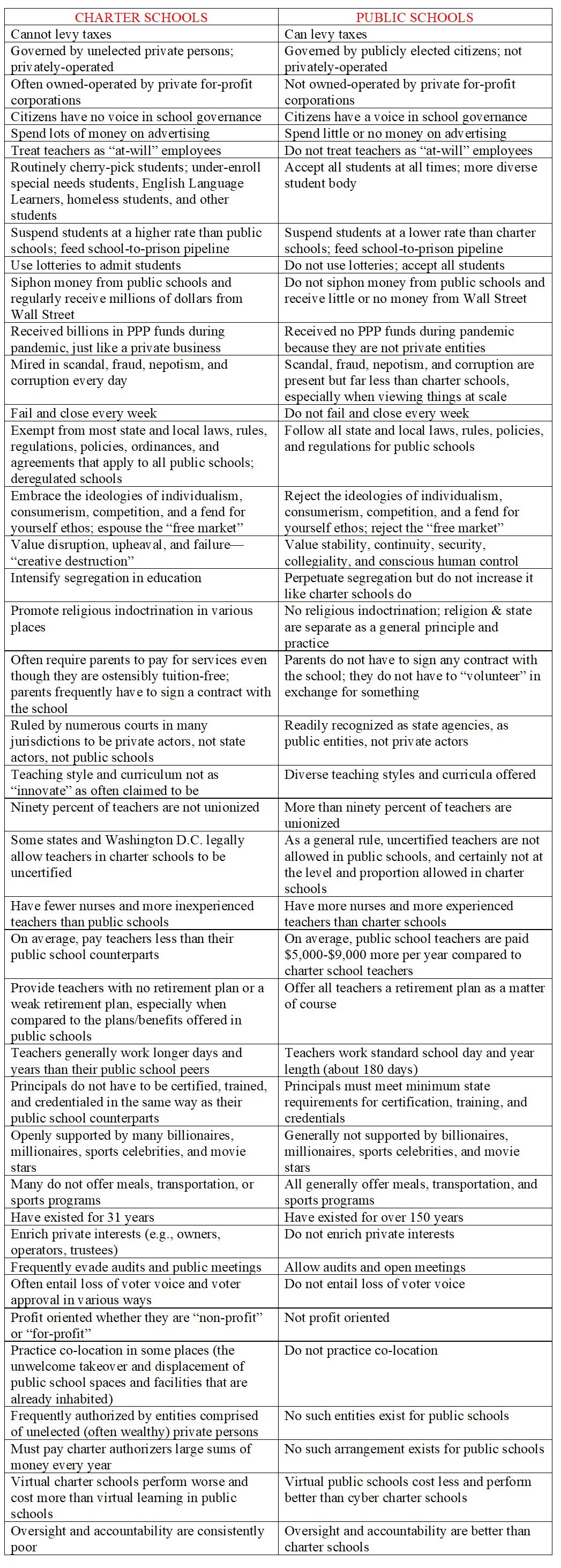
Charter Schools Will Desert and Violate Thousands In 2024

By Shawgi Tell


Privately-operated charter schools have been around for 32 years. They fail and close every week, abandoning and harming hundreds of parents, students, teachers, education support staff, and principals. Neoliberals cynically call this “free-market accountability.”

These closures, moreover, are often sudden and abrupt, revealing deep problems and instability in the charter-school sector. Parents, students, teachers, education support staff, and principals often report being blindsided by such closures and how they have to anxiously scramble to find new schools for students.

Officially, 2,315 charter schools failed and closed between 2010-11 and 2021-22 alone (an 11-year period). On average, that is 210 privately-operated charter school failures and closures per year, or four charter school failures and closures per week. The real number is likely higher. Over the course of 30+ years more than 4,000 privately-operated charter schools have failed and closed. That is a high number given the fact that there are under 8,000 privately-operated charter schools in the country today.

The top four reasons privately-operated charter schools fail and close every week include low enrollment, poor academic performance, financial malfeasance, and mismanagement. Thus, for example, every week the mainstream media is filled with articles on fraud, corruption, nepotism, and embezzlement in the charter school sector. Not surprisingly, arrests and indictments of charter school employees, trustees, and owners are common.

While fraud, corruption, nepotism, embezzlement, and scandal pervade many institutions, sectors, and spheres in America, such problems are more common and intense in the charter-school sector.

Despite all this, a dishonest neoliberal narrative keeps insisting that these privately-operated schools are superior to the public schools that have been defunded and demonized by neoliberals for more than 40 years. The public is constantly under top-down pressure to ignore or trivialize persistent charter school failures and problems.

In this context, the public should reject relentless neoliberal disinformation that public schools are a commodity or some sort of “free market” phenomenon. It should discard the idea that parents and students are consumers who should fend-for-themselves while “shopping” for a school. The law of the jungle has no place in a modern society. Such a ruthless survival-of-the-fittest approach to individuals, education, and society is outmoded, guarantees winners and losers, perpetuates inequality, and increases stress for everyone.

The public should defend the principle that education in a modern society is a social human responsibility and a basic human right, not a commodity or consumer good that people have to compete for. A companion principle is that public funds belong only to public schools governed by a public authority worthy of the name.

Charter schools are not public schools. They are privatized education arrangements, which means that they should not have access to any public funds that belong to public schools. Public funds should not be funneled to private interests. School privatization violates the right to education.

Currently, about 3.7 million students are enrolled in roughly 7,800 privately-operated charter schools across the country. The U.S. public education system, on the other hand, has been around for more than 150 years and educates about 45 million students in nearly 100,000 schools.


Shawgi Tell, PhD, is author of the book “Charter School Report Card.” His main research interests include charter schools, neoliberal education policy, privatization and political economy. He can be reached at stell5@naz.edu.

"I Don't Believe Capitalism Can Be Fair": An Interview with Clara Mattei

[Photo credit: AFP via Getty Images]


By Diego Viana


Where capitalism goes, austerity invariably follows. This phenomenon has puzzled intellectuals for generations. Why does the dominant economic system consistently adopt reforms that seem to destabilize its very foundations?

Dr. Clara Mattei is a renowned scholar and professor of economics at the New School whose research tackles this question. Her latest book, The Capital Order: How Economists Invented Austerity and Paved the Way to Fascism, argues that austerity isn’t “a policy mistake” but is instead a core feature of capitalism. 

Her analysis concentrates on Europe in the years immediately after World War I. Following the armistice, European workers had a rare moment of revolutionary fervor, spurred by the recognition that war governments were perfectly capable of managing the economy beyond the imperatives of profit.

Dr. Mattei argues that, from 1920 to 1927, austerity was instrumental in upholding European capitalism. It accomplished this via three tools: fiscal, monetary, and industrial policy. The trinity entails, respectively and roughly, cuts in social expenditures and regressive taxation, interest rate hikes, and labor suppression. Neoclassical economists like the United Kingdom’s Ralph Hawtrey and Italy’s Maffeo Pantaleoni worked hard to argue for these policies. Ultimately, though, implementation required the break from democracy and political violence that enabled Benito Mussolini’s fascist regime and the development of a fascist mindset which later spread across Europe.

Last month, Hampton Institute contributor and economic journalist Diego Viana interviewed Dr. Mattei about her thesis and worldview. Please enjoy the following transcript, which we have edited for clarity and length:


Diego Viana | Your book argues that austerity is central to the capitalist order. How do current mobilizations figure into this argument?

Clara Mattei | They make the book very topical! Look at the United States. People are mobilizing. And it's not just the strikes. Workers are questioning wage labor altogether. This happened after World War I, when the state politicized the economic realm by intervening in it as part of the war effort. And it’s happening, to a lesser extent of course, again today. Folks got a taste of life without exploited work during COVID when the government offered some social support. Why should they return to work in such horrible conditions now?

That’s where austerity enters the picture. It increases our dependence on markets. That’s typical and specific to capitalism. Most people only have rights if they have money in their pockets that they acquire through wage labor. By cutting social benefits and weakening workers' bargaining power, austerity seeks to ensure no alternative but to bend our necks and accept exploitative conditions.


DV | Nevertheless, mobilizing workers remains difficult due to precarity, reduced union density, etc. Is victory possible?

CM | Your analysis is accurate. It speaks to the “success” of austerity. A half century of hardcore measures has made labor precarious, with fewer union rights, less welfare, and more privatization. Interest rates are rising too, which limits ordinary people’s access to credit and produces more unemployment. Yet people are still mobilizing. True, unions are weaker now than they were after the Second World War — and definitely after the First. But our system is based on exploitation of the majority. So, whenever this majority mobilizes, it's a big deal.

This October the United Auto Workers secured a more generous and progressive wage structure following a 45-day strike. This victory is very serious. And it shows that — when push comes to shove — capital needs workers, who thereby have tremendous leverage to win demands. So —  wherever they are — if workers withhold their labor, that frightens capital.

My book talks about the weapons of the State and its political and economic elites to wage class war against the people. But the book is also optimistic. It recognizes that class struggle is ongoing and workers can win. Indeed, capital as wealth requires capital as a social relation — namely, wage slavery. This means that, so long as we have capitalism, the fight continues. Of course, there have been historical moments when workers were in retreat. But I think now we’re seeing that austerity doesn't mean the death of workers. Austerity is a tool to keep workers in check. In that sense, it acknowledges their power.


DV | Many American economists believe recent stimulus plans mean the age of austerity is over. You push back against this by conceptualizing fiscal, monetary, and industrial policy as a trinity of tools to enforce austerity. Explain how that trinity operates in our current milieu.

CM | The trinity is operating at all levels. Hiking interest rate disciplines workers by “loosening” a tight labor market, which simply means increasing unemployment. And that is exactly what the Fed aims to do. They want unemployment to keep workers desperate enough to accept low wages. That's a really powerful weapon right now. Even if it hasn’t worked yet, it will. The recession is coming. The recession is a short-term cost for a much longer-term gain, which is stabilizing class relations.


DV | How about the fiscal side?

CM | I try to break from mainstream definitions of austerity. People equate it to budget cuts and tax increases. This means nothing. It’s the typical practice of economists to look at the aggregate, disregarding the class dynamics of who wins and loses. But this approach leads to mistaken conclusions — like the idea that austerity is behind us. The state is spending a lot of money, after all! The crucial point is that austerity does not mean “small government” but it means that the government is actively intervening in favor of the elites and to the detriment of the many. 

So fiscal austerity is central, and Bidenonomics is a good example. The public budget expanded. But where did the money go? It went to war, the military-industrial complex, and  energy companies to incentivize them to go green — and, of course, bank bailouts. The state is spending money but giving it to capital owners while structurally defunding social services. For me, fiscal austerity is about social expenditures — not state expenditures generally.


DV | So austerity is compatible with considerable state spending?

CM | Yes! The point is where the state spends. And it’s spending not on the people but the market. It’s commodifying basic services. Joe Biden has done nothing in terms of social redistribution. And his fellow Democrat, Eric Adams, the mayor of New York City, has just announced massive cuts to social spending, spurred also by the fact that interest rate hikes make it more expensive — especially for local governments — to borrow.

So, there, we see the connection. The elements of the trinity reinforce one another. Monetary austerity is reinforcing fiscal austerity. And then there’s the other side of fiscal austerity, which is not just about social expenditure cuts but also regressive taxation. Who is paying the taxes? Again, we’re seeing constant increases in consumption taxes and a total unwillingness to tax capital, profits, inheritance, or any form of wealth. This is very structural. And it’s not unique to the United States. In Italy, Prime Minister Georgia Meloni is doing the same. It's worldwide.


DV | The third element is industrial austerity, particularly in the form of repression.

CM | Biden’s administration can try to give the impression of being pro-labor but it's able to do very little to combat privatization and labor deregulation. It has actually even intervened in a quite cooperative way to block railway workers from striking to achieve better rights last winter. The wins today are coming from organized labor — not the administration.

In other countries, industrial austerity is more present than ever and unions are suffering. Work is getting increasingly precarious. Austerity is really about class — it is about the state’s management of the economy in favor of the elites.

DV | Beyond explaining austerity, you put it at the core of the capital order — the very structure of capitalism itself. Is this a renewal of Marxian economic thinking?

CM | Yes. My work aims to use Marxian methodology, which understands economic relations as inescapably political. This naturally leads to a complete rethinking of austerity. I want to help people realize that the relationship between capitalism and austerity is structural. And this means that the state is constantly intervening to weaken workers and protect capital. Analyzing how austerity works in real time totally confirms this.

Now more than ever, we must heed the most important insight of Karl Marx's critique of political economy. Marx described how economic growth is founded on capital as a social relation. The majority of people must sell their labor for a wage and this is not at all a natural feature Value creation under capitalism ultimately requires exploitation. While a lot of people — even on the Left — take capitalism for granted, capital is based on a specific social relation. That means it’s not only very political but also inherently fragile. This is why it needs constant protection. There are certain historical moments in history in which that fragility emerges.


DV | You describe a change after World War I in which the spontaneous austerity of Gilded Age capitalism had to become managed and coordinated, hence the Brussels and Genoa conferences. Is this the bedrock of later institutions like the Bretton Woods system or the G7, the World Economic Forum, the World Trade Organization?

CM | Exactly. And I think the book doesn’t do justice to the ways in which political institutions prior to the War were actively preserving austerity. There's plenty of literature showing how the gold standard was not a natural mechanism. It was actually quite politically encased. What I argue in the book is that austerity became visible after World War I.

Austerity is always latent in capitalism and emerges when the system is most contested. When its pillars shake, institutions coalesce to protect the capital order. That's why I focus on 1919 and the period right after World War I. It was a moment in which indeed there was a lot of demand for economic democracy.

In Britain, besides universal suffrage, people demanded a greater say in economic issues. They understood the pretext of balancing budgets was purely ideological and no longer tenable. During the War, states spent all the money they wanted. So people were asking for a post-war reconstruction in which resources were utilized in their favor rather than for profit making.

In these moments of political crisis, austerity refines its tools. Many institutions sprung into action in the early 1920s — especially independent central banks — to insulate monetary decisions from democratic intrusion. I focus on this period in the book. But my next project is to examine how austerity operated after World War II. So austerity could be an angle to rethink the history of capitalism in the 20th and 21st centuries.


DV | The book’s subtitle is about austerity paving the way to fascism. In the case of Italy, the opposite seems to have happened. Fascism paved the way for austerity. What do you make of that?

CM | A common idea is that fascism emerges as a reaction to austerity. But you’re right. In Italy, something different happened. The original fascism — Benito Mussolini's fascism — swept to power because of its capacity to implement austerity. Fascism and austerity needed one another. The authoritarian state was able to enforce austerity much more effectively than any democratic government. Unlike its liberal counterparts, it could intervene directly to repress wages, curtail strikes, and implement a whole slew of social cuts and privatization while jailing opposition. That’s why, as I describe in my book, neoclassical economists were very excited about Mussolini. He imposed their pure models on reality. 

Mussolini was a response to the fact that, shortly before the March on Rome, there were full-blown factory occupations. Workers were gaining lots of rights and crumbling wage relations in favor of democratic management of industry via factory councils, of which Antonio Gramsci was a very important leader. The elite couldn’t have that. Fascism was a godsend. Montagu Norman, who was the governor of the Bank of England, said, “Fascism has surely brought order out of chaos… The Duce was the right man at a critical moment.”

Norman said this in 1926, when the regime had already shown what it meant to be a fascist regime — killings and all. But he liked that fascism was all about suppressing wages, defending private property and investment, and using the state to keep industrial peace to maximize profit above everything else.


DV | How do you see the link between fascism and austerity today?

CM | Today, a lot of fascist or authoritarian governments come to power promising no austerity. Indeed, people feel the economic violent impact of austerity on their daily lives and desire something different. However, because of austerity’s preeminence, people have lost class consciousness and believe they can trust bourgeois politicians — especially the lie that it's all the fault of migrants. So there's an inability to see what’s at stake, because class struggle is never discussed.

Italy today is emblematic. Citizens voted for Meloni’s far-right government because they promised change. However, there's complete continuity between the liberal technocratic governments of former prime ministers Mario Draghi and Mario Monti  and the current one. Meloni's Minister of Finance is Giancarlo Giorgetti from Bocconi University — the same guy who was there with Draghi! And Meloni’s budget for the coming fiscal year is pure austerity. She’s defunding hospitals and schools, eliminating the subsidies for the poor called reddito di cittadinanza, expanding regressive taxation, and privatizing while pushing for further labor deregulation. It's the whole austerity trinity — except for monetary policy, which is managed by the European Central Bank. This is no shock. Historically, when it comes to managing the economy, liberals and fascists have been allies. That's still true. Their authoritarian tendencies may surface in different ways. But, ultimately, the two camps are pushing in the same direction.


DV | Since WWI, has anyone defeated the drive toward austerity?

CM | Not to my knowledge. While 1919 was a really exciting year both for the reformists, who passed many welfare initiatives, and the more radical workers’ councils, who called for workers’ self-governance, this did not last long. Even in revolutionary Russia, Vladimir Lenin’s New Economic Policy basically acceded to some form of austerity. The Soviets had little choice. To compete globally in a capitalist system, they had to deflate their economy. From the 1920s onward, it’s been quite austere all around.


DV | Couldn’t that ingrain a sense of powerlessness? Recall Fredric Jameson's formulation. “It's easier to imagine an end to the world than an end to capitalism.”

CM | I hope the message of the book is actually the opposite. The fact that we think there's no way forward outside of capitalism speaks to the “success” of austerity. If you break out of austerity, you're breaking out of capitalism. We need to think big, but this doesn't mean that it's impossible. There's a huge amount of movements going on even now as we speak that are about achieving independence from market forces. Look at La Via Campesina, a movement that unites farmers throughout the South of the globe to demand workers’ sovereignty in food production or the neighborhood councils in Chile that mobilize to organize resources democratically and had a big role in the Chilean constitutional process before it was tanked by their supposedly left-wing government. Organizations like these are rekindling democratic engagement in the production process and ecological sustainability.

Now more than ever, we must rethink what type of state we want. The capitalist state is clearly one that must do austerity. And this is also clear for other systems that had to compete in the global order. Even globalization is unnatural and politically constructed. But everything that's actively constructed can also be actively deconstructed if people participate. And this is why I think those on top are constantly concerned. They know that the system is fragile. Although they’ve used neoclassical economics to convince us it isn’t. But I believe in the power of workers to think bigger and defeat capitalist realism.


DV | Economists in the last decade have become smitten with cash transfers, basic incomes, taxing capital flows, etc. as antidotes to economic malaise. These proposals are mostly encased in the framework of neoclassical microeconomics and liberals seem excited about them.

CM | I think those proposals are quite naive. They assume you can have the best of all worlds — a sort of “fair capitalism.” I don't believe capitalism can be fair. In a capitalist economy, the state’s ability to redistribute is necessarily limited — especially politically. These economists fail to see that. Otherwise they’d understand that a livable universal basic income would be a revolutionary measure. Society would cease to be capitalist. Some neoclassical economists, especially those who work at the Federal Reserve and International Monetary Fund, are perfectly aware of this. That is why they often block such policies.


DV | Have you debated other economists who criticize austerity, but consider it merely a bug and not a feature of capitalism?

CM | It's hard to have these debates. Economists generally believe the political and economic realms should be separate. They think I’m not really doing economics because the discipline is ontologically founded on that separation. But that’s an artificial, ideological divide. It’s ideological in the sense that it perpetuates illusions which help foster consensus for the system. Even colleagues at the New School, whose economics department is amongst the most radical, separate politics and economics. The dominant creed is that doing economics has little to do with the actual social relations of production.


DV | After World War II came the Keynesian era of the welfare state and managed capitalism, where wages and capital returns grew at similar rates. Why didn't we see the wave of austerity and fascism that followed World War I?

CM | This is a very important question and is indeed the guiding one of my next book project with the University of Chicago Press. I can start providing a very preliminary answer. The revolutionary spirit of 1919 was not as palpable after World War II. Workers became more integrated in the capitalist state apparatus. This was the great success of Fordism — the system of mass production and consumption characteristic of “developed” economies. Fordism got workers to accept exploitation in return for somewhat higher wages and moderate social benefits. In moments when political upheaval is weaker, states can undertake more ambitious redistributive efforts without risking subverting the entire system. By contrast as I show in my book, after World War I, reconstructionists tried to appease the population through welfare reform. But, in moments of more heated challenge to the pillars of the system, they weren't successful. Rather, their reforms instilled in workers a greater sense of possibility. Getting something caused the majority of citizens to demand more — perhaps even an overthrow of the whole system. Why just accept the lengthening of the leash? 

After World War II, the revolutionary surges weren’t as powerful. This enabled the reformist vision of giving a little without challenging capital accumulation as such. That’s their political project.

Consider the policies implemented after World War II. The term "austerity" was popularized by Britain’s Labour government in 1948. Why? Because they prioritized the inflationary threat. In the historical trade-off between inflation and full employment, they chose to tame inflation. This led to a huge wage freeze in 1964.

Policymakers in Britain, the United States, and Europe were always concerned with compressing wages to avoid diminishing profits and private investment. Monetary stability and international competitiveness were sacrosanct. Sure, profits were so high that real wages grew alongside them. But how much space was there for more structural distribution of resources?

All this makes you question the supposedly great divide between Keynesians and Hayekians that I intend to explore further. Neither John Maynard Keynes nor Friedrich Hayek theorized about exploitation or understood capitalism as the problem. That’s why Keynes sought to optimize the system rather than replace it with something better. Let’s not make the same mistake.

Internationalism Today: An Interview with Paweł Wargan

By Daniel Benson


Republished from Monthly Review.


What does a progressive foreign policy look like today? How should we understand imperialism? What is at stake in reclaiming an internationalist political horizon for the left? What forms of organization are best adapted for a new international? Given the many contemporary global challenges—such as climate change, far-right extremism, pandemics, and the increasing threat of nuclear war—it is urgent to develop a strategic, organizational, and theoretical perspective for the international left. Paweł Wargan discusses these and other questions in the interview that follows. Researcher, activist, and coordinator of the secretariat of the Progressive International, Wargan is well suited to highlight the prospects for a new internationalism today. The interview is conducted by Daniel Benson, assistant professor of French and Global Studies at St. Francis College and the editor of Domination and Emancipation: Remaking Critique (Rowman and Littlefield Publishers, 2021).


Daniel Benson: I’d like to begin with a discussion of your overall political perspective and development. What are some of the main events or intellectual influences that have impacted your current writing and activism?

Paweł Wargan: I worked in public policy when the last great wave of climate activism emerged. Every Friday, I would make my way through crowds of protesting schoolkids to get to work. Occasionally, some would block the roads. What struck me was that the ideas expressed in these spaces carried a clarity, a creativity, and an urgency that I never saw at work—where ideas were staid, unambitious, never coming close to addressing the urgency of the moment. So, I took to the streets.

You learn through struggle. You build confidence through struggle. You begin to articulate the reasons for your struggle and develop a feel for the possibilities it opens. The great challenge, I learned over time, is that it’s not enough to have good ideas. In large parts of our movements, demands for “system change” resolve into a politics of advocacy that focuses on appealing to existing institutions rather than building new ones. The very form of these protests—they are often held outside government buildings—speaks to that relationship of supplication. We entreat our ruling classes to deliver something that is not in their power to deliver. And we become despondent when we fail. This reflects a poverty of imagination, which has been carefully cultivated by the ideological machinery of capitalism.

Not long after, I had what you might call a eureka moment. I was working on a long report that envisioned what a green transition might look like in Europe. One day, I was editing a section submitted by an Italian architect. In it, he argued that to build sustainable cities Europe needed to shift to prefabricated, high-rise apartment blocks surrounded by parks and public amenities. I was living in Moscow at the time, on the fourteenth floor of a prefabricated high-rise apartment block surrounded by parks and public amenities. I looked out the kitchen window and wondered: What was this society that, many decades ago, began to build the future we are only now envisioning? That led me to study processes of socialist construction.

Fidel Castro once said that when he first read The Communist Manifesto, he began to find explanations for phenomena that are typically explained in terms of individual human failings—moral failings. He began to understand, he said, the historical processes and social processes that produce both great wealth and terrible immiseration. You don’t need a map or microscope to see class divisions, he said. I think about that often. What Castro meant—and what you learn from reading revolutionaries like Karl Marx, Frederick Engels, V. I. Lenin, Walter Rodney, and others—is that there are observable processes of contradiction and class antagonism that shape the world. The job of the left is not to hover above these processes and preach progressive ideas. This is the domain of idealism, of liberalism. You can’t build the future with ideas. You can’t repair the environment with ideas. You can’t feed the hungry with ideas. Our job is to build power through struggle, at every step seeking to institutionalize that power, building structures that can realize the aspirations of the people. That is what the great processes of socialist construction—past and present—teach us.


DB: I agree that building institutions on the left is vital. I think there is an increasing consciousness among left-leaning thinkers, activists, and scholars of the need to focus on organizational issues, on strategy, on building power, and not merely on symbolic gestures or purely theoretical problems. But recent history has shown the difficulty of creating lasting institutional change: from the anti-World Trade Organization protests of 1999 in Seattle to the Iraq War protests of 2003 to the Occupy movements of 2011. Moreover, even when leftist parties can organize and achieve political power at the national level (for instance, Syriza in 2015), they have proven incapable of challenging dominant global institutions. Or, turning to the Global South, progressive projects have struggled to freely develop (Venezuela, Bolivia, Cuba, among others) in large part due to U.S. imperialism.

I’d like to turn, then, to the question of internationalism and how it relates to building power on the left. I feel that many individuals, students, and even progressive activists see international politics as distant from their everyday life or local struggles. This is very different from, say, the long 1960s, where resistance to the Vietnam War, decolonization, and socialist construction were seen as interrelated and part of the same struggle. Could you explain, first, why internationalism is important to building progressive, leftist institutions? And, second, why you propose the Third International, or Communist International, as an important resource to rebuild internationalism in the contemporary moment?

PW: There is a story I have heard repeatedly—the cast changes, the setting changes, but the story stays roughly the same. Moved by the exploits of Che Guevara, an enthusiastic U.S. socialist travels to Nicaragua. He visits the encampments of the Sandinista movement, which is waging armed struggle against the U.S.-backed Somoza dictatorship. “I want to join your struggle,” they say. “What can I do to help you?” The response is blunt: “Go home and make a revolution in the United States.”

The answer tells us two important things about internationalism.

First, the struggle of the Sandinista movement does not occur in isolation. It takes place against the backdrop of overwhelming U.S. imperial violence, which is the international extension of its oppressive, racist, and colonial politics at home. In the 1980s, Nicaragua was subjected to an economic and military blockade. Its harbors were mined. The Contras—a fascist force that massacred hundreds of thousands of people across Latin America—were covertly armed and trained to destroy the aspirations of the people. There was a very real need to sever the threads that bound Nicaragua’s brutal immiseration with the prosperity of the U.S. ruling classes—and that necessitated building a revolution in the United States.

Second, the construction of a revolutionary process is in itself an internationalist act. What can you do for the people of Haiti, or the people of Cuba, or the people of Western Sahara, or the people of Palestine, or the people of Venezuela as an individual, without first building power? Can you send them a tanker of oil? Can you send them a container of medical supplies? Can you help them build modern industrial capacities—or support their green transition? The degree of our collective power at home, and the political orientation of our movements, dictates the shape of our commitments abroad.

In 1918, Lenin wrote a piece railing against those who sided with their governments in the First World War. In privileging the “defense” of their countries over the overthrow of those responsible for the war, he wrote, these forces substituted internationalism with a petty nationalism—backing a predatory capitalist and imperialist leadership against the imperative of peace and social revolution. In the end, Lenin said, the position of the Bolsheviks was vindicated. The October Revolution generated the ideas, strategies, and theories that came to power a global revolutionary movement. Like messengers from the future, the Russian people pierced through the terrors of capitalism, and revealed a path forward.

Turning that path into a highway was, to a great degree, the mission of the Third International. Through it, Lenin said, the nascent USSR would lend a “helping hand” to peoples seeking emancipation from colonialism. That mission was born from a thesis that echoes in our story from Nicaragua. The thesis is that European capitalism draws its strength not from its industrial prowess, but from the systematic looting of its colonies. That same process both feeds and clothes the European working class, suppressing their revolutionary aspirations, and generates the material power that sustains their exploitation. The police forces, prisons, weapons, and tactics tested and honed in the colonies are always, after all, readily turned against workers back home. The primary duty of internationalism, then, is to strike at capitalism’s foundations: colonialism and imperialism.

These ideas carry great weight in our time. Whenever we—ensconced in the comforts of the imperial world—advance ideas for the reform of the capitalist system, we are effectively saying: “We don’t care that over two billion people go to bed hungry. We don’t care that hundreds of millions already live in a wrecked climate. We don’t care for the people who suffocate under the weight of our sanctions. Their plight doesn’t concern us.” The theories of the Third International teach us that the power of our ruling classes is the mirror image of the immiseration of the great planetary majority. Now, as countries and peoples begin to assert themselves against U.S. hegemony and its drive towards nuclear and environmental exterminism, our task is to build power with the grain of that historical process—not against it. Now, more than at any point in human history, is the time to build a revolutionary struggle grounded in clear anti-imperialist politics.

DB: Let’s turn to concrete organizational questions of how to build such a revolutionary movement. The late Marxist scholar and activist Samir Amin was an active participate in organizing across borders and bridging the divide between the Global North and Global South. Amin called for launching a “Fifth International” in 2006 or a “New International” just before his death in 2018. The latter call generated important discussion among scholars, theorists, and activists about how best to “do” politics in the context of neoliberal globalization. Much of the debate revolves around two issues: (1) the longstanding debate on the left of finding the right balance between a “horizontalist” perspective (democratic, pluralist, non-hierarchical, open to various ideological tendencies) and a “verticalist” one (strict criteria of membership, centralized decision-making); and (2) what is the right or appropriate level (local, national, international, global) at which to organize.

What are some of the organizational challenges and successes you’ve encountered in your own experience building left internationalism today?

PW: Organization is simply the way in which we store and instantiate our collective capacity to act—coming into contact with others, forming communities, building confidence, and making the strategic and programmatic decisions about the future that we want to build.

How helpful is the distinction between the “horizontal” and the “vertical”? In my mind, those who reflexively privilege the “horizontal” over the “vertical” cling to the view—cultivated to a great extent in the anti-communist project—that the outcomes we want can spontaneously materialize without us actively pursuing them. That when things become bad enough, the anger of the masses will translate into change. Instead, as movements have repeatedly learned, a commitment to extreme “horizontalism” operates as an obstacle to unity and provides fertile ground for the emergence of invisible hierarchies that immobilize and breed discontent. Equally, organizations that are sometimes derided as “vertical” made tremendous leaps in what we might now call inclusivity. For the first time in history, Lenin’s Comintern brought the demands of women, anticolonial movements, national liberation movements, Black liberation movements, and others under its banner—translating diversity into collective power grounded in a shared analysis of the political situation.

We need to build institutions prepared to address the profound challenges that confront humanity. What are these challenges? In his proposal for a new international, Amin described the U.S.-led imperialist system as totalitarian. I side with Domenico Losurdo in questioning the integrity of that concept, but in this case it is perhaps uniquely appropriate. Capitalism and imperialism sever our connection to the productive process, to nature, to other human beings, and to our own imaginations. We become trapped in a world of imposed ideas, imposed structures. The history we learn, the clothes we wear, the possibilities that we ascribe to the future—these are not ours. They form through the operation of capital accumulation at the global scale, a process that we sometimes euphemistically describe as “globalization,” but which is more accurately understood as imperialism. Extreme violence has been wielded—and continues to be wielded—to preserve this system. Its primary function, as Amin reminds us, is to preserve the “historical privilege” of the colonizers to pillage the resources and exploit the workers of the Global South. But the system is not inevitable.

Marx and Engels devoted their lives to showing that historical processes are not arbitrary. They have motor forces that can be studied and whose movements can be charted. The interaction of these forces generates tensions, or contradictions, that manifest in different ways at different times in our history. Revolutionary processes that ended the enslavement of human beings gave way to a new system of economic organization in which the primary contradiction was between workers and factory owners, or, elsewhere, peasants and landlords. History has shown that these contradictions can be overcome, but only through the collective efforts of the people. This cannot happen spontaneously, and it cannot happen if we cling to the false belief that the previous system can be redeemed or reformed—that a fairer slavery is possible, or that a fairer imperialism is possible. So, one of the primary tasks—and challenges—of the internationalist is to break through the structures of alienation that imprison our minds, our bodies, and our societies.

What does that mean in practice? It means creating the conditions by which peoples and movements from disparate parts of the world can learn from one another and become aware of one another’s fundamental interconnection—overcoming, for example, the idea that the struggle of the Amazon warehouse worker in the United States is separate from the struggle of the garment worker in Bangladesh. When we buy a pair of jeans on Amazon, we wear the labor of the textile weaver in Dhaka. And in that labor, we find the sources both of our collective power and of Amazon’s monopoly power. Our power exists in the socialization of production, in the fact that manufacturing is a collective process and a set of social relations that can be disrupted or captured by the organized working class. Amazon’s power is born of the surplus value generated by its capacity to exploit, dispossess, and plunder, both at home and abroad—a “historical privilege” currently protected by the North Atlantic Treaty Organization, the 800 U.S. military bases that circle the globe, a sanctions regime that suffocates states seeking to embark on paths of sovereign development, and other infrastructures of economic and military coercion.

But understanding is one part of the puzzle. Sloganeering, however radical, can only take us so far. How can we help build the trade unions in Bangladesh, who are resisting international capital and its agents in government? And how do we politicize the popular movements in the United States that hold the capacity to sever imperialism’s grip on the rest of the world, but largely eschew anti-imperialism as a political horizon? There is a dynamic interplay here between the local sites of organization and action, the transnational networks that seek to unite and coordinate that action in a programmatically coherent way, and the global horizon, where the framework of imperialist globalization reveals to us the threads by which our struggles are connected. The geographic scale of action must dynamically respond to the conditions it confronts. That is why, to me, an International must be a laboratory of political action—grounded in a comprehensive theory of the political and economic conjuncture, faithful to the historical tradition it builds upon, but not dogmatically wedded to this or that organizational template.


DB: I’d like to ask you a question about language and terminology. Specifically, the difficultly in effectively framing and articulating a left internationalist laboratory you describe. Since the rise of neoliberal globalization, which kicked into high gear after the dismantling of the Soviet Union, the very vocabulary of internationalism itself has given way to terms like global justice, global citizenship, transnationalism, and cosmopolitanism. These terms are all palatable to a world in which nation-states have become subordinate to global finance. Such terms have seeped into progressive social movements, NGOs, institutions of higher education, and United Nations entities, at least in part to disengage and disassociate from, or simply reject, an entire history of internationalist struggle that you touched on earlier. What is at stake in reclaiming internationalism as a political horizon today?

PW: The Polish journalist Ryszard Kapuściński—among my earliest political influences— compared history to a river. On the surface, he said, the water moves quickly. Beneath the surface, the flow is steadier. Similarly, events pass us by quickly, but in their multitude we can observe stable structures and patterns of thought, which change over long historical epochs. I start here because internationalism carries within it concrete traditions of thought and action that we derive from Marxism, which contain within them a view of the river’s slow undercurrent.

The most important of these is dialectical and historical materialism, an analytical method that teaches us to train our eye not on individual events, but on the movement of history. The dominant philosophy of our time compels us to see only the surface of the river, only the quick succession of events. But these events pass us by with astonishing speed. We struggle to discern patterns, we become overwhelmed. Unable to situate developments in the world within their proper context, we begin to suffer from amnesia. We forget our history. Our creativity is imprisoned because we lose the ability to relate our actions to reality. And our politics resolve into idealism: we believe that a just world can be imagined into being; that our system can be transformed by gradual reform; or that nothing can really be done. Rodney outlined three features of this bourgeois perspective. First, it purports to speak for all of humanity rather than a particular class—the logic that says, “we are all in this together.” Second, it is highly subjective, claiming universal truths while concealing its ideological commitments—just look at the entire field of economics! Third, it refuses to acknowledge contradictions.

Marxism repudiates these notions. It teaches us that historical movement is a product of contradictions between and within things. You cannot have poverty without wealth, a proletariat without a bourgeoisie. The position of these classes reflects their relationship with the material world, with the means of production. The ideas that each group subscribes to also relate to their material environment, to their class position. Idealism is the philosophy of the bourgeoisie, while communism is the philosophy of the workers and oppressed peoples. And central to the communist tradition is the idea that collective human effort can resolve contradictions in favor of the oppressed. In his eleventh thesis on Feuerbach, Marx wrote that “philosophers have only interpreted the world; the point is to change it.” Marx was not just a thinker. He founded the International Workingmen’s Association, the First International, which emerged in part from textile workers’ opposition to British involvement in the U.S. Civil War. At the time, Lord Palmerston’s government was plotting to intervene on the side of the Confederacy. The workers of Britain saved Western Europe, Marx said in his inaugural speech to the First International, from plunging into “an infamous crusade for the propagation of slavery on the other side of the Atlantic.” The conviction that we have the capacity to change the world—that it is our duty to change the world—is inseparable from the tradition of internationalism, which is a communist tradition.

Today, with their imaginations stymied by old, unchanging ways of thought, many organizations do not set out to change the world, because they do not exist in the world. They do not exist among children who struggle to eat, or the workers who struggle to make ends meet, or the peasants dispossessed from their land. They are bourgeois in their makeup. So, they subscribe to categories of thought that hold little relevance for the hungry, the poor, or the dispossessed—and the institutions they build do not serve the interests of those for whom the world must change. The language they use is a product of their class commitment, and one that has been carefully cultivated: the substitution of movements for liberation with NGOified sloganeers is an instrument of demobilization. It shields the status quo by institutionalizing bourgeois ideology.

In a sense, then, everything is at stake in reclaiming internationalism as a political tradition—and I have a very optimistic view of our prospects. Liberalism has not, cannot, and will not find answers to the complex crises facing humanity. But, from the violent, ceaseless flow of events that confront us, internationalism helps us recover sight of history’s laws of motion, and of the peoples and movements that are its engines. It reveals to us the ways in which our struggles and experiences are connected across borders, and the class dynamics that shape them. Even if they have yet to take hold, the ideas of internationalism, of socialism, are alluring to many precisely because the prevailing ideology is not ours. But, where bourgeois thought fails us, socialism shines a light through capitalism’s darkness, reclaims the past from its amnesia, and recovers hope from its futurelessness. These are our traditions, and we have nothing to fear in proclaiming them.


DB: My last question is on how to formulate a progressive, anti-imperialist foreign policy. At the end of Marx’s inaugural address you mentioned, Marx affirms that the working classes recognize “the duty to master themselves the mysteries of international politics; to watch the diplomatic acts of their respective governments; to counteract them, if necessary, by all means in their power.” Today, a lot of mystery, or deliberate mystification, swirls around international politics, not least the Russia-Ukraine conflict.

Among the anti-imperialist left, the debate tends to turn on how to understand imperialism. Should imperialism be seen in the singular, as predominately U.S.-led; or are there multiple, competing imperialisms, such that Russia, China, and the United States would all be equally imperialist powers? How does this debate impact the development of a coherent foreign policy for the internationalist left today?

PW: What is imperialism? In the intellectual tradition of the left, it refers to a situation in which capitalist economies mature, the rate of profit falls, and corporations begin to look abroad for resources to extract and labor to exploit. This is the same dynamic that sees small “Main Street” businesses grow into chains, then regional conglomerates, and then into national and ultimately international monopolies. The laws of capitalism demand that expansion. Companies that fail to grow are pushed out of business or bought up by others. Then, state power is wielded to turn sovereign nations into export markets, sources of cheap resources and labor, and outlets for investment for these corporations.

Today, the United States has a degree of power that is incomparable to any empire in human history. This is a product of a particular historical moment that I situate at the end of the Second World War. Having lost 27 million lives to defeat Nazism, the Soviet Union was in tatters. Europe was ruined. China, having faced an even longer war at the heel of a century of colonial subjugation, faced a desperate situation. But the United States emerged not only unscathed, it emerged economically and militarily strengthened, cloaked beneath the terrible aura of the atomic bomb, giving it something resembling omnipotence in the international arena.

How has it wielded that power? From the very beginning, it has wielded it to suffocate humanity’s aspirations for sovereignty and democracy. In the late 1940s, the people of Korea rose up against feudalism and the brutal U.S.-backed dictatorship of Syngman Rhee, which operated death camps for suspected communists. In response, the United States destroyed the north of Korea, killing roughly a quarter of its population and destroying 85 percent of its buildings. It threatened to use nuclear weapons on several occasions. This holocaust has largely been written out of history—and its victims are now the subject of vicious and routine derision by those who sought to erase them. If you ever wondered what the world might look like had fascism prevailed, look no further than the U.S. destruction of Korea.

Then came Iran in 1953, Vietnam in 1961, Guatemala in 1954, Congo in 1956, Vietnam in 1961, Brazil in 1964, Indonesia in 1965, Chile in 1973, Nicaragua in the 1980s—the list goes on and on. Wherever the United States arrived, its parasitic capitalist model of globalization followed like a cancer, suffocating states’ capacities to respond to the needs of their people. Tens of millions of lives have been claimed by direct or proxy violence instigated by the United States, and many more from the effects of being subordinated to the U.S.-led imperial system. Roughly five million people die each year because they do not have access to adequate healthcare—a problem that socialist projects have largely eliminated. But socialism is not allowed in the U.S. template for humanity.

We may ask a counterfactual, then: How might the world look if the United States had not picked up imperialism’s mantle after the Second World War? The defeat of Japanese imperialism and the German colonial project in Eastern Europe—and we must insist on its recognition as a colonial project—severely weakened the colonial powers. It set off a process that saw the British and French empires shrink dramatically. It inaugurated a new, modern consensus for humanity, with the adoption of the UN Charter and the pursuit of decolonization. It gave great prestige to the project of state socialism. The United States pushed against these currents—against the movement of history—and built a global system through which it exerts, at the barrel of a gun, near-total financial, cultural, and political power over the vast majority of humanity. No country in history has a comparable military footprint or proven capacity for destruction.

Attempts to downplay or relativize this violence are an insidious form of apologia. More often than not, accusations of, say, “Chinese imperialism” are rooted entirely in the hypothetical: “China is building infrastructure that could allow it to become a new imperial power.” In this case, the “twin imperialisms” thesis serves to put on equal footing an unsubstantiated conjecture with the actual violence of imperialism—it puts a moral claim on equal footing with an empirical fact. As the historian Vijay Prashad has remarked, we are afraid of Huawei’s 5G towers because we are told they could be used to spy on us, but we are unconcerned by the actual spying that is carried out by the U.S. government, which Edward Snowden and others have revealed. What is this but another red scare, scaffolded in our culture by the increasingly virulent Sinophobia manufactured by the United States and its allies? There are also more surreptitious forms of this on the left: attempts to “redefine” imperialism and cleave it from its analytical tradition to make it more suitable to the particular moral commitments of the day.

This phenomenon—the denial of imperialism—is infantilizing. It confuses left strategy, because it severs our ability to relate to the actual processes of history. It immobilizes, because in a world where everything is bad, nothing is possible. And it risks producing a moment in which, as U.S. violence against China escalates, forces on the western left will side with their own blood-soaked ruling classes rather than build power against them. Guarding against these impulses is among the most important tasks of the day. The moment has arrived for us to heed Lenin’s call to turn the imperialist war into a war on the bourgeoisie that suffocates us.


Note: A French version of this interview was published by the Association Nationale des Communistes on September 18, 2023.

The Publishing Problem: Reading Between the Lines of Industry Self-Censorship

By Chris Richards


Republished from the author’s substack.


At first I didn’t know what to make of Judd Legum’s piece on what he calls “Scholastic’s Bigot Button.” It raises some interesting ideas about whether or not a publisher should pander to conservative political biases by allowing them to hide liberal titles. It shows how not offending certain kinds of white people continues to be an important cultural priority. It informs readers of a right wing pressure campaign against Scholastic Corporation, spearheaded by a conservative Christian publisher of children’s books called “Brave Books.” What it doesn’t really engage with is who Scholastic Corporation is and why the company has so much power.

This is important because who Scholastic is, what they do, and the power they have is central to the right wing pressure campaign to which Scholastic is capitulating. At the moment, Scholastic is selling at $37.48 a share. As Judd Legum points out in his article, it is a publicly traded company with more than a billion dollars of market capitalization. What that means in plain English is that Scholastic’s division Arthur A. Levine Books is the original US publisher of JK Rowling and Philip Pullman. Levine himself left Scholastic in 2019 to establish his own company, but Scholastic still handles the back catalog. That means Harry Potter and “The Golden Compass” are controlled by Scholastic here in the US. In addition, Scholastic itself is the publisher of Suzanne Collins. That’s a lot of Young Adult literary culture in one place.

That’s just one of Scholastic’s four main business lines. Children’s and Young Adult publishing is big money as it is, but the media rights for those books is big money too. Which is why Scholastic Entertainment exists, to develop intellectual property from Clifford the Big Red Dog, to Harry Potter, the Hunger Games, and the Golden Compass, to Goosebumps. There’s a lot of money in this area too, and a lot of power, but this isn’t why Kirk Cameron’s publisher is going after Scholastic.

You see, Scholastic pretty much controls school book fairs. It turns out that schools don’t just hold book fair themselves using decorations made by teachers and librarians. They pay someone to run the book fair for them. Usually that someone is Scholastic Book Fairs. So nearly every time a public school holds a book fair, Scholastic makes a buck. Scholastic also has book fair packages designed to appeal to different schools as different markets. Here is where Brave Books and their pressure campaign targeting Scholastic comes in.

According to its website, Brave Books was founded by Trent Talbot. Dr. Trent Talbot was a practicing ophthalmologist who was so disgusted by “the inappropriate content being pushed upon children”that he just needed to found a right wing Christian kids’ book and YA publishing company to give parents and schools “a wholesome alternative.” So he naturally decided that Kevin Sorbo and Kirk Cameron were the people he should turn to for help. I think of “wholesome” and I immediately want Kevin Sorbo to teach my kids about masculinity, right?

Because being an obnoxious conservative bigot is a brand in today’s America, Brave Books opened its own book club and book fair divisions to compete with Scholastic and chose an openly confrontational marketing tactic. Brave decided to accuse Scholastic of advancing the LGBTQ+ agenda, because we all know that blatantly accusing your competition of wanting to groom parents’ kids is one way to stake out your own recognizable brand. It also makes it clear that you value the thoughts, feelings, and spending money of the Christian conservative market.

This is the basic background of the specific issue that Legum is writing about. I want to be clear about this background before touching on the specifics of his piece and the core problem left unaddressed by his piece. That core problem, imo, is more important than the immediate specifics of what Scholastic is doing under pressure from Brave. The problem is one of capitalism, and of how the fiduciary responsibilities of corporate officers are seen in the modern business culture.

The specifics of this news are simple. In the face of a marketing offensive from a competitor accusing Scholastic of marketing “inappropriate material” at book fairs, Scholastic has introduced an easy button that school employees planning a book fair can use to eliminate any “objectional content” from their school’s book fairs. Naturally the “objectional content” is all about racial inclusion, the lives of Black people like Ketanji Brown Jackson and John Lewis, and teaching kids that LGBTQ+ families are as valuable as traditional Christian families.

It’s important to keep this in the proper context and look at the material underpinnings of what is happening. This isn’t about Scholastic executives being afraid they will be censored by an out of control state governor like Ron DeSantis. This isn’t even about complaints being made by vigilante parents. This is about a corporate competitor of Scholastic choosing to compete by condemning the morality of Scholastic, as a company, in order to try to sell some schools Christian book fair packages. This is the business of capitalism as usual, with Brave Brooks choosing to brand themselves as the “choice for Christians who want their kids to be safe at the book fair.” It’s a marketing gimmick.

When Scholastic adds a button to their system to exclude liberal content to which conservatives might object, they aren’t knuckling under to any public censorship campaign. They aren’t bowing to the forces of a repressive state. No, it’s much simpler.

They are protecting their market share by giving conservative Christian school employees the easy and quick option to keep liberal material out of the book fair. They don’t want to lose market share because the school districts in Texas and Florida go with the conservative book fair option. So they are making sure their interface allows conservative Christian school employees to feel comfortable with their buying decisions.

There’s a conversation that we should be having about corporate control of our “public” education system that we’re not having.

Examining the Role of Anti-Communist Rhetoric in the Growth of Reactionary Cult Movements

By Oskar Kaut


Amidst America’s increasingly polarized political climate, there has been growing concern regarding the emergence of reactionary groups that display cult-like behaviors and tactics, posing vital questions about the impact these groups have on individuals as well as mainstream political discourse. Cults can be broadly defined as groups or movements that share a set of philosophical, spiritual, or political beliefs that are by and large considered to be extremist or deviant by mainstream society. On the other hand, the label “reactionary” is typically given to individuals or organizations that oppose social change and desire a return to “traditional” values and practices. Such beliefs have been on the steady rise for several years, and the conception and popularization of affiliated organizations and movements have followed (Rodrik 162). Many fringe reactionary groups such as the Proud Boys and Patriot Front have come under scrutiny for some of their practices, which are often highly secretive and can involve physical and psychological manipulation (Ashland 37). In recent years, there has been a concerning rise of far-right movements worldwide, providing an opportunity for reactionary groups to amplify their message and reach a much larger audience. Many of these groups display clear cult-like behaviors, as demonstrated by their deference to authority and distorted sense of reality. These groups often use anti-communist rhetoric to infiltrate mainstream political discourse, which serves as a gateway to legitimizing and normalizing the extremist ideology of far-right cults. Resultantly, it is crucial to recognize and address the presence of these cults within right-wing movements and the impact their rhetoric can have on broader society. 

A cult is a group or movement centered around a given (typically extremist) belief system that uses coercive tactics to maintain its hold over followers. Sociological research has shown that cults utilize tactics of social influence in order to manipulate their followers into submission (Corvaglia 9). Morton Deutsch and Harold Gerard divided the concept of social influence into two subcategories. Informational social influence refers to humans’ intrinsic desire to be “right”, whereas normative social influence refers to the desire to be liked by others. Both of these concepts can be aptly applied to cults. Cults use normative social influence (known colloquially as “peer pressure”) to recruit new members. In an increasingly isolated society, cults offer some individuals an opportunity to be a part of something that they see as larger than themselves. The propagation of this form of influence can lead to cult members partaking in practices that they would normally oppose in an attempt to gain favor with other members (Deutsch & Gerard 14). Similarly, in a world where misinformation is increasingly rampant and it can be difficult to know which sources to trust, cults make use of informational social influence to develop genuine conformity to their beliefs and practices. Cults attempt to create a hegemony of “accurate information” for their followers, thus justifying even private conformity in which individuals truly believe that the group is right or justified in their struggle (Corvaglia 18).  

Many reactionary organizations and movements embody the aforementioned cult characteristics. Stanley Milgram’s classical experiments in conformity shed light on the willingness of individuals to obey those whom they view as authority figures and perform actions that go against their own conscience (Slater 32-63). The experiments found that test subjects were willing to administer increasingly severe electric shocks to another person (who they believed to be a fellow test subject) even to the degree where they believed the shocks to be lethal. Reactionary cults (like other cults) often exert substantial social influence over their members and rely on a hierarchical structure of authority that leaves them vulnerable to pressures similar to those exhibited in Milgram’s experiments. Oftentimes–as can be seen in the cults of personality surrounding Gavin McInnes within the Proud Boys or Nazi-collaborator Stepan Bandera in Ukrainian nationalist organizations–members of far-right movements are subject to pressures to conform to the extreme beliefs and practices of groups under the direction of authoritative leaders (Rabotyazhev 525). In many ways, this demonstrates the presence of normative influence within reactionary groups and movements. Moreover, members of fringe right-wing movements are also frequently subject to constant messaging from the group’s ideological leaders and even cut off from external sources of information (Jurg & Tuters). This can be clearly seen as an application of informational social influence, in which far-right organizations appeal to their members’ intrinsic desire to be right by bombarding them with their subjective version of reality accompanied by statements such as “facts don’t care about your feelings”. The intent of this process is to present their extreme viewpoints as objective truths that cannot be challenged, thereby working to shift members’ worldviews over time. The existence of such cult-like behavior in reactionary groups and movements presents real issues for mainstream society as the prevalence of these cults continues to grow. 

In recent years, the presence of reactionary groups has risen sharply both in the United States and globally (Rodrik 162). The attention given to these cults has also increased in the wake of sustained political polarization and social unrest. Large rallies such as the 2017 Charlottesville “Unite the Right” march and the January 6th, 2021 attack on the United States capitol demonstrate the power that these fringe movements now hold as well as their capacity for violence and contribution to the erosion of democratic norms and social stability. The prevalence of right-wing cults can also be seen through the drastically increased proliferation of disinformation and conspiracy theories. Now more than perhaps ever in modern history, mainstream American politics are characterized by a general rejection of the notion of objective reality (Bleakley 1). One of the main causes of this rejection can be attributed to the prominence of echo chambers among political extremists on social media, in which aligning beliefs are reinforced and dissenting viewpoints are actively suppressed (Bleakley 12). This phenomenon hints at a bleak reality: the influence of reactionary cults and movements is not limited to their own movements. Rather, their extremist views and tactics can be observed slipping into mainstream political discourse. 

The growth of reactionary cults within far-right politics has drastically influenced mainstream political discourse. These cults both directly participate in mainstream political campaigns and employ a number of more indirect methods to influence political dialogue. As previously mentioned, the rise of fringe, right-wing cults has coincided with a sharp increase in the prevalence of disinformation and harmful conspiracy theories (Bleakley 2). Reactionary groups have used their growing platforms to disseminate propaganda promoting their fringe ideology and undermining that of their political opponents. Much of this is centered around tactics of fear-mongering in an attempt to create a feeling of urgency for action. Additionally, fringe-right cults are able to methodically slip into mainstream political discourse through media coverage of contentious issues as well as through the actions of individual politicians. Over the past several years, a large number of far-right politicians have adopted language that echoes the beliefs held by reactionary cults in attempts to appeal to certain voters. For example, both Rep. Marjorie Taylor Greene and Rep. Lauren Boebert are former followers of the QAnon cult and continue to espouse much of the same rhetoric supported by the group today, even as they hold some of the highest elected offices in the country. Powerful politicians and media figures’ adoption of framing similar to that propagated by reactionary cults has led to a dramatic shift in the “Overton Window”—the frame of what beliefs are considered socially acceptable within mainstream society. 

The Overton Window is a concept designed to describe the range of ideas that are considered largely acceptable within conventional society at a given time. Joseph Overton (for whom the term is named) conceptualized that ideas outside the window (i.e., politically unacceptable) may later fit within the realm of acceptable ideas because the “window” can “either move or be transformed in size” (Oleksandr 52). It is through this process that reactionary cults are able to slip their ideas into conventional political discussions. Even over relatively short periods of time, one can observe how views that were previously unthinkable become widely adopted within the mainstream. Similar to the concept of the Overton Window is that of deviance, which refers to the idea of departing from generally accepted standards present in society. According to Hewitt, “Deviance…represents a real or imagined threat to social order, and the deviant is accorded a special and discredited position in relation to it,” (214). Thus, views outside of the Overton Window at a given point in time typically also fall under the umbrella of deviant views. The concepts of the Overton Window and deviance (and the relationship therewithin) are crucial to understanding the strategic importance of falling within the views accepted by mainstream society for far-right organizations. As Zuckerman puts it, “Stray outside the sphere of legitimate debate into the sphere of deviance, and your position becomes invisible to mainstream media dialog,” (16). Essentially, in order to reach a larger audience, reactionary cults have to struggle to fit within the established norms of society at any given point in time. Because of the tactical need to infiltrate mainstream political discourse, many right-wing, reactionary cults seek to normalize their own viewpoints by falsely equivocating their views with those held on the left. 

Reactionary groups often use anti-communist rhetoric to slip into mainstream political discourse by framing their opposition to communism as a defense of democracy, individual liberties, and freedom. One of the simplest means by which fascists can achieve their ultimate goal of consolidating power is by utilizing anti-communism as a tool to create a common enemy. By depicting socialism as a threat to national security, reactionaries can silence opposition, suppress meaningful dissent, and legitimize their authoritarian system. Another means by which reactionary groups seek to utilize anti-communist rhetoric is to equivocate fascism (and oftentimes Nazism) and communism. This is of course, on its face, absurd: while communism promotes the seizure of the means of production by the workers (Marx & Engels 38), Nazism is characterized by its emphasis on racial purity and antisemitism. The false equivalence of communism and Nazism is often propagated by far-right cults and media figures alike as a means to both discredit left-wing ideas and shift the Overton Window in favor of their own ideology. Making the comparison between communism and Nazism serves to downplay the severity of the crimes of one of the worst atrocities in human history and silence legitimate criticisms of capitalism and neoliberalism. The conjoined propaganda tools of finding a common enemy around which to unite and equating communism to the atrocities of Nazism allow reactionary cults to both delegitimize leftist movements and slip their own beliefs into conventional political discourse, ultimately serving their own end goal of consolidating power within mainstream institutions. 

  Fictitious tropes equating communism to Nazism have been widely disseminated and adopted within transnational mainstream political discourse, perpetuating misinformation, reinforcing negative stereotypes about leftist political movements, and legitimizing the views of reactionary cults. While the degree to which such attempts varies, in some parts of the world (especially in former Soviet states), reactionary cults have been able to “...[capitalize] on decades of anti-communism mainstream discourse built-up to develop a full-blown populist radical right narrative and politics,” (Popescu & Vesalon 5). In practice, this means that fascist sects such as the AUR in Romania and the OUN/UPA cult in Ukraine have been able to normalize their own beliefs and have massive impacts on public opinion and public policy (Crstocea). As previously discussed, cults have a tendency to rely on (among other things), informational social influence. In many instances, this can include followers accepting blatantly false information and shaping their perceptions of reality around lies (Corvaglia 9). Naturally, it’s not difficult why it would be undesirable for distorted worldviews to slip into mainstream politics, but in many instances, it already has. One such example can be seen in The Black Book of Communism (Courtois et al, 1999), which coined the “100 million deaths by communism” myth that has since been thoroughly debunked (Francois et al 4). Despite being categorically disproven, this myth is still perpetuated within mainstream conservative (and even many liberal) circles. As the views of reactionary cults with distorted worldviews gain traction within mainstream political discourse, they are enabled to both expand their influence and increase their numbers. 

The presence of anti-communist rhetoric in mainstream political discourse has led to the growth of reactionary cults characterized by informational isolation and a deference to authority. The use of anti-communist rhetoric fosters an atmosphere of apprehension and widespread suspicion toward leftist ideologies, which renders individuals more vulnerable to the perspectives of reactionary groups. The fear-mongering and demonization of communism that has pervaded Western political discourse for decades has created a fertile breeding ground for reactionary cults and movements that espouse radical anti-communist ideologies. These groups oftentimes promise protection against a supposed communist threat and frame themselves as protectors of freedom and traditional values. By stoking fears of a communist takeover of institutions, these cults and cult-like movements are able to tap into the anxieties of ordinary people who are disillusioned with mainstream neoliberal politics and searching for a sense of belonging and purpose. Further, the adoption of fictitious anti-communist tropes by mainstream political leaders and media figures can also serve as a means of legitimizing the views of these movements, leading to a further increase in their membership and influence. As reactionary cults continue to gain traction in mainstream political discourse, the consequences of anti-communist rhetoric are becoming increasingly evident. The aforementioned groups are given steadily more and more massive platforms to promote fringe ideologies and often resort to violence, as seen in the 2017 “Unite the Right” rally in Charlottesville, North Carolina, and the storming of the United States Capitol on January 6th, 2021. Additionally, the dissemination of anti-communist disinformation and conspiracy theories among these cults creates a pipeline toward radicalization and a complete rejection of objective, factual information, facilitating the exacerbation of societal divides. The normalization of radical, anti-communist rhetoric also perpetuates narrow-minded perspective ideologies, discouraging both critical thought and nuanced discussions about complex societal issues. In conclusion, the prevalence of anti-communist rhetoric in mainstream political discourse has led to a sharp rise in reactionary cults, posing a threat to the very institutions that underpin Western so-called “liberal democracy”. Acknowledging and rectifying the adverse consequences of the normalization of anti-communist rhetoric is vital in averting the proliferation of reactionary cults and the further degradation of the material conditions of everyday Americans.


References

Andreotti, L. (1992). The Aesthetics of War: The Exhibition of the Fascist Revolution. Journal of Architectural Education, 45(2), 76–86. https://doi.org/10.1080/10464883.1992.10734493 

Ashland, A. (2022). The Cult Fascist: Establishing Cultic Behavior in Proud Boys and Incels. University Honors Theses. https://doi.org/10.15760/honors.1197

Bleakley, P. (2021). Panic, pizza and mainstreaming the alt-right: A social media analysis of Pizzagate and the rise of the QAnon conspiracy. Current Sociology, 001139212110348. https://doi.org/10.1177/00113921211034896

Cikara, M., Fouka, V., & Tabellini, M. (2022). Hate crime towards minoritized groups increases as they increase in sized-based rank. Nature Human Behaviour, 6(11), 1537–1544. https://doi.org/10.1038/s41562-022-01416-5

Crstocea, R. (2016). Stepan Bandera: The Life and Afterlife of a Ukrainian Nationalist. Fascism, Genocide, and Cult. Journal on Ethnopolitics and Minority Issues in Europe, 117–127. https://www.proquest.com/docview/1787817745

Deutsch, M., & Gerard, H. B. (19570201). A study of normative and informational social influences upon individual judgment. The Journal of Abnormal and Social Psychology, 51(3), 629. https://doi.org/10.1037/h0046408 

Dittmann, M. (n.d.). Cults of hatred. American Psychological Association. Retrieved February 24, 2023, from https://www.apa.org/monitor/nov02/cults 

França, T., Gaspar, S., & Mathias, D. (2021). Anti-Communism and the Hundreds of Millions of Victims of Capitalism. Capitalism Nature Socialism, 32(1), 1–17. https://doi.org/10.1080/10455752.2021.1875603 

Jurg, D. H. M., & Tuters, M. (2023). Cult Leaders, Masculinity, and White Supremacy on YouTube: The Case of Stefan Molyneux. Digital Methods Initiative. https://researchportal.vub.be/en/publications/cult-leaders-masculinity-and-white-supremacy-on-youtube-the-case- 

Karpenko, O. (2019). The “Overton Window” as Manipulative Mechanism of Public Values Transformation. National Academy of Public Administration under the President of Ukraine, 1, 51–54. https://doi.org/10.32461/2226-3209.1.2019.166531 

Levitan, L. C., & Verhulst, B. (2016). Conformity in Groups: The Effects of Others’ Views on Expressed Attitudes and Attitude Change. Political Behavior, 38(2), 277–315. https://doi.org/10.1007/s11109-015-9312-x 

Marx, K., & Engels, F. (1848). The Communist Manifesto. In Ideals and Ideologies (11th ed.). Routledge.

Mosse, G. L. (1996). Fascist Aesthetics and Society: Some Considerations. Journal of Contemporary History, 31(2), 245–252. https://doi.org/10.1177/002200949603100202 

Rabotyazhev, N. (2021). Far-right Radicalism in Ukraine in Past and Present. Post-Soviet Issues, 7(4), 516–531. https://doi.org/10.24975/2313-8920-2020-7-4-516-531 

Rodrik, D. (2021). Why Does Globalization Fuel Populism? Economics, Culture, and the Rise of Right-Wing Populism. Annual Review of Economics, 13(1), 133–170. https://doi.org/10.1146/annurev-economics-070220-032416 

Slater, L. (2004). Opening Skinner’s Box: Great Psychological Experiments of the Twentieth Century.”. W.W. Norton.

Walsh, Y. (2001). Deconstructing “brainwashing” within cults as an aid to counselling psychologists. Counselling Psychology Quarterly, 14(2), 119–128. https://doi.org/10.1080/09515070110058558 

Weiner, A. (2001). The Black Book of Communism: Crimes, Terror, Repression (review). Journal of Interdisciplinary History, 32(3), 450–452. https://muse.jhu.edu/pub/6/article/16325 

Zuckerman, E. (2017). Mistrust, efficacy and the new civics: understanding the deep roots of the crisis of faith in journalism. Zuckerman. https://dspace.mit.edu/handle/1721.1/110987

Assessing Empire: A Marxist Review of Vijay Prashad and Noam Chomsky's 'The Withdrawal'

By Edward Liger Smith


Republished from Midwestern Marx.


Last year in the summer of 2022 a wonderful friend named Debbie sent me a copy of Noam Chomsky and Vijay Prashad’s new book The Withdrawal. A year later I finally got the chance to sit down and read it (sorry it took me so long Debbie) and I was not disappointed as this text provides an excellent history of the major events and developments that have taken place within Western Capitalist imperialism throughout the last forty years or so. Those looking for a dense historical text will be disappointed as The Withdrawal is actually a transcribed conversation between Prashad and Chomsky, but this makes it a quick and easy read, perfect for beginners setting out to understand modern American policy and geopolitics.

Going into this book I was curious to see how Chomsky and Prashad reconciled their views on existing socialist countries. Prashad is someone I’ve always admired for his ability to stand up for existing socialist countries and his refusal to parrot U.S. State Department talking points about countries like China. Chomsky on the other hand, has always provided brilliant critiques of the American empire, but has a tendency to sound like a mainstream  liberal propagandist when the topic of the Soviet Union or Leninism comes up. However, it seems that Chomsky may be turning over a new leaf at the ripe age of 94 as attacks on China, Vietnam, and other existing socialist countries are notably absent from this book. 

The Withdrawal provides an excellent summary of the American Empire going back thirty years at least, and it does an incredible job of placing the major geopolitical events of the past few decades within their proper historical context. By example Chomsky’s analysis of the 9/11 terror attacks doesn’t begin on September 11th 2001. Instead he details the millions of dollars that were funneled into Osama Bin Laden’s terrorist group known as the Mujahideen by the United States after the Soviet Union occupied Afghanistan in an attempt to stabilize the country. Through this historical analysis Chomsky reveals how the U.S. empire created the forces who carried out 9/11, then used 9/11 as justification to invade two countries, Afghanistan and Iraq, who had nothing to do with the attacks on September 11th. In fact, the U.S. waged war against Taliban and Iraqi Governments that were actually enemies of Osama Bin Laden’s Al-Qaeda group, an outgrowth of the Mujahideen. 

Notably absent from Chomsky’s analysis is the claim so often made by Western academics that Soviet imperialism in Afghanistan was just as bad as American imperialism. Instead, Chomsky admits that most Afghans see the era of Soviet occupation as the most hopeful time in the country’s history. The Soviet soldiers fought bravely on behalf of the Marxist Democratic Government in power at the time against U.S. backed terrorist groups like the Mujahideen. They also helped the Government build factories, hospitals, infrastructure, and launch literacy campaigns teaching people to read even in the impoverished rural regions of the country. The U.S. on the other hand, dumped money and arms into Jihadist extremists who would throw acid on the faces of literacy workers and women who dared to walk outside without being covered head to toe. Thankfully, The Withdrawal avoids falling into the Western myth that tries to conflate Soviet and American imperialism as equal evils. And this may be due to the influence of Prashad, who has said in another book, Washington Bullets, that the CIA makes a concerted effort to conflate Soviet foreign policy with the worst acts of Western imperialism

Similarly absent from the book are any attacks against the People's Republic of China (PRC), which Prashad and Chomsky accurately say is providing a counterweight to the long-held hegemony of the American empire. The Shanghai Cooperation Organization (SCO) and Belt and Road Initiative (BRICS) were created to counter American imperialism through cooperation and economic development, not to rival American imperialism through exploitation and debt trapping. The authors refuse to fall into the Western trope of dismissing everything that the PRC is doing as “authoritarian” or “imperialist” as so many academics tend to do. Instead, they take a measured and fact-based approach to looking at the foreign policy of the PRC, which ends up making socialist China look pretty dang good.

The book covers four core topics including Vietnam and Laos, 9/11 and Afghanistan, Iraq, and Libya. It will be an enlightening read for anybody who believed the mainstream media myths surrounding these major events. Chomsky brilliantly counterposes the facts of what actually happened in these four wars, to the mainstream media myths that were created to justify them. He also explains how the empire’s justification myths have morphed over time from the war against communism, used to justify the horrific bombing campaigns against Vietnam, Laos, and Cambodia, into the war on terror, used to justify the invasions of Afghanistan, Iraq, and Libya (as well as Syria although it’s not discussed thoroughly in The Withdrawal). 

In totality the book provides a fantastic summary of American imperialism since World War II, and I would recommend that beginners in the field of geopolitics read this text in conjunction with Prashad’s Washington Bullets that I mentioned earlier (After you read Imperialism the Highest Stage of Capitalism by Lenin of course). The Withdrawal is an easy read and it is not cluttered with hundreds of academic sources, but it is filled with the knowledge of two academics who have spent most their lives studying the U.S. Empire.


Critique 

My criticisms of The Withdrawal are contained to the explanations given by Prashad and Chomsky as to WHY the U.S. carries out the murderous and imperialistic policy that it does. For one, the authors use the analogy of the Godfather to explain U.S. policy, arguing that since World War II the U.S. has held unrivaled and unprecedented power on the global stage, allowing them to act like a mafia, breaking the knees of anybody who goes against their interests. I agree with this description of American power, and I find the Godfather to be a useful analogy for how the U.S. conducts foreign policy, constantly ignoring international law in order to violently protect their own economic interests.

Where I disagree with Chomsky and Prashad is when they say that American Policy is “rooted in a settler-colonial culture” or history. Make no mistake American policy is ROOTED in the mode of production, in the economic system of capitalism. America is not a uniquely evil country where people are born with some kind of innate drive to conquer foreign lands. Rather, we are a country of working people who are dominated by multinational corporations and finance capitalists that deceive the public in order to use them as pawns for advancing their global interests. It is not an attitude held by the American public that drives imperialist aggression, it is the incessant need for capital to expand, and the drive for surplus value inherent to the capitalist mode of production. The U.S. did not invade Iraq because Americans are a bunch of settler colonialists who wanted to seize a random country in the middle east. The U.S. invaded Iraq because the Koch brothers and other capitalists wanted Iraq’s oil. That is what American imperialism is rooted in, the need for constant expansion and increased profits which results from the capitalist mode of production, the basis for American society. And it is only through transforming this mode of production into a socialist one that we can bring a halt to American imperialism. Labeling the American working class as “settlers” will simply not achieve this goal.

In fact, America’s settler colonial attitude and history, to the extent that it has existed historically, is itself rooted in the capitalist mode of production, not the other way around. It was the expansion of capital that brought European settlers to America in search of new land, labor, and resources; and it was capitalism that incentivized the mass genocide of the native populations. As Karl Marx brilliantly details in Capital Volume I, in order for capitalism to work it requires a large population of workers who do not own their own means of production or produce their own means of subsistence (food and other things humans need to survive) and thus are forced to sell their labor power to capitalists in order to survive. When European settlers got to America the native peoples already had their own mode of production and produced their own means of subsistence, and thus they needed to be wiped out by the settlers, or divorced from their own means of production and subsistence, in order for capitalism (and the bourgeois form of slavery seen in the American south) to take hold as the dominant mode of production. The genocidal settler colonial culture of European settlers at the time was rooted in the capitalist mode of production and its incessant need to expand. To say that American imperialism and the expansion of capital is rooted in a settler colonial attitude or culture is to flip reality on its head. Although, the capitalist mode of production has certainly benefited from such attitudes.

Additionally, over 500 years have passed since European settlers first came to America. The U.S. is no longer a settler colonial project akin to the apartheid state of Israel, where every day native Palestinians are being forced off their land to make room for new Israeli settlement. It cannot be said that a settler colonial attitude has carried over hundreds of years later, and now acts as the motive force of American Imperialism in the year 2022 (the year the book was published). 

From the Marxist perspective, settler colonial or American exceptionalist attitudes stem from the mode of production, and in turn help to condition the mode of production. By example the attitude of American exceptionalism has been produced and maintained by the ruling economic class of capitalists in order to get the American people on board with their regime change wars. American exceptionalism is rooted in the capitalist imperialist system, and in turn helps to keep that system churning. Again, to say that U.S. imperialism is rooted in an attitude of American exceptionalism or settler colonialism is to flip reality on its head.

Chomsky has never claimed to be a Marxist or dialectical materialist, and so I was not surprised to see him make this mistake. Prashad however, does come from a Marxist-Leninist tradition similar to myself, and I hope that he gets a chance to read this review and reconsiders his use of the word rooted when it comes to describing attitudes of American exceptionalism and settler colonialism. 

Regardless, The Withdrawal is a fantastic text from two intellectuals who I deeply admire. It is filled with information about American Imperialism that has been systematically withheld from the American public by the American ruling class of capitalist, bankers, shareholders, and neoconservative/neoliberal politicians. I would recommend this text to any Americans who want to know what our government has been doing around the world in our name for the last 75 years or so. 


Edward Liger Smith is an American political scientist (with a focus on Geopolitics, Socialist Construction, and U.S. health care), wrestling coach, and Director of the Midwestern Marx Institute for Marxist Theory and Political Analysis. 

Ambiguity In An Art World Shaped By Capital

[Pictured: The author’s painting, entitled “The Bench Sitters”]


By Ian Matchett


“You can’t be Neutral on a moving train”

- Howard Zinn 


I am standing in front of an assemblage of found objects, culled from a midwestern city ravaged by capitalism and racism. The pile has been helpfully located here by an artist with support of the local billionaire’s philanthropic foundation, and a private art school in the suburbs. The artist’s statement informs me that the work is about the possible importance of these objects in the past, before they were abandoned, he wants me to consider how the objects were theoretically important to someone once. I’m confused because these are not trinkets from ancient Rome, many of the people who abandoned them are likely still alive, and the reason they were abandoned seems inextricably connected to the billionaire who paid for the show. I move along to a second piece, a display of books about the apocalypse. The artist's statement again offers insight, saying that they find the books interesting because the apocalypse has never come. I turn and look back at the shards of shattered lives that the artists had piled up with the help of the billionaire. It seems that the apocalypse came for those people. Their worlds ended and broke. Perhaps it doesn’t count if the apocalypse didn’t affect the rich people. Perhaps the next apocalypse will. The artist's statement assures me that the meaning is in the uncertainty, the billionaire’s logo bids me farewell as I leave.

Ambiguity is a key tool of the artist. The use of unresolved imagery and open metaphors allows for artwork to incorporate collaboratively constructed meaning, built by both the artist and the viewer. This allows the artists to deepen and expand their craft- developing a broad range of approaches to connect with an audience beyond direct literal representation. However when we look around at the post modern context, something seems to have gone wrong with this tool. What was once uncertain meaning has become in many cases intentionally oblique artworks, at best requiring an advanced degree to appreciate, and at worst offering little more than their own lack of clarity as a thesis. Today, the art world seems to have fetishized ambiguity: celebrating inscrutability for its own sake, regardless of the effect on the piece- and seem almost to value a failure to communicate with a mass audience as the highest form of work. It seems worth at least briefly investigating the effects of this trend, try to understand why it may be playing such a role at this moment in history, and offering a lens to understand and critique not ambiguity as such, but this trend of fetishized inarticulate artistic production.

In the modern art world, so completely dominated by capital: from foundations, to galleries, auction houses, collectors, tax loopholes, and media; excessive ambiguity seems to abdicate the construction of meaning not to the individual viewer, but to these very capitalist institutions. The artist allows capital to construct and guide the meaning of a piece far beyond any mythologized individual interaction between viewer and artwork. Taken from this perspective ambiguity risks creating art that simply allows the meaning of culture to be even more shaped by the rich and stamped with their world view. 

I am personally invested in the role of artwork in helping shape and transform the world, how it can support working class emancipatory politics, and inspire communities engaged in this struggle. This is obviously not the only goal of art, however, judging by present discourse in the art world, it appears to be a deeply undervalued one. Empowered by this broad indifference, I hope to offer not a complete conclusion, but to at least reassert a key avenue of critique.

To begin we must generally define what we mean by “Ambiguity.” For the purposes of this critique I identify ambiguity as the quality of uncertain meaning or subject in a piece of artwork, and the endorsement of this uncertainty by the creator. As stated above, at its best ambiguity allows an artwork to elevate beyond pure depiction, or a single viewpoint, and create a space where the perception of the viewer helps create the piece. Sometimes this creates a specific interpretation but just as likely it can make the uncertainty and quest for meaning a living part of the work. All of this is perfectly reasonable and indeed critical as a tool of the artist. A career of artwork that speaks in one voice and offers no space for engagement is less that of an artist and more of an advertiser. The quarrel then is not with ambiguity as such, but the more specific role it plays in the socio-economic context of the modern art world. 

It is difficult to define a clear line between the use of ambiguity by any one artist, and the more general trend of fetshized ambiguity. This is in part because the difference occurs not just at the level of the individual creator, but at the structural level- what works are purchased, funded, rewarded, and discussed by the broader art world. The break arises when ambiguity becomes not a tool for engaging an audience member, but to distance them from the artwork, to enforce a division between an elite who “gets” the piece, and the masses who are increasingly deflected from engagement. Rather than creating space for the audience to collaboratively craft meaning, fetishized ambiguity seems intent upon alienating or distancing a significant portion of the audience, in order to make what can often boil down to fairly shallow points about the uncertainty of modern life. Some of this is visionary complex work to be sure, but it seems worth questioning the inherent elitism of this approach, its widespread popularity among the institutions of the art world- and its intention in an art world already so deeply imbued with divisions class and power.

As with all aspects of cultural production, ambiguity functions in a matrix of several variables, and its meaning must be evaluated in this context. Key factors include: the relative visibility of the artist in society, the socio political system of artistic production and validation, and the overall reproductive system of the society at large. Thus, as the visibility of the artist in the society escalates, or the system artistic production is more captured by a specific class interest, or the political moment becomes more tenuous, the issue of ambiguity must be critiqued with more precision. In this context, the tool of ambiguity can overtake the overall mission of artwork- becoming fetishized into an end in it’s own right in order to serve specific class interests. This tendency is similarly conditioned by the very same social/political factors such as methods of display, popularization, materials costs, scale etc. that condition production as a whole. The question is not one why artists are creating ambiguous work, nor why their work is increasingly fetishizing ambiguity, this but why this tendency is being rewarded by the capitalists in control of the artistic sphere.  

In our present moment then, we must engage with how the art world functions and the role that fetishized ambiguity might play in this system. The art world in capitalist society is controlled not by the public, artists, critics, or even curators- but by capital. This is a point made by many fabulous scholars, though I am most influenced by Mike Davis essays, and Chin Tao Wu’s book “Privatizing Culture.” Through this scholarship, we can understand the art world less as a site of artistic production than of capital accumulation, appreciation, and tax avoidance. As a site of capitalist production, it has faced the same escalating investment as any industry, with capital propping up key galleries, expensive artistic experiences or traveling shows, and private foundations as key value and taste making institutions. A huge amount of artistic labor is done on speculation, never rewarded by collectors/foundations uninterested in its output, or by communities too under resourced to support it. 

Under capitalism the “art market” is concerned with the production of commodities that meet the needs of it’s consumers — who, be it through the foundation, gallery, or direct patronage, are the rich. Art becomes less about expression and more about developing either speculative value on the art itself OR a variety of side benefits be it to increase the value of a real estate holding, improving the patrons’ image, or helping avoid taxes. There remains a portion of this that is artistic production, attempting to explore human experience, emotions, history etc. but this role is increasingly eclipsed by the role of accumulation and commodification that has developed to serve the broad goals and needs of the rich. While the rich may also patronize specific works of a radical, or particular voice, these exceptions prove the broader structural rule of the modern art world- creating imagery in the service of capital. It is in this context that the fetishization of ambiguity must be evaluated for it’s purpose and role in the art world- which is to say in the goals of the rich. 

So why does artwork that fetishizes ambiguity serve the goals of the rich? In the context of capitalist production, art is valued as a site of surplus value production, cultural capital, and to obscure value from the state. None of these goals is invested in the content of the work- and in fact many of them may be harmed by work with a specific viewpoint that makes it unappealing to other wealthy buyers, particularly when coming from new artistic voices without pedigree that can be banked upon. A Jackson Pollock painting thus is more easily sold and resold by various investors (the word collector here seems to give them too much credit) than is a piece with a more clear, enunciated, or challenging content. Particularly once key taste making foundations and funders have funded and popularized his work. Thus ambiguity serves to increase the transferability of an artwork- no just allowing the rich to control it’s messaging, but to complete the transformation of artwork into a transferable token of wealth- a goal potentially undermined by political stance and clarity of purpose of the artists.

This fetishization of ambiguity is even more particularly interested, not just in the ambiguity of message- but in an ambiguity of solutions. Political artwork has long proved perfectly capable of being incorporated as yet another commodity to be incorporated into the value circuits outlined above. While it may suffer some limitations as a commodity that more formalistic or abstract work does not (narrower market, negative reception etc.) it can still be metabolized to this system and its goals. Where the line of demarcation is more starkly apparent however, is on the ambiguity of solutions about the political problems we face. The reason for this is not overly complex- living as we do within a capitalist society characterized by the exploitation and oppression of the vast majority in order to benefit the wealthy- many solutions that fundamentally address the problems we face are tied up with doing away with this system, and by extension the rich as a class. Artwork that clearly asserts this fact and communicates with a working class audience not only doesn’t serve the goals of the rich, but actively inverts the distancing of modern art, alienating the primary force creating and shaping the art world: wealth, and reaching out instead to a mass audience. Criticism is acceptable, collectible, and profitable, so long as the artist does not begin to reach for solutions, and/or so long as those solutions remain unconnected from the working class. 

When a piece of artwork is created, it is not released into an abstract individualized world, but rather into a web of social relationships constructed by capital and history. To release an ambiguous piece, in a context where the audience, spaces, language, and reward structures are all inextricably linked to and shaped by capital, is to risk handing over the task of interpretation to the rich. What institutions frame the work, what “public” views it, and what interpretations are crafted and elevated all become conditioned by a specific capitalist class, race, and gender analysis. In this context, is a gallery that relies upon the Gilbert foundations likely to show work that points out the exploitative/feudal relationship he has built with the city and its people; and If it does, will the gallery prioritize this critical interpretation if given the space to avoid doing so by the ambiguity of the piece and the artist’s stance? 

The point is not that ambiguity is a bad tool- it is that constructing an art world around the fetishization of ambiguity does not put the artists into dialogue with an independent audience, but rather into a dialogue with a disproportionately rich, white audience in an art world shaped by the rich. Ambiguity then becomes a tool for the rich to shape meaning in such a way as to continue their primary goals of profit expansion, and shaping our understanding of reality so as to limit the alternatives to the status quo. What’s more, we should perhaps be more sketical of an ambiguity that repeatedly asks questions with researchable answers, or invite us to once more contemplate the complexity of life.

So if the problem is not with ambiguity as such, but with the broader structures of wealth, where does that leave us? I would hesitate to fully prescribe a solution to such a vast and structural issue- however the very scale of the forces involved does suggest a first step: enter into a community practice. Socially conscious art can not be made in isolation, and an individuals distanced observations will all too frequently retain a voyeuristic shallow quality. Join a party, an organization, a reading group, a union, your block club- the point is to enter into the life of the masses, not attempt to interpret your community in isolation.

Beyond this, it would be foolish to try and prescribe some sort of universal formula for how to approach ambiguity as an artist. It seems better to hold a few questions in tension as we produce work- a lens to critique how and why we are choosing to use ambiguity in our work. Why are you choosing to use ambiguity in your work? Are you uncertain about the question you are asking? Have you done enough research to make a meaningful statement? Does your work stop at asking “what is happening?” Or does it invite the viewer into a process of imagining and building the future? Who will see this work, and in what context? What readings of the work will be most empowered by that audience and venue? 

Finally, there is the issue of the artist who stands behind the work. While it is no substitute for creating work that is able to communicate, artists must use as much of their platform as possible to explicitly combat a softening or limiting of their work by the art world. This does not mean self martyrdom by refusing to ever make money, or ever have your work engaged with by the art world, but it does mean being explicit about your values when in these spaces- and not deriving our value as artists from these spaces. Again this approach becomes meaningful and possible only as the artist roots themselves in their community and the actual work of understanding the world. The struggle to produce impactful work does not end when the artist sends their work out into the world- it continues as long as capital dominates the institutions and structures that interpret culture.

Despite all of this ambiguity remains a critical tool. The future is full of uncertainty, and art has a huge role to play in helping us as we struggle toward a future that we do not yet know. Ambiguity, framed as a collaboration with a working class audience to develop new meanings for our work and our world- this is a key place for this type of artistic ambiguity and exploration in our world. What we must abandon, or at least interrogate far more critically, is the ambiguity of analysis, of alternatives, of struggle. Neither artists nor the working class more generally needs yet another discussion of “what does it mean to pay rent and live in a world of ruthless exploitation, imperialism, and ecological collapse,” rather we need artwork that is helping us all engage with what me must do about these facts: a decisive shift from endlessly reflecting “what is happening” and toward the new horizons of “what is to be done?”


Ian Matchett is an organizer and artist working in Detroit. His art can be found on his website.

40 Differences Between Public Schools And Charter Schools

By Shawgi Tell

Public schools and charter schools are apples and oranges. They differ profoundly from each other, including in organizational, fiscal, philosophical, and legal ways.

Below is an annotated comparison chart of some of the differences between public schools and charter schools. Each annotation could be extended to show more nuances and how deep the dissimilarities go.

Three Important Notes

  1. Charter schools have been around for 31 years while public schools have existed for over 150 years. Today there are 7,800 charter schools and 91,000 public schools in the U.S. About 45 million youth attend public schools while 3.7 million youth attend charter schools.

  2. When comparing public schools and charter schools, scale, scope, and proportion have to be considered, both quantitatively and qualitatively. For example, if a problem exists in a public school, it is typically much worse or more serious in a charter school. For instance, teacher turnover occurs in both public schools and charter schools, but, pound for pound, in terms of scale and proportion, the teacher turnover rate is usually far greater and more serious in charter schools than public schools. The fact that problems in charter schools are more severe than problems in public schools given the numbers in note number one is revealing.

  3. For decades neoliberals have painstakingly set up public schools to fail while simultaneously promoting failed charter schools and dividing people.

Educators Must Help Defeat the New Racist and Imperialist 'Red Scare'

By Derek R. Ford

Originally published on PESA Agora

Introduction: Racism and imperialism unite ‘both sides of the aisle’

Responding to criticism of the political system of the newly-independent Tanzania, the great African teacher, revolutionary, and theorist Julius Nyerere responded, observing ‘the United States is also a one-party state, but with typical American extravagance, they have two of them.’ He was and is right. Rhetorical differences and popular presentation aside, the two ruling-class parties effectively function as a dictatorship domestically and globally. For concrete and contemporary evidence, look no further than the New McCarthyism and Red Scare promoted by media outlets and politicians on ‘both sides of the aisle,’ from Fox News and Marco Rubio to The New York Times and Chuck Schumer.

On August 5, The New York Times released a report that, in essence, boldly and baselessly suggests groups and other organisations advocating for peace with China are part of an international conspiracy by the Chinese Communist Party (CCP). Despite the absence of any substantive proof, politicians are already using it as ammunition in their broader ‘new McCarthyism’ agenda, which could potentially have devastating consequences for the globe. Fortunately, a variety of institutions and networks are already mobilising against it by building a fight-back movement in which education plays a key role, and you can too.

Their presentation opens with the racist logic guiding their investigation as they try to discredit the multitude of spontaneous global actions against anti-Asian racism in 2021. They narrate a single action in London where a scuffle broke out, they contend, after activists with No Cold War (one of the event’s organisers) ‘attacked activists supporting the democracy movement in Hong Kong.’ They offer only two words to back up this narrative: ‘witnesses said.’

No Cold War is dedicated to promoting peaceful relations between the US and China, organising in-person and virtual events to advance the global peace movement. Having spoken on their panels and attended others, I can confirm they are educational, generative and productive intellectually and politically. They include a range of perspectives, given they are working toward peace. This principle is unacceptable for the Times and the New McCarthyites, however, as the journalists ‘reveal’ that No Cold War is merely ‘part of a lavishly funded influence campaign that defends China and pushes its propaganda.’ So too, it seems, is any group advocating for peace.

The investigators construct an international conspiracy centred on Neville Roy Singham, a millionaire sympathetic to peace and socialism who donates his millions to left-wing non-profits who, in turn, help finance very active and crucial anti-war, anti-racist, and anti-imperialist organisations. This is where the most dangerous suggestion emerges, one upon which pro-war forces quickly seized: that groups receiving funding from Singham could be agents of the Chinese Communist Party and thus in violation of the Foreign Agents Registration Act (FARA).

These suggestions are completely unfounded. The only ‘evidence’ presented are statements made by a handful of former employees and members of some organisations partly funded and supported directly or indirectly by Singham, including the Nkrumah School, the media outlet New Frame, and the Socialist Revolutionary Workers Party in South Africa. Then, of course, there is the fact that Singham supported Hugo Chávez, has relationships with some of the million members of the Chinese Communist Party, is pictured at a CCP meeting (excuse me, ‘propaganda forum’) taking notes in a book ‘adorned with a red hammer and sickle.’ And I almost forgot the nail in the hammer: a plaque of Xi Jinping hanging in Singham’s office.

Fox News and other right-wing outlets and politicians are at the helm of the bandwagon as well. For years they promoted propaganda alleging China is influencing US schools and universities as a method of attacking freedom of inquiry and speech in the US, including in my state of Indiana. In August 2021, Indiana’s Attorney General Todd Rokita (whom most Hoosiers don’t support) threatened to investigate the Confucius Institute at a small college, Valparaiso University, saying it operates ‘to spread propaganda and circulate the mantra of the CCP at both the university and in several K-12 schools in Indiana.’ The University closed the Institute but, importantly, maintained Rokita was lying about its function, which is to promote cross-cultural understanding and dialogue. Unfortunately, almost all such institutes have shuttered.


Old or new, ‘McCarthyism’ is reality, not hyperbole

On August 9, Senator Marco Rubio officially called on the Department of Justice to investigate a range of progressive organisations in the US for violating FARA and acting as unregistered Chinese agents. Rubio’s evidence? The Times ‘investigation.’ Rubio includes but adds to the groups smeared in the Times article. The strategy is to discredit anti-war groups, grassroots movement hubs, and anti-imperialist and anti-racist organisations as CCP operatives, thereby silencing opposition to their foreign policy strategy, part of which includes funding separatist movements in places like Hong Kong. In their opening, the Times journalists neglect to mention that most people in that region of China actually oppose the ‘freedom movement,’ partly because of its political character, exemplified by its leaders such as Joshua Wong, a close collaborator of Rubio, who led the charge to nominate Wong for the Nobel Peace Prize.

Rubio’s letter to the Biden Administration’s Attorney General names nine entities, including the anti-war group Code Pink, the Tricontinental Institute for Social Research, and The People’s Forum, amongst others. This list will likely expand to include numerous others who either didn’t respond to the journalists’ red-baiting or who maintain some connection to the groups identified.

Already serious, it could potentially be devastating. I don’t know a peace or social justice activist, let alone an anti-imperialist or anti-racist revolutionary organisation, with a substantial base, membership, or level of activity, that isn’t somehow related to one of these organisations and networks. The People’s Forum should be of particular concern for educators, as it is the most active and pedagogically innovative popular education institute in the US. Academic journals and publishers work with them to host events and book launches, and a range of professors, including myself, teach classes for them (without getting a paycheck, let alone a ‘lavish’ one, I should add).

There are several continuities between the anti-communist and anti-Black witch-hunts of the 1940s-50s and the new McCarthyism. In both cases, the same ruling-class parties united as outlets like The New York Times recklessly promoted their campaign, slandering heroic Black figures like W.E.B. Du Bois, Langston, Hughes and Paul Robeson. Newspaper headlines alone facilitated this work, such as the 1949 Times headline calling Robeson a ‘Black Stalin’ who “Suffered ‘Delusions of Grandeur.”’ This continued with the Civil Rights Era and was a major factor stalling its militancy and has again resurfaced. They never apologised for their role in spreading such racist propaganda.


Imperialism and white supremacy: More than and predating McCarthy

Labeling this wide historical period and its complex political configurations as ‘McCarthyism’ is useful in speaking popularly, but educators should note it can be misleading. The anti-Black and anti-communist/radical crusade preceded Sen. Joseph McCarthy. Historian Gerald Horne cogently locates the foundations of contemporary racist US capitalism in the imbrication of white supremacy and anti-communism insofar as it

‘is undergirded by the fact that slave property was expropriated without compensation.… [O]ne of the largest uncompensated expropriations before 1917 took place in this nation: African-Americans are living reminders of lost fortunes.’

Similarly, Charisse Burden-Stelly’s concept of modern US racial capitalism specifically designates a ‘political economy constituting war and militarism, imperialist accumulation, expropriation by domination and labour superexploitation.’ Like Horne, the system ‘is rooted in the imbrication of anti-Blackness and antiradicalism.’

History proves their theses correct. For one example, take Benjamin J. Davis, the first Black communist ever elected to public office in the US. He served as a New York City Councilman from 1943 until 1949, when he and other Communist Party leaders were arrested under the Smith Act. In Davis’ set of ‘autobiographical notes’ penned while captive in an apartheid federal prison in Terre Haute, an hour’s drive from where I’m writing, the Black Party leader recounts how, following the end of the US’s alliance with the Soviet Union, ‘the pro-fascist, Negro-hating forces which had been held in check during the war, began to break loose.’ The Republicans, Democrats, FBI, and other state elements sat idly by as racist attacks, including a mass lynching in Atlanta by the Klan, intensified.

Communists, on the other hand, responded immediately, with the Party’s Black leadership uniting and mobilising broad sectors of society. It was only then that the state responded, and not to the racist lynching but to those fighting them. In other words, while the US state passively accepted racist and fascist groups in the US, they turned to active repression when Black people and their supporters and comrades fought back.

The 1949 conviction and imprisonment of Davis and other Party leaders for violating the anti-communist Smith Act was an example of this repression. The US imprisoned and suppressed hundreds of communist leaders and fellow travelers, with countless others driven underground, blacklisted, and deported.

It was not only their organising that threatened the state; it was also their ideology. Thus, prison administrators prevented the publication of Davis’s book for a decade after he was released. Physically and ideologically repressing communism was part of a project to exterminate the revolutionary, internationalist, and Black Liberation movements and traditions just as a new wave of US imperialist aggression was kicking into high gear.


Decolonisation and anti-colonialist struggle: A matter of survival, not academic fodder

This leads to one other glaring connection between the Red Scare of today and then, one that demonstrates the historical and ideological continuity of racist US imperialism, helps define the current conjuncture, and might convince academics we don’t need new words and more language but action: the US war against the Korean national liberation and socialist struggle.

Seventy years ago, on July 27, the resistance of the Korean masses forced the US to sign an armistice agreement, ceasing the US’s horrendous violence against the peninsula. Despite their military might, new chemical and biological weapons, and bombs that even the Air Force admits inflicted ‘greater damage than German and Japanese cities firebombed during World War II,’ they couldn’t defeat the freedom fighters in the Korean People’s Army (many of whom were from the south).

Before the armistice signing on February 2, Trinidadian-born Black communist Claudia Jones, who at 37 years of age was a high-ranking Party member and leading organiser and theorist, stood before Judge Edward J. Dimrock in a New York courtroom along with a dozen other Party leaders They were all convicted of several charges, including conspiring to overthrow the US government. The pre-sentencing statement is generally used to plea for leniency, but, as a revolutionary communist, Jones saw another opportunity to agitate and raise consciousness.

Jones opened by making it clear it wasn’t meant for the Judge or the state. No, Jones addressed the real power in the world: the global revolutionary movement. ‘If what I say here,’ she began, ‘serves even one whit to further dedicate growing millions of Americans to fight for peace and to repel the fascist drive on free speech and thought in our country, I shall consider my rising to speak worthwhile indeed.’

Overall, this and other trials that persecuted communists and progressives weren’t about specific articles or actions, although, as Denise Lynn notes, in 1947, J. Edgar Hoover directed the FBI to surveil ‘her every speech, radio interview, mention in the Daily Worker, and all of her written work as well as party functions she attended or hosted.’

The prosecution, Jones highlighted, introduced her articles as evidence but did not read them; actually, they could not read them aloud because, in the first place, doing so would affirm ‘that Negro women can think and speak and write!’

Jones then called attention to the second piece of evidence they could not read: her historic speech delivered at an International Women’s Day rally and published in Political Affairs under the title ‘Women in the Struggle for Peace and Security’ in March 1950, the same year the state obtained her deportation order.

In that speech, delivered months before the ‘barbaric’ war against Korea, as she called it, Jones proposed that ‘a fundamental condition for rallying the masses of American women into the peace camp is to free them from the influence of the agents of imperialism’ by linking them with the new phenomenon of a global anti-imperialist women’s movement spanning 80 countries. This would ‘inspire the growing struggles of American women and heighten their consciousness of the need for militant united-front campaigns around the burning demands of the day.’ Thus, the prosecution could not read it aloud because

‘it urges American mothers, Negro women and white, to emulate the peace struggles of their anti-fascist sisters in Latin America, in the new European democracies, in the Soviet Union, in Asia and Africa to end the bestial Korean war … to reject the militarist threat to embroil us in a war with China, so that their children should not suffer the fate of the Korean babies murdered by napalm bombs of B-29s, or the fate of Hiroshima.’

How terrifyingly presciently Jones’s words resonate with us here today, 70 years on. We face ongoing imperialist aggression against the Korean people and their struggle for peace, national liberation, and reunification, the ramping up of US militarism as they prepare for a war against China, and the accompanying ‘Red Scare’ to produce consent, silence dissent and inhibit solidarity efforts.


The US is a … Pacific power?

The US’s ‘Pivot to Asia’ dates at least back to 1898 when they waged a war against and occupied the Philippine Republic, but its current iteration emerged in November 2011, when then-President Barack Obama told the Australian Parliament ‘The United States is a Pacific power, and we are here to stay.’ That month, his Secretary of State, Hillary Clinton, published an article in Foreign Policy (the unofficial organ of the US State Department) articulating the US’s new line, that first and foremost entailed ‘a substantially increased investment – diplomatic, economic, strategic and otherwise – in the Asia-Pacific region.’

We all know what Clinton meant by ‘otherwise,’ as did the Chinese people, government, and governing Party. For some context, recall that this came out one month earlier Clinton erupted in joy during a CBS interview after hearing of African revolutionary Muammar Gaddafi’s brutal assassination by reactionary forces (whose campaign was based on disproven propaganda and racism against migrant workers from the southern part of the continent). ‘We came, we saw, he died,’ she said laughingly after destroying an independent African nation and its widely popular government.

As the US was waging dozens of wars, occupations, covert military operations, and more, China followed the CCP’s line of a ‘peaceful rise.’ They did so as long as they could, and when it was clear the US wasn’t stopping, both China and Russia finally stood up to the US.

Especially since the election of Xi Jinping to the position of General Secretary of the CCP, China has made a sharp shift to the left and now, after decades, finally offers an alternative pole for the world order so the people of the world can finally be freed from the colonial rule of the US through military occupations and other mechanisms like the International Monetary Fund and World Bank. This is why the Belt and Road initiative is critical to formerly colonised states, and why it is falsely labeled ‘colonialist’ by ruling-class figures from Steve Bannon to Clinton.


What would you do then? Do it now! Resisting intimidation is the path to victory

Rubio ended his letter to the DOJ by proclaiming: ‘The CCP is our greatest adversary, and we cannot allow it to abuse our open system to promote its malign influence any longer.’ The threat of war is not rhetoric. The Department of Defence’s new military doctrine is explicitly guided by ‘Great Power Rivalry, a euphemism for an all-out war to recolonise and redivide China.

As US imperialist occupations expand, as they continue conducting military exercises in the South China Sea, China remains remarkably restrained. Can you imagine what the US would do if, say, China sent nuclear-armed submarines to the shores of California, patrolled the Atlantic waters off the coast of New York City, or stationed military bases throughout Mexico and Canada?

It is irrelevant wherever one stands on China, its political system, or any issue or policy. In terms of internationalist solidarity, the least that educators in the imperialist core can do is restrain our government. Even if one of your colleagues supports US imperialism, however, they will hopefully at least stand against attempts to intimidate and silence opposition and free speech. As the petition against the New McCarthyism states:

‘This attack isn’t only on the left but against everyone who exercises their free speech and democratic rights. We must firmly resist this racist, anti-communist witch hunt and remain committed to building an international peace movement. In the face of adversity, we say NO to xenophobic witch hunts and YES to peace.’

Read, sign and, share the petition now. Don’t be intimidated. The heroic freedom fighters we teach and write about, the ones we admire, never gave in despite their extraordinary oppression and unthinkable suffering.

For those of us committed to ending white supremacy, capitalism, imperialism, or at the very least, to protecting the freedom of speech and dissent, one small thing to do now is to talk with everyone about it, to sign this petition and affirm that you won’t be silenced or intimidated. Let’s follow the words and deeds of Jones, not Marco Rubio.

Our enemies aren’t in Russia or China, North Korea or Cuba. They are right here in the US, from the Pentagon and Wall Street to the cops who routinely murder and harass the exploited and oppressed. What the police do here, the US military does across the globe. Together, we can defeat them.


Full Citation Information:


Ford, D. R. (2023). Educators must help defeat the new racist and imperialist ‘Red Scare.’ PESA Agora. https://pesaagora.com/columns/educators-must-help-defeat-the-new-racist-and-imperialist-red-scare/