
By Aminah Sheikh
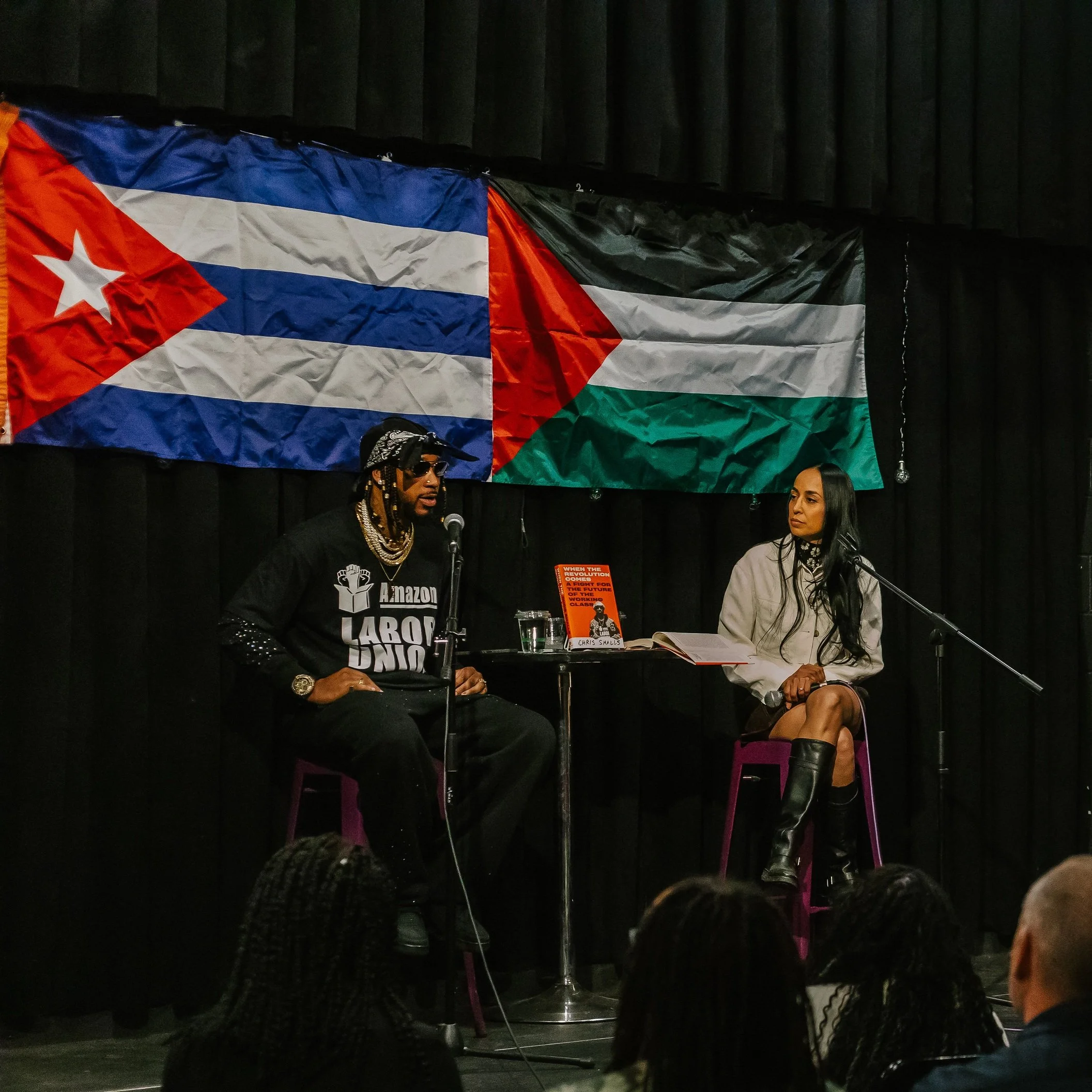
This interview took place on Tuesday, October 6th at Moon Palace Books in Minneapolis, Minnestota.
A’minah Sheikh: Why did you write this book?
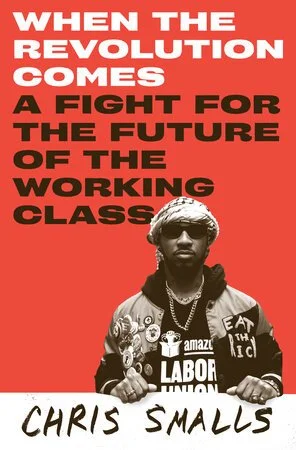
Chris Smalls: The book took me about three years to write, and I wrote it primarily to get my voice back. Six years ago during COVID-19, I was fired from Amazon during a deadly pandemic. My life changed overnight. "Fired Amazon worker" was the headline media outlets like The New York Times called me. I was all over the front page in 2020. Then Jeff Bezos—the richest man in the world at the time—decided to personally smear me. I was somebody making less than $50,000 as an assistant manager in warehouse operations. In a meeting, he said I wasn't "smart or articulate" and suggested making me the face of the unionizing efforts to put Amazon in a better PR position so they wouldn't have to answer questions about health and safety.
Someone in that room leaked the memo to Vice News, and then The New York Times got a hold of it. I remember my lawyer calling me, pissed off, but I said, "That's a good idea! Make me the face!" I had no initial intention to organize a union; I was just a fired Amazon worker who lost healthcare and income as a single parent raising three kids. Amazon literally gave me the idea to unionize, which was probably the worst business decision Bezos ever made.
Over the years, I went from a fired Amazon worker to the Amazon Labor Union president, voted in by the workers' committee. We founded the ALU on April 20, 2021—the day after the Bessemer, Alabama union vote was lost. In 2024, before stepping down at the end of my term, I affiliated the union with the International Brotherhood of Teamsters as ALU-IBT Local 1.
My title changed again in the media to "celebrity activist". Then I started fighting for Palestine—my union was one of the first to pass a resolution—and last summer I put my body on the line by joining the Gaza flotilla as a humanitarian activist. But the only title I care for is "pissed-off fired Amazon worker".
I wrote this book because the articles, interviews, and podcasts don't capture who I really am. The Black and Brown workers at Amazon I organized with are still 100% with me, and I have never abandoned or crossed them. As a labor president registered with the Department of Labor, any financial misconduct would put me in federal prison, making media claims absurd. This book opens up my personal space, tracing my life from childhood all the way to the Amazon victory.
A'minah Sheikh: I took my time reading your book, and the themes of struggle—like working brutal shifts, falling behind on bills, and being unhoused—really touched me. In the prologue, you describe working the graveyard shift at a grocery warehouse while working a second job at a tile factory and taking your kids to school, calling it a brutal schedule needed to make ends meet. You compare warehouse conditions to prison and write in your historical analysis that slavery hasn't ended. Could you talk a little bit about that?
Chris Smalls: What you're referring to in the prologue was before I worked at Amazon, when I was a rank-and-file Teamster at a local grocery distribution warehouse. That work was even more physical than Amazon. The conditions were prison-like because all the workers were Black or Brown, while management was white. Many came from the roughest parts of New Jersey, like Newark, which used to be the murder capital with an average life expectancy of 25 for a Black man due to violence. As the youngest employee, it was eye-opening to work in such an intense environment.
Regarding modern slavery—that's Amazon, fast-forwarding 400 years. Episode 3 of the 1619 Project documentary on Hulu details how productivity metrics originated in slave cotton fields, where picking was calculated daily by weight. Fast-forward to Amazon: my job was a "picker"—using the exact same terminology. They measure productivity digitally, requiring pickers to process hundreds of items an hour, or 4,000 to 5,000 items per 10-hour shift. Slavery never ended; it was just reformed. There is no ethical way to become a billionaire without exploiting the working class, and that's exactly what these corporations do.
A'minah Sheikh: You organized out of necessity for survival, whereas today organizing has become trendy for formal, college-educated people who work as union "salts" in places like warehouses. You note in the book that salts can leave when things fail, whereas working-class workers don't have that privilege. What do you think college-educated folks with more class privilege can learn from workers with lived experience like yours? Are you building an ongoing working-class theory through your struggle?
Chris Smalls: Labor history is not taught in our classrooms. On career days, kids see police officers and firefighters, but we need working-class educators to teach kids about these struggles early on.
Regarding salts: traditional union campaigns spent over $50 million trying to organize Walmart and failed. Millions were spent on Amazon before the ALU, yet our campaign raised only $100,000 over 11 months. We didn't need high-dollar budgets to beat a trillion-dollar corporation because we knew our people.
Amazon hires Ivy League and college graduates for management, but there is no degree for working operations in a warehouse. They had to shadow me for months. When college-educated managers failed, they asked me why they couldn't motivate workers. The reason is a disconnect: over 70% of management is white, Asian, or military background, while workers are Black and Brown folks straight from the hood. I respected people and understood their struggle because I come from it.
Salts from privileged backgrounds can always go back home if a campaign fails. For us, working at Amazon was our household's primary income. Organizers can't just post on Instagram or demand people sign cards; you defeat Amazon by standing outside face-to-face for 300-plus days. Four years later, in 2026, JFK8 remains the only federally recognized Amazon union in the entire country. When you organize, you can't have one foot in and one foot out; you have to be fully committed.
A'minah Sheikh: Where do you see the role of formal labor unions in broader social movements—such as the socialist, internationalist, and Black liberation movements—in North America?
Chris Smalls: Does anyone in this room feel like there is a real labor movement in the U.S.? We have moments, but we don't move as a collective. Both Amazon and Starbucks workers unionized four years ago and are still struggling without contracts. Private sector union density in the U.S. is under 6%, placing us at the bottom globally compared to Sweden (90%), the Nordics (over 80%), or Canada (35%).
Unions need to be on the front lines of every working-class struggle, yet major unions stay silent on international issues like Palestine or Cuba. When I joined the flotilla to Gaza as a labor leader, the U.S. labor movement was silent—the only supportive statements came from my union and National Nurses United.
We have to hold the labor movement accountable instead of letting political parties drive union agendas. In Italy, 3 million people shut down the country for Palestine after labor unions issued a call to action and students occupied schools. In the U.S., with threats like AI, we have to get organized in our own communities. No cavalry is coming to save us.
A'minah Sheikh: Media hit pieces, including a recent article in Jacobin, attack your looks, style, and persona, reflecting anti-Black racism and hatred of working-class culture—scrutiny that white union leaders like Shawn Fain or Sean O'Brien never face. How do you reconcile this anti-Blackness and continue organizing? What advice do you have?
Chris Smalls: The hit pieces are ridiculous. White supremacy and racism exist inside the labor movement.
Let's compare salaries: as ALU president, my salary was set in our constitution to equal a warehouse worker's pay—$30,000 a year, which is public record on the Department of Labor website. I donated my salary back to the union to pay bills. Meanwhile, major union leaders like Shawn Fain, Sean O'Brien, or Liz Shuler make $250,000 to $500,000 a year.
It's ironic because Jacobin originally built me up as "Jeff Bezos's worst nightmare" four years ago. Politicians like Bernie Sanders and AOC ignored us before we won, but came to Staten Island after the victory. Bernie wrote my nomination for TIME's Most Influential People. When I met President Biden, I wore my "Eat the Rich" jacket, Jordans, and chains because I represent where I come from.
I've always been flashy—I drove a BMW before Amazon. Hip-hop culture and fashion were key to beating Amazon because it built a community workers connected with. When Amazon fired 1,000 card-signers, I gave out free food and weed outside the warehouse to rebuild support in two days.
Historically, Black leaders don't get their flowers until they're dead, but I'm still alive. When Kamala Harris invited me to the White House for Juneteenth and Pharrell invited me to Paris for a fashion show, I skipped both to organize an Amazon warehouse in Vancouver, BC—which became the first unionized Amazon facility in Canada. I don't care about red carpets; I let my work speak for itself.
Anthony (Audience Member): Can you elaborate on the contrast between your experience organizing around Palestine and Cuba directly with rank-and-file working-class people versus your experience dealing with the formal institutions of American labor unions?
Chris Smalls: I haven't been working with labor institutions; I've been working with rank-and-file workers and community members. Institutional unions will never lead us to liberation. No politician is going to save us. Revolution requires personal sacrifice. Over the years, organizing cut the time I spend with my kids in half, but I sacrifice that time so our children have a future.
American labor unions are far behind. Internationally, unions are much more militant. In France, I met with the CGT, where French unions offered to share union dues to support our efforts. When French workers called a general strike in Paris, electricians shut off water to politicians' neighborhoods for three weeks.
We need international solidarity. I started the "Disarm Genocide" campaign, raising over $179,000 for the USB union in Italy, which organized general strikes to block arms shipments. Over 40 European countries signed on to stop weapons shipments to Israel, but the U.S. refused. Weapons leave U.S. ports for Israel every 15 hours, yet U.S. union leadership remains silent. I'm not working with them; I'm working against them.
Dan (Audience Member): The ALU inspired many as an independent union. Can you talk about being independent, and then your decision to affiliate with the Teamsters (IBT)?
Chris Smalls: We were independent because that was the only way to get it done. When we started, established unions brushed us off and didn't take us seriously. The day we won, we had $2.50 in our account, and by the next day, $500,000 in donations came in.
However, fighting a multi-billion-dollar corporation in federal court created massive legal fees. Amazon dragged us through court with high-priced attorneys while we relied on our amazing 77-year-old pro bono lawyer, Genie. Over 200 Unfair Labor Practice (ULP) filings, $30,000 a month in legal costs, and $12,000 a month for our Staten Island office made independence unsustainable without collecting dues from our 8,000 members before securing a contract. I refused to charge workers dues until they got higher wages.
Amazon wanted to bankrupt us. So, while still president, I negotiated an ironclad affiliation deal with the Teamsters. We maintained complete jurisdiction and local autonomy as ALU-IBT Local 1—the Teamsters cannot dictate what we do—while gaining access to financial resources, including a $1,000-a-week strike fund for workers.
My relationship with the Teamsters leadership is rocky. I don't support their political donations or endorsements on either side. I stepped down from the presidency by choice at the end of my term—I was never voted out, nor was I ever personally sued by workers. Affiliating ensured the union could sustain itself financially and back workers with real muscle if they go on strike.
Aminah Sheikh is the Co Chair of the Twin Cities Democratic Socialists Chapter. She is a Labor Organizer. Her work and focus is around organizing and expansion of socialist organizations, and inter worker solidarity. She is also a member of Afro Socialists and Socialists of Color.
