


Black Liberation

Bury Me Not in a Land of Slaves: A Short History of Immediatist Abolitionism in Philadelphia, 1830s to 1860s

By Arturo Castillon (Edited by Madeleine Salvatore)

[The above image is a depiction of the 1851 Christiana Riot, near Lancaster, Pennsylvania, where a slave-owner was shot and killed when attempting to retrieve an alleged "fugitive slave." The subsequent trial took place in Philadelphia.]


I ask no monuments, proud and high,

To arrest the gaze of the passers-by;

All that my yearning spirit craves,

Is bury me not in a land of slaves.


-Frances Ellen Watkins Harper, "Bury Me in a Free Land"


In the 1850s, the author of the above poem, Frances Harper, was part of a network of revolutionaries who made it their mission to abolish slavery in the United States. Known as Abolitionists, these partisans of freedom fought for the immediate emancipation of slaves, and developed a specific approach to Abolitionism known as "immediatism." [1] In the 1820s, the most radical Abolitionists in England and the United States began using this term, "immediatism," to distinguish their strategy for abolition from the predominant, gradualist one. [2]

The Abolitionists that we are most familiar with today - Harriet Tubman, Frederick Douglass, John Brown - all fought for the immediate emancipation of slaves, a prospect that most people at the time, even most abolitionists, considered extreme and impractical. Yet in the long term, the immediatist tendency proved to be the most practical and strategic. Instead of miring themselves in legislative strategies or insular sects, the immediatists built organizations to secretly assist thousands of people fleeing from slavery, who in taking the risk of freedom, deprived the southern planters of their primary source of labor-slave labor.

In Philadelphia, black abolitionists like Frances Harper, William Still, and Robert Purvis would rise to the forefront of the immediatist struggle against slavery. Because of the city's proximity to the South, it was an important junction point on the Underground Railroad, a secret network of routes and safe houses that people followed northward when fleeing from slavery. Undeterred by the Fugitive Slave Act of 1793, which legally guaranteed a slaveholder's right to recover an escaped slave, hundreds of escapees made their way to Philadelphia every year, most coming from nearby Virginia and Maryland. With the Compromise of 1850, the Southern slaveholders strengthened the Fugitive Slave Act, which now required the governments and citizens of free states, like Pennsylvania, to enforce the capture and return of "fugitive slaves." This compromise between the Southern slaveholders and the Northern free states defused a four-year political crisis over the status of territories colonized during the Mexican-American war (1846-1848). For the immediatist wing of the Abolitionist movement in Philadelphia, the implications of the new Fugitive Slave Law were clear: it had to be disobeyed and disrupted, even if that meant engaging in illegal activities to assist fugitives.[3]

Already by the early 1830s, the Abolitionist movement in Pennsylvania had begun to radicalize, reflecting developments on the national scene, such as David Walker's 1829 Appeal to the Coloured Citizens of the World, and the 1831 Nat Turner slave insurrection. The older, mostly white Quakers, who had led the movement for decades, favored legal, non-violent measures for gradually abolishing slavery, while a growing tendency of mostly black abolitionists demanded the immediate abolition of slavery. [4] This growing dichotomy, between the gradualists and the immediatists, reflected the essential difference between reformist and revolutionary politics in the Abolitionist movement.

As the Abolitionist movement became more immediatist in the 1830s, the Vigilance Committee, as it came to be known, emerged as the principal organizational form for assisting fugitives as well as victims of kidnapping. After black Abolitionist David Ruggles founded the first Vigilance Committee in New York City in 1835, Robert Purvis and James Forten formed the "Vigilant Association of Philadelphia" in 1837. Abolitionists in the rural counties surrounding these cities soon followed suit, becoming part of a regional network between Philadelphia, New York City, and other nearby cities, like Boston. The Vigilance Committees raised money, provided transportation, food, housing, clothing, medical care, legal counsel, and tactical support for people escaping from slavery. [5]

The committee in Philadelphia was a racially integrated group that also included a (predominantly black) women's auxiliary unit, the "Female Vigilant Association." This degree of inter-racial and inter-gender organization was unheard of at the time, even in the Abolitionist movement. [6] The committee also included ex-slaves. Amy Hester Reckless, for example, was a fugitive who went on to become a leading member of the committee in the 1840s. [7]

While providing strategic resources to fugitives, the committee also carried out bold interventions. Members of the committee orchestrated two of the most notorious slave escapes of the 1840s: 1) that of William and Ellen Craft from Georgia, who used improbable disguises to make their way to Philadelphia in 1848, and 2) that of Henry "Box" Brown from Virginia, who arranged to have himself mailed in a wooden crate to Philadelphia in 1849. These daring escapes were widely publicized in the antislavery movement, and these fugitives appeared in public lectures in order to rally support to the Abolitionist cause. [8]

However, by the early 1850s, several waves of repression had left the committee disorganized. These included anti-abolitionist riots, and a string of crippling lawsuits against those who defied the Fugitive Slave Law, including participants in the Christiana Riot of 1851, wherein a slave-owner was shot and killed after attempting to capture a "fugitive." A new organization was needed, so in 1852 William Still and other abolitionists established a new Vigilance Committee to fill the void left by the older, scattered one. [9]

Led by William Still, who had escaped from slavery as a child with his mother, the new Vigilance Committee was even more effective than its predecessor, assisting hundreds of fugitives every year in their quests for freedom. By the mid-1850s, Still and the immediatists had transformed Philadelphia into a crucial nerve center of the Underground Railroad, by then a massive network that spanned the U.S. and extended into Canada. The most prominent "conductors" of the Underground Railroad, people like Harriet Tubman and Thomas Garrett, directed hundreds of fugitives to the Philadelphia Vigilance Committee every year. [10]

Although the original Vigilance Committee was a clandestine organization, its reincarnation operated both publicly and in secret. Some of the members of the committee were lawyers who defended fugitives in the Pennsylvania courts, while others assisted fugitives using methods that were unequivocally prohibited by those same courts. Some even published their names and addresses in the Pennsylvania Freeman newspaper and in flyers so that fugitives could easily find them. In order to generate public support for their cause, they used the antislavery press and public lecture circuit to broadcast the success of their illegal activities-without revealing specific incriminating details and only after the fugitives were safe. Carefully documenting the daily operations of the committee, William Still wrote extensively about the hidden stories of slave resistance and the inner workings of their secret network. When he finally published The Underground Railroad Records in 1872, it would be the first historical account of the Underground Railroad. [11]

This delicate balance between secret operations and public activity was dramatically demonstrated in the summer of 1855, when William Still and others organized the escape of Jane Johnson and her children from their owner, John Wheeler, as they were en route to New York, docked in Philadelphia. During the escape, Passmore Williamson, one of the only white members of the Vigilance Committee, physically held back Wheeler, a well-known southern Congressman, while Still led Johnson and her children away to a nearby safe house. [12]

In the legal proceedings that ensued, a federal judge charged Williamson with riot, forcible abduction, and assault. The judge in the case rejected an affidavit from Johnson affirming that she had left Wheeler of her own free will and that there had been no abduction, and Williamson spent 100 days in Moyamensing prison. The case became a national news story, as Abolitionists used the media to trumpet the success of the Johnson rescue, and to expose the southern slaveholders' domination of the federal court system, which the Abolitionists called a "Slave Power Conspiracy." Harriet Tubman, Frederick Douglass, and other Abolitionist leaders visited Williamson during his confinement and wrote admirably of his actions in the antislavery press. [13]

The Philadelphia immediatists were fully aware of their strategic role in the national struggle against slavery. At a mass meeting in Philadelphia in August 1860, leader of the immediatist wing, William Still, explained that because they were "in such close proximity to slavery" and their "movements and actions" were "daily watched" by pro-slavery forces, they could do, "by wise and determined effort, what the freed colored people of no other State could possibly do to weaken slavery." [14] By defying the Fugitive Slave Law in a border city, the immediatists in Philadelphia exacerbated the growing conflict between the free states of the North and the slave states of the South to a degree that few other Abolitionists could.

The Vigilance Committee acted as the organizational nucleus of the Underground Railroad in a city that was publicly very hostile to Abolitionism. Most white workers were opposed to the abolition of slavery as well as the legalization of racial equality, while the merchant elites and early industrialists of the city had close economic ties to slaveholders in the South and throughout the Atlantic. There where numerous anti-black and anti-abolitionists riots throughout the 1830s and 1840s in Philadelphia. [15] Even though they were vastly outnumbered, by subverting the Fugitive Slave Law in this border city, the immediatists antagonized the slaveholders and their allies-a much larger and well-established enemy.

As the overall antislavery movement continued to grow throughout the North, the southern slaveholders went on the defensive. With the John Brown attack at Harpers Ferry, Virginia, in 1859, and the 1860 election of Abraham Lincoln, who campaigned against the expansion of slavery, the slaveholders in the South became more entrenched and alienated from the rest of the United States. In February 1861 the Lower South region of the U.S seceded, creating a separate country called the Confederate States of America, also known as the Confederacy. The U.S. national government, known as the Union, refused to recognize the Confederacy as a legal government. The Civil War officially began in April 1861, when Confederate soldiers attacked Fort Sumter, a Union fort in the harbor of Charleston, South Carolina. As the Civil War took its course, Abolitionists from Philadelphia, like Octavius Catto, worked to radicalize the Unionist cause from within. Catto and other Abolitionists organized the enlistment of black troops into the Union army and advocated for a coordinated military assault on slavery in the South, for which they were strongly condemned by white Philadelphians. [16]

Before the war, and during its initial years, much of white Philadelphia was sympathetic to the Southern slaveholder's grievances. But with the deepening of the conflict between North and South, most Philadelphians came to support the Union and the war against the Confederacy. A turning point came in 1863 when the city was threatened with Confederate occupation. Entrenchments were built and people fought to defend the city, defeating the Confederate Army at the Battle of Gettysburg. [17] However, even with the shifting of opinion against the South, most white Philadelphians still believed that the Civil War had nothing to do with slavery. Many white Americans continued to believe that the Civil War was a "white man's war" to preserve the Union and nothing more. Abolitionists and black Philadelphians continued to be the targets of mob violence, and some white Philadelphians even blamed the Abolitionists for the war. [18]

With all odds stacked against them, the Abolitionists proclaimed the need to end slavery from the very beginning and identified the structural contradictions that would tear the nation apart. But rather than wait for the gradual disintegration of slavery, the immediatists worked to hasten its destruction. In a society that was for the most part hostile to their cause, the immediatist wing of the abolitionist movement performed the historic duty of following through, with long-term consistency, those revolutionary tactics that alone could save the Union and drive the Civil War to a decisive conclusion. More and more slaves escaping from plantations, the enlistment of black troops into the Union army, the immediate emancipation of slaves throughout the South-these tactics were indeed the only ways out of the difficulties into which the Civil War had descended.

The Civil War stemmed from a breakdown of the structural compromise that developed between two distinct modes of production-northern industrial wage labor, and southern slave labor. The growth and radicalization of the antislavery movement over time made this "unholy alliance" impossible to maintain. In this, the Civil War confirmed the basic lesson of every revolution, which stands the logic of gradualism on its head. Revolution doesn't advance with small increments, with legislative preconditions, but with prompt, uncompromising actions that destabilize the structural limits of the existing system.

The will for revolution can only be satisfied in this way-with strategic, revolutionary activity. Yet the masses of people can only acquire and strengthen the will for revolution in the course of the day-to-day struggle against the existing class order-in other words, within the limits of the existing system. Thus, we run into a contradiction. On the one hand, we have the masses of people in their everyday struggles within a social system; on the other, we have the goal of immediate social revolution, located outside of the existing system. Such are the paradoxical terms of the historical dialectic through which any revolutionary movement makes its way. The immediatists transcended this contradiction by responding to the mass self-activity of the slaves, who in their day-to-day resistance to the slave system offered the Abolitionists a means to realize their revolutionary objectives.

For over three decades, through ebbs and flows, victories and defeats, the immediatists consistently engaged with the everyday struggles of the slave class. They constructed multi-racial, multi-gender organizations that operated both legally and illegally, publicly and secretly, in order to help people emancipate themselves from slavery, to help them stay free, and to help them gain basic legal rights. In doing so, they fostered the development of a revolutionary movement that precipitated the U.S. Civil War and culminated in one of the greatest social revolutions of world history-the emancipation and enfranchisement of millions of slaves and workers in the South during the Reconstruction Era.

By the end of the Civil War, a once-persecuted minority of fanatical Abolitionists were now national leaders. Today we see them as good-hearted activists, or even as moderates. But there should be no mistake about it-all Abolitionists were considered extremists prior to the Civil War, and during most of it. Few people believed that the slave system would fall. The Abolitionists certainly did not believe their revolutionary goal would one day become official government policy. In the end, the Abolitionists recognized the historical crisis in front of them for what it was, and the immediatists responded to it better than any other Abolitionist tendency of their time.


"Lines," Frances Ellen Watkins Harper:

Though her cheek was pale and anxious,

Yet, with look and brow sublime,

By the pale and trembling Future

Stood the Crisis of our time.

And from many a throbbing bosom

Came the words in fear and gloom,

Tell us, Oh! thou coming Crisis,

What shall be our country's doom?

Shall the wings of dark destruction

Brood and hover o'er our land,

Till we trace the steps of ruin

By their blight, from strand to strand?


Arturo Castillon is an independent historian and retail-service worker from Philadelphia, who has participated in movements and struggles against gentrification, police violence, sexual harassment, homophobia, workplace exploitation, and racism.


This article was previously published on the blog of the Tubman-Brown Organization .


Notes

[1] On Harper's and others contributions to the abolitionist movement in Philadelphia, see Still, Underground Rail Road, 740-61; Helens Campbell, "Philadelphia Abolitionists ," The Continent; an Illustrated Weekly Magazine, January 3, 1883, 1-6.

[2] Junius P. Rodriguez, "Immediatism," The Historical Encyclopedia of World Slavery, Volume 1; A-K (Santa Barbara, California, 1997), 364.

[3] On the Underground Railroad in Philadelphia and Pennsylvania, see Fergus M. Bordenwich, Bound for Canaan: The Epic Story of the Underground Railroad, America's First Civil Rights Movement (New York, 2005), 49; Carol Wilson, "Philadelphia and the Origins of the Underground Railroad," unpublished essay on file in the archives at Independence National Historic Park, Philadelphia.

[4] On the radicalization of the antislavery movement in Pennsylvania, see Richard S. Newman, The Transformation of American Abolitionism: Fighting Slavery in the Early Republic (Chapel Hill, N.C., 2002), chapter 3.

[5] Beverly C. Tomek, "Vigilance Committees," http://philadelphiaencyclopedia.org/archive/vigilance-committees/

[6] Ibid, Tomek.

[7] Joseph A. Borome, "The Vigilant Committee of Philadelphia," Pennsylvania Magazine of History and Biography 92 (January 1968); 320-51.

[8] Elizabeth Varon, " 'Beautiful Providences': William Still, the Vigilance Committee, and Abolitionists in the Age of Sectionalism" Antislavery and Abolition in Philadelphia, 230-31.

[9] Ibid, Varon; Borome, "The Vigilant Committee of Philadelphia," 320-51.

[10] James A. McGowan, Station Master on the Underground Railroad: the Life and Letters of Thomas Garret (Jefferson, N.C, 2005); Kate Clifford Larson, Bound for the Promised Land: Harriet Tubman, Portrait of an American Hero (New York, 2004), 122-25.

[11] Varon, "'Beautiful Providences'" Antislavery and Abolition in Philadelphia, 233- 34.

[12] For a detailed account of the Jane Johnson rescue and its impactions, see Nat Brandt and Yanna Koyt Brandt, In the Shadow of the Civil War: Passmore Williamson and the Rescue of Jane Jane Johnson (Columbia, South Carolina, 2007).

[13] Ibid, Brandt.

[14] National Anti-Slavery Standard , August 18, 1860.

[15] Russel F. Weigley, "The Border City in Civil War, 1854-1865" Philadelphia: A 300-Year History, (New York and London, 1982), 295-296.

[16] Donald Scott, "Camp William Penn's Black Soldiers in Blue-November '99 America's Civil War Feature" http://www.historynet.com/camp-william-penns-black-soldiers-in-blue-november-99-americas-civil-war-feature.htm .

[17] Ibid, Scott, 389-93.

[18] Ibid, Scott.

How Liberals Depoliticize White Supremacy

By Amir Khafagy

It could be argued that this past year was the year that the term "white supremacy" has gone mainstream. Everybody and their mother is talking about fighting or resisting white supremacy. White leftists are usually the ones who are seemingly throwing themselves on the front lines. They also come across as the most eager to smash white supremacy, ultimately overshadowing the ones who are directly oppressed by it. Since the arrival of Trump, liberals have joined the fray, focusing much of their anger on the man himself.

So, let me be real about this and come out and say that it bothers me. For the longest time I couldn't really articulate it but in my gut something just didn't feel right. The term "white supremacy" has never been a popular colloquial term, nor has it ever been even truly acknowledged by white America as a very real reality for most black Americans. If white supremacy was ever discussed, it was generally talked about in its isolated fringe form and relegated to annals of day-time talk shows.

Throughout the 90s I would remember the times I stayed home from school and watched sensationalist shows such as Jerry Springer or Geraldo Rivera when they would bring on neo-Nazis and Klan members to generate easy ratings. Geraldo even got his nose broken during one episode, when a Klan member threw a chair at his face. For the majority of white liberal Americans of the post-civil rights era, white supremacy has been viewed in the context as a mere relic of history only maintained by isolated, fringe, far-right groups. White supremacy was viewed as a part of history, not as existing in the present or lingering into the future.

Only with the rise of Trump have we begun to have mainstream discussions about the role white supremacy plays in our society. And that's great! We need to be having that discussion. Yet what has been lacking from that conversation is the systematic nature of white supremacy and how it's directly tied to capitalism. Liberals who claim to be part of the "resistance" are acting as if Trump has opened a long, dormant Pandora's Box of hatred, xenophobia, and white supremacy. The "resistance" accuses the current head of the American empire of being a white supremacist fascist, without ever questioning whether or not the American empire is inherently white supremacist in nature.

Much of the focus coming from liberal camps has been on the symbolism of what Trump the individual represents, and not on the material reality of what America represents. With this approach, the horror of white supremacy is ultimately stripped of its historical and current roll in supporting capitalism and empire. It becomes diluted when liberals only see white supremacy through the prism of individualistic, interpersonal relations.

Privilege politics is a manifestation of individualizing white supremacy. If "radical" means "grasping things at the root," like Angela Davis once said, then this myopic approach taken under the banner of privilege politics is the opposite of radical. It is superficial. Rather than recognizing and struggling against the structural forces that create white privilege in the first place, we are instead expected to politely ask that white people somehow give up their privileges; or, at very least, recognize that they have privilege.

It should be obvious to anyone that this approach makes little sense because it forces us to depend on white people to enact symbolic change while we surrender what little power we have in the first place to make fundamental change. Privilege politics also assumes that white supremacy in our society is result of individualistic patterns and behaviors - that is an outlier, not a norm. In reality, people's patterns and behaviors reflect the political and economic conditions of society. Systems don't change because people change, people change because systems change. All of this amounts to the depoliticizing of white supremacy, and it's preventing us from fully understanding that America's foreign, domestic, and economic policy is essentially white supremacy in action, and always has been.

For an example of what the depoliticization of white supremacy looks like, we can assess the reaction to the recent debate between Dr. Cornel West and writer Ta-Nehisi Coates. In an article he penned for the Guardian, Dr. West put it bluntly and accused Coates of being "the neoliberal face of the black freedom struggle." West went on to say that "any analysis or vision of our world that omits the centrality of Wall Street power, US military policies, and the complex dynamics of class, gender, and sexuality in black America is too narrow and dangerously misleading." He then adds his most powerful indictment by saying "In short, Coates fetishizes white supremacy. He makes it almighty, magical, and unremovable."

In looking past the controversy and fanfare sparked from his article, we can see that West's words and message are crucial. He accurately theorizes that any discussion which removes structural white supremacy from its central role in upholding America's capitalist empire will inadvertently end up reinforcing white supremacy. However, instead of seeing West's critique of Coates as a valid insight on the state of the black liberation struggle, most folks chose to frame the debate as some sort of personal beef between the two most prominent black intellectuals in the country, resembling some sort of Hip-Hop celebrity feud.

Detractors of West, such as Dr. Michael Eric Dyson, have even gone on accusing West of "throwing shade" because he's somehow jealous of Coates' success, echoing the same responses given to West's vital critiques of Obama. As if West's criticisms were based on piety narcissism rather than grounded in a legitimate concern for the fate of black America. It's just plain dismissive to reject what West has to say without fully analyzing the points he was trying to make. Borrowing West's own logic, the reactions are indicative of a neoliberal culture that is insistent on removing all traces of critical thinking which challenge the orthodoxy of privilege politics.

Critics of West have completely ignored his points, choosing instead to denounce him as a "washed-up, bitter, old man." An important message has been lost in the winds of this drama. West was trying to make us understand that white supremacy is embedded into every fabric of American life and society. It is not relegated to fringe groups or individuals like Trump, and it is not some mystic force that is indestructible. He wants us to understand that the responsibility to make change is not held by those who have privilege. It's not for them to kindly give up their privilege or come to terms with it; rather, it is our responsibility to struggle against this unjust system that creates such unearned privileges.

Only when we are able to see that the fights against white supremacy and capitalism are interconnected struggles (two sides of the same oppressive coin) is when we will finally be able to make real progress towards liberation. The gatekeepers of neoliberalism come in many forms. West was handing us a key.


Amir Khafagy is a self-described "Arab-Rican" New Yorker. He is well known as a political activist, journalist, writer, performer, and spoken word artist. Amir is currently pursuing a Master's degree in Urban Affairs at Queens College. He can be reached at amirkhafagy@gmail.com

Decolonizing Zwarte Piet

By Darryl Barthe

When I arrived in the Netherlands in March of 2016, I was forewarned by a number of colleagues and friends that the Dutch tradition of Zwarte Piet would challenge me. I'd seen the images of Dutchmen in blackface handing out candy while dressed as Harlequins, but I honestly had no idea how it would affect me until my daughter came home from school with a little "golliwog" figure that she had colored that day as a part of Sinterklaas festivities. I'd heard the arguments from Prime Minister Mark Rutte's people: this is a "normal" expression of Dutch culture. I'd also heard the arguments from Geert Wilder's people (who really didn't sound so different from Rutte's people, in this regard): anyone who has a problem with this part of Dutch culture should get out of the Netherlands. [1]

zwartepiet1.jpg

I like haring. I like being able to ride a bike everywhere. I like the fact that cannabis is decriminalized and that prostitutes are organized into labor unions. However, I do not like racist caricatures of African people that inspire my neighbor from Djibouti to keep her child home from school rather than allow him to be subjected to cartoonish representations of black people as brutish, goofy, slaves. This dilemma inspired me to look to the origins of Zwarte Piet to interrogate this narrative of golliwogs being integral to some Dutch people's sense of national identity.

The connections between the Germanic god of Magic, War and Rulership, known variously as "Woten," "Woden," and "Odin," and "St. Nicholas," "Father Christmas," "Sinterklaas," and "Santa Clause" are convincingly documented by a number of scholars. The figure of "Sleipnir," Odin's 8-legged horse, is re-imagined in the English poem "The Night Before Christmas," as "eight tiny reindeer," for example. The All-father's habit of visiting unsuspecting families and testing their hospitality is the reason that American children leave Santa milk and cookies ("koekjes," being the original Dutch word; what Americans call "cookies" are called "biscuits" in the UK) and why Dutch children leave hay or carrots for Sinterklaas' horse. It is ironic that this tradition, grounded in a belief in the transcendent, moral, value of hospitality, should be expressed in blackface, a mode of drama and comedy steeped in a history of racist dehumanization and exploitation.

zwartepiet2.jpg

In the case of the "naughty" children -those who do not show the All-father hospitality-there are a number of re-interpretations of the Old Norse myth which involved Odin, in some way, cursing the offenders. All involve some reinterpretation of the mythical "svartalfar," or "dark elves," who controlled all the minerals under the mountains. So, good children get gold while bad children get coal; good children get presents while bad children get abducted by the dark elves in a manner suggested by the German Christmas tradition of "Krampus," and the story of the Pied Piper of Hamlin. In the Santa Claus tradition, the svartalfar have been reimagined as "Santa's elves" who leave children lumps of coal in their stockings if they are naughty, as opposed to treats.

zwartepiet3.jpg

The present tradition of Zwarte Piet can be directly traced to the middle of the 19th-century, and a children's book written by Jan Schenkman,Sint Nikolaas en Zijn Knecht ( Saint Nicholas and his Servant). The myths of the svartalfar were submerged in a colonial narrative of servile (yet simultaneously violent and cruel) "Moors" (or, alternatively, "Spaniards") accompanying the aging (white) patriarch, Sinterklaas, to Holland. When Netherlanders don their blackface and pantaloons, the pre-Christian significance of that imagery -a significance that speaks to an older, pre-Romanized, sense of "Dutchness"-is, for the most part, lost on them. What is confounding, however, is the extent to which the racist, colonial, White Supremacist, significance of that imagery is also lost on many Netherlanders, as well.

Dutch identity, today, is only vaguely related to the Batavians, the ancient Germanic tribe that lived at the Rhine Delta during the 1 st Century CE. Even less so is contemporary Dutch identity related to the Chatti, an ancient Germanic tribe of Lower Saxony and Hesse, from whom the Batavians supposedly descended. Rather, contemporary Dutch identity is most often articulated as the collective social and cultural inheritance of 17th century merchant seamen, who traded mostly in spices and flowers.

zwartepiet4.jpg

There is a vague notion that the Dutch played some role in the slave trade, but only rarely is this fact seriously interrogated in the Netherlands where, according to University of Amsterdam Professor Gloria Wekker, "fear and avoidance of the axis of race/ethnicity are dominant" in academic discourses.[2] The Dutch embrace a view of themselves as a tolerant, anti-racist, people despite the glaring, obvious, historical silences surrounding the brutality of Dutch colonialism, the underlying ideology of racism and White Supremacy that fueled that colonial program, and the lingering effects that that history has had on the Dutch people (and, perhaps more to the point, Dutch people of African descent). My Dutch students often recoil in horror and righteous indignation when I relate the bloody, gory, history of racism and lynching in the US; this is in contrast to the looks of surprise and confusion that I get when I tell those same students that the first enslaved Africans brought to the English colonies in North America were brought there by Dutch sailors.

zwartepiet5.jpg

Every year the Dutch legacy of colonialism (and the attendant white Supremacy that justified the Dutch colonial program) is articulated through the "innocent tradition" of Dutch people donning costumes portraying buffoonish images of fat-lipped, Afro-wearing, golliwogs, prancing about goofily, handing out candy. To suggest that this display accomplishes the racist dehumanization of black people can often invite defensiveness from Dutch people who are genuinely horrified at the thought that anyone would ever call them racist. Many Netherlanders - fair-minded, reasonable people, committed to notions of equality and ideologically opposed to racism and prejudicial discrimination-will admit in candid moments that they honestly cannot understand what it is about Zwarte Piet that is so offensive to black people.

The best among the Dutch are willing to allow space for Black people in the Netherlands to explain it to them. Since 2013, there has been a growing movement to discontinue the portrayal of Zwarte Piet. In 2014, the city of Amsterdam decided to discontinue the blackface tradition. In 2015, the UN Committee on the Elimination of Racial Discrimination urged the Netherlands to confront the problem of this national celebration of racist stereotypes, a suggestion the Dutch government took under advisement. Not all Netherlanders are so reasonable, however.

A few weeks ago, pro Zwarte Piet demonstrators blocked a highway, preventing antiracist activists from marching on the city of Dokkum where "traditional" Zwarte Piet celebrations were commencing. Mark Rutte's response to the (illegal blockade) protest was to suggest that children should not be forced to deal with angry Zwarte Piet demonstrators when they were simply out for a little Christmas fun: "Sinterklaas is een mooie traditie, een kinderfeest. Dus laten we met elkaar een beetje normaal doen" ("Sinterklaas is a beautiful tradition, a children's holiday party. So, let's all get together and be a little normal"). [3]

zwartepiet6.jpg

I am certain that Mark Rutte was unaware of the deep irony in his suggestion that racist theater represented Dutch "normality." For the most part, the sort of active, aggressive, racial hatred that exists in colonial contexts (like the US, for example,) does not exist in the Netherlands. At the same time, the racism of the Dutch colonial program was always buttressed by a principle of "white normativity" which posited only white people as people, and which recognized the humanity of non-white people only to the extent that those non-white people resembled (and internalized the value systems of) white people. That principle of white normativity -a passive, unaggressive, racism which even allows for individual kindness and intimacy, including the legendary "black friend," or even the occasional black spouse- defines the parameters of the discourse on race in the Netherlands and that will not change until the Dutch start honestly confronting their own history of racism and colonial violence, and not until the vantages of people of color in the Netherlands are properly integrated into Dutch notions of "normaal."


Notes

[1] See Mark Rutte, "Lees hier de brief van Mark," (VVD.nl, 22 January 2017) https://www.vvd.nl/nieuws/lees-hier-de-brief-van-mark/ (accessed December 23, 2017). See also Ben Winsor, "Wilders prepares law to protect 'Zwarte Piet' holiday blackface," ( SBS.com.au, February 16, 2017) https://www.sbs.com.au/news/wilders-prepares-law-to-protect-zwarte-piet-holiday-blackface (accessed December 23, 2017).

[2] Gloria Wekker, White Innocence: Paradoxes of Colonialism and Race (Durham: Duke University Press, 2016), 52.

[3] "Zwarte Piet supporters close motorway to stop demo as Sinterklass arrives" (DutchNews.nl, November 18, 2017), http://www.dutchnews.nl/news/archives/2017/11/zwarte-piet-supporters-close-motorway-to-stop-demo-as-sinterklaas-arrives-in-dokkum/ (accessed December 23, 2017); "Premier Rutte over Zwarte Piet-discussie: 'Laten we een beetje normaal doen'" ( rtvnoord.nl, November 18, 2017), https://www.rtvnoord.nl/nieuws/186365/Premier-Rutte-over-Zwarte-Piet-discussie-Laten-we-een-beetje-normaal-doen (accessed December 23, 2017).

Coups and History: An Interview on Zimbabwe

By Brenan Daniels

This is the transcript of a recent interview with Abayomi Azikiwe, of Pan African Newswire, and Netfa Freeman, an Analyst and Events Coordinator for the Institute for Policy Studies (IPS), a longtime organizer in the Pan-African and international human rights movement, and former Liaison for the Ujamma Youth Farming Project in Gweru, Zimbabwe. Netfa hosts and produces the radio show Voices With Vision on WPFW 89.3 F. The interview focuses on the recent coup in Zimbabwe, putting it in current and historical context.


The coup in Zimbabwe seemed to happen all of a sudden. What were the events leading up to it?

Abayomi Azikiwe: These factional dispute within the Zimbabwe African National Union Patriotic Front (ZANU-PF) ruling party have been coming to a head for over three years. With the expulsion of the former Vice President Joice Mujuru and her supporters in Dec. 2014, the stage was set for an intensified struggle between those aligned with the now Interim President Emmerson D. Mnangagwa on the one side and the forces surrounding First Lady Grace Mugabe on the other.

The Generation 40 Group aligned with the First Lady appeared to be gaining the upper hand when the-then Vice President Mnangagwa was expelled during early Nov. Nonetheless, the Lacoste Group, the supporters of Mnangagwa, had strong backing within the military and this was the determining aspect of the struggle which shifted power toward the current leadership group. On the surface the conflict appeared to be an internal struggle within the ruling party itself although there have been suggestions and some documented proof that outside interests such as the United States and Britain may have played a role as well in forcing the resignation of President Robert Mugabe. It was quite interesting that the Voice of America reported on Nov. 21 that the State Department had already outlined the terms for the lifting of sanctions against Zimbabwe.

Whether the sanctions are actually lifted will remain to be seen. There have been western business-friendly statements made by some officials of the current leadership within the party such as a willingness to compensate the British settlers for land confiscated in 2000; the scaling down of government personnel including ministerial portfolios; the amendments already made to the indigenization policy; and the potential for Zimbabwe re-entering the Commonwealth.

Netfa Freeman: Some are disputing use of the term coup given that it doesn't fit other historical examples of coups in Africa. But getting into that would be too much and would deviate from the question.

First, nothing of this nature can happen all of a sudden. The context might be a little too complicated to explain in this interview but a synopsis seems to be that this was the culmination of power struggles within the ruling party ZANU PF that have been brewing since at least 2015 or 14. Contributing factors to their acuteness are the economic tensions largely due to imperialist sanctions imposed on the country and concerns over who would succeed the aging President Robert Mugabe now 93. It should be no wonder that tensions about succession would arise and intensify.

As they say politics abhors a power vacuum. Factions formed, one delineated as a younger strain of ZANU PF party members known as G40 or Generation 40, led by Grace Mugabe and the other being the old guard of members many of whom fought in the liberation struggle for independence led by one of two Vice-presidents, Emmerson Mnangagwa. Some very contentious politburo meetings ensued with accusations being leveled against one another of plots to force a government take over. The tensions led President Mugabe to depose Mnangagwa of his post. This seemed to set of what seemed to be a contingency plan already in place by Mnangagwe and Defense Commander Constantino Chiwenga to use the military to constrain the police forces and anyone under the influence of G40. Then assume control of the various levers of the government.

I can't pretend to know which of the factions (G40 or Team Lacoste, as the other is known) were motivated by the more altruistic concerns or revolutionary principles. The lessons for African and the struggling world are many. What we do know now is that after initially holding out, Mugabe has resigned.


Mugabe is generally shown as a dictator by mainstream American sources. Can you shed some light on who exactly Mugabe is?

Abayomi Azikiwe: President Mugabe's position in modern African history is secured as a liberation movement leader, progressive governmental head-of-state and an ideological contributor to the African revolutionary struggle for Pan-Africanism, Anti-imperialism and Socialist-orientation. Mugabe worked as an educator and youth leader during his younger years. In the 1960s he was imprisoned by the settler-colonial regime of Rhodesia for ten years. After being released in 1974 during an internal crisis within ZANU, he was able to steer the liberation movement to victory by 1979-1980.

After gaining independence in April 1980, he presided over a government of reconciliation and transition for five years as prime minister. The 1985 constitution made Mugabe president and by late 1987 he along with Joshua Nkomo, considered the "father of the movement", who headed the Zimbabwe African People's Union (ZAPU), merged the two groups into ZANU-PF which ended the initial instability which occurred in Matebeleland in the early 1980s after independence where a rebellion was ruthlessly suppressed by the Zimbabwe Defense Forces (ZDF) Fifth Brigade. The reconciliation with Nkomo was historic and can serve as a model for African governance moving forward.

The 2000 Land Reclamation program was key in consolidating the genuine independence of the country. However, it drew the ire of western imperialism which imposed sanctions that hampered the capacity for economic growth and development. In addition, the advent of the opposition Movement for Democratic Change (MDC) parallels the land redistribution program debates and enactment from 1998-2000. MDC has been funded by the West along with other groups in a failed effort to reverse the independence process. These methods have failed due to the incompetence of the opposition leaders largely stemming from their lack of support among the people and gross opportunism.

Netfa Freeman: I can't agree with that. Generally seen by whom as a dictator? I do know that the West consistently refers the leaders of countries that do not bow to them economically and politically as dictators.

But if a dictator is defined as a ruler with total power over a country then how can one be a dictator in a country with a parliamentary system constitutionally consisting of Executive, Judiciary and Legislative structures? This is what has been in Zimbabwe. And on top of that it's been a multi-party system? Even if accusations were true that the system has been manipulated to give disproportionate power to Mugabe, it can't be said that he held total power.

But to answer your question who is Mugabe; Robert Mugabe was the son of a carpenter and as a youth attended Roman Catholic mission schools. He won a scholarship to go to a Black University in South Africa where he achieved the first of his 6 degrees in one year and became an African nationalist. He returned home to what was then called Rhodesia to teach for 4 years before going to teach and study in Ghana and becoming influenced by Kwame Nkrumah. Once he returned to Zimbabwe he involved himself in African nationalist politics advocating revolution through non-violent direct action, propaganda, and civil disobedience. At that time he considered himself a Marxist and staunch anti-racist. In the early years of the struggle he was arrested several times by the white minority regime. In a 1965 government crack down on the African nationalist movement Mugabe was incarcerated for 10 years without trial. While in prison he taught and also earned 3 law degrees.

During this time was when he and his comrades determined that armed struggle was the only way to liberation. After his release he was given refuge by the new revolutionary government in Mozambique where he founded ZANLA, Zimbabwe African National Liberation Army with many of his former fellow political prisoners and entered into the fray. ZANU, the Zimbabwe African National Union was formed later as the political arm.

To make a long story short, in 1979 the Rhodes as they were referred to were forced to the negotiation table in Lancaster. After the Lancaster House Agreement established elections for a new president in 1980 in which Africans ran for office, Mugabe won in a landslide victory.


Talk about how the economic situation has changed and deteriorated over the past several years.

Abayomi Azikiwe: Zimbabwe has been hampered through the sanctions imposed by the United States, Britain and the European Union. There have been discussions held with Washington for a number of years around lifting the sanctions particularly after the acceptance of a Global Political Agreement and coalition government after the disputed 2008 national elections. Yet despite the bringing of opposition forces into the government between 2008-2013, the U.S., Britain and EU have maintained the sanctions.

This clearly reveals that the ultimate objectives of the sanctions were to either topple ZANU-PF or drastically shift the domestic and foreign policy of Zimbabwe. The impact of the sanctions have been compounded by the worst drought in recent history which exists throughout the entire Southern Africa region. Also there has been a precipitous decline in commodity prices over the last three years that was a direct result of U.S. economic policy under the administration of President Barack Obama. Prices are starting to rise again in the energy and strategic mineral industries.

Zimbabwe has large deposits of diamonds and platinum. Consequently, the imperialists are set on gaining favorable terms for any long term economic relationships with Zimbabwe and other states in the sub-continent.

Netfa Freeman: Yes there is hyper-inflation and high unemployment and the value of currency is very precarious. But what is often missing from the explanation are the effects of the EU, UK and US sanctions legislation explicitly designed to damage the economy. This is done by denying any extension of credit and loans to the government or any balance of payment assistance from international financial institutions. The sanctions also actively dissuade investments in, or trading with the country. All this has had devastating effects on the ordinary citizens of Zimbabwe in multitude of ways, a fact that Western media and liberal progressive pundits never fail to ignore.

I'm not denying that there is some mismanagement and corruption. The government officials in ZANU PF and Mugabe himself acknowledge it but this is not to blame for the magnitude of the economic problems. The economic warfare that had been being waged against Zimbabwe also included denying it access to foreign exchange which is needed to carry out diverse international business transactions.


There has been some talk of China possibly giving the green light to the coup plotters. What are your thoughts on this?

Abayomi Azikiwe: I have not seen any evidence that China was involved in the military intervention and the resignation of President Mugabe. Typically Beijing does not get involved in the internal affairs of African states. China is a large trading partner with Zimbabwe and its assistance along with the neighboring Republic of South Africa and Republic of Mozambique have been essential in maintaining stability in Harare. Relations between the People's Republic China, the ruling Communist Party of China, and ZANU-PF goes back to the era of the national liberation war. These ties have been maintained, strengthened and enhanced over the years since independence.

Netfa Freeman: This seems a mischaracterization. As we know China has a strong and long relationship with Zimbabwe in many economic areas. And it has been further strengthened by ZANU's "Look East Policy" in response to the belligerence of the West toward them. Mnangagwa and General Chiwenga were simply assuring that China would not feel compelled by a change of forces to interfere in Zimbabwe's internal affairs and that the diplomatic and economic relationship would remain.


It was reported recently by the Australian Broadcasting Company that Zimbabwe is looking to go back into the British Commonwealth. Why would they do that? What about giving the white farmers back land?

Abayomi Azikiwe: Zimbabwe under President Mugabe in 2002 did not leave the Commonwealth voluntarily. They were in effect expelled. London set terms for their return and these conditions were rejected by ZANU-PF. These are colonial institutions. ZANU-PF has developed a "Look East" policy. The objectives are to build economic relations with other African states, countries in Asia and Latin America. This is the future of the world. Britain is facing a tremendous crisis due to the vote by the electorate to withdraw from the EU in June 2016.

There maybe an attempt to re-enter the Commonwealth under Interim President Mnangagwa. Nevertheless, what will Zimbabwe have to sacrifice in order to re-enter this declining system? There are many other former British colonies in Africa who are Commonwealth members yet their people remain impoverished and uneducated. Zimbabwe has the largest literacy rate in Africa where over 95 percent of the people can read and write. This is a monumental achievement of the Revolution.

Netfa Freeman: First on the land question, no one could give back the land to the white farmers even if they wanted to. That process is past the point of no return. Besides doing that would be the easiest way to get the country to revolt against the new dispensation. The media is fond of showing images in the urban areas, particularly Harare the capital, of what are basically opposition forces to ZANU and Mugabe. But the majority of the population is in the rural areas, which are also the areas that benefitted most directly from the 2000 fast track land redistribution. What Emmerson Mnangagwa did say was that the land reform would remain untouched but that they would continue to compensate the white farmers for certain upgrades they made to farms. That part really wasn't anything new and had already been part of the 2000 fast track land reclamation process.

About the British Commonwealth, I don't know. I've been hearing that said but not yet from the leaders of the new dispensation themselves. Every time i read it is Europeans saying that they would welcome them back if they meet certain conditions. If they are looking into it, i would be careful that we not have a knee-jerk reaction to it, as if that in and of itself is a sellout move. Zimbabwe was suspended from the Commonweath in 2002 based on imperialist hegemonic demonization that claimed among other things that Zimbabwe elections weren't free and fair. But this is bull for two reasons. One is that those elections were certified by independent electoral observes, including a delegation of the NAACP that drafted a detailed report on how fair those elections were. The second reason is the West doesn't really care about democracy in other countries. They will invade and over throw democratic countries.

But many people, myself included, applauded Mugabe's response to them suspending Zimbabwe from the Commonwealth. He basically said Africans don't need the approval of Europeans and then left the body all together. But because Member states have no legal obligation to one another and there are some benefits to being a part of it, like in trade agreements and working together to cooperate on things like migration policies for instance, I don't think it should be seen as principled position to stay out of it. It has a different history than the OAS, Organization of American States but essentially serves the same purpose. Countries just need to make sure rejoining is not based on compromising its sovereignty and revolutionary or socialist principles.

This is actually is the area that I am concerned about in the new developments


What are your thoughts on the future of Zimbabwe?

Abayomi Azikiwe: This will depend on the policies coming out of the interim government between now and the elections slated for mid-2018. If the Party maintains its legacy it will do well in the elections. However, the imperialists now perceive an opening and will utilize the current situation in an attempt to influence domestic and foreign policy. As I have outlined in a previous report, there are four areas which are significant in assessing the direction of events in Zimbabwe.

The land question, indigenization, the country's commitments to regional institutions such as the Southern African Development Community (SADC) and the African Union (AU), and the role of the U.S. Africa Command (AFRICOM). The developments in Zimbabwe should be a lesson as well for the African National Congress (ANC) in South Africa. There are factional problems within ANC and the imperialists along with their allies within the opposition parties inside the country are seeking to overthrow the ANC using similar methods.

Therefore, the situation in Southern Africa is at a critical stage and the next year will be important as it involves the region and the continent as a whole.

Netfa Freeman: It is still too early to determine what lies ahead and to know where the heads are of those who have assumed leadership of the country. I'm very concerned over some things we're seeing. All the imperialist countries that have had Zimbabwe in their crosshairs are now pledging to help with economic recovery and sending emissaries to the country etc. The new leadership seems to be working toward re-establishing dealings with institutions of neo-colonialism, like the World Bank and the International Monetary Fund. These institutions are notorious for imposing their "economic structural adjustment programs" (ESAPs) on underdeveloped countries. These programs obligate countries to surrender to foreign trade relations tilted to benefit multi-national corporate interests, like privatization of public goods and services, deregulations, wage caps, and all sorts of things not in the interest of the masses.

It is hard to pass judgment on the leaders for the decisions they make. I am not in the predicament they are in and don't know what decisions i would make if actually in their shoes. But history teaches us that Imperialism does not make such commitments unless they are certain that their economic interests are secured. So what is being worked out behind closed doors concerns me. I do think that peace and justice loving people outside of Zimbabwe should take the principled stand for the unconditional lifting of sanctions and for her people's right to national self-determination.

Hashtag Me Two: Reflections on Women's Solidarity

By Michelle Black Smith

When Hollywood actress Alyssa Milano tweeted #MeToo in solidarity with the all too many women who have been subjected to sexual assault and harassment, she started a firestorm, but not a movement. That distinction belongs to Tarana Burke, founder of the nonprofit Just Be Inc., an organization devoted to the "health, well being and wholeness of young women of color everywhere." Burke created the Me Too movement in 2006 after listening to young women speak of their experiences with sexual abuse. Burke, who has remained active in the fight for women's health and justice, raised the antennae of numerous women of color. Much to the chagrin of some, Burke was largely unacknowledged by many notable white feminists.

Burke's niche popularity and subsequent rise to prominence following research into the origins of the hashtag MeToo bring to the forefront a troubling but persistent state of being for white and black women in the struggle: how the former can be entirely committed to the equality of all women, and the latter become trustful of a group with members who have practiced betrayal in every movement central to the freedom of women, from the suffrage movement to women's rights to women's rights redux in 2016. This tension, existent since African girls and women arrived on American shores, shape shifts, becoming more or less easy to grasp with each decade but never abates. #MeToo is a powerful and galvanizing tool in the chest of women who wield it to assert voice while feeling support and safety in numbers. For her part, Burke has supported the hashtag with her own tweets. Yet, the movement Me Too, the #MeToo, and Burke's reaction to it leapfrog us backward in time to the mid-1800s when Sojourner Truth stood before a large conference of white women to assert her pain, her struggle, her femininity before a feminist gathering that recognized oppression through a narrow, exclusionary gaze. The "Ain't I a Woman" declaration by Truth has come under skepticism in recent years as histories of her direct quote and reaction to it at the 1851 Women's Convention in Akron, Ohio differ. What is certain: the "Am I Not a Woman and a Sister?" motto dates back to the British abolitionist movement of the 1820s, and the American abolitionist movement of the 1830s. Sojourner Truth, as her surname suggests, was in fact calling for a political landscape in which white men acknowledged the equality of black people and all women, and surrendered to the inevitability of power sharing. Fast forward to the present and Truth might be surprised to learn that the basic tenets of the struggle have not changed. White men and women are still fighting over power between themselves while black women are positioned in the middle, still having to determine who is an ally while carving out their own spheres of power and protecting their flanks.

The position of black women located between and behind white women and men is historical fact and contemporaneously significant. From the first wave of Africans landing on America's shores to the legal end of slavery in 1865, black girls and women were routinely caught between two brutal masters - the white men who owned and raped them, and the white women who commanded and resented them. There are documented examples of emotionally and spiritually mature white women who saw the enslaved woman's status as a moral dilemma if not a legal crime. Those legally free women sought to protect their sisters in bondage within their realms of power, their ability ranging from meager to substantial. That protection could take the form of bringing the enslaved woman from the fields to the big house, negotiating terms for the woman to grow special food or make extra clothes, or teaching her children - often the mistresses de facto step-children - how to read. More often, the enslaved girl or woman was seen as the "mistress," the adulterous female stealing affection and corrupting the slave master. Moreover, the enslaved woman was often a surrogate - the proxy sexual partner who relieved the slave master's spouse of her "wifely duties."

So, it is against this historical backdrop that I begin to examine my own unease with #MeToo, the hashtag and the movement. My black woman's cellular memory is wary, concerned that a repeat scenario of Sojourner Truth's experience in Akron is eminent. And it is. Witness the statistical majority of white women who voted for Donald Trump. While ninety-four per cent of black women voted for the over 60, flawed but unarguably qualified white woman, fifty-three per cent of white women voted to elect the over 70, sexually aggressive, "pussy-grabbing" unproven and underqualified man to the most powerful political office in the country. If white women cannot in a majority vote in their best interest, where does that place black women and other women of color in an ostensibly inclusive feminist struggle?

Simultaneously and increasingly, I am made uneasy by the number of complaints against prominent men concerning their sexually aggressive behaviors ranging from harassment to criminal assault. Are the accusations reported in the media indicative of actions by powerful men limited to certain professions, or are these pervasive behaviors that go largely unreported or unaddressed in spaces not commonly held in the public eye? Will the volume of complaints begin to desensitize a society to the grievances of wronged women? Will society become desensitized to the point of discouraging women from speaking out, thus victimizing the very population that deserves justice for the violence done to them? The feminist in me rejects any inclination to discount the legions of women who have come forward in the wake of the first Harvey Weinstein allegations, arguably the opening of the floodgate. My concern for humanity wants to place a protective arm around every niece, sister or girlfriend's daughter who might be a victim of the abhorrent and/or criminal behaviors named. The black activist in me struggles to understand how Bill Cosby is more dangerous and newsworthy than Bill O'Reilly and Roger Ailes. The womanist in me can't comprehend how so many of my white sisters could practice such an obvious act of self-hatred and sacrifice of self-interest that the result is a 21st century America that feels as perilous to me in my time as my grandmother must have felt in hers, as Sojourner Truth must have felt in hers. To be sure, Ms. Truth's life had none of the choices, freedoms or protections that I enjoy in mine. However, fear, like power, is both relative and real.

So, this January 20, 2018, I contemplate with apprehension whether to participate in the second national Women's March. Proximity is not an issue - I am an hour away from New York City. My late mother, a smart, progressive, self-loving and self-respecting black woman, was born on January 20th - I could march in honor of her. Or would she consider my marching honorable? A part of me thinks staying home will honor her as well. But, to stand in truth, and to stand with Truth is, for this black woman, the opportunity to wield my power, claim possession over my body, celebrate the black female aesthetic, and resist the simultaneous over-sexualizing and de-sexualizing of the black feminine form.

Let me be clear, I am not marching for the self-loathing, naval-gazing women who voted against their self-interests and mine. However, I will march for their offspring. If I march, I put foot to pavement to honor my mother and all the Sojourners of this world. I will march in support of the girls and young women and the vulnerable women who do not (yet) share my fully realized place in this world. I will march with the same pride I felt watching women of all colors, self-identifiers, cultural, ideological and faith backgrounds organize, lead and participate in the march of January 2017. I will not, however, accept the number two spot in a movement that only purports to empower and include all women. I will not proclaim "me too" at any white woman's latest ambivalent protest against a white male patriarchy where I am cast as the interloper in a marital spat. I can, however, walk alongside my white feminist sisters, as long as they are able and willing to walk alongside black womanist me.


Works Cited

Garcia, Sandra E. "The Woman Who Created #MeToo Long Before Hashtags." The New York Times 20 Oct. 2017 <https://mobile.nytimes.com>

Just Be Inc ., Tarana Burke <https://about.me>

Young, Gifted, and Black: Art's Power for the People

By Corinna Lotz

Outside the door opening up to the Soul of a Nation exhibition at Tate Modern screens offer vintage news footage of Black leaders Martin Luther King, Stokely Carmichael, James Baldwin, Malcolm X and Angela Davis.

These men and women - two of whom were assassinated - shaped the political landscape of the 1960s and 1970s. The echo of their voices lends resonance to Nina Simone's call for artists to reflect their times.

In the wake of white supremacist brutality in Ferguson and Charlottesville, revisiting the Black power movement in America has gained a new urgency.

Soul of a Nation shows how artists were swept up in the struggle against the oppression of the institutionally racist US state. Through determined resistance, self-organisation, self-education and study of revolutionary theory, the movement and its artists asserted the possibility of a non-racist and revolutionary culture.

Support for Black power arose out of frustration with the pacifist orientation of the Civil Rights movement led by Martin Luther King. Leaders like Malcolm X called for justice "by any means necessary".

Bobby Seale and Huey Newton founded the Black Panther Party in October 1966 to defend victims of police violence. The party championed Black self-determination. At the same time, its 10-point programme was distinctly anti-capitalist and socialist. It appealed to all oppressed and working class people to unite against the ruling classes and the state.

But the US state struck back. Under its chief, J Edgar Hoover, the FBI's counter intelligence programme (COINTELPRO) targeted Black Panther leaders. Police backed by FBI agents murdered Black Panther leaders around the country. Amongst the first to be killed in this way was the BPP's 21-year-old deputy chair, the talented and popular organiser, Fred Hampton. After being drugged by an FBI agent, Hampton was shot whilst asleep in his bed. It was an act of extreme brutality commemorated by artist Dana C Chandler in his reconstruction Fred Hampton's Door.

David Hammons' multi-media Injustice Case (1970) leaps out of the wall: shadowy body marks move around like ghostly x-rays on a white background, framed by the Stars and Stripes. Hammons used imprints of his own body on paper in this cry of anger against the treatment of Black Panther Party co-founder Bobby Seale. Seale was bound and gagged by the trial judge when he was accused of conspiracy after anti-war demonstrations during the 1968 Democratic Convention in Chicago.

Emory Douglas became the Panthers' Minister of Culture designing a remarkable series of propaganda posters and back covers for The Black Panther newspaper. Large-scale outdoor murals gave artists a chance to reach out to large numbers of people. The famous Wall of Respect, which 14 artists painted on a derelict building in Chicago's South Side in 1967, commemorated Black heroes and heroines including Muhammad Ali, Aretha Franklin and Martin Luther King. It was part of a nation-wide mural movement.

Black and Asian photographers made a special contribution. They celebrated the streets and inhabitants of Harlem as well as engaging in more abstract and lyrical subjects - musicians and singers in performance, still lives and nudes. Just waiting to be re-discovered is a 1955 photo book, The Sweet Flypaper of Life. It is a miniature gem of a story by Langston Hughes accompanied by Roy DeCarava's photographs.

Controversies arose about whether Black art had to be figurative or openly propagandist or whether the artist could work in an abstract idiom. Some like Jack Whitten used abstraction to pay homage to Malcolm X and African American history. British-Guyanese painter, Frank Bowling, took part in these debates. His magisterial Middle Passage features in the second to last space. A superb display of his work is currently at Munich's Haus der Kunst .

The last space at Tate Modern takes on a new spirit of joy in the inventiveness of Lorraine Grady who involved hundreds of people on a parade celebrating Harlem's African American Day Parade.

This is a knock-out show. Go and see it.


Soul of a Nation: Art in the Age of Black Power will be on display at the Crystal Bridges Museum of American Art in Arkansas at the beginning of 2018 and at the Brooklyn Museum in New York from September 18, 2018.


This article was originally published at the Real Democracy Movement

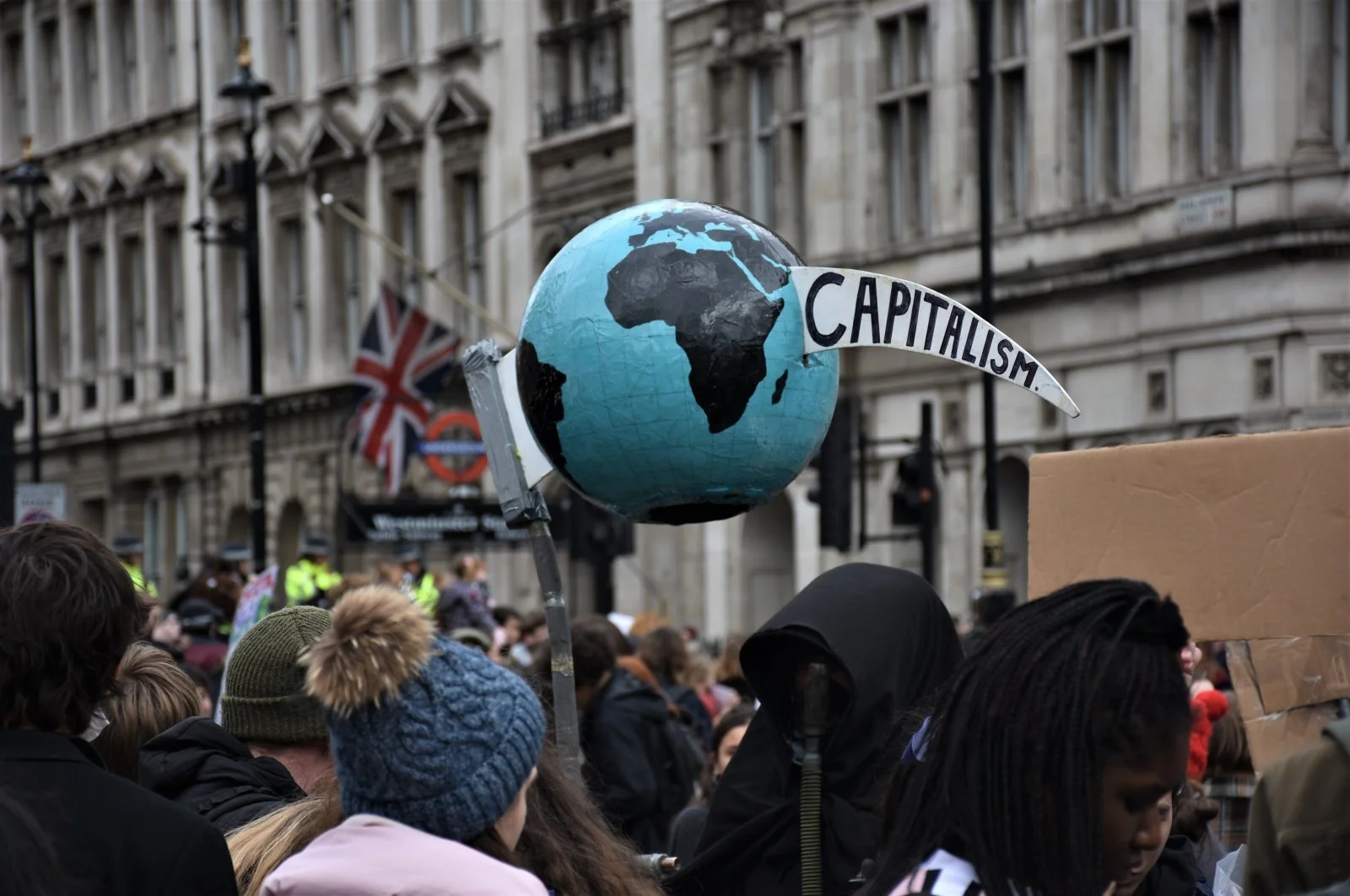
Capitalism and White Supremacy: The Two-Headed Dragon that Must Be Slain

By Matthew Dolezal

Four decades of neoliberal Reaganomics has decimated the American poor and working class. Median wages have remained stagnant since the late 1970s, despite a consistent increase in productivity. The top 1 percent owns 40 percent of the country's wealth, and top CEOs make more than 300 times that of the average worker (which is a 1,000 percent increase since 1978). There are 46 million Americans officially living in poverty, but, due to the arbitrary nature of the poverty line, another 100 million are "near poor" (i.e. cannot afford basic necessities). And keep in mind - this is happening in the richest country in the world. These third-world levels of economic inequality make the US look a lot like an oligarchy. The vast majority of new income goes to the top 1 percent, and one family -  the Waltons of the Walmart empire - has more wealth than the bottom 40 percent of the population.

Wealth concentration and poverty under neoliberalism aren't abstract concepts; they have tangible consequenses. For example, half of all Americans don't even live paycheck to paycheck, student loan debt is diminishing the prospects of home ownership, climate change is beginning to devastate poor communities while helping the rich, and 45,000 people die every year due to a lack of health insurance. In Dr. Martin Luther King, Jr.'s final speech to the Southern Christian Leadership Conference in 1967, he said :

"One day we must ask the question, 'Why are there forty million poor people in America?' When you ask that question, you begin to question the capitalistic economy."

But this is a democracy, right? Who would vote for such a grim existence? Well, according to an academic study from Cambridge , there is literally no correlation between public opinion and government policy. Turns out the plutocrats are running the show (thanks, in part, to Citizens United ).

Generic, theoretical capitalism is inseparable from our current paradigm of advanced, hyper-consumerist, job-shipping, union-busting, soul-crushing neoliberalism. Prominent capitalists have fought desperately to achieve this sadistic system, which is the culmination of an evolutionary history of laissez-faire. One day, long ago, Adam Smith planted roses, and all that remain are the thorns. To quote King again, "today capitalism has out-lived its usefulness."

But capitalism is not an equal-opportunity destroyer. These social tragedies demonstrably and empirically affect folks of color at vastly disproportional rates. For instance, the average net worth of black households is $6,314, compared to $110,500 for the average white household. Blacks are more than twice as likely as whites to be poor, and a white male with a criminal record is more likely to get a job than an equally qualified person of color with a clean record. Median black household income is approximately $43,300, while median white household income is around $71,300. This discrepancy is roughly 40 percent greater today than it was in 1967. And these economic disparities are just the beginning. For instance, in the area of mass incarceration, more than 40 percent of US inmates are black men, while that demographic only makes up 6.5 percent of the general population. In the area of police violence, black teens age 15-19 are 21 times more likely to be shot and killed by the police than white teens of the same age group. These statistics could continue for pages. Profound systemic racism poisons every aspect of American society. These horrors are manifestations of the racial caste system that has always existed in the US, which is discussed at length by Michelle Alexander in her groundbreaking book The New Jim Crow: Mass Incarceration in the Age of Colorblindness.

We often forget that merely five decades ago, our country maintained a government-sactioned apartheid system. This included the intentional creation of black ghettos through redlining and other discriminatory policies. Political inertia, mixed with the racist War on Drugs, has preserved the vestiges of white supremacy. The reality on the ground looks a lot like the same ol' Jim Crow; that guy we swore we kicked out in 1964.

But racism isn't just institutional; it is often overt. The recent emergence of Trump made this crystal-clear . Not only did the Ku Klux Klan and white nationalists endorse him, but even for his voters, " fear of diversity " was a significant motivating factor.

The evils of racism are clearly apparent to any non-psychopath, but racial ideologies also serve to pit poor and working-class white folks against people of color and minorities, distracting them from their true nemesis; the ruling class. This is a classic example of "divide and conquer," and has benefited the elites immensely. Anti-racism activist and author Tim Wise elucidates this phenomenon in a concise Marxian manner:

"The history of America is the history of rich white men telling not rich white people that their enemies are black and brown."

Let's put an end to this madness. Let's build a movement to confront and destroy this dual evil of economic and racial injustice. Might I suggest…

Socialists have a rich tradition of fighting racism, from the Communist Party of Alabama , to Cuba's critical support of black South Africans during Apartheid, to early 20th century socialist politician Eugene Debs , to revolutionary Marxist Rosa Luxemburg , to the original Black Panthers Party . Socialists not only see racism as contrary to worker solidarity, but as a destructive and dehumanizing hierarchy, just like the class system itself. And indeed, capitalism and racism have a symbiotic relationship. Two modern organizations that are battling this double-headed beast are Democratic Socialists of America (DSA) and Redneck Revolt .

Founded in 1982, DSA is the largest socialist organization in the US, with a total dues-paying membership of 25,000 (a four-fold increase since November of 2016). Members have been active in opposing the agenda of the Trump regime, as well as carrying the torch of the Bernie Sanders political revolution. DSA has been on the front lines fighting for a $15 minimum wage, universal healthcare, LGBTQ equality, climate justice, reproductive rights, and many other progressive causes. However, one thing that separates DSA from other left-leading organizations such as Our Revolution is their vehement anti-capitalism. DSA document Where We Stand: Building the Next Left explains:

"We are socialists because we reject an international economic order sustained by private profit, alienated labor, race and gender discrimination, environmental destruction, and brutality and violence in defense of the status quo.

We are socialists because we share a vision of a humane international social order based both on democratic planning and market mechanisms to achieve equitable distribution of resources, meaningful work, a healthy environment, sustainable growth, gender and racial equality, and non-oppressive relationships."

On the topic of anti-racist activism, DSA Honorary Chair and prominent intellectual Cornel West writes :

"A long and deep legacy of white supremacy has always arrested the development of US democracy… When the system is declining, it can bring despair. That's why Black Lives Matter   -   and all other young people of all colors who are mobilizing   -   is a beautiful thing. We are having a moral and spiritual awakening. It gives us democratic hope... It's time to move from being spectators, to being actors."

Members of Redneck Revolt are not liberals . They are pro-gun, pro-labor, anti-fascist, and anti-racist. The movement is rapidly expanding, with more than 30 chapters around the US. Developing around 2009 as an outgrowth of the John Brown Gun Club, this diverse group now focuses on recruiting rural, southern and Appalachian working-class folks to join the fight against white supremacy and capitalism, while protecting and supporting people of color and other marginalized communities. After all, many of these poor southern white folks have been voting against their own interests for decades after falling for the xenophobic rhetoric of prominent politicians. Dave Strano, a founding member of the organization, explains:

"The history of the white working class has been a history of being an exploited people. However, we've been an exploited people that further exploits other exploited people. While we've been living in tenements and slums for centuries, we've also been used by the rich to attack our neighbors, coworkers, and friends of different colors, religions and nationalities."

Member Max Neely summarized their strategy by saying simply:

"We use gun culture as a way to relate to people. No liberal elitism. Our basic message is: guns are fine, but racism is not."

Now, I know just mentioning the term "white privilege" can make people uncomfortable , but this sociological reality must be acknowledged and dismantled as an inherent aspect of entrenched white supremacy. White privilege is the flip-side of the oppression and marginalization faced by people of color. Simply being given an unconditional pass to avoid oppression, discrimination, profiling, and other forms of profound inequality is in itself a major manifestation of white privilege. But an understanding of intersectionality as it relates to privilege is also crucial, just as it is in understanding oppression and exploitation. If one has privileges based on other sociological aspects of their identity, this privilege may extend beyond merely avoiding the injustices uniquely faced by non-whites. In addition to race, these realms include class, sexual orientation, religion, gender identity, etc. The more dominant groups one belongs to, the more privileges that are usually afforded to that individual. Based on a rudimentary analysis of modern American society, the most privileged demographic would be wealthy, white, heterosexual, cisgendered, Christian men. Indeed, if you pay even peripheral attention to current events and history, you'll quickly realize that these are, more often than not, the people who own and control our society and have since its inception. One such man was "founding father" and forth president of the United States, James Madison, who was passionate about protecting "the minority of the opulent against the majority." Oh, and he also owned over a hundred slaves. There are still dudes like this, but now they're banksters and Koch -fiends. Let's break this trend. To those of us with various forms of privilege, let's use it to fight for a better future for everyone.

The genocide of the indigenous inhabitants of the Americas was our nation's original sin. White supremacy and capitalism were then built upon this rotten foundation. These parasitic abominations emerged simultaneously in American society; let's dismantle them simultaneously as well.

Black Bolsheviks and White Lies: Reflections on the Black Radical Tradition

By Peta Lindsay

A lot of nonsense has been written about the role of Putin's Russia in subverting "our democracy." As though our democracy had been functioning perfectly (even reasonably) well, until these shadowy Russian forces purchased a few Facebook ads that sent us all into the streets. It's a laughable concept. I'm sorry, did Putin acquit George Zimmerman or Jason Stockley? Did Putin shoot 12-year-old Tamir Rice? Russia did not carry out the drug war against African Americans or implement policies of mass incarceration, or pass voter ID laws in the U.S. - all of which have contributed to disenfranchising millions of African Americans over the years. The U.S. has a lot to answer for with regard to systematically denying the democratic rights of African Americans and this is not the first time they've tried to deflect criticism for that by blaming Russia. As a student of history I've mostly just rolled my eyes this time around while the Democrats attempt to make red-scare tactics that are very old, new again. But a recent entry in this canon of "Black activists are pawns of Moscow" writing is so insulting and patently false, that, as we approach the hundredth anniversary of the Russian Revolution, it seems very important to reply.

Last month an author named Terrell Jermaine Starr wrote a piece for The Root entitled, " Russia's Recent Facebook Ads Prove the Kremlin Never Loved Black People ."

I've enjoyed entries from The Root before, particularly in chronicling racist attacks against African Americans that are underreported in the mainstream media. But their willingness to toe the Democratic Party line, uncritically in most circumstances, has been noted.

Starr's piece is supposedly historical in scope but is premised upon a huge, glaring, historical fallacy: that of conflating the Russian Federation with the Soviet Union. In one sentence, Starr describes the two as essentially the same (showing you the level of material historical analysis he's interested in engaging in) and then for the rest of the article proceeds to whitewash the history of Black communism, using the favorite arguments deployed by racists - that Blacks who supported socialism did so because they were duped, and that the Soviet Union was only interested in Black liberation insofar as it meant spiting their enemies in the White House.

These assertions deny the agency of African Americans, many of whom were amongst the most prominent Black intellectuals of their time, who looked to the Soviet system as an alternative to American racism and exploitation. This interpretation also denies the real solidarity and support that the Soviet Union expressed in their assistance to liberation movements of many Black, brown and oppressed people all over the world. Since anti-communist propaganda is easily promulgated without evidence in this country, allow me to present some of the evidence that exposes these racist lies for what they are.

The Union of Soviet Socialist Republics was birthed via a revolution in 1917 and overthrown via counter-revolution in 1991. While Russians were in the majority of the population, the USSR itself was actually an extremely diverse and vibrant society for all of its existence. The Soviet Union spanned 14 time zones and comprised many independent nationalities and ethnic groups, such as Tajiks, Kazakhs, Lithuanians, Tartars - all of whom spoke different languages, practiced different religions - and suffered terrible racist oppression under the Tsar. The triumph of the socialist revolution and the very existence of this unique political formation was the result of a revolution carried out by united oppressed peoples, who rose up as one and took control of society away from their Tsarist and capitalist exploiters. The Bolsheviks always took the task of uniting oppressed people and elevating their struggle very seriously. This was a key to their success and a guiding principle in their work. It was Lenin who pioneered communist opposition to imperialism and he who changed the Marxist formulation, "Workers of the World Unite" to "Workers and oppressed people of the world unite" as an expression of the priority they placed on the struggle of colonized people against imperialism.

Around the world, the 1919 triumph of Lenin and the Bolsheviks was greeted by the imperialists with great dismay and by oppressed/colonized peoples with great enthusiasm, inspiration and hope. In America, 1919 was an infamous year, known for its "Red Summer" of intense lynchings, race riots and gruesome violence against African Americans at the hands of white mobs. The Black American political movement had entered a new era of militancy, as veterans returning from WWI were less inclined to submit to Jim Crow and more inclined to fight for their dignity, wages and rights. A new wave of radical Black intellectuals all but took over the Black political scene, many from the Caribbean and mostly based in Harlem in the 1920s and 30s. These men and women were considered some of the premier thinkers and writers of their time and of the majority of these radical African American leaders-regardless of political orientation- held the Russian Revolution in very high esteem.

According to historian Winston James, in his work Holding Aloft the Banner of Ethiopia, the appeal of the Russian Revolution to Black people in America at the time lay not in their having been "recruited" by Russia as the Root article asserts, but in their own independent evaluation of the Bolshevik government and where it stood with regard to equality for oppressed and colonized people.

James wrote about three major factors that attracted Black people to Bolshevism in the 1920s and 1930s. The first was the domestic policies promoting national minorities and oppressed groups that were put in place almost immediately after the triumph of the revolution. After the revolution the Bolshevik government undertook what can be described as the most far reaching and thorough affirmative action plan that any government has ever attempted, dedicating much in the way of their limited resources towards raising the standard of living for groups who had been historically oppressed and creating conditions that could facilitate greater equality for those groups.

To Black Americans, the most convincing example was the swiftness and seriousness with which the Soviets began redressing historical inequality suffered by the Jews, including immediately outlawing discrimination against them and putting an end to the violent pogroms that had plagued them under the Tsar. In 1923 Claude McKay, the young Black intellectual, writer and poet wrote: "For American Negroes the indisputable and outstanding fact of the Russian Revolution is that a mere handful of Jews, much less in ratio to the number of Negroes in the American population, have attained, through the Revolution, all the political and social rights that were denied to them under the regime of the Czar (166)."

The other two factors explored by James were the "uncompromising rhetoric of anti-colonialism, anti-imperialism, and the right of self-determination for oppressed nations (165)" espoused by the Bolshevik government and the creation of the Third Communist International, an international body that openly encouraged colonized (often Black or Brown) people to rise up against their (mostly European) exploiters all over the world.

At a point when the U.S. government had systematically ignored the pleas of Black people to pass even one federal law against lynching, when city and state governments all over the country were colluding in lynchings, race riots and allowing whites who attacked Blacks to go free, or even reap rewards - it doesn't take a genius to figure out why many Black thinkers were genuinely excited that such a different kind of government, one that spoke to them and had taken action to support and defend its own national minorities, had come into the world.


Black and white (film)

Langston Hughes was a Black intellectual of this generation, this being the same generation that we associate with the Harlem Renaissance and the New Negro. Of all the insults buried in that heinous Root article, the disrespect to Langston Hughes, inarguably one of the greatest American writers of the 20th century, is one of the most difficult to endure. Starr paints Hughes as a dupe, someone "recruited" to champion the Soviet Union, as if the man had not traveled all over the world, studied and written extensively and was not capable of genuinely supporting a government that he believed to be on the right track. We revere Hughes' poetry that celebrates Black beauty, he is the jazz poet laureate of Black America and we love to recite his words that affirm our deep history and continued struggle in the face of white American racism. But what about his poetry celebrating the Soviet Union? Here's a link to a poem that he wrote praising Lenin . Did they break that one out at your school's Black history month event? Probably not. But that doesn't change the fact that Langston Hughes was extremely sympathetic to the Soviet Union, as is abundantly evident in his autobiographical writing, including in the chapter of I Wonder As I Wander, "Moscow Movie."

The Root provides perhaps the most cynical and shallow reading of this chapter possible, though I hesitate to affirm that that author of that piece has even actually read it. "Moscow Movie" tells an important story about a time in 1932 when Langston Hughes was invited to the Soviet Union by the government, to work on a major film production. This film was called "Black and White" and it was supposed to highlight the struggle of Black workers in the South and give an international showcase to the racism and oppression experienced by Black people in America. According to Langston Hughes, it was "intended to be the first great Negro-white film ever made in the world (80)," though unfortunately it did not come to fruition.

Hughes accompanied a delegation of 22 young African Americans who were supposed to star in the film, though it was odd that most in that group were not actors or performers by trade. Starr erroneously attributes this casting to racism, saying that Hughes determined that the Soviets were so racist that they assumed that all Black people could sing and dance (and play sports?) and so didn't bother to check the backgrounds of the people they hired for the film.

In fact, Hughes said nothing of the sort. He addressed the peculiar composition of the delegation early in the chapter, stating, "That most of our group were not actors seems to have been due to the fact that very few professional theater people were willing to pay their own fares to travel all the way to Russia to sign contracts they had never seen. Only a band of eager, adventurous young students, teachers, writers and would-be-actors were willing to do that, looking forward to the fun and wonder of a foreign land as much as to film-making. There were a few among them who wanted to get away from American race prejudice forever, being filled up with Jim Crow (70)."

It's important that Hughes highlighted their motives as traveling to seek a reprieve from American racism. So high was the esteem for the Soviet Union in the group, that "When the train stopped beneath this banner for passports to be checked, a few of the young black men and women left the train to touch their hands to Soviet soil, lift the new earth in their palms, and kiss it (73)," according to Hughes.

In his accusations of racism what Starr may be referring to is where Hughes says at one point, "Europeans as well as Americans, seem to be victims of that old cliche that Negroes just naturally sing (80)." That is hardly an indictment of any particularly Russian racism and more of a complaint on how African Americans are represented on the world stage.

Lack of specific cultural knowledge about African Americans was a problem throughout the film's production and that is what Hughes believes ultimately damned the film. Hughes was given an early copy of the script and let them know that he did not think it was usable because there were so many errors with regard to what racism and working class struggle actually looked like in the American South. Hughes said that the author of the script was well intentioned but had never been to America. He also said that information from or by Black Americans was rarely translated into Russian in those days. Even with these critiques, it's nearly impossible to interpret Hughes as being at all bitter or resentful at the Soviets for their attempt at making this film. On the contrary, Hughes wrote with unmistakable good humour throughout the chapter and also repeatedly mentioned that they were all paid in full and well taken care of, even when it became clear the film wouldn't be made.

The reception that the students received in Moscow is really remarkable, especially considering the historical context - none of which The Root brings up, of course. The students were "wined and dined" in Hughes' own words, they were put up in the most lavish hotels and treated to free tickets to the theater, the opera, the ballet and dinners and parties with dignitaries and important people, almost every night. They were official guests of the state and treated with the highest honors. No Black delegation has ever been received in America with such grace. Hughes says that they were always introduced as "representatives of the great Negro people (82)" and after describing the incredible amenities at one of the elaborate resorts they were housed in, he adds "I had never stayed in such a hotel in my own country, since, as a rule, Negroes were not then permitted to do so (93)."

On their reception by ordinary Soviet citizens, Hughes writes:

"Of all the big cities in the world where I've been, the Muscovites seemed to me to be the politest of peoples to strangers. But perhaps that was because we were Negroes and, at that time, with the Scottsboro Case on world-wide trial in the papers everywhere, and especially in Russia, folks went out of their way there to show us courtesy. On a crowded bus, nine times out of ten, some Russian would say, "Negrochanski tovarish - Negro comrade - take my seat!' On the streets queueing up for newspapers or cigarettes, or soft drinks, often folks in line would say, "Let the Negro comrade go forward." (74)

This is in 1932! Nowhere in America were Black people treated like this in 1932. Hell, many of us could not get that treatment today, if our lives depended on it (and they sometimes do). This account echoes many others by African Americans who visited or moved to the Soviet Union. In William Mandel's Soviet but Not Russian, Muhammad Ali is quoted as saying of his 1978 visit to the Soviet Union:

"I saw a hundred nationalities. No such thing as a Black man, or a white man, or 'you nigger,' or get back. People say, 'Oh well, they just showed you the best.' You mean all of those white folks rehearsed, said: 'Muhammad Ali's coming!' .. 'All hundred nationalities, pretend you get along. Muhammad Ali's coming!'…'They just took you where they wanted to go.' I know that's a lie. I got in my car and told my driver where to go. Lying about the Russians.. I jogged in the mornings in strange places where they hardly ever saw a Black man. I ran past two little white Russian ladies who were walking to work. They didn't look around and ask what I was doing. I can't go jogging in some streets in America in the morning in a white neighborhood." (85)

The Root tries to paint a picture of a USSR where the same racism that existed in Jim Crow America infected everyone there, but there simply is not enough evidence to say that was the case. They cite the experiences of one Black American man (Robert Robinson), thoroughly. But what about the experiences of the estimated 400,000 African students who were educated for free in the Soviet Union between 1950-1990? These Black youth attended technical schools, Lumumba University and the special Lenin school for leadership, they lived and traveled all over the Soviet Union and upon graduation, they would return to their homelands with skills necessary to aid in the new independence governments. Mandel interviewed quite a few Black Soviets for his book, including other African Americans who moved to the Soviet Union- and the picture they paint is very different from the one in Robinson's account. Providing no evidence, Starr also asserts that interracial relationships would naturally be a problem in the Soviet Union, saying "both Russian and white American men weren't cool with their women messing with black men." Since he introduced the term "bullshit" just before that line, I'm going to call bullshit on that.

Langston Hughes' account features many stories of the men in his group dating Soviet women and not a word about anyone batting an eye at such pairings - which in 1932, would have gotten someone lynched in the United States. Please stop projecting American racism onto the Soviet Union, when you just don't have the evidence to back that up. As W.E.B. Dubois wrote on his third visit to the USSR in 1949, "of all countries, Russia alone has made race prejudice a crime; of all great imperialisms, Russia alone owns no colonies of dark serfs or white and what is more important has no investments in colonies and is lifting no blood-soaked profits from cheap labor in Asia and Africa." The material basis for widespread Jim Crow style racism just wasn't there.

Hughes was aware that the western press celebrated the failure of the movie and spread many rumours that they knew to be false concerning the Soviet government maneuvering against the Black students. He writes that Western journalists, who saw them spending money and carousing in Moscow nightclubs, filed stories in the U.S. about how they were going unpaid and neglected.

Hughes wrote that some in his group suspected that the movie was scrapped because the Soviets were sacrificing the Black struggle to appease the American government - but Hughes himself did not believe that. He was one of the only members of the group who saw the script and he was unequivocal in stating that more than anything else, it was the script that caused the project's failure. Hughes also repeatedly mentioned the context of the international campaign in defense of the Scottsboro Boys, a Black struggle that was most certainly not being dropped by the Soviets, as all this was going on.

The Root miscasts this excerpt from the life of Langston Hughes to support their conclusion that "the Soviets' attempts to curry favor with the black struggle" was "insincere and downright fraudulent." I would counter that this anti-communist propaganda is actually "insincere and downright fraudulent" but allow me to present further evidence on the genuine solidarity expressed by the Soviet Union. Sticking with the theme, let's keep talking about film.


Focus on Africa in film

In the book Focus on African Film, noted film scholar Josephine Woll describes "The Russian Connection" between the Soviet Union and African film, an invaluable alliance in making postcolonial African cinema a reality. As alluded to in the previous section, the Soviet Union expended a lot of resources on aid and development for African nations, who were in the process of throwing off their own colonial oppressors and beginning their independence after World War II. These countries were severely underdeveloped, as chronicled by Walter Rodney and the Soviet Union was a key ally in providing material support, education and technology to allow these countries to thrive without being beholden to their former colonial masters. It's worth noting that the greatest victory for Black liberation to occur in my lifetime, the fall of apartheid in South Africa, involved a great deal of material and political support from the Soviet Union, which was integral to the success of that movement.

Film was another area in which the Soviet Union provided Africans with crucial foundational support. Ousmane Sembene of Senegal, widely considered the "father of African film" was educated in the Soviet Union. This was also the case for other pioneering African filmmakers, like Souleymane Cissé of Mali and Abderrahmne Sissako of Mauritania/Mali and Sarah Maldoror, the French daughter of immigrants from Guadeloupe who made many films about African liberation. In addition to technical know-how, the Soviet Union also provided the essential film and production equipment, distribution and promotion, to bring African cinema onto the world stage.

Dr. Woll seems to believe that the motives of the Soviets were clearly political, but also genuine. Woll wrote: "The Bolshevik Revolution and its aftermath, radically altered how, why, and for whom films were made. Financial profit still mattered but it competed with other goals: educational, political, promotional. The new regime in post-tsarist Russia, like the new leaders of post-colonial African nations, willingly allocated part of its budget to subsidizing cinema because it recognized how effective the medium could be as an instrument of propaganda; and most Soviet filmmakers in the 1920s, though they had individual and often compelling aesthetic agendas, readily supported the politics of revolution (225)." In the U.S. we tend to be very cynical of the word "propaganda" but in revolutionary times, propaganda is necessary and the Africans needed aid in producing theirs. Ousmane Sembene clearly agreed; he was adamant about telling compelling political stories through his films and he fully recognized the potential for his films to "help decolonize Africa (225)."

The Soviet Union trained and equipped these African directors, so that they could bring the beauty and the struggle of their people to the world stage. The work of these revolutionary African filmmakers can be seen as a happy ending to the saga that was begun with "Black and White." While we never got the Soviet sponsored film about Black struggle in the U.S. that they wanted to produce, we have since seen a variety of films out of different African countries that highlight their struggle in similar, but undoubtedly much more accurate, ways.


Conclusion

I realize that this was a lot to write in response to a small article that was probably not even this carefully considered by the author himself. But the legacy of the Soviet Union with regard to Black struggle is unique and inspiring and should be celebrated, not horrifically distorted and denied. In Paul Robeson Speaks, the great Black American actor says:

"Mankind has never witnessed the equal of the Constitution of the U.S.S.R. . . . Firstly, because of the significance it has for my people generally. Everywhere else, outside of the Soviet world, black men are an oppressed and inhumanely exploited people. Here, they come within the provisions of Article 123 of Chapter X of the Constitution, which reads: "The equality of the right of the citizens of the U.S.S.R. irrespective of their nationality or race, in all fields of economic, state, cultural, social, and political life, is an irrevocable law. Any direct or indirect restriction of these rights, or conversely the establishment of direct or indirect privileges for citizens on account of the race or nationality to which they belong, as well as the propagation of racial or national exceptionalism, or hatred and contempt, is punishable by law." (1978, 116)

While our current President appoints KKK members to the Department of Justice and calls Nazi murderers "very fine people," while his opponent Hillary Clinton called our children "super predators" and campaigned for them to be locked up en masse- we have to appreciate how significant it is that a national government - in 1919 - put laws on the books like the ones described above. They outlawed racism. They invested heavily in Black education and Black artistic expression. They gave guns to those fighting imperialists and fascists all over the world. What more could you want? Terrell Jermaine Starr and The Root may be confused about which government cares about Black people, but I can't say that I am. I'm proud to be a socialist and I'm proud of the legacy of friendship between my people and the USSR.

As I mentioned in the start of this article, calling Africans who fight for their liberation "Commies" or "dupes" is nothing new. John Hope Franklin referred to this in From Slavery to Freedom, saying that the response to Black self-defense against race riots in 1919 caused such speculation: "Many American whites freely suggested that foreign influences - especially … Bolshevik propaganda after the 1917 Russian Revolution - had caused blacks to fight back. Perhaps there is some truth to that… However, black Americans all along the political spectrum (from conservative, to moderate, to radical left) ridiculed the claim that their new assertiveness was the result of 'outside agitation.' American blacks needed no outsiders to awaken their sense of the tremendous contradiction between America's professed beliefs and its actual practices (362)".

That remains as true today as it was when written. Additionally, I'll close with one more statement from that time, which also remains true, for myself at least. The militant Black Harlem publication The Crusader, under the leadership of fiery Black Communist Cyril Briggs declared in 1919: "If to fight for one's rights is to be Bolshevists, then we are Bolshevists and let them make the most of it!"


This article originally appeared at Liberation School .


References

Hughes, Langston. (1984). I wonder as I wander: An autobiographical journey. New York: Hill and Wang.

Robeson, Paul. (1978). Paul Robeson speaks: Writings, speeches, interviews 1918-1974, ed. by P.S. Foner. New York: Citadel.

Workers Behind Bars: Private Prisons and Mass Incarceration

By Chris Costello

In the era of neoliberalism, the institution of private prison is the subject of much debate. Proponents argue that the system is a cost-effective option. It allows the government to conserve tax dollars and allows cash-starved states to reallocate the funds. However, these assertions run counter to the vast majority of data. In this essay, I will argue that private prisons are not in fact cost effective. Instead, they serve only to incentivize criminalization and exploit the labor of inmates. Further, their function is one that capitalism-and especially neoliberal capitalism-cannot do without. As such, the abolition of private prisons is impossible under capitalism.

The most important argument offered up by the pro-privatization camp is that for-profit prisons are cheaper than publicly owned correctional facilities. This argument rests on the assumption that cost-cutting is important enough to overlook the violence and exploitation that occurs in private prisons, which strikes me as spurious. A great many activities that harm humanity, such as the cutting of environmental safety regulations, result in greater profits. Despite this, no one (except of course the capitalist) would say that profit stands above the wellbeing of the environment. Why, then, should this logic apply to prison privatization? Regardless, this is a myth that has been employed time and again in defense of private prisons, so it is worth taking the time to deconstruct it.

It is true that there is no database of public and private prisons through which it would be possible to control for things like size, jurisdiction, and so on. This makes a comparative cost analysis admittedly difficult. However, the data that does exist does not support the idea that private prisons are more cost effective than public ones. Data from the Arizona Department of Corrections show that private prisons can cost as much as $1,600 more per year, while many cost about the same as they do in state-run prisons [1].

Further, researchers at the University of Utah concluded in 2007 "cost savings from privatizing prisons are not guaranteed and appear minimal" [2]. Finally, a review of the 24 studies on the cost effectiveness of private prisons revealed inconclusive results regarding cost savings. They also found no considerable difference in cost effectiveness [3]. These studies all show that the myth of the cost-effective private prison is just that: a myth. At best, the data are inconclusive. There is simply no credible way to assert that private prisons are more cost effective than their public counterparts.

There have been several studies that claim to prove this point, however. One was conducted at Temple University by two researchers who claim to be independent. However, the study received funding from Correctional Corporation of America, the United State's largest private prison company [4]. Clearly, studies that are paid for by the very industry they seek to expose cannot be considered credible. There have been very few truly independent studies that have found that private prisons provide a monetary gain to taxpayers. As such, there is no economic justification for the proliferation of private prisons.

If private prisons do not justify themselves from a monetary standpoint, as I have just argued, what exactly do they do? Their purpose cannot be saving taxpayers money, but neither could they exist without a purpose. It must be the case that private prisons perform some function. The question now is, which function? They are certainly not concerned with rehabilitation, and may even incentivize criminalization. Data from one Minnesota report confirm, "that privatization significantly lowers the level of correctional effectiveness, facility security, and public safety compared to what is now provided by the public system" [5]. Private prisons, therefore, cannot be considered more effective or safer than public facilities. Their purpose must be something other than the rehabilitation of criminals.

As Angela Davis has argued, the true purpose of private prisons is the exploitation of labor. According to Davis, the use of prison as a source of labor began earnestly in the 1980's. She writes, "Companies such as Correctional Corporation of America (CCA) and the GEO Group reaped the profits attracting investments from household names, including the Bank of America, Fidelity Investments and Wells Fargo and also from many universities around the nation" [6]. They gained these profits by forcing their inmates to engage in labor. The inmates are well aware of this. According to one report, as many as 60,000 detained immigrants have engaged in "forced labor" for profit-driven correctional facilities [7]. Private prisons, to put it bluntly, are sites of a new American slavery.

This slavery is completely legal. The 13th amendment prohibited slavery-with one exception. The so-called "punishment clause" mandates that forced labor shall be prohibited "except as a punishment for crime" [8]. This clause was taken directly from the Northwest Ordinance of 1787. The clause reflected a common belief that hard work was essential to the rehabilitation of criminals. From its inception, however, the clause was used to police black citizens and restrict their rights. Frederick Douglass described it this way at the time: "[States] claim to be too poor to maintain state convicts within prison walls. Hence the convicts are leased out to work for railway contractors, mining companies and those who farm large plantations. These companies assume charge of the convicts, work them as cheap labor and pay the states handsome revenue for their labor. Nine-tenths of these convicts are negroes" [9]. Douglass also notes that so many blacks were behind bars because law enforcement tended to target them. This insight remains relevant to discussions of private prisons today. Law enforcement targets vulnerable populations-immigrants and people of color-and force them to labor for the profit of the owners. This is not fundamentally different from the institution of slavery of centuries past. Correctional corporations have used the specter of economic efficiency to perpetuate a barbaric and inhuman institution. For this, there is no excuse.

It is true that criminals should be expected to forfeit some portion of their freedom when they commit crimes. However, many of the aforementioned detained immigrants have committed no offenses beyond entering the country illegally. Many immigrants must contend with immense poverty in their home countries, oftentimes imposed by the United States. The North American Free Trade Agreement, or NAFTA, was intended to promote economic development for the United States and Mexico. According to a report from the CPER, however, "Mexican poverty has risen since the deal's implementation in 1994 as economic growth and real wages stagnated while nearly 5 million family farmers were displaced, propelling Mexico's poor toward migration to the United States" [10]. Immigration is directly attributable to the poverty imposed upon Mexico by NAFTA. Private prisons do not generally house dangerous elements that must be cut off from wider society. They are used to pen in desperate workers who believe they have no other choice.

This is remarkably similar to the processes that beget the development of capitalism in Europe. European capitalism arose out of feudalism, but this was not a natural occurrence. Rather, it came about through the enforced transformation of the peasant masses and feudal retinues into an industrial working class. Peasants were driven off their land and into the cities to work in factories. Drunkenness, pauperism, and vagrancy-the cardinal sin of existing while homeless-these became criminal offences. Prisons began as a means by which to discipline an emergent working class [11]. Even the classical political economists of the time understood the integral role of prison in the exploitation of labor. Bentham, a celebrated economist, detailed plans for a structure he called the Panopticon. In the words of author Michael Perelman, this was, "a prison engineered for the maximum control of inmates in order to profit from their labor" [12]. Although the Panopticon never materialized, the prison system continued to be a weapon for the repression of the workers during this period. This system was widely considered a success at the time, so it is no wonder that the American ruling class has seen fit to replicate it today.

A predictable rebuttal would be that this is an unfair comparison, since there is not a developing working class in the United States as was the case in England. Granted, Mexican farmers and English peasants in the feudal era have very different experiences of day-to-day life. In a broad sense, however, parallels can be drawn between them. Both worked land, often communally, until capitalist states forced them off this land and into poverty. Faced with starvation, both migrated to other areas to work for bosses in exploitative conditions. Many Mexican farmers still perform agricultural labor, while feudal peasants often worked in then-new factories.

Further, feudal peasants migrated within England, whereas Mexican immigrants have been forced to leave their home country entirely. Despite these differences, however, both instances have meant mass migration and an increase in the amount of exploitable labor in a particular area. As such, the characterization of Mexicans displaced by NAFTA as a "developing working class" or an "emergent proletariat" is accurate, at least in the American context.

Private prisons are not about rehabilitation. They are not even about crime. Like the prisons of the industrial revolution, they are about disciplining the working class. They serve a purpose that is necessary for the perpetuation of capitalism at this particular moment. The experience of capitalism's beginnings shows that prisons themselves have always been a tool of the ruling class. The privatization of prisons was inevitable, brought about by changes in the relations of production (the movement from feudalism to capitalism). It therefore follows that private prisons cannot be done away with without the abolition of capitalism.

The prison industrial complex, as Davis has termed it, can only be understood in a dialectical sense [13]. Prison profiteering is both the cause and effect of mass incarceration. Capitalism's contradictions spawned the prison system. One of the many causes of crime under capitalism is poverty. The results of one study "imply that if there is a culture of violence, its roots are pronounced economic inequalities" [14]. Capitalism, as a system that pits workers in competition with one another, requires poverty in order to function. Poverty allows capitalists to drive down wages and worsen conditions. If one worker will not accept a particular job, poverty ensures that some other worker will. In this sense, capitalism uses poverty as a tool to perpetuate itself.

German political economist Karl Marx elucidated a similar point in his book The Economic and Philosophical Manuscripts of 1844, in which he wrote, "When society is in a state of progress, the ruin and impoverishment of the worker is the product of his labor and of the wealth produced by him" [15]. Because workers under capitalism produce wealth that does not belong to them, the very process of production ensures that workers will be poor. The principle of exploitation states that workers are only ever paid enough money to enable them to continue working, nothing more. This means that the vast majority of workers will be poor.

Even if poverty did not serve the function mentioned above, it would still be an unavoidable aspect of capitalism. This being the case, capitalism is structurally incapable of addressing the root of crime. The system must, therefore, find a way to profit from it. The prison system, as a result, is now a lucrative investment opportunity for innumerable corporations.

Microsoft, Wal-Mart, and Dell, among others, have adopted a system that bares a striking resemblance to the convict-leasing system described by Douglass. In prisons across the country, inmates work sunup to sundown for major corporations. They produce or package every kind of commodity, from weapons intended for military use to Starbucks coffee. According to the Federal Bureau of Prisons, "Sentenced inmates are required to work if they are medically able. Institution work assignments include employment in areas like food service or the warehouse, or work as an inmate orderly, plumber, painter, or groundskeeper. Inmates earn 12¢ to 40¢ per hour for these work assignments. Approximately sixteen percent (16%) of work-eligible inmates work in Federal Prison Industries (FPI) factories. They gain marketable job skills while working in factory operations, such as metals, furniture, electronics, textiles, and graphic arts. FPI work assignments pay from 23¢ to $1.15 per hour" [16].

In addition to private prisons getting away with paying lower wages than private corporations, they also subject their inmates to atrocious conditions. A prisoner forced into agricultural labor describes her experience this way: "They wake us up between 2:30 and three AM and kick us out of our housing unit by 3:30AM. We get fed at four AM. Our work supervisors show up between 5AM and 8AM. Then it's an hour to a one and a half hour drive to the job site. Then we work eight hours regardless of conditions . . .. We work in the fields hoeing weeds and thinning plants . . . Currently we are forced to work in the blazing sun for eight hours. We run out of water several times a day. We ran out of sunscreen several times a week. They don't check medical backgrounds or ages before they pull women for these jobs. Many of us cannot do it! If we stop working and sit on the bus or even just take an unauthorized break we get a major ticket which takes away our 'good time'" [17].

Here, we see the true purpose of private prisons. They are intended to create an easily manipulated workforce who can legally be paid wages that are below the value of their labor power. The exploitation and disciplining of the working class represented the impetus for prisons to exist in the first place, and the same logic is being used to promote their privatization today.

It should be noted that the function of prisons as a method of social control-a tool to discipline the working class-is the primary function of prisons, both public and private, in the United States. While private prisons are in many cases a money-making venture for capitalists, their major function is to control the working class of oppressed nations. When we look at prison populations (whether private or public), we can see where mass incarceration gets its impetus. The vast majority of prisoners are from oppressed nations, even though euro-Americans are the majority of the U.S. population. The prison is not primarily a revenue racket, but an instrument of social control. Although profit-making (and thus exploitation) is a motivating factor in their proliferation, they should be seen as tools to beat the working class into submission [18].

Scholars Wagner and Rabuy support this idea in their paper "Following the Money of Mass Incarceration". The paper presents the division of costs within the prison industry as the judicial and legal costs, policing expenditures, civil asset forfeiture, bail fees, commissary expenditures, telephone call charges, "public correction agencies" (like public employees and health care), construction costs, interest payments, and food/utility costs [19]. The authors outline their methodology for arriving at their statistics and admit that "[t]here are many items for which there are no national statistics available and no straightforward way to develop a national figure from the limited state and local data" [20]. Despite these obvious weaknesses in obtaining concrete and reliable data, the overwhelming correctness of this analysis stands.

Wagner and Rabuy discuss the private prison industry at the end of the article. Here, they write, "To illustrate both the scale of the private prison industry and the critical fact that this industry works under contract for government agencies - rather than arresting, prosecuting, convicting and incarcerating people on its own - we displayed these companies as a subset of the public corrections system [21]." Private prisons have been justified on the basis that they are more cost-effective than the alternative. Data show that this is incorrect. Even if this were the case, however, that would not justify the rank exploitation of the inmates. Chattel slavery is no longer justified by this logic, so there is no reason that slavery behind bars should be subject to this argument either.

Private prisons, contrary to what proponents argue, have nothing to do with rehabilitation. They are about amassing profits for wealthy corporate owners and, chiefly, controlling undesirable populations. There is no argument, economic or otherwise, that can be used to justify their continued use. Prisons serve only as another tool in the capitalist's arsenal, a weapon with which to wage the war against labor. Private prisons and the capitalist system that necessitates them must be abolished. What this shows is that neoliberalism is simply a new era of capitalist development. In our struggle against it, we should continue to look to Marx and those who came after him.


Notes

Oppel, Richard A. "Private Prisons Found to Offer Little in Savings." The New York Times, The New York Times, 18 May 2011,

Lundahl, Brad, et. al. MSW "Prison Privatization: A Meta-Analysis of Cost Effectiveness and Quality of Confinement Indicators" Utah Criminal Justice Center, College of social work, University of Utah. April 26, 2007.

Oppel, Richard A. "Private Prisons Found to Offer Little in Savings." The New York Times, The New York Times, 18 May 2011,

Petrella, Christopher. "CCA Continues to Cite Misleading Study It Funded." American Civil Liberties Union. American Civil Liberties Union, 26 Apr. 2015

Austin and G. Coventry, "Emerging Issues on Privatized Prisons," Bureau of Justice Assistance, February 2001.

"Dr. Angela Davis - The Voice of the Oppressed." Center for the Study of Democracy, 9 Nov. 2015.

Short, April M. "As many as 60,000 detained immigrants may have engaged in forced labor for private prison companies." Salon.

Kamal, Ghali. "No Slavery Except as a Punishment for Crime: The Punishment Clause and Sexual Slavery." UCLA Law Review, 22 Oct. 2009,

"The Convict Lease System by Frederick Douglass." The Reason why the colored American is not in the World's Columbian Exposition, 1893.

TeleSUR et al. "NAFTA Plunges 20M Mexicans into Poverty: Report." News | teleSUR English, www.telesurtv.net/english/news/Thanks-to-NAFTA-Mexico-Poverty-Grew-Economy-Stagnated-Report-20170329-0033.html.

"Poverty and the workhouse." The British Library - The British Library, www.bl.uk/learning/timeline/item106501.html.

Michael Perelman, The Invention of Capitalism. Duke University Press, 2000, p. 21

"Dr. Angela Davis - The Voice of the Oppressed." Center for the Study of Democracy, 9 Nov. 2015. Op. Cit.

Judith R. Blau and Peter M. Blau, American Sociological Review Vol. 47, No. 1 (Feb., 1982), p.114-129

Karl Marx, "Marx 1844: Wages of Labor." Marxists Internet Archive

"Federal Bureau of Prisons." BOP: Work Programs,

Victoria Law, Truthout. "Martori Farms: Abusive Conditions at a Key Wal-Mart Supplier." Truthout, 2011.

Peter Wagner and Bernadette Rabuy, Following the Money of Mass Incarceration (Prison Policy Initiative), 25 January 2017.

Ibid

Ibid.

Peter Wagner, Are Private Prisons Driving Mass Incarceration? (Prison Policy Initiative), October 7, 2017.

Ibid.

To the Memory of Malcolm X: Fifty Years After His Assassination

By Ike Nahem

"I believe that there will be ultimately be a clash between the oppressed and those who do the oppressing. I believe that there will be a clash between those who want freedom, justice and equality for everyone and those who want to continue the system of exploitation. I believe that there will be that kind of clash, but I don't think it will be based on the color of the skin…"

- Malcolm X, One Month Before His Murder


"There are those who will consider it their duty, as friends of the Negro people, to tell us to revile him, to flee, even from the presence of his memory, to save ourselves by writing him out of the history of our turbulent times. Many will ask what Harlem finds to honor in this stormy, controversial and bold young captain - and we will smile. Many will say turn away - away from this man, for he is not a man but a demon, a monster, a subverter and an enemy of the black man - and we will smile. They will say that he is of hate - a fanatic, a racist - who can only bring evil to the cause for which you struggle! And we will answer and say to them : Did you ever talk to Brother Malcolm? Did you ever touch him, or have him smile at you? Did you ever really listen to him? Did he ever do a mean thing? Was he ever himself associated with violence or any public disturbance? For if you did you would know him. And if you knew him you would know why we must honor him. Malcolm was our manhood, our living, black manhood! This was his meaning to his people."

- Eulogy delivered by Ossie Davis at the Funeral of Malcolm X, Faith Temple Church Of God, Harlem, February 27,1965


The Assassination

On February 21, 1965 , Malcolm X, the great African-American and US freedom fighter and outstanding world revolutionary leader, was gunned down in the Audubon Ballroom in upper Manhattan's Washington Heights on Broadway and 165th Street in New York City. Commemorations of this bitterly sad anniversary that truly altered US and world history have been held in New York City, Malcolm's home base, across the United States, and throughout the world.

Malcolm X was a peerless orator of tremendous wit and power as well as an indefatigable and effective political organizer. On that fateful and horrible 1965 day he was murdered in cold blood, in front of his wife and children, while addressing a full house of over 400 people, under the auspices of the Organization of Afro-American Unity, the non-religious political formation he founded after his split from Elijah Muhammad's Nation of Islam (called the "Black Muslims" in the US media).

The gunmen were undoubtedly agents and operatives of the Nation of Islam (NOI). From the moment Malcolm X left the NOI he was subjected to the most vile personal attacks and slanders from Louis Farrakhan and other NOI leaders, including open calls for his death. While the evidence directly linking NOI leaders to the murder plot continues to be covered up, their moral and political responsibility is unquestionable. But this truth also begs the larger question of the direct or indirect responsibility of the United States government in Malcolm X's death. It is known that US government agencies, that is, the Federal Bureau of Investigation (FBI) within the United States, and the Central Intelligence Agency (CIA), which took over during Malcolm's international travels, had stepped up their illegal surveillance, harassment, and hounding of Malcolm X after his departure from the NOI. Federal and local cops and spooks had Malcolm X under constant surveillance. The New York Police Department (NYPD) knew two weeks in advance that Malcolm X was being targeted for assassination. NYPD had at least one undercover agent in the OAAU and had a wiretap on Malcolm X's phone. Yet no police were in sight at the Audubon Ballroom when he was murdered right in the open. It is also know that part of the FBI's COINTELPRO operation directed against Malcolm X included exploiting and instigating person venom against Malcolm by his former associates and manipulating the atmosphere of hostility and provocation.

Much of the documentation of this outrageous and illegal US government harassment - which included poison pens letters, instigating and promoting false rumors, personal antagonisms, the leaking and planting of disinformation in the media, and so on has come to light from lawsuits under Freedom of Information Act legislation. In a then-secret 1968 memorandum, Hoover wrote that the FBI must, "Prevent the rise of a 'messiah' who could unify, and electrify, the militant black nationalist movement. [Malcolm X] might have been such a 'messiah'…"


A Hero of My Youth and Always

My first lasting memory of Malcolm X was when, as a 13-year old boy in southern Indiana I was shaken by a graphic photo-spread of his assassination in the old LOOK magazine which my parents subscribed to. I had developed the habit of reading newspapers and following what was called "current events" in school so I was aware of and instinctly sympathetic to the Civil Rights Movement, as were my parents, although they had no direct involvement. A year or two later, we moved to the relatively big city of Cincinnati, Ohio and I went from a segregated small-town high school to a late-1960s urban cauldron.

The racial and social composition of my new high school was, more or less, about 40% "white" working class and middle class, 40% Black working class, with the rest, including me, mostly Jewish. It was a volatile mix in extremely volatile times, with the Black rights struggle literally exploding nationally as the Vietnam War - and mounting opposition to it - escalating. Interesting alliances and struggles formed in my new high school alongside racial antagonisms and tension. Black and white students united to change the schools draconian dress code; T-shirts, long-haired "hippies," and Afros proliferated. My high school was even written up in LIFE magazine in one of the era's ubiquitous pieces on the alienation and rebelliousness of "today's youth."

A few of my radicalizing Jewish friends and I gravitated to some of the outspoken Black students. I started sneaking off to attend civil rights protests. At one point we organized a controversial protest over the required recitation of the "Pledge of Allegiance" to the US flag at morning homeroom. Where the closing line says, "One Nation Under God, With Liberty and Justice For All," we added, ""If You're White." That landed us in the Principal's office.

When Martin Luther King was assassinated, the Black ghetto in Cincinnati exploded and my High School was shut down by students who refused to attend classes, considering it an insult to King's memory that schools remained open.

One day in 1967 I was looking to spend my sparse allowance money on some music at a rock-and-roll and "soul music" store in downtown Cincinnati when there in the stacks, in a section called "Spoken Word," I saw an LP titled "The Wit and Wisdom of Malcolm X," excerpts from his speeches. At $1.49 I could afford it. It was an earthshaking experience for me. What eloquence and logic I found within those grooves. What powerful use of language, what masterful employment of analogy and metaphor. What uncompromising exposure of hypocrisy and duplicity. What passion and compassion

Perhaps most unexpected for me was the profound and brilliant humor. At the time I had ambitions to be a comedian and I devoured comedy albums and movies as well as books on comedy "theory" - Lenny Bruce, George Carlin, Slappy White, the Marx Brothers, Burns and Allen, Flip Wilson, Don Rickles, and all the regulars on Ed Sullivan and Johnny Carson. I found out that the feared and hated (by some) Malcolm X was funny as hell! I played that soon-to-be scratchy album on my rickety record player to the point where I'm sure I drove my mother crazy. Soon after that purchase I stayed up all day and night and read The Autobiography of Malcolm X nonstop barricaded in my room. Like so many millions of others, reading The Autobiography was a real turning point in my life outlook and in the development of my political and social consciousness.


The Autobiography

The Autobiography of Malcolm X is a riveting and astonishing book that rises to great literature. Translated into over 30 languages, it should be essential reading for any literate human being in this country and indeed on this Earth. But if your only introduction and exposure to Malcolm X is this wonderful book, you will be unable to grasp and understand his world historical significance and true legacy, both the continuity and the profound transformation of his short, remarkable life.

The Autobiography was a book dictated by Malcolm X to Alex Haley on the run over the last two years of his life, while he was engaged in a grueling schedule of intense political organizing in the United States that was intertwined with extensive international travel that broadened and sharpened his moral and political outlook. His collaboration with Haley began while Malcolm X was still a member of and under the discipline of the Nation of Islam. But by the end of 1963 Malcolm's estrangement from the NOI was reaching a climax. For Malcolm X the radical split, which had been building for some time from moral and political motivations, became a personal and political liberation that was the catalyst pushing him forward. Responding later to a reporter trying to tie him to old NOI dogmas, he stated, "I feel like a man who has been asleep somewhat and under someone else's control. I feel that what I'm thinking and saying is now for myself. Before it was for and by the guidance of Elijah Muhammad. Now I think with my own mind, sir!

Malcolm X was unable to edit and correct many specific mistakes and misinterpretations in The Autobiography. He was unable to explain and elaborate on the new positions and his rejection of NOI nostrums he had promulgated by rote as an NOI leader. One example of this was his position against interracial marriages which he changed as he dumped Muhammad's "Yacub's theory" that "all whites" were the devilish offsprings of the experiments and machinations of an evil scientist from way back when. An expression of his old position was contained in The Autobiography. But in a November 23, 1964 press conference -less than three months before his murder - Malcolm was asked, "Are you against the love between a black person and a white person." His answer: "How can anyone be against love? Whoever a person wants to love that's their business - that's like their religion."

In general, Haley's editing of The Autobiography transcripts dilutes or deletes what was a sharp shift and trajectory to the left in Malcolm's political and philosophical views. Steadily, and more and more explicitly, Malcolm X embraced anti-capitalist and pro-socialist standpoints as he understood them. Within the Nation of Islam, Malcolm had always positioned himself on the side of the Black masses, the working people, as opposed to the more "respectable" "Black bourgeoisie," as he put it, who were afraid to "rock the boat." His blistering, uproarious popularization of the class divides within the oppressed Afro-American nationality at the time of the mass struggles of the 1960s was articulated brilliantly in his classic oratorical construction, "The House Negro and the Field Negro" that he inserted into many speeches. (This can be easily found on YouTube and elsewhere online.)

Outside the NOI, and in close contact with revolutionary internationalists of all skin colors and nationalities who were influenced by Marxist ideas and working-class struggles, these questions had moved more and more to the center of Malcolm's consciousness at the end of his life.

Malcolm wished to change and reformulate many things in The Autobiography, especially in the last chapters covering the period of his split from the NOI. Haley resisted, citing deadline pressures and Malcolm was murdered before the book was published. The printed book focuses on - doing a generally beautiful job - the narration of Malcolm's turbulent and searing life experiences. But the published narrative is incomplete. To fully appreciate the complete journey and legacy of Malcolm X, The Autobiography must be supplemented by reading and studying the man and his ideas directly in his own words.

Fortunately this is possible in print, audio, and video. Pathfinder Press is a small but prestigious socialist publishing house ( www.pathfinderpress.com ), affiliated with the Socialist Workers Party (SWP), a Marxist group which developed a close relationship with Malcolm X, and published his speeches, before his death. Pathfinder undertook immediately after Malcolm X's death a major project, in collaboration with his wife Betty Shabazz, to gather and publish as much direct material of Malcolm X's considerable output - speeches, essays, transcripts of interviews and press conferences, and so on from the crucial last year-and-a-half of his life. All of this remains in print today, completely uncensored and in basic chronology, so the reader can see for themselves the development and political evolution of this genuine American revolutionary. (I was a member of the SWP for over 20 years from the early 1970s to the mid-1990s and played a small part in helping Pathfinder to proofread and prepare for print some of the later published volumes.).


Targeted for Destruction

During this last period of his life Malcolm X functioned under and confronted - almost alone - tremendous pressures and life-threatening circumstances. He was literally marked for death by the NOI. A week before his assassination, his Queens, New York home was firebombed as he, his pregnant wife, and their four daughters were sleeping, all narrowly escaping death. The NYPD "investigation" was slovenly and perfunctory, implying he did it himself!


The Split

Malcolm X's accumulating and mounting estrangement from the Nation of Islam intensified with his deep revulsion and abhorrence at a sordid sexual scandal and cover up involving Elijah Muhammad. This brought to the fore growing and irreconcilable political differences between Malcolm X and the conservative NOI hierarchy over how to achieve Black freedom in the United States. The differences were not abstract or theological in content, but had red hot immediacy because the context was the exploding movement among the Black masses for freedom that characterized the end of the 1950s and beginning of the 1960s. The obscurantist and hidebound Nation of Islam (NOI) preached religious piety and individual self-improvement and abstained from the mass political struggles and mobilizations that were rocking Black communities North and South.

Malcolm was attracted to these struggles and wanted the NOI, which his organizational skills had largely built into a significant presence in the Black ghettos and among Blacks incarcerated, as Malcolm had been, in US prisons, to jump into these struggles. But under Muhammad's extreme sectarian outlook - which disdained mass political struggle and counterposed "self-reform," abstinence from drugs and alcohol, and promoting the NOI's growing business interests (which made Muhammad a rich man), this was rejected. Malcolm began to feel like a prisoner within the NOI. It was not only the growing mass mobilizations of the Civil Rights Movement and the growing political militancy and radicalization among Black youth and working people that found resonance within Malcolm X. He was also increasingly conscious of the contradictions and absurdities of the philosophical rationalizations put forward in the above-mentioned "Yacub's theory" for the "separatist" program of the NOI. Malcolm's accumulating break with all this quasi-religious mystification and hocus-pocus became definitive once he was liberated from the NOI straightjacket. Among the elements of the NOI positions that Malcolm jettisoned was his open rejection of the anti-Semitism and scapegoating of Jews that was embedded in the NOI outlook.

Rid of NOI dogma, Malcolm's trip abroad across the African continent and to the Middle East and Mecca facilitated his final break with race-based theories and generalizations about "white" people. He sharpened his view that "race" is, at bottom, itself a myth and a wholly artificial political construct. In the United States, he said, "white" essentially means "boss," that is, that "white supremacy" has no rational scientific content or meaning other than as an expression of and rationalization for the oppression, subordination, and degradation of the Afro-American people or nationality.


Anti-Imperialism

A voracious reader of history and politics Malcolm began to develop a coherent anti-imperialist world outlook. He knew his facts and he had a keen grasp for the historical framework to sort out and understand factual contradictions. As a result he was a master at sniffing out and untangling media distortions, lies, and half-truths. With withering contempt he exposed media disinformation and lying spin regarding anti-colonial struggle for independence and national liberation across Africa, Asia, Latin America, and the Middle East. He bristled when "Western" media, echoing Washington's line, attacked the Mau-Mau freedom fighters in Kenya who were fighting the brutal rule of a declining British imperialism, as "savages." The bourgeois media, Malcolm never tired of pointing out, were masters at "turning the criminal into the victim, and the victim into the criminal."

Even before his split with the NOI, Malcolm was, like Martin Luther King and the emerging new generation of US civil rights leaders and activists, deeply affected by the African independence struggles that burst onto world politics in the post-World War II period through the 1950s and 60s. He connected the experience of what he termed "Afro-Americans" to the struggles in Africa and the rest of the so-called Third World. The Black freedom struggle, he argued, was part of, not separate from the worldwide anti-colonial and anti-racist struggle. Both were interconnected and exploding at the same time under the dynamics unleashed by the massive revolutionary changes ushered in by World War II and its end. Malcolm sought to build practical relations of political collaboration with leaders of oppressed peoples around the world.


Washington Targets Malcolm

The powers-that-be in Washington were at this time the unchallenged leader of the capitalist world and facing the post-World War II explosion of colonial independence and national liberation struggles in Africa, Asia, Latin America, and the Middle East. Washington sought to prevent the vacuum left by the weakened and withered ex-colonial empires of Britain, France, and other European powers from resulting in radical social revolutions along the lines of the Chinese, Vietnamese, and Cuban Revolutions. These national liberation struggles were seen as both a threat to US and "Western" economic and financial interests as well as an arena of "geopolitical" "Cold War" competition with the Soviet Union and "Red" China.

As previously said, Malcolm X was under permanent surveillance and harassment by agencies of the United States government - the Lyndon Johnson White House and its J. Edgar Hoover-led FBI. The US State Department and CIA dogged his every step during his overseas travels to newly independent African countries and elsewhere. A month before his murder, Washington pressured the French government to bar his re-entry to the country where he had been invited to speak before a huge gathering. Washington feared his broad political appeal after he gained his moral and political independence from the NOI and began to devote his indefatigable energy to organizing in the United States and internationally.

In particular, Washington was horrified over Malcolm's outspoken condemnation of the brutal US intervention in the Congo, his early, sharp opposition to the escalating US war in Vietnam, and his open, enthusiastic embrace of the Cuban Revolution. Additionally, Washington undertook a big effort to counter Malcolm X's major campaign to bring before the United Nations General Assembly for a vote the human rights violations against African-Americans in the United States, which was gathering support internationally and in the US. In the period before his murder Malcolm was preparing to go on a speaking tour of US campuses to speak out against US aggression in Vietnam.


The Congo

Events in the Congo had a powerful impact on the political consciousness the evolution into a revolutionary of Malcolm X.

What transpired in the Congo was surely one of the greatest crimes of both the 19th Century, repeated again in the 20th Century. A Belgian colony, the Congo, in the 19th Century under the rule of King Leopold, was essentially a semi-slave territory where huge profits for Belgian capitalists were extracted among rubber workers and other toilers under the most horrid conditions, including amputations of workers limbs for supposed labor infractions. Belgian Congo was a laboratory for the genocides of the 20th Century, with an estimated 4-8 million indigenous Congolese killed under Leopold's reign of terror. (For documentation see the classic indictment by Mark Twain, King Leopold's Soliloquy, written in 1905 by the great American novelist, essayist, and satirist and Adam Hochschild's grim and vivid 1998 best-seller, King Leopold's Ghost: A Story of Greed, Terror, and Heroism in Colonial Africa.)

By the 1950s Belgian rule was in crisis and no longer tenable as the Congolese people became a leading contingent of the post-World war II struggles for independence that swept the African continent from top to bottom. The decrepit, declining Belgian rulers conceded the holding of elections to be followed by a formal process leading to independence. The central figure and inspiring leader of the Congolese independence struggle was the teacher Patrice Lumumba who handily won the promised elections and established a popular government that began to implement desperately needed measures in a large country which the Belgian colonialists had left destitute with a puny number of schools and hospitals and no infrastructure other than what was needed to transport the country's vast mineral and other wealth out of it. Lumumba's government also staked out an independent non-aligned foreign policy which Washington found intolerable.

The departing Belgians, with Washington's backing, began from day one to subvert and work to destroy Lumumba's government. Along with the South African apartheid state they financed, armed, and promoted separatist forces led by the notorious mercenary and killer Moishe Tshombe. With growing chaos, and under United Nations cover, Washington and Brussels engineered a coup against Lumumba in September 1961. Lumumba was taken hostage and brutally murdered in January 1961. The CIA had a direct hand in all of this. The imperialist coup installed a lackey regime led by the tyrant Tshombe that Washington and Belgian could depend on to protect the nation's vast copper, rubber, and other mineral holdings for super-profitable exploitation by imperialist capital.

As resistance to the pro-imperialist coup mounted among the Congolese followers of the martyred Lumumba, Washington and Belgium organized a racist mercenary army. In cahoots with apartheid South African and the British colonial-settler state of Rhodesia (now Zimbabwe) they recruited racist and ultra-rightist mercenaries from the United States, other European states, and some anti-Castro counter-revolutionary exiles from Cuba. These forces, under barely covert US CIA supervision, carried out murderous bombing raids against "rebel-held villages" and other terrorist atrocities and massacres that resulted in many thousands of Congolese deaths.

These crimes, and the shameless lies turning reality on its head in the big-business US media towing the US government's line, infuriated and galvanized Malcolm X. He continuously spoke out against Washington's crimes, in solidarity with the Congolese people. He spoke the bold and unvarnished truth in the face of imperialist propaganda. In the last interview he gave before his death to the Young Socialist magazine, Malcolm stated, "Probably there is no greater example of criminal activity against an oppressed people than the role the US has been playing in the Congo, through her ties with Tshombe and the mercenaries. You can't overlook the fact that Tshombe gets his money from the US. The money he uses to hire these mercenaries - these paid killers supported from South Africa - comes from the United States. The pilots that fly those planes have been trained by the US. The bombs themselves that are blowing apart the bodies of women and children come from the US. So I can only view the role of the United States in the Congo as a criminal role."

US-led "Western" policy action eventually led to the installation of the dictator Joseph Mobutu (aka Mobutu Sese Seko) who led an exceedingly venal and vicious regime for over 40 years, becoming a multi-billionaire until his regime collapsed in 1997.


Malcolm X and the Cuban Revolution

Malcolm X was a strong supporter of the Cuban Revolution even before he left the NOI. Among the first acts of the revolutionary government led by Fidel Castro after the triumph of the Cuban Revolution on January 1, 1959 was the radical extirpation of all laws and state practices upholding Jim Crow-style segregation in Cuba. Afro-Cubans were among the greatest beneficiaries and most enthusiastic supporters of the Revolution and as fighters in the guerrilla army. Malcolm X was prominent among a large layer of Black intellectuals and activists including W.E.B. DuBois, LeRoi Jones (later known as Amiri Baraka), Robert F. Williams, William Worthy and many others who welcomed and defended the Cuban Revolution, which was coming under increasing US attack.

The Cuban Revolution had already begun to implement radical social programs (of which smashing legal segregation was one), including a radical land reform, that was having a definite material impact on those US economic and financial interests which utterly dominated Cuban society. The Eisenhower Administration was already deeply involved in the initial planning of what became the Bay of Pigs invasion, and was leading the bipartisan consensus across the US government that the revolutionary Cuban government had to go down.

In September 1960, while still in the NOI, Malcolm X met with Fidel Castro in Harlem. The circumstances of Malcolm and Fidel's meeting have become legendary (for details see Rosemari Mealy's excellent Fidel and Malcolm X: Memories of a Meeting, Ocean Press). Faced with unacceptable impositions and expenses by the management of the Shelburne Hotel, the Cuban delegation to the special fall gathering of world heads of state at the United Nations packed up and moved uptown to the Theresa Hotel in Harlem and enthusiastic crowds of African-Americans and other friends and supporters of the Cuban Revolution.

Malcolm's attitude to the Cuban Revolution was favorable before he exited from the Nation of Islam: "The Cuban Revolution, that's a Revolution. They overturned the system," he said in his last major speech as an NOI representative. But his political attraction to its revolutionary internationalist and socialist program deepened after his split from the NOI.

Malcolm's admiration for the Cuban revolutionaries not only flowed from his consciousness of the vigorous anti-racist measures carried out by the Revolution, but also from the words and deeds of the revolutionary Cuban government in support of African liberation in general and the Congolese anti-imperialist struggle in particular. Che Guevara not only spoke eloquently at the United Nations condemning imperialist policy in the Congo, saying "All free men must be prepared to avenge the crime of the Congo," but later actually fought there with followers of Lumumba, attempting to organize an effective revolutionary resistance.

Malcolm X personally invited Che to speak in Harlem in December 1964, but his appearance had to be put off over security concerns. As Malcolm read Che's solidarity message, he said, "I love a revolutionary. And one of the most revolutionary men in this country right now was going to come out…" When the crowd responded to Che's solidarity message with strong applause, Malcolm said the applause "lets the man know that he's just not in a position today to tell us who we should applaud for and who we shouldn't applaud for."


From Pariah to Icon

It would be hard to find a figure in US history more slandered, vilified, and misrepresented while he was alive than Malcolm X. He was labeled a "hatemonger," a "racist-in-reverse," a promoter and man of violence, and worse. This was not confined to blatant racists and segregationists but was the standard line in more respectable and genteel liberal society. When it came to Malcolm X, especially after he broke free from the dogma and narrow confines of Elijah Muhammad's Nation of Islam, moved sharply to the left, and began to speak out and organize freely, the gloves came off among most liberal voices, and a furious hatred came to the surface. This was captured in the classic Phil Ochs satiric ballad, "Love Me, I'm a Liberal" whose opening stanza goes, "I cried when they shot Medgar Evers, Tears ran down my spine, And I cried when they shot Mr. Kennedy, as though I'd lost a father of mine…But Malcolm X got what was coming, He got what he asked for this time, so love, love me, love me…I'm a liberal."

Perhaps the most notorious example of this was a scurrilous editorial in the liberal, sophisticated, pro-civil rights New York Times, published the day after he was murdered. To the Times editorial board Malcolm X was "an extraordinary and twisted man, turning many true gifts to evil purpose." With a stunning and brazen disregard for the slightest accuracy and truth, the editorial asserted that Malcolm X held a "ruthless and fanatical belief in violence…[that] also marked him for notoriety and for a violent end." Continuing on the insinuation that Malcolm X was responsible for his own death, the Times editorial continues, "He could not even come to terms with his fellow black extremists. The world he saw through those horned-rim glasses of his was distorted and dark. But he made it darker still with his exaltation of fanaticism.

"Yesterday someone came out of the darkness that he spawned, and killed him…[T]his murder could easily touch off a war of vengeance of the kind he himself fomented." The bile and vitriol of that shameful editorial was echoed in the even-more liberal Nation magazine which placed Malcolm X on the "Negro lunatic fringe" that was, furthermore, "defeatist."

Later that year, the Autobiography of Malcolm X and Malcolm X Speaks, unedited and uncensored full presentations of his actual speeches and words, were published by the maverick Grove Press, the latter book in conjunction with Pathfinder Press. They became instant classics and best sellers, especially among Blacks and students. It was no longer possible to write such lies and garbage about Malcolm X and both the New York Timesand The Nation changed their tune, publishing reviews and articles that were highly favorable and sympathetic to Malcolm X, reflecting the new esteem and appreciation of him in growing layers of society, Black and Caucasian. Over time a new mythology regarding Malcolm X began to congeal, a new distortion of his political and moral trajectory, this time not from open opponents but purported friends and admirers. Of course, it helped that he was dead.

Today, fifty years after his murder Malcolm X has become as icon. There is a US Stamp issued with his likeness, major streets are named after him, the legendary Autobiographyis considered a classic, still selling briskly and assigned to numerous high school and college classes. New York Mayor Bill de Blasio and numerous other liberal and conservative political figures have cited it as a major influence on their lives.

Nevertheless, this latter iconization of Malcolm X, more often than not, is the other side of the coin that previously disparaged him when he was alive, in the sense that he has been transformed by "mainstream" forces into a harmless icon, with his sharp revolutionary anti-imperialist and anti-capitalist political program diluted and softened. The conscious or unconscious operation strains to turn Malcolm X, who was above all else a genuine revolutionary, into a conventional liberal or conservative, someone who can be folded into the traditional spectrum of bourgeois Democratic and Republican party US politics. This is a travesty of the actual Malcolm X and his actual political and moral trajectory.

The death of Malcolm X was a devastating blow to the Black freedom struggle in the United States and for oppressed and exploited people in every continent worldwide. In the US, Malcolm was trying to establish the Organization of Afro American Unity as an independent Black political movement, that is, completely independent of both the Democratic and Republican parties. He rejected lesser-evilism and the two-party set up and division of labor that oversaw the capitalist system of racism, imperialism, and exploitation. "The difference between the Republican and the Democrats," Malcolm would say, "is that the Republicans stick the knife in your back six inches, and the Democrats pull it out one." That perspective of complete political independence and principled opposition to both capitalist parties has never since had such a powerful voice.

The absence of Malcolm after 1965 had a deleterious impact on the revolutionary upsurge of the "Black Power" movement in the late 1960s which he greatly inspired. The movement had its greatest organizational advance with the mass growth of the Black Panther Party led by Huey Newton and Bobby Seale, but the Panthers floundered and collapsed under heavy illegal government harassment and murderous repression, as well as its own ultraleftist, militaristic, cultist, and opportunist mistakes under tremendous pressure. The Panthers and the 1960s generation of revolutionary-minded fighters would have benefited greatly from Malcolm X's political clarity, organizational skills, tactical savvy, and discipline.

A new political reality is opening up in the United States today. A new generation of youth, of all nationalities, is radicalizing and mobilizing from Ferguson, Missouri to Staten Island, New York and across the US. This has been sparked by a wave of police killings of unarmed, mostly Black and Latino, civilians and subsequent Grand Jury exonerations in clearly manipulated settings. This reality now confronts the US ruling Establishment. The framework for this new consciousness and struggle is the grotesque obscenities that now mark the so-called criminal justice system in the US, with its mass incarceration of youth, especially Black and Latino youth, the virtual impossibility of seeing any kind of justice in case after case of police killings and brutality, and more broadly the mounting impact of the permanent capitalist economic crisis, growing impoverishment, and increased working-class struggles for decent jobs and wages, against obscene inequality in education, health care, and so on. Those coming into the fight will find no greater historic champion and inspiration in the fight for their better future than Malcolm X. For those who take the time to search, discover, and study this towering human being, beautiful vistas will open up before you.


This article originally appeared on the July 26 coalition's website .

Ike Nahem is a longtime anti-war, labor, and socialist, and activist. Nahem is the coordinator of Cuba Solidarity New York and a founder of the New York-New Jersey July 26 Coalition (july26coalition.org). Nahem is an Amtrak Locomotive Engineer and member of the Brotherhood of Locomotive Engineers and Trainmen, a division of the Teamsters Union. He can be reached at ikenahem@gmail.com with comment or criticism.