
By Wayne Kidd
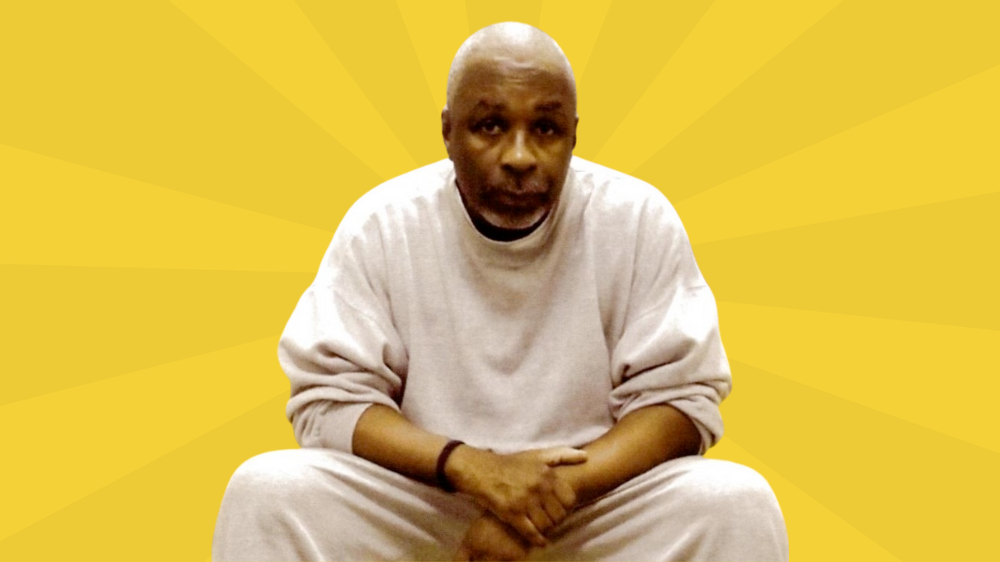
The movie begins with a voice seeming to speak into a void: “Yeah, i wanna say something about my moms, man.” The words appear in subtitles on a blank panel. Suddenly, New Afrikan Political Prisoner Shaka A. Shakur appears. He speaks about his mother and his last words to her. Asking his wife to put the phone to her ear, Shaka tells her “You can let go… we going to be all right.” For the first time in a while, she lifted her eyebrows. She heard him. The next day, he says, while working out in the yard, he was struck by a rush of emotions. As he would soon find out, that rush occurred the same time his mother passed.
After the two-minute cold opening, a narrator voices over photos of Shaka’s childhood home, asking why Shaka couldn’t see his mother or go to her funeral? As the scene shifts to footage of a Virginia prison, we’re asked why this grandfather and well-known human rights advocate remains incarcerated hundreds of miles from his family and community. It isn’t until later that we forcefully learn the answers to these questions, answers that are not answers but outrageous injustices that any human with a shred of compassion can relate to.
I must admit the cold opening left me wondering if I was watching the right documentary. But the interview that opens “Across Enemy Lines: Shaka A. Shakur” was recorded in August 2024, just after Shakur’s mother passed—which makes her part of the Black August tradition. For those who may be unfamiliar, Black August was first commemorated in California’s San Quentin prison in 1979 in honor of the assassination of Black Panther Party Field Marshal George Jackson by San Quentin Prison guards on August 21, 1971. It was also a time to celebrate another decade in one of the most militant eras in prison rebellions. Throughout the film, several comparisons are made between Shaka Shakur and George Jackson, like how both “turned prisons into schools of revolution.” Another photo of Leola Jones enters the screen to extend Black August beyond the prison to the struggle for Black/New Afrikan liberation in its entirety.
By the end of the succinct and powerful new film about the significant organizer behind bars—whose organizing and case are finally starting to get the recognition needed to free him—all confusion had melted away. Derek Ford and TheKingTrill, the film’s co-directors, made sure to use each of the 40 minutes of the film to demonstrate the dialectical relationship between the personal and the political, a dialectic that plays out breathlessly and beautifully, but also painfully and furiously.
A Humble, Elderly Man: Why is the State so Afraid?
The story is told primarily through video conferences with Shaka and interviews with people from various aspects of his life: a man who mentored and helped politicize Shaka when he was first incarcerated as a juvenile; his wife, Dr. Akili Shakur, leaders in the New Afrikan Independence Movement of which Shaka is a leading theoretician, organizer, and builder; his comrades from the Shaka Shakur Freedom Campaign, some who’ve known Shaka for a few years and others for over 30 years.
His wife, Akili, smiles as she recollects catching Shaka out of the corner of her eye. “Those locks…” she sighs, before stating she “fell in love with his mind first.” His first mentor, Duncan Bridgeforth, tells a room that Shaka was the only person he would let highlight in the books he lent Shaka. “Shaka wouldn’t highlight no senseless stuff,” he says, “and he was hungry. That’s what made the difference to me.
Seth Donnelly, who has been a friend of and advocate for Shaka since meeting him in 1992, gives us a glimpse of the advanced revolutionary prison movement Shaka helped lead. Even when “the state started separating out these cadre,” he and Shaka put together a newsletter called “Human Rights Held Hostage” to maintain those connections and keep building.
Throughout, Shaka talks about his political evolution honestly and frankly. When he was first incarcerated, he tells us he “was a little wild,” before admitting, “OK, i was a lot of wild.” But the older prisoners saw his ability to mobilize people, his magnetic personality, and his genuine humility. “If you was to use that in the service of your people, you’d be a hell of an individual,” they said.
Shaka decided to use his gifts in the service of his people and ancestors, and for that reason he remains captive. We learn that he remains imprisoned even though he has served the entirety of the sentence of which he was convicted in 2002: a trumped-up charge of attempted murder of a Gary, Indiana police officer during an incident in which no one was injured.
Here is a man who was arrested as a child but tried and convicted as an adult. He went on to spend almost two decades in one of the first Super Maximum-Security prisons in the country. He was transferred there because he and fellow inmates organized to put an end to the reign of terror by racist white COs and their “good ole-boys network” that dominated the state’s prisons during the 1970s-80s. During Shaka’s first stint in prison, these guards were now running the Department of Corrections and were replaced by COs who longed for the good old days or, as Shaka puts it, “are fascinated by these stories of brutalization” and “nostalgic for a time gone by.” Many had fought against—and tortured—the Iraqi and Afghan people and they broug those torture techniques home with them. “At the State Farm in Putnamville, they were extremely vicious: chaining brothers to tables and shit, beating them… Some of us were going through that shit at eighteen, nineteen, twenty-years-old.
While at the notorious Indiana State Prison, Shaka and fellow inmates—later known as the “Indiana Six”—organized to put an end to this terror. On December 8, 1994, when the state tortured Ajamu Nassor to death while watching pornography on tv. After, the partied all night in the administration building. The response this time was limited to one or a small group of individuals when, around 14 days later, one of the COs was discovered dead in cell house D. Two years later, when the state was set to murder Nassor’s co-defendant, Ziyon Israel, on June 14, 1996, there were no individuals at ISP; only an organized political force that was united despite the segregation of prisons. About two weeks beforehand, Shaka organized a silent protest in cell house D, when “approximately 150 prisoners of all nationalities ate their afternoon meal in complete silence.” The next day, Shaka and others were kidnapped by SWAT teams, shackled, chained, pepper-sprayed, beaten, and transferred to the Maximum Control Complex in Westville, Indiana. That didn’t stop him, and Shaka and the movements inside and outside the walls he helped build and lead eventually forced investigations into the human rights abuses taking place regularly, including the landmark Human Rights Watch report, Cold Storage: Maximum Security Confinement in Indiana.
Let’s Bring Shaka Home
Here is a man who kept organizing for basic human rights and who did so across national (or “racial”) lines no matter the consequences. Even 13 years in solitary confinement couldn’t force him to acquiesce to or simply go along with the injustices he witnessed and suffered—let alone break him.
Yet when he was released in 2000, no one recognized the trauma of imprisonment. Still, we learn, he went back to helping people—especially the youth. At the time, Shaka had a son, Jela. They were incredibly close. One night, Jela called Shaka for a ride. By the time Shaka arrived, Jela’s body was lifeless. The police—who hounded him at every turn—made wisecracks at the young boy who was shot in the back in a senseless act of violence. Without any treatment, Shaka broke down—as would any parent or human. One night as the Lake County cops tried to pull him over, he acted out. He fired rounds at the police cruiser. The cop fired back until he ran out of bullets. Shaka drove off even though he still had ammunition. In other words, he wasn’t attempting to murder anyone. He got sentenced to more time for “injuring” a police car than the young man who murdered his son.
Here is a man who has already served over 20 years—more than that required for his 2002 conviction in Gary, Indiana—yet still faces life behind bars because the state refuses to apply the updated “three strikes” law to him and because he has never stopped organizing to make our world better. Listening to the words of young people who Shaka mentors, watching them try to make sense of how he manages to persist in the face of such adversity, it’s clear there’s nothing they can do to prevent him from helping others. His last words that close out the film make that abundantly apparent.
It’s time to bring Shaka A. Shakur home!
